


Perched on a high bastion beside the main gateway to the Acropolis, the Temple of Athena Nike is small enough to miss in a hurry, yet important enough to shape how Athenians saw war, victory, and their own city. As you climb toward the Parthenon, this delicate marble shrine appears on your right like a watchful guardian above the ancient road, its columns catching the Attic light. This guide explains who Athena Nike was, what the temple represented, how it fits into an Acropolis visit today, and how to get the best views and photos without adding stress to your time in Athens.
Get the latest updates straight to your inbox!
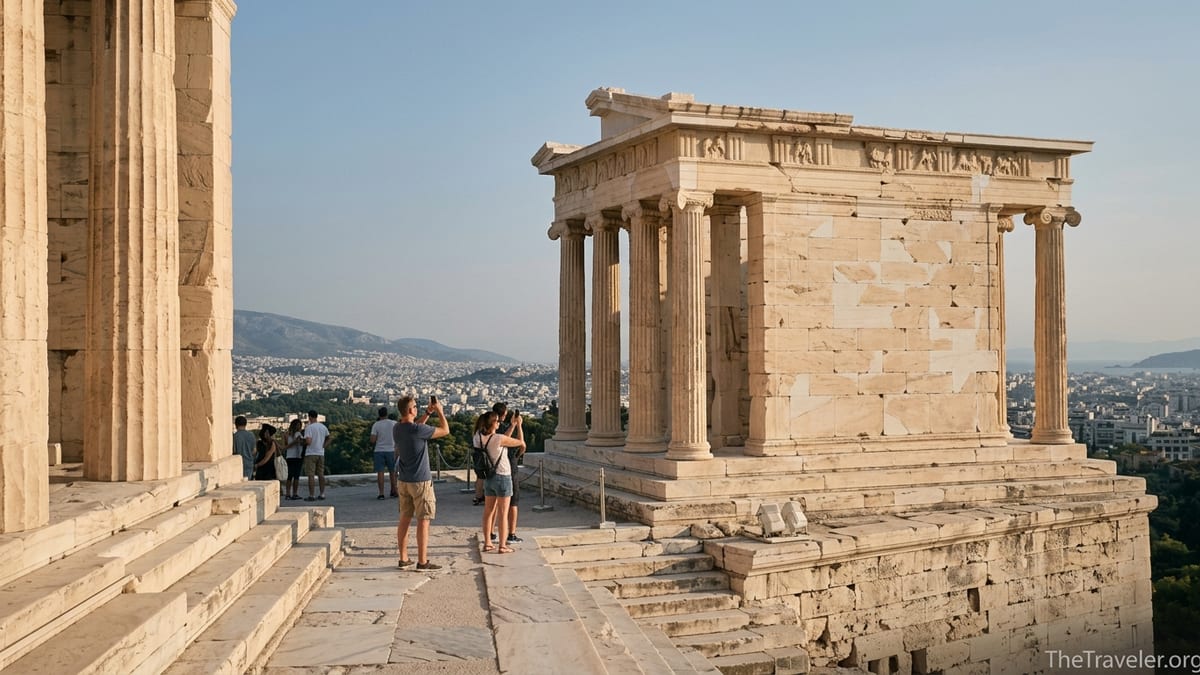
Who Was Athena Nike and What Did This Temple Represent?
The Temple of Athena Nike is dedicated to Athena in her aspect as bringer of victory, closely linked with the goddess Nike, who personified triumph. In practice, Athenians did not worship two separate deities here but a particular form of Athena, the city’s patron goddess, associated with success in war and in protecting the polis. The sanctuary looked outward over the ancient road to Piraeus, the port where Athens’ navy departed, so it naturally became a place to thank the goddess for safe returns and military successes.
Ancient writers describe a wooden cult statue of Athena Nike kept inside the temple. Later tradition claimed that the statue had no wings, which gave rise to the nickname “Apteros Nike,” or Wingless Victory. According to the story, Athenians wanted to keep Victory rooted in their city so she could never fly away. Whether literally true or not, the idea reflects how Athenians saw this space: a place to secure good fortune, stabilize power, and remind citizens and visitors that the city’s strength came from both divine favor and human effort.
The rituals here were practical as well as symbolic. When fleets sailed or armies marched toward the Peloponnese, offerings were made at Athena Nike’s altar on the bastion. After important battles, Athenians might dedicate shields, armor, or carved reliefs showing Nike setting up trophies. When you stand by the viewpoint railings today and look toward the Saronic Gulf, it is easy to imagine processions climbing the steps to the temple, citizens dressed in white garments and carrying small votive offerings before watching their soldiers disappear down the road toward the sea.
For modern visitors, understanding Athena Nike’s role turns the monument from a pretty ruin into a lens on Athenian priorities. The temple does not glorify war for its own sake. Instead, its sculptures and position emphasize vigilance, thanksgiving, and the hope that victories will be both frequent and enduring. That nuance often resonates with travelers who arrive in Athens after seeing memorials and war museums elsewhere in Europe and then encounter here a far older, more religious way of thinking about conflict and success.
A Brief History of the Temple of Athena Nike
The marble temple you see today was built in the late fifth century BC, around 427 to 421 BC, as part of the ambitious building program that also produced the Parthenon and the grand entrance gate, the Propylaea. Its architect was likely Kallikrates, who worked alongside Iktinos on other Acropolis projects. The temple replaced earlier shrines on the same spot, including an archaic sanctuary destroyed during the Persian invasion of 480 BC. When you read about “Periclean” Athens in history books, this temple is one of the clearest surviving expressions of that confident, post-Persian-Wars city.
Within a few decades of its construction, a marble parapet was added around the edge of the bastion to protect worshippers from the steep drop. The outward-facing side was carved with elegant reliefs of winged Nikes in motion: some leading sacrificial bulls, others holding armor, and one famously shown bending down to adjust her sandal. These figures combined everyday gestures with religious symbolism, blending grace and piety in a way that still feels surprisingly intimate. Today, the originals are preserved in the Acropolis Museum, and what you see around the bastion are careful modern reconstructions that evoke the original impact while protecting the ancient stone from pollution and weather.
The temple has had a turbulent later history. During the seventeenth century, when the Ottomans fortified the Acropolis against a Venetian siege, they dismantled the building and reused its blocks in a defensive wall and tower. Early nineteenth-century archaeologists, including Greek and foreign specialists, rediscovered the scattered architectural fragments and re-erected the temple in a pioneering restoration. That first effort was imperfect by modern standards, so Greek conservation authorities have returned to the monument several times. A major restoration in the early twenty-first century strengthened the foundations, cleaned the stone, and reset several blocks, giving the temple its crisp yet authentic appearance today.
Knowing this story adds depth when you approach the bastion. You are not simply seeing a classical building left untouched since antiquity, but a monument that has been dismantled, rebuilt, studied, and carefully stabilized. For visitors who have seen the ongoing work on the Parthenon’s western side, the Temple of Athena Nike offers another example of how modern Athens invests in preserving its most delicate structures for future generations of travelers and scholars.
Architecture and Sculptures: What to Look for on Site
The Temple of Athena Nike is the smallest of the Acropolis temples, but its scale is part of its charm. It is a compact Ionic structure, with four slender columns at the front and four at the rear. There are no colonnades along the sides, which makes the building feel almost like a marble box crowned with columns. As you face the bastion from the main approach, pay attention to the proportions: the columns are thinner and more decorative than the heavy Doric columns of the Parthenon, with spiral volutes at their tops instead of the simple block-like capitals of the larger temple.
Because visitors are not allowed to enter the bastion itself, you will see the temple slightly from below or from the side as you climb the Propylaea steps. Use this vantage point to look for the continuous sculpted frieze that once wrapped around the upper part of the walls. The originals, now in the Acropolis Museum, show scenes of Greeks in battle and seated Athena watching over winged Nikes. On the monument, you will notice lighter-toned blocks where reconstructions fill gaps left by missing antiquities. These differences in color and texture help conservationists and visitors distinguish original pieces from modern replacements.
To appreciate the famous “Nike Adjusting Her Sandal” relief, you will need to visit the Acropolis Museum later in your day. There, in climate-controlled galleries, the marble is displayed at eye level, and you can see the fine carving of drapery that clings to the goddess’s body like wet fabric. Many travelers remark that they only truly understand how refined the temple’s decoration was after seeing these museum pieces, then recalling how small the original building is in comparison.
On site, pay attention also to the bastion itself. This massive stone platform predates the classical temple and once formed part of a Bronze Age fortification. The decision to build Athena Nike’s shrine on top of it was symbolic: the new marble temple literally stands above older layers of defense, blending military practicality with high classical aesthetics. Standing at the railing near the Propylaea, you can see how the bastion juts out from the Acropolis rock, commanding views toward the Saronic Gulf and the hills around Athens. That strategic placing is part of what made this an ideal location for a goddess of victory.
Where the Temple Sits on the Acropolis and How to Find It
Many visitors first glimpse the Temple of Athena Nike while still at street level, queuing for the Acropolis entrance and looking up at the rock. From below, the bastion and small marble temple stand out on the southwest corner of the plateau, like a white lookout tower. Once you pass through the ticket control and begin the climb along the sloping path, keep the Propylaea in front of you. The temple is just to the right of the main gateway, slightly above the level of the approach, so you will see it from various angles as you ascend.
The standard visitor route leads up broad steps into the Propylaea. As you pause on these steps, turn to your right. This is arguably the best close-range public viewpoint of the Temple of Athena Nike. On a typical summer morning, you might share this spot with small guided groups, families stopping for water, and independent travelers studying guidebooks. Most tours pause here for a few minutes so that guides can point out the temple, explain its function, and give people time to take photos before continuing toward the Parthenon.
If you prefer quieter views, consider visiting either early in the morning around opening time or toward the late afternoon, when the day’s last groups thin out. The temple’s southwest orientation means it catches soft side light in the early morning and warm glow in the late afternoon, which suits photography and also enhances the fine details in the stone. On clear days, you can look past the temple’s columns to see the modern city, distant ships in the Saronic Gulf, and hazy hills beyond, which helps you imagine the same vista in the classical period filled with sail-powered warships and country sanctuaries.
Since the bastion is narrow and the temple is fragile, there is no general public access onto the platform itself. You will admire the monument from a short distance behind safety railings. This comes as a surprise to some travelers who expect to walk right around it. Planning for this in advance helps manage expectations: you can still obtain excellent views and photographs without needing to step onto the bastion, and conservation measures ensure the temple will remain standing for many more generations of visitors.
Tickets, Opening Hours, and Practical Tips for Seeing Athena Nike
The Temple of Athena Nike is included in every standard Acropolis ticket, so there is no need to purchase a separate pass. As of summer 2026, a regular adult ticket to the Acropolis costs roughly 30 euros in high season, with reduced prices for certain categories such as some students and young visitors from European Union countries. Travelers often purchase timed-entry tickets online in advance to avoid long queues at the ticket office on busy mornings, especially between May and October when cruise ship passengers and group tours are at their peak.
The Acropolis typically opens early in the morning, often around 8 am, and closes in the late afternoon or early evening depending on the season. Exact times can change, so it is wise to check current hours shortly before your visit. For a comfortable experience, many travelers aim for the first time slot of the day to enjoy cooler temperatures and lower crowds. If you enter near opening time, you can reach the Temple of Athena Nike around 8:20 or 8:30 am, when the stone is still cool and the light is gentle. Another strategy is to choose a later afternoon time, arriving two to three hours before closing, when day-trippers have started to leave.
Footwear and heat management are more important here than at many city attractions. The marble paths and steps leading up to the Propylaea can be smooth and slippery, particularly after a brief rain or when dust has settled. Closed, flat shoes with good grip are preferable to sandals with slick soles. In summer, temperatures in Athens often climb above 30 degrees Celsius by late morning, and there is limited shade on the Acropolis slopes. Bring water, a hat, and sunscreen, and think about visiting the nearby Acropolis Museum afterward to cool down and see the original sculptures from Athena Nike’s parapet in air-conditioned galleries.
Guided tours can add context that is hard to glean from signage alone. Small-group tours that focus on the Acropolis typically cost somewhere in the range of 30 to 60 euros per person, not including the site ticket, depending on group size and length. Private guides charge more but allow you to set the pace and spend extra time where you are most interested, whether that is the Parthenon’s architecture or the smaller sanctuaries such as Athena Nike. Travelers who prefer to explore alone often bring a reputable guidebook or download an audio guide so they have background information when they pause near the bastion to admire the temple.
Photography: Capturing the Temple Without Losing the Moment
Although you cannot step onto the bastion, there are excellent spots for photographing the Temple of Athena Nike along the main approach to the Propylaea and just beyond it. As you climb, try a few shots from slightly lower angles that frame the temple against the sky. Moving closer, use the stairs to the Propylaea to capture the building at eye level, with visitors in the foreground to give a sense of scale. Some photographers like to lean gently on the railing, steadying their camera or smartphone to avoid blur while still respecting the space and other people moving past.
Morning and late afternoon light are particularly flattering for this small white structure. In midday, strong Greek sun can flatten details and wash out contrast, especially in smartphone photos. To cope with harsh light, tapping to expose on the temple’s façade or using high dynamic range mode on your phone can help. If you are using a camera with interchangeable lenses, a standard zoom in the 24 to 70 millimeter range works well: at wider settings you can place the temple in its broader landscape, while at the longer end you can isolate the columns and frieze.
Many travelers are tempted to focus only on the temple itself, but some of the most memorable images use it as part of a larger composition. For instance, you might frame the temple on the right third of the image, with the sweeping view toward the sea and modern Athens filling the rest. Alternatively, you can capture people pausing on the steps, listening to a guide with the temple behind them, which conveys how lively the site feels in high season. Even if you are not a serious photographer, taking a moment to look at the shifting play of light on the marble can deepen your appreciation of the monument beyond simply taking a quick snapshot.
Remember that the Acropolis is both an archaeological site and a place of deep cultural significance. Tripods and large camera rigs are often restricted, and drones are not permitted. Be considerate of other visitors by stepping aside after you have taken a few photos, especially in tight spots on the stairs. Some of the best memories come not from perfect images but from brief pauses: watching swallows circle above the bastion, noticing the way the marble glows slightly pink near sunset, or imagining the processions that once climbed past the same point on festival days.
Combining Athena Nike with the Acropolis Museum and the Rest of the Hill
A satisfying half-day in Athens might combine an early visit to the Acropolis with an extended stop at the Acropolis Museum. Many travelers start at the hill as soon as it opens, see the Propylaea, Temple of Athena Nike, Parthenon, and Erechtheion in about two hours, then descend for a break before entering the museum late in the morning. Inside, you can seek out the original friezes and reliefs from the Athena Nike parapet, including the famous “Nike Adjusting Her Sandal.” Seeing these close up often answers questions you may have had while looking at the reconstructed elements on the bastion above.
Tickets for the Acropolis Museum are separate from Acropolis entry and, as of 2026, cost around 20 euros for a standard adult ticket in high season. Timed entries are increasingly common, and visitors sometimes report queues for same-day tickets at midday. Booking ahead online or planning your museum visit for later in the afternoon can reduce waiting time. Because much of the museum is dedicated to objects from the Acropolis, you will see numerous artifacts from the area around the Temple of Athena Nike, such as votive offerings and architectural fragments that help fill in details of the sanctuary’s long history.
On the hill itself, it makes sense to treat the Temple of Athena Nike as an integral stop on a loop rather than a separate destination. After passing the bastion and exploring the upper plateau, you can circle the Parthenon and then pause again near the Propylaea on your way out. This second look often reveals details you missed when first arriving, such as the subtle differences between ancient and restored blocks or the way changing light shifts the temple’s appearance. Travelers who enjoy slower sightseeing sometimes allot a full three hours to the Acropolis alone, giving them time to sit on low walls in permitted areas, sketch, or simply soak up the atmosphere around landmarks like the temple.
If your time in Athens is short, you can still experience the essence of Athena Nike without a long stay. Even a quick ten-minute pause at the Propylaea steps, with a short explanation from a guide or audio tour, provides enough context to appreciate how this small building fits into the broader ensemble of the Acropolis. The key is to know what you are looking at: a compact masterpiece of Ionic architecture, perched on a prehistoric bastion, dedicated to a version of Athena who symbolized both the city’s military strength and its hopes for enduring good fortune.
The Takeaway
The Temple of Athena Nike rewards travelers who look closely. While most visitors arrive on the Acropolis eager to see the Parthenon, this smaller sanctuary beside the main gateway offers a more intimate window into the daily concerns and spiritual life of classical Athenians. Its dedication to a wingless form of Victory, its strategic placement above the road to the harbor, and its delicate sculptures of goddesses in motion all combine to create a space where military power, religious devotion, and artistic ambition intersect.
For modern visitors, the experience is layered. At one level, you are admiring a graceful Ionic temple against a wide Athenian panorama. At another, you are standing before a building that was dismantled to make way for cannons, then patiently reassembled and restored by archaeologists and conservators over nearly two centuries. Pausing here, even briefly, connects your own journey through Athens with the countless processions, soldiers, travelers, and pilgrims who have passed the same spot, looking up at the same marble columns in search of protection, meaning, or simply a better view.
Plan a little extra time at the Propylaea steps to let the Temple of Athena Nike speak for itself. Visit early or late for gentler light, combine the stop with a visit to the Acropolis Museum to see the original reliefs, and use what you learn about Athena Nike’s role to read this modest temple as more than an architectural footnote. Treated that way, this small shrine becomes one of the most memorable places on the Acropolis, a quiet but powerful reminder of how strongly Athenians believed that victory, like the goddess who embodied it, could be encouraged to stay close to home.
FAQ
Q1. Where exactly is the Temple of Athena Nike on the Acropolis?
The temple stands on a high bastion at the southwest corner of the Acropolis, immediately to the right of the main gateway known as the Propylaea, overlooking the route toward the ancient harbor.
Q2. Is the Temple of Athena Nike included in the regular Acropolis ticket?
Yes. Entry to the Temple of Athena Nike area is included with all standard Acropolis tickets, so you do not need to purchase a separate ticket or add-on to see it.
Q3. Can visitors go inside or walk around the Temple of Athena Nike?
No. Because the bastion is narrow and the structure is fragile, public access onto the platform is restricted. Visitors view the temple from nearby paths and stairways with excellent sightlines.
Q4. Who was Athena Nike in Greek mythology?
Athena Nike represents Athena in her aspect as bringer of victory, closely associated with the personified goddess Nike. At this temple, Athenians sought success in war and protection for their city.
Q5. When was the Temple of Athena Nike built?
The marble temple visible today was constructed in the late fifth century BC, around 427 to 421 BC, during the same era that produced the Parthenon and the Propylaea.
Q6. Why is the statue sometimes called “Wingless Victory”?
Later tradition describes the cult statue of Athena Nike as having no wings, leading to the nickname “Apteros Nike,” or Wingless Victory, symbolizing that victory should remain permanently with Athens.
Q7. Where can I see the original sculptures from the temple?
The original friezes and many reliefs from the Temple of Athena Nike, including the famous “Nike Adjusting Her Sandal,” are housed in the nearby Acropolis Museum in central Athens.
Q8. How long should I plan to spend at the Temple of Athena Nike during my visit?
Most visitors spend about 10 to 20 minutes viewing the temple from different angles as part of a broader Acropolis visit of two to three hours that also includes the Parthenon and other monuments.
Q9. What is the best time of day to photograph the Temple of Athena Nike?
Early morning soon after opening and late afternoon before closing usually offer the most flattering light, with softer shadows and fewer crowds than midday.
Q10. Do I need a guided tour to appreciate the Temple of Athena Nike?
A guided tour is not essential but can be helpful. A knowledgeable guide or a good audio guide adds context about Athena Nike, the temple’s history, and its role within the wider Acropolis complex.