


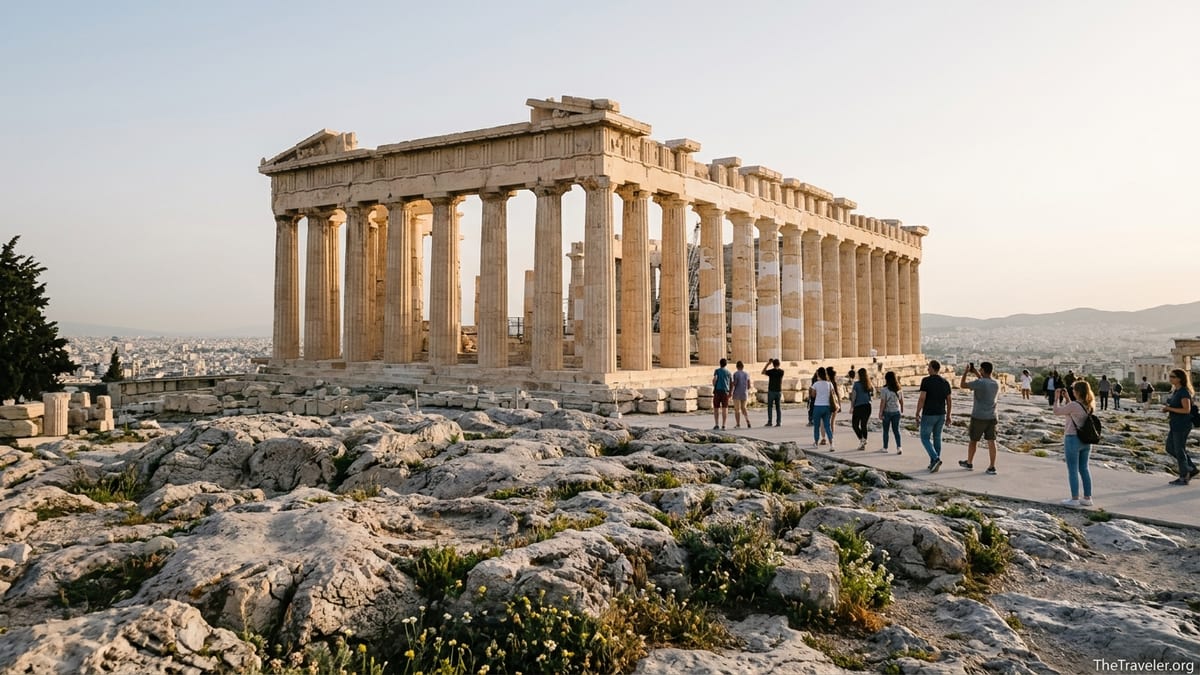
For many travelers, the first encounter with Athena is not in a dusty myth but in marble and sunlight, standing on the Acropolis of Athens with the Parthenon rising against the Attic sky. Yet the goddess behind those ruins is far more than an ancient name. Athena, patron of Athens and one of the most complex figures in Greek mythology, still shapes how we imagine wisdom, strategy and civic life today. Understanding her story adds a rich new layer to any trip through Greece and to many museums, cities and even brand names around the world.
Get the latest updates straight to your inbox!
Who Athena Is: From Mount Olympus to Modern Imagination
Athena is one of the twelve Olympian gods of Greek mythology, best known as the goddess of wisdom, strategic warfare, crafts and cities. Ancient writers describe her as a calm, rational counterpoint to the more impulsive war god Ares, favoring strategy over bloodlust and protecting heroes who used intelligence as much as strength. Travelers exploring Greek sites quickly discover her presence everywhere, from coins and pottery in the National Archaeological Museum in Athens to sculptures in the British Museum or the Louvre.
According to myth, Athena was born fully armed from the head of Zeus after he swallowed her pregnant mother Metis. On the east pediment of the Parthenon, sculptors once depicted this dramatic moment, which visitors can now study in surviving fragments and reconstructions in the Acropolis Museum and other collections. This extraordinary birth story set Athena apart as a deity of intellect rather than instinct, emerging literally from the mind of the king of the gods.
Athena’s personality combined traits that modern travelers might think of as contradictory. She was a virgin goddess associated with self-control and discipline, yet she presided over traditionally “domestic” crafts such as weaving and also over high politics, diplomacy and war councils. In many myths she steps into human conflicts as a negotiator, a tactician and a quiet but powerful advocate for her chosen heroes.
Today, her name appears on universities, publishing houses and technology companies that want to signal intelligence or clarity of thought. Seeing “Athena” printed on a faculty building at a European campus or embossed on the cover of a philosophy book in a museum gift shop is a reminder that this ancient goddess continues to shape modern language and values.
What Athena Represents: Wisdom, Strategy and Civic Life
For ancient Greeks, Athena stood for a particular kind of wisdom: not abstract knowledge alone, but practical intelligence applied to real problems. She advised rulers on lawmaking, guided craftsmen in designing tools and inspired sailors, architects and soldiers to think ahead. When visitors walk through the fortified gates of the Acropolis, they are entering a space once dedicated to the idea that intellect and planning could protect a city as much as stone walls could.
Athena’s connection to war was specific and nuanced. She represented strategic warfare, planning, logistics and just causes, unlike Ares, who embodied chaotic battle rage. Guides at major archaeological sites in Greece often point out shields, helmets and spears in statues of Athena, explaining that these were signs of her role as a protector in battle rather than a bringer of indiscriminate violence. This difference is still visible in modern culture, where she is often used as a symbol on military academies and defense institutions that emphasize training and discipline.
Another side of Athena’s domain was craftsmanship and technology. She was credited with inventing the chariot, the plow and even the flute in some traditions, and she patronized weaving, metalwork and shipbuilding. Travelers interested in ancient crafts can see this legacy in the detailed depictions of looms, armor-making and sailing equipment on Attic vases displayed in museums from Athens to Berlin. The goddess who oversaw battles also cared about how a cloak was woven and how a ship hull was shaped, drawing a line between artistry, utility and civic prosperity.
Above all, Athena symbolized the city itself as a living community. Her association with law courts, assemblies and public debate made her an emblem of measured argument and shared responsibility. Standing on the Pnyx hill in Athens, where citizens once gathered to vote, visitors can look across to the Acropolis and imagine Athena as the invisible guardian of those early experiments in democracy.
Symbols of Athena: Owls, Olive Trees and the Aegis
Athena’s symbols remain some of the most recognizable in all of classical mythology. The owl, associated with clear sight in the dark, became her emblem of wisdom. Ancient Athenian silver coins frequently showed the head of Athena on one side and an owl on the other, a design travelers can still admire in coin cabinets at the Numismatic Museum of Athens or in touring exhibitions. Modern souvenir shops around Syntagma Square in Athens echo this tradition with small bronze or marble owls marketed as good-luck charms for students and exam-takers.
The olive tree was another of Athena’s signature symbols. In the foundational myth of Athens, she and the sea god Poseidon competed for patronage of the city by offering gifts. Poseidon struck the rock of the Acropolis and produced salt water, while Athena planted the first olive tree, promising food, oil, wood and wealth through trade. The Athenians chose her as their protector, and olive cultivation became central to the region’s economy. Visitors today can see gnarled olive trees growing in and around ancient sanctuaries, including a symbolic “sacred olive” on the Acropolis, and taste local olive oil at markets in the Plaka neighborhood or at tavernas across Attica.
Athena is also closely associated with armor and a distinctive protective garment called the aegis. In sculpture and reliefs, she sometimes wears a cloak edged with snakes and the head of the Gorgon Medusa, a frightening image intended to terrify enemies and ward off danger. Replicas of this iconography appear in museum shops as small plaques and jewelry pieces. In the Nashville Parthenon in the United States, a full-scale modern reconstruction of the ancient statue of Athena Parthenos includes the aegis draped over her shoulders, helping visitors visualize how imposing the original would have been.
Other common symbols include the helmet, spear and shield that mark her as a warrior, along with Nike, the winged figure of Victory, who often stands in Athena’s hand in large cult statues. When you walk around the Acropolis Museum or the Acropolis itself, guides will often point out tiny carved Nikes crowning Athena on friezes and metopes, reminding viewers that military success, in Athenian eyes, came through the goddess’s disciplined guidance.
Athena and the City of Athens: Temples, Festivals and Everyday Life
The bond between Athena and Athens was so strong that it shaped the city’s identity for centuries. The very name “Athens” reflects that mythic contest between Athena and Poseidon, and ancient authors describe extensive festivals in her honor. Travelers visiting Athens today still walk streets that were once lined with processions on her feast days, especially during the Panathenaic Festival, the city’s most important religious celebration.
During the Great Panathenaia, held every four years, Athenians organized athletic competitions, musical contests and a grand procession up to the Acropolis. Young women, called arrephoroi and kanephoroi, had special roles, carrying sacred baskets and presenting a newly woven robe, or peplos, to Athena’s ancient wooden cult statue. Modern visitors can trace this route from the Kerameikos cemetery through the ancient Agora and up the Acropolis slope, often following interpretive signs and reconstructions in on-site museums that explain how the festival once animated the city.
In daily life, Athena’s presence was visible in household shrines, city walls and administrative buildings. Archaeological finds from across Attica show terracotta figurines and small reliefs of the goddess placed in homes and workshops. Today, museum galleries in Athens, Thessaloniki and regional sites like Corinth display these modest objects alongside grand marble statues, illustrating how devotion to Athena ranged from intimate, domestic spaces to monumental architecture.
For travelers, that continuity is especially striking. You might start your day with a coffee in a modern Athenian square ringed by bank headquarters and ministry buildings bearing neoclassical facades, then walk a few minutes to see ancient inscriptions invoking Athena’s protection over city finances and legal disputes. The city’s official logo, public art and even franchise names often continue to draw on her imagery, making her as much a part of twenty first century Athens as of the fifth century BCE.
The Parthenon and Other Temples of Athena Around the World
The most famous monument to Athena is the Parthenon, the fifth century BCE temple that crowns the Acropolis of Athens. Built largely between 447 and 438 BCE under the statesman Pericles, it was designed as a showcase of Athenian power, wealth and artistic achievement as well as a home for a colossal gold and ivory statue of Athena Parthenos. Even in its ruined state, the Parthenon remains a powerful symbol of democratic ideals and classical architecture, drawing millions of visitors each year who climb the hill, buy timed-entry tickets and wander among the Doric columns in the sharp Mediterranean light.
Inside the original Parthenon, the statue of Athena would once have towered over worshippers, reportedly more than 12 meters high, with a spear that could be seen from the sea and a smaller figure of Nike standing on her outstretched hand. That statue was lost in late antiquity, but travelers can see Roman-era copies and modern reconstructions that attempt to capture its scale and decoration. The Acropolis Museum displays fragments and interpretations of the sculptural program, while the full-scale painted replica in Nashville, Tennessee offers a striking, if modern, impression of how overwhelming Athena’s presence would have been to ancient visitors.
Athena had other temples on the Acropolis as well, including the Erechtheion, with its famous Caryatid maidens, and the small Temple of Athena Nike near the entrance gateway. These shrines highlight her different aspects: protective of the city’s mythical kings, guardian of victory in battle and patroness of ritual weaving. Travelers can explore them all on a single visit, often with a licensed guide explaining how each structure fit into the city’s religious and political life.
Beyond Greece, the influence of Athena’s temples appears in neoclassical architecture worldwide. City halls, courthouses and university buildings in North America and Europe often copy the Parthenon’s colonnades and pediments, using this visual language to suggest stability, law and reason. The Nashville Parthenon is the most literal example, but travelers will spot echoes of Athena’s temple on everything from the Supreme Court building in Washington, D.C., to smaller town libraries that feature Doric columns and triangular pediments inspired by her ancient shrine.
Key Myths of Athena: Heroes, Contests and Cautionary Tales
Many of the most famous Greek myths involve Athena as a guide, protector or stern judge. In Homer’s Odyssey, for example, she supports the hero Odysseus, helping him plan his escape from enemies and even disguising him when he returns home to Ithaca. Readers walking through Homer-themed exhibitions or browsing modern retellings in Greek bookshops will often see Athena depicted as a thoughtful woman in armor, leaning in to advise the wandering king.
Athena also plays a crucial role in the story of Perseus and Medusa, lending him the reflective shield that allows him to defeat the Gorgon without turning to stone. In art museums from Rome to New York, travelers can find marble reliefs and painted vases showing Perseus holding Medusa’s severed head while Athena stands beside him, underscoring her role as a divine strategist rather than a distant observer.
Not all of Athena’s myths are celebratory. Some are cautionary tales about challenging the gods. Arachne, a mortal weaver who boasted that she could outdo Athena, was punished by being transformed into a spider, explaining in mythic terms why spiders spin webs. Another story tells of the musician Marsyas, who picked up a flute discarded by Athena and dared to compete with Apollo, leading to a brutal punishment. These narratives emphasized humility and respect for divine gifts, and today they still appear in children’s storybooks and educational panels in archaeology museums.
Athena’s interactions with other deities also reveal tensions in Greek society around gender, power and family. In one myth, the craftsman god Hephaestus attempts to assault Athena, but she repels him and the resulting child, Erichthonius, becomes an Athenian founding hero she raises herself. Visitors examining the east pediment sculptures and friezes of the Acropolis buildings sometimes hear guides relate these stories as metaphors for the city’s claim to a special, self-generated origin under Athena’s protection.
Why Athena Still Matters to Travelers Today
Athena’s relevance today goes far beyond academic interest. For travelers, she provides a lens through which to understand how ancient and modern societies think about intelligence, power and community. Standing in front of the Parthenon, listening to a guide explain how its slight curves and optical refinements embody mathematical knowledge, visitors can sense why Athens chose a goddess of wisdom as its patron. The very engineering of the temple becomes a tribute to her values.
In contemporary culture, Athena’s image appears in university seals, legal institutions and even financial logos, signaling trust, expertise and calm decision-making. When visitors tour law schools in Europe or North America, they may find statues or reliefs of Athena alongside figures representing justice, reminding students that argument and strategy are as important as raw authority. Her owl still symbolizes analytical thinking in textbooks and academic branding around the world.
For those exploring Greece, engaging with Athena’s story enriches even simple experiences. Tasting extra-virgin olive oil at a family-run taverna on an Aegean island recalls her mythic gift of the olive tree. Watching local weavers in a mountain village on the Peloponnese demonstrates crafts that ancient Greeks once placed under her protection. Attending a summer performance of a classical play at the ancient theater of Epidaurus or the Odeon of Herodes Atticus in Athens can turn into a living seminar on the values and dilemmas Athena represents.
Athena also resonates in modern debates about women’s roles and authority. Some see her as a symbol of female leadership in traditionally male-dominated arenas like politics, law and the military. Others critique her myths for aligning too closely with patriarchal structures. Visitors will find these conversations reflected in contemporary art exhibitions and public lectures in Athens and beyond, where Athena’s image might be reinterpreted on murals, posters or installations exploring gender and power.
The Takeaway
Understanding Athena deepens any encounter with the ruins, museums and cultural landscapes of Greece and the wider world. She is not just the distant namesake of a ruined temple but a complex figure who weaves together war and peace, craft and politics, myth and city life. For travelers, tracing her symbols and stories across Athens and beyond turns a standard sightseeing itinerary into a journey through the ancient roots of modern ideas about wisdom and community.
Whether you are standing before the Parthenon on a bright July afternoon, examining a small owl coin in a glass case or sipping olive oil that evokes her legendary gift, Athena is there in the details. Paying attention to her presence allows you to see each site not only as an isolated monument but as part of a larger narrative about how societies honor intelligence, plan for the future and argue about what justice should look like. In that sense, Athena remains a living companion for thoughtful travelers, guiding them through both the ancient stones of Athens and the questions they bring home.
FAQ
Q1. Who is Athena in Greek mythology? Athena is the Greek goddess of wisdom, strategic warfare, crafts and cities, and she serves as the patron deity of Athens, where she was honored with major temples like the Parthenon.
Q2. What are the main symbols of Athena? Her key symbols include the owl for wisdom, the olive tree for peace and prosperity, and military equipment such as helmet, spear, shield and the protective aegis.
Q3. Why is the Parthenon important for understanding Athena? The Parthenon on the Acropolis of Athens was the principal temple dedicated to Athena Parthenos and once housed a colossal cult statue of her, making it the central monument of her civic and religious role.
Q4. How is Athena connected to the city of Athens? Myth says Athena won patronage of the city by gifting the first olive tree, and historically Athenians honored her as their protector through festivals like the Panathenaia and through monumental architecture.
Q5. Can I see representations of Athena outside Greece? Yes, major museums in cities such as London, Paris, Berlin and New York display statues, reliefs and vases depicting Athena, and architectural copies of her temples, like the full-scale Parthenon replica in Nashville, also highlight her legacy.
Q6. What myths best show Athena’s character? Stories such as her support for Odysseus in the Odyssey, her guidance of Perseus against Medusa and the cautionary tale of Arachne illustrate her strategic mind, protective nature and insistence on respect for the gods.
Q7. How does Athena differ from Ares as a war deity? While Ares represents chaotic battle fury, Athena embodies planned, disciplined warfare and defense of the city, focusing on tactics, logistics and just causes rather than violence for its own sake.
Q8. Why does Athena matter to travelers today? Learning about Athena helps travelers interpret the art, architecture and city planning they encounter in places like Athens, and it offers insight into enduring ideas about wisdom, leadership and civic responsibility.
Q9. Where can I experience Athena’s legacy most vividly in Athens? Visiting the Acropolis, the Acropolis Museum, the ancient Agora and the route of the Panathenaic procession offers a concentrated experience of Athena’s religious, political and everyday significance in the ancient city.
Q10. How is Athena used as a symbol in the modern world? Today her image and name appear in university seals, legal and military institutions, brands and public art to evoke intelligence, strategic thinking, protection and a commitment to reasoned judgment.