


More news on this day
Operations at Atlanta’s Hartsfield-Jackson International Airport descended into widespread disruption as a cascading "meltdown" of schedules triggered nearly 970 delays and 73 cancellations for Delta Air Lines and Southwest Airlines across their global networks, according to flight-tracking data and published reports.
Get the latest news straight to your inbox!
Storm Cells, System Strain and Staffing Combine in Perfect Storm
Early assessments from aviation data providers and industry analysts indicate that a combination of fast-moving storm cells over the Southeast, lingering staffing constraints and system strain across airline networks converged to create the severe disruption centered on Atlanta. The hub’s role as a critical connecting node for Delta and a key market within Southwest’s domestic map meant that every grounded aircraft and missed crew connection in Georgia sent shockwaves through schedules nationwide.
Publicly available information shows that thunderstorms repeatedly swept through the Atlanta area, forcing ground stops and tightening arrival and departure windows. Each ground stop compressed operations into shorter intervals, leaving airlines with little margin to recover when additional issues emerged. As aircraft waited for clearance and crews edged toward duty-time limits, an already congested afternoon schedule tipped into widespread gridlock.
Industry observers note that the episode fits into a broader pattern of vulnerability at major U.S. hubs when severe weather and high summer demand collide. Even incremental delays at a dominant hub like Atlanta can multiply rapidly across the system, particularly for carriers such as Delta and Southwest that rely heavily on tight turns and high aircraft utilization to keep their networks efficient.
Data from similar disruption days in recent months highlight how quickly operations can unravel when weather intersects with staffing shortages in air traffic control and ground operations. While each incident has its own triggers, the latest Atlanta meltdown underscores persistent fragility in the U.S. aviation system during peak travel periods.
Ripple Effects Across Delta and Southwest Networks
Flight-tracking data compiled after the Atlanta disruption point to an especially heavy impact on Delta and Southwest, which together accounted for roughly 970 delayed flights and 73 cancellations across domestic and international routes. The majority of those disruptions were concentrated in North America, but knock-on effects were recorded on transatlantic and Latin American services as equipment and crews failed to reach their next scheduled legs on time.
Delta, which uses Atlanta as its largest hub, appeared to bear the brunt of the operational turmoil. Published coverage of recent disruption days shows that when Atlanta slows, Delta’s entire system can experience rolling delays that extend deep into the night as crews time out and aircraft end up in the wrong locations. This latest episode followed that familiar pattern, with secondary hubs in New York, Detroit, Minneapolis and Salt Lake City reporting elevated delay volumes.
Southwest, which operates a point-to-point network but relies heavily on connecting flows across the eastern United States, also saw schedules buckle. Reports indicate that the carrier recorded a surge in late arrivals into key airports including Baltimore, Chicago Midway and Denver as Atlanta-related congestion cascaded through its rotation plans. Even markets with no direct link to Atlanta experienced disruptions as aircraft arriving from the Southeast missed their downstream departure slots.
The global reach of the two brands magnified the impact. Delta’s international services to Europe and Latin America, along with Southwest’s extensive domestic footprint, meant that passengers far from Georgia encountered delays and cancellations whose roots could be traced back to the earlier gridlock at Hartsfield-Jackson.
Passenger Experience: Long Queues, Missed Connections and Scramble for Seats
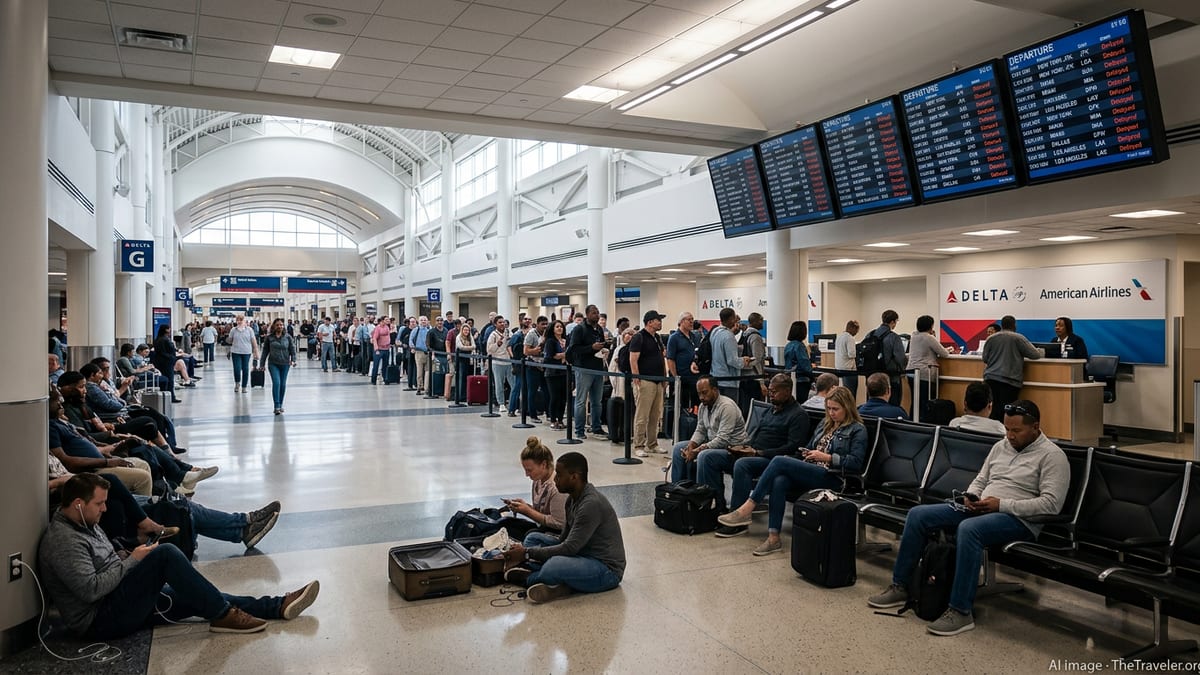
Travelers passing through Atlanta and affected hubs reported scenes of overcrowded terminals, extended customer service lines and departure boards filled with yellow and red status alerts. Social media posts and traveler accounts described passengers queuing for hours to secure rebookings, seek hotel vouchers or obtain meal assistance as evening turned into night.
Many connecting passengers found themselves stranded when inbound flights landed too late for onward departures. With aircraft and crews out of position and remaining seats limited on later flights, options narrowed quickly. In some cases, travelers were rebooked on multi-stop routings that stretched short-haul journeys into all-day odysseys, while others were offered departures one or two days later as schedules filled to capacity.
Publicly available guidance from airlines shows that both Delta and Southwest typically activate flexible travel policies during large disruption events, allowing affected customers to change itineraries without additional fees and, in some circumstances, request refunds. However, the scale of the Atlanta meltdown meant that even with waivers in place, practical choices were constrained by simple seat availability.
The disruption also rippled into nearby airports used as alternates or diversions. Reports from regional facilities around the Southeast indicated heavier-than-normal passenger volumes and packed gate areas as rerouted travelers sought to complete their journeys by renting cars, taking intercity buses or booking last-minute tickets on competing carriers.
Broader Implications for U.S. Aviation Resilience
Aviation analysts say the Atlanta event raises fresh questions about the resilience of U.S. airline operations as carriers push to meet robust travel demand. The combination of aging infrastructure, constrained air traffic control staffing and tightly wound airline schedules leaves limited slack in the system when severe weather or technical problems emerge at a major hub.
Recent incidents at other large airports, including operational breakdowns in Los Angeles and storm-driven cancellations in the Midwest and Northeast, showcase similar patterns of cascading disruption. When an airport that anchors a hub-and-spoke network experiences a sharp reduction in capacity over several hours, delays radiate along connecting routes and can persist well into subsequent days.
Industry data and government reports examining on-time performance trends suggest that airlines have improved reliability in some metrics compared with earlier years, but they also show that extreme events still generate significant spikes in delays and cancellations. Episodes like the Atlanta meltdown highlight how incremental improvements may not fully offset the operational risk created by packed schedules and rising passenger volumes.
Advocacy groups and transportation researchers have pointed to potential mitigation measures, including additional investment in airport infrastructure, modernized air traffic management systems and more conservative scheduling on peak days. The Atlanta disruption is likely to feed into ongoing policy discussions about how best to balance efficiency with resilience as U.S. air travel continues to recover and grow.
What Travelers Can Expect in the Days Ahead
Based on patterns from previous large-scale disruption events, residual effects from the Atlanta meltdown are likely to linger beyond the initial day of chaos. Even after storms pass and ground stops are lifted, airlines typically require multiple scheduling cycles to realign aircraft and crew rotations, particularly when international routes are involved.
Travel experts recommend that passengers with near-term itineraries on Delta or Southwest monitor flight status frequently, allow extra time at airports and consider building longer layovers into self-booked connections. Publicly available consumer guidance from transportation agencies also emphasizes the importance of understanding passenger rights, including eligibility for refunds when flights are canceled and the conditions under which airlines provide meal or hotel assistance.
Aviation data from similar episodes indicate that early-morning departures on the days following a major disruption often operate more reliably, as airlines use overnight hours to reset aircraft positioning. Later bank departures, particularly in the late afternoon and evening, can remain vulnerable to knock-on delays when any new weather or technical problem interacts with already tight schedules.
For Atlanta, the latest meltdown serves as another reminder of both the airport’s central role in U.S. and global air travel and the far-reaching consequences when operations falter. With the busy summer season under way and storm patterns still active across large parts of the country, travelers and airlines alike face a period in which operational resilience will remain under intense pressure.