


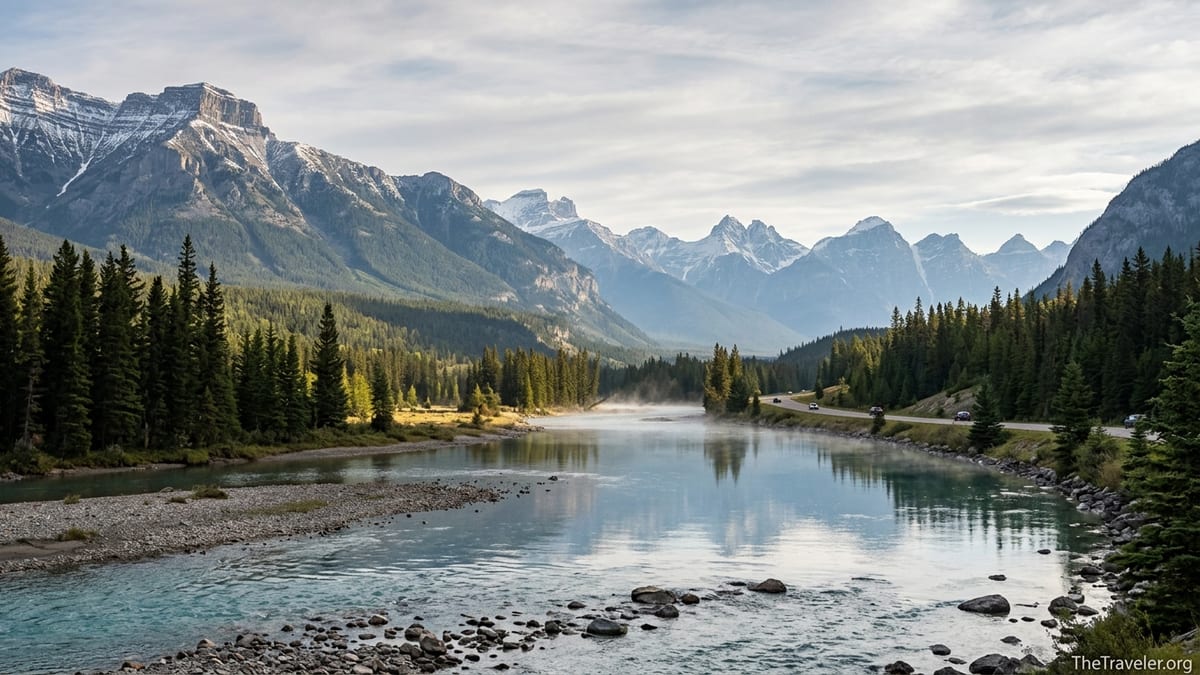
The Bow Valley is the kind of landscape many travelers picture when they dream about the Canadian Rockies: a turquoise river threading between snow-dusted peaks, evergreens climbing the slopes, and trains and wildlife moving quietly through the scene. Stretching from the foothills east of Canmore through Banff National Park to Lake Louise, this single valley manages to gather an extraordinary variety of viewpoints, trails, lakes and historic routes into a compact, easy-to-explore corridor. That unique combination of drama and accessibility is a big reason so many photographers and hikers consider Bow Valley home to some of the finest scenery in the Rockies.
Get the latest updates straight to your inbox!
A Natural Corridor Through the Heart of the Rockies
Bow Valley follows the course of the Bow River, which rises in the glaciers around Bow Lake and winds its way through Lake Louise, Banff and Canmore before spilling out toward Calgary. For travelers, this means you can trace a single river and experience a surprising range of landscapes, from tight canyon walls and turquoise pools to open montane meadows and broad, braided channels. You can stand beside the Bow in downtown Banff, then drive less than an hour and watch it carve S-shaped curves beneath the highest peaks near Lake Louise.
Because the Trans-Canada Highway and the Bow Valley Parkway both follow this same corridor, the scenery is remarkably accessible. You do not need a 10-hour backcountry trek to find the big views: pullouts like the Bow River viewpoint in Banff, the pedestrian bridge in Canmore, and classic overlooks along the Parkway offer postcard scenes right from the roadside. First-time visitors often comment that the drive from Canmore to Lake Louise feels like a highlight reel of the Rockies, with new angles of Mount Rundle, Cascade Mountain, Castle Mountain and Mount Temple unfolding around every bend.
The valley also acts as a natural gateway to surrounding parks. To the south, Highway 40 peels off toward Kananaskis Country and Spray Valley Provincial Park, where peaks like Mount Yamnuska and Ha Ling form the backdrop for quiet lakes and wildlife corridors. To the west, the Bow climbs into the higher elevations of Banff National Park, with access to world-famous lakes such as Lake Louise and Moraine Lake. For a traveler with only a few days, basing in Bow Valley makes it possible to sample all of these iconic landscapes without constantly relocating.
What sets Bow Valley apart among Canadian Rockies destinations is this sense of continuity. Even on a short visit, you begin to recognize the turquoise thread of the river, the silhouettes of familiar peaks and the way light moves down the valley over the course of the day. It feels less like a series of disconnected highlights and more like one long, unfolding story.
Iconic Viewpoints: From Morant’s Curve to Castle Mountain
Some of the most photographed scenes in all of Canada can be found along Bow Valley, and most are straightforward to reach. Near Lake Louise, Morant’s Curve is perhaps the best-known. Here the Bow River bends in a graceful S-shape beneath Mount Temple and Fairview Mountain, while the Canadian Pacific Railway tracks hug the inside of the curve. Photographers regularly wait 20 or 30 minutes in the roadside pullout hoping to catch a long freight train snaking through the frame, especially in the soft light of early morning or late afternoon.
Closer to Banff, the cliffs of Castle Mountain rise abruptly above the Bow Valley Parkway. There is a small day-use area and several pullouts where you can step out of your car and see the peak’s layered rock formations towering above the forest. Travelers driving the Parkway often combine a quick stop at Castle Mountain viewpoints with a walk around nearby Hillsdale Meadow or a picnic at the Storm Mountain overlook, where the Bow River glints far below.
Within the town of Banff, scenic viewpoints are woven right into everyday spaces. The pedestrian bridge over the Bow River, a few minutes’ walk from Banff Avenue, frames Mount Rundle and Cascade Mountain behind the water. On many evenings you will see a mix of locals walking dogs, visitors with tripods and people carrying takeout coffees, all pausing to watch the last light slide down the peaks. In winter, hoarfrost clings to the riverside willows, while summer brings reflections of bright green forest on the river’s surface.
Farther east in Canmore, the Bow River Loop trail offers another easily reached classic. The path starts near a small parking area beside the river and roughly follows the shoreline for a flat 2-kilometer circuit, with constant views of the Three Sisters and Ha Ling Peak. In late June and July, wildflowers line sections of the trail, and many visitors walk it in regular running shoes, stopping at simple benches along the way. It is exactly the kind of quick, accessible walk that delivers the sense of being enveloped by big mountains without demanding serious planning or gear.
Bow Valley Parkway: Slow Travel Through Peak Scenery
The Bow Valley Parkway, a quieter alternative to the main highway between Banff and Lake Louise, is one of the best arguments for why this valley offers such exceptional scenery. The road runs for roughly 50 kilometers, paralleling the Bow River, with a lower speed limit and frequent pullouts and picnic spots. Because of seasonal vehicle restrictions on the eastern section to protect wildlife, much of the year you can also experience parts of the road by bike or on foot, which only heightens the sense of traveling through a living landscape rather than just driving past it.
For many travelers, Johnston Canyon is the signature stop on the Parkway. The trail here climbs gently along steel catwalks bolted into the canyon walls, passing turquoise plunge pools, hanging gardens and narrow rock corridors. It takes most visitors 30 to 45 minutes at a casual pace to reach the Lower Falls, with the option to continue to the Upper Falls and even the Ink Pots meadow beyond. The fact that you can walk this route in regular trainers and still feel close to roaring waterfalls and polished canyon walls is part of what makes Bow Valley so memorable.
Wildlife sightings further enhance the experience. The slower speed limit and relatively quiet feel of the Parkway make it a favored corridor for elk, bears and bighorn sheep, especially in spring and early summer. It is not unusual for a morning drive to be punctuated by cars pulling over to watch a black bear graze on dandelions at the roadside or a herd of elk moving through a meadow. Travelers are advised to stay in their vehicles or maintain a generous distance when on foot, but these moments often become the defining memories of a Bow Valley trip.
Small details along the Parkway reinforce its character as a place to linger. Many picnic areas have simple wooden tables, pit toilets and river access, so it is easy to pick up sandwiches or baked goods in Banff or Lake Louise and spend an unhurried lunch beside the water. Pull into a spot such as Muleshoe or Sawback and you may find only a handful of other visitors, even on summer days when parking lots at better-known lakes are full.
Canmore and Kananaskis: The Valley’s Softer, Wilder Edges
At the eastern end of the valley, Canmore offers a slightly less touristy, more lived-in counterpoint to Banff. The town spreads along both sides of the Bow River, with multi-use paved paths following the water and crossing it via pedestrian bridges and boardwalk sections. Early in the morning, you might see local runners and commuters sharing the riverside trail with visitors taking photos of the Three Sisters glowing pink in the first light. Cafes and bakeries just off Main Street supply takeaway breakfasts, making it easy to grab a coffee and stroll down to the river without a set agenda.
From Canmore, a short drive up a well-maintained road leads to the Canmore Nordic Centre Provincial Park and then into the backroads of Spray Valley and Kananaskis Country. The transition is rapid: within 15 to 20 minutes, townhouses give way to dense forest and views of peaks such as Ha Ling, Rimwall and Mount Rundle from unfamiliar angles. Day-use areas along the Spray Lakes Reservoir and in Spray Valley Provincial Park cater to casual visitors with gravel parking lots, pit toilets and clearly marked shoreline paths, but the scenery feels decidedly wilder and less crowded than on the main Banff corridor.
Bow Valley Provincial Park, situated where the Bow and Kananaskis rivers meet east of Canmore, adds another facet to the landscape. Here the mountains step back slightly, creating space for meadows, oxbow ponds and warm springs. Short interpretive trails such as Many Springs, Flowing Water and Middle Lake loop around wetlands and through forest, providing textbook examples of montane ecosystems that are easy to explore in under an hour. Families often camp at Bow Valley or Willow Rock campgrounds for precisely this mix of gentle riverside scenery, frequent wildlife sightings and straightforward access from Calgary.
This eastern stretch of the valley is also where you most clearly see the interplay between wild landscapes and everyday life. Freight trains curve along the river past Canmore’s neighborhoods, hikers set off after work for quick summits like Ha Ling Peak, and local children ride bikes along the Bow River Loop trail. For travelers, staying in Canmore or nearby Dead Man’s Flats can feel like joining that rhythm for a few days, enjoying mountain views from hotel balconies or riverside patios without sacrificing practical conveniences like grocery stores and gear shops.
Seasonal Transformations: Why Any Month Can Be Spectacular
One of the strongest arguments for Bow Valley’s world-class scenery is how dramatically it changes through the seasons, while remaining photogenic year-round. In June and early July, snow lingers on the higher peaks while the valley floor erupts in green. The Bow River typically runs high and fast with snowmelt, turning an opaque, milky turquoise that contrasts with the dark conifers. Wildflowers appear in meadows around Bow Valley Provincial Park and along trails like the Bow River Loop, while wildlife is especially active as animals move between spring feeding areas.
Late September and early October bring a different palette. Aspen and poplar groves between Canmore and Banff turn shades of gold, especially around day-use areas near the Bow. The larch forests that cloak higher slopes above the valley begin to shift to bright yellow, attracting hikers to nearby trails in Kananaskis and around Lake Louise. On clear days, you can stand along the Bow River near Banff Avenue and see a foreground of golden trees, a turquoise river and, on the highest peaks, the first dustings of new snow.
Winter transforms Bow Valley into a quieter, more contemplative landscape. The river partially freezes, creating ribbons of open water against snow-covered banks, and peaks stand out in sharp relief against low, pale sunlight. Along the Bow Valley Parkway, snow often piles high on tree branches and the roofs of picnic shelters, and visitors are more likely to be photographers on tripods than families with coolers. Cross-country ski networks in places like the Canmore Nordic Centre and Lake Louise allow travelers to experience the valley at a slower pace, sliding through the trees with the sound of the river muffled by snow.
Spring, from late April into May, can be underrated yet beautiful. While some higher trails remain snowbound, lower paths along the Bow, such as the Fenland Trail near Banff or the riverside walk in Canmore, become accessible early. The river starts to swell, songbirds return to riparian thickets, and bears emerge from hibernation to graze roadside dandelions, especially along quieter stretches like the Bow Valley Parkway and near Bow Valley Provincial Park. Travelers willing to embrace changeable weather are rewarded with fewer crowds and a sense of watching the valley wake up.
Experiencing the Scenery: Practical Ways to See More
The variety of ways you can experience Bow Valley’s scenery is another reason it stands out in the Canadian Rockies. Even if you are not an experienced hiker or skier, you can still access extraordinary viewpoints. A typical visitor might start a day with a sunrise walk across the Banff pedestrian bridge, continue with a mid-morning drive along the Bow Valley Parkway to Johnston Canyon, spend an hour on the catwalks to the Lower and Upper Falls, then carry on to Lake Louise for an afternoon stroll along the lakeshore. Each segment involves modest physical effort but delivers signature mountain views.
Budget-conscious travelers can keep costs relatively modest. A single Parks Canada pass covers access to Banff National Park and the key viewpoints along Bow Valley, and many of the highlight experiences do not require guided tours. For instance, the Bow River Loop in Canmore, Fenland Trail in Banff, and the short interpretive paths in Bow Valley Provincial Park are all self-guided and free once you have the necessary park or day-use permits. Picnicking at roadside viewpoints instead of dining in resort restaurants lets you soak in the scenery while keeping spending under control.
Those looking to splurge have options too. Scenic helicopter flights departing from bases just east of Canmore sometimes follow the Bow River toward the high peaks, offering a bird’s-eye view of the entire valley corridor. In winter, staying at a lodge in nearby Kananaskis or along the Spray Lakes backroads delivers a version of Bow Valley scenery far from town lights, with stars bright above ice-covered lakes. Photography workshops based in Canmore or Banff often build their itineraries around classic Bow Valley locations such as Morant’s Curve, the Vermilion Lakes and the Bow River viewpoints, taking advantage of the area’s reliable compositions and changing light.
Because most key sights are connected by high-quality roads, it is relatively easy to structure days that alternate between exertion and recovery. One afternoon you might hike a steeper trail in Kananaskis or around Lake Louise, then the next day focus on drives and short walks: a coffee in Banff followed by detours to Vermilion Lakes, the Surprise Corner overlook of the Fairmont Banff Springs, and late-afternoon reflections on the Bow back in Canmore. That flexibility is a big part of what makes the valley appealing to mixed groups that include serious hikers, casual strollers and travelers with limited mobility.
The Takeaway
Bow Valley’s reputation for exceptional scenery rests on more than just a handful of famous lookouts. It comes from the way the landscape unfolds as a coherent whole, from the open meadows and oxbow ponds of Bow Valley Provincial Park to the tight canyon walls of Johnston Canyon and the broad river curves of Morant’s Curve. Everywhere, the turquoise Bow River provides a visual anchor, threading through towns, forests and peaks.
For travelers, the valley offers a rare blend of drama and accessibility. Within a single day, you can watch sunrise on the Three Sisters from the Bow River in Canmore, stand beside thundering waterfalls on the catwalks of Johnston Canyon, eat a riverside picnic beneath Castle Mountain and end with alpenglow on Mount Rundle from a bridge in Banff. These are not hard-won backcountry views but experiences that fit easily into a short itinerary, which is why so many visitors leave feeling they have seen the essence of the Canadian Rockies.
Whether you come in the rush of summer or the quiet of winter, choose a budget-friendly campsite or a mountain lodge, or arrive with hiking boots or a pair of city sneakers, Bow Valley has a way of making the mountains feel close. It is a landscape that rewards slow travel and repeated visits, revealing new perspectives with every bend in the river. For anyone planning a first or fiftieth trip to the Canadian Rockies, following the line of the Bow is one of the surest ways to encounter the region at its scenic best.
FAQ
Q1. Where exactly is Bow Valley in the Canadian Rockies?
Bow Valley follows the Bow River from the Lake Louise area through Banff and Canmore toward the foothills west of Calgary, forming a key east–west corridor through the Rockies.
Q2. Is Bow Valley suitable for travelers who are not strong hikers?
Yes. Many of the best viewpoints, such as Morant’s Curve, Bow River bridges in Banff and Canmore, and short trails in Bow Valley Provincial Park, are accessible via short walks on relatively flat paths.
Q3. What is the best time of year to visit Bow Valley for scenery?
Scenery is impressive year-round. June to September offers green valleys and open trails, late September brings fall colors, and December to March delivers snowy peaks and a quieter atmosphere.
Q4. Do I need a car to enjoy the scenery in Bow Valley?
A car gives the most flexibility, especially for the Bow Valley Parkway and Kananaskis side trips, but shuttles, local transit and guided tours can connect you to many major viewpoints from Banff and Canmore.
Q5. How long should I plan to stay to see the main sights?
With two full days you can sample highlights between Canmore, Banff and Lake Louise. Three to five days allow time for slower drives, extra hikes and side trips into Kananaskis.
Q6. Is the Bow Valley Parkway always open to vehicles?
No. Sections of the Bow Valley Parkway, particularly the eastern part near Banff, can be seasonally restricted to protect wildlife, so it is wise to check current conditions before you go.
Q7. Can I see wildlife easily in Bow Valley?
Wildlife sightings are common, especially at dawn and dusk along the Bow Valley Parkway and near Bow Valley Provincial Park, but encounters are not guaranteed and animals should always be given plenty of space.
Q8. Are there budget-friendly ways to experience Bow Valley?
Yes. Once you have the necessary park passes, scenic drives, riverside walks, self-guided trails and picnics at viewpoints provide low-cost ways to enjoy the valley’s landscapes.
Q9. What should I pack for a day exploring Bow Valley?
Pack layered clothing for changeable mountain weather, sturdy footwear suitable for uneven paths, water, snacks or a picnic, sun protection and a camera or phone for photos.
Q10. Is Bow Valley a good base for exploring other parts of the Rockies?
Bow Valley makes an excellent base, with road access to Kananaskis Country, Lake Louise, Moraine Lake and other areas of Banff National Park within typical day-trip driving times.