


More news on this day
A cascading operational meltdown at Austin-Bergstrom International Airport has ignited fresh chaos across the U.S. air travel system, as widespread cancellations on American Airlines and Southwest Airlines strand thousands of passengers and cripple connecting traffic at major hubs.
Get the latest news straight to your inbox!
Domestic Hub Overload Turns Austin Disruption Into National Gridlock
According to live aviation tracking data and airport status dashboards, Austin-Bergstrom entered the weekend with elevated delay levels and a cluster of cancellations concentrated on American Airlines and Southwest Airlines, the airport’s two largest carriers by daily departures. As flights were scrubbed or pushed back from Austin, missed connections rippled outward to Dallas-Fort Worth, Phoenix, Denver and a string of East Coast and Midwest airports already operating with little slack.
Publicly available flight-monitoring information shows American cutting a significant share of its Austin schedule, particularly regional routes feeding Dallas-Fort Worth and Charlotte, while Southwest recorded a wave of scrubbed departures to key leisure and business destinations. The pattern mirrors earlier 2026 disruptions in which concentrated problems at one airport rapidly migrated across the network, creating rolling bottlenecks that lasted well beyond the initial weather or staffing trigger.
By early afternoon, national disruption maps indicated a marked spike in knock-on delays affecting travelers who never passed through Austin at all but were relying on connections operated by American or Southwest. Aviation analysts note that this kind of hub-and-spoke stress is particularly acute in summer when aircraft utilization is high and spare crews and jets are scarce.
Reports from passenger forums and social media suggest that rebooking options quickly dried up on popular routes, with travelers offered itineraries pushed one or two days later or rerouted through already congested hubs. The result, according to these public accounts, was a patchwork of stranded passengers and rolling gate holds across multiple time zones.
American and Southwest Confront System Strain After Earlier 2026 Stumbles
The Austin breakdown lands at a sensitive moment for both American and Southwest. Recent operational scorecards compiled from aviation data providers show American already under scrutiny following severe weather and staffing disruptions at Dallas-Fort Worth and other hubs earlier this month, where a combination of storms and crew availability problems produced double-digit cancellation rates on some days.
Southwest, meanwhile, has spent much of 2026 navigating a challenging reshaping of its network, including the removal of service from several large airports and the ramp-up of new routes such as additional Austin flights to mid-continent cities. Industry coverage has highlighted how these changes, combined with heavy summer demand, have left the carrier vulnerable when localized issues erupt at airports where it concentrates departures.
Publicly available performance data for June indicates that both airlines have struggled at times with on-time reliability relative to some competitors, particularly when convective weather or ground stops ripple through Texas and the central United States. Analysts cited in recent aviation briefings argue that aggressive scheduling, tight aircraft turns and delayed staffing investments have left the two carriers with limited margin to absorb surprise shocks.
The Austin event appears to fit that pattern, with a localized problem quickly morphing into a systemic one. As cancellation totals mounted, aircraft and crews that were supposed to be positioned for later flights elsewhere in the country never arrived, forcing additional cancellations hours and even a full day after the worst of the disruption in Texas had passed.
Storm Systems and Infrastructure Limits Expose Austin’s Growing Pains
Weather has again played a central role. Forecast discussions from the National Weather Service and regional radar imagery show repeated rounds of thunderstorms and low cloud ceilings passing through central Texas in recent days, contributing to arrival metering programs and departure holds at Austin-Bergstrom. While the conditions were not unprecedented for June, they aligned poorly with peak morning and evening departure banks.
Austin’s own growth has compounded the strain. City aviation documents chart a sharp climb in passenger volume and daily departures in 2025 and 2026, with American and Southwest together accounting for the majority of seats in and out of the airport. Terminal infrastructure and apron capacity have lagged demand, as evidenced by periodic reports of security bottlenecks, long check-in lines and aircraft waiting for gate space during busy events.
As the latest meltdown unfolded, publicly visible airport dashboards showed elevated taxi-out times and flights circling in holding patterns, suggestive of a facility operating near its physical limits. Once a few key departures on American and Southwest were canceled outright, ground congestion briefly eased, but the damage to the broader network had already been done.
Observers note that Austin’s dual role as both an origin-and-destination market and a de facto mini-hub for certain domestic flows makes it particularly vulnerable to this type of cascading disruption. Travelers starting and ending their journeys in Austin compete for capacity with those using the airport as a connection point for cross-country itineraries, leaving little buffer when operations seize up.
Passengers Confront Long Lines, Sparse Information and Limited Rebooking Options
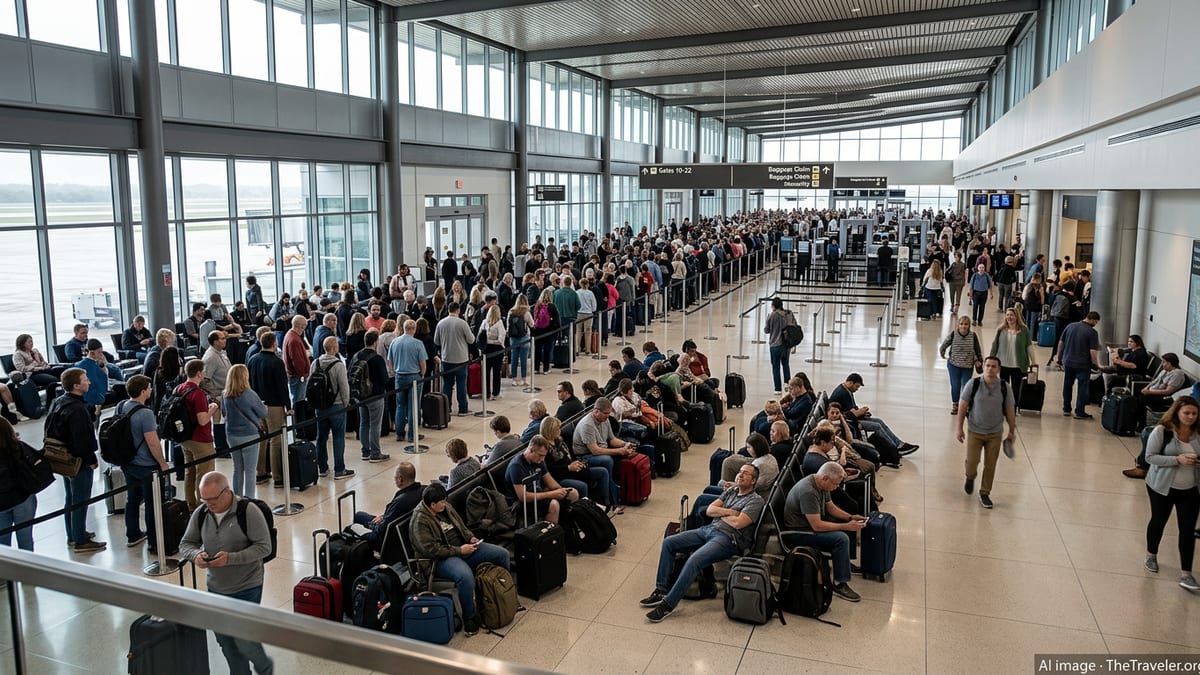
For travelers caught in the middle, the operational dynamics translated into familiar scenes: swelling lines at ticket counters, crowded gate areas and customer-service channels overwhelmed by rebooking requests. Passenger accounts shared publicly describe waits of several hours to speak with an agent, as automated rebooking tools struggled to find open seats on remaining departures.
Several posts from Austin-based travel forums reference American customers who were automatically reprotected on next-day flights through alternative hubs, only to see those connections later delayed or canceled as the disruption spread. Southwest customers reported receiving rolling notifications of new departure times before cancellations were finally posted, complicating decisions about whether to remain at the airport or seek overnight accommodation.
Consumer advocates consulted in recent coverage of similar 2026 meltdowns have emphasized that U.S. federal rules provide limited guaranteed compensation for weather-related cancellations, leaving many stranded passengers to rely on airline goodwill policies and credit card travel protections. In practice, that often means meal vouchers or hotel assistance are inconsistently available, particularly when airlines classify a disruption as weather-driven even if underlying staffing or fleet issues also contribute.
Public-facing airline dashboards on both American and Southwest encouraged passengers to use mobile apps and websites for self-service changes, a strategy that has reduced lines in normal conditions but has drawn criticism during large-scale breakdowns when alternative itineraries are scarce. Some travelers reported more success calling international customer-service numbers than waiting in domestic phone queues or at airport counters.
Broader Concerns Over U.S. Airline Resilience Ahead of Peak Summer
The Austin meltdown feeds into a broader debate about the resilience of U.S. carriers as the peak summer travel period accelerates. In recent weeks, other large airports have experienced their own flashpoints, including system breakdowns and weather-related gridlock that temporarily paralyzed operations at major hubs. Each episode has added to concern that the national network is operating too close to the edge.
Aviation-focused publications point to a cluster of common themes linking these events: aging infrastructure, congested airspace, limited crew reserves and carrier strategies that prioritize maximizing capacity over maintaining generous buffers. American and Southwest, both heavily exposed to the storm-prone central and southern United States, have repeatedly found themselves at the center of such breakdowns.
Industry analysts say the Austin crisis may serve as another test case for emerging Department of Transportation initiatives that pressure airlines to improve customer-service commitments during mass disruptions. While regulators have encouraged carriers to publish clearer compensation and rebooking policies, enforcement actions remain relatively rare, and most remedies still rely on voluntary measures.
For now, system data suggests that operations are slowly recovering, but residual delays and scattered cancellations remain likely across Sunday and into Monday as aircraft and crews are repositioned. With demand still trending above pre-pandemic levels and more severe weather expected in key regions, travelers planning to connect on American or Southwest in the coming days may face an uneasy wait to see whether the Austin meltdown proves an isolated shock or a preview of a turbulent summer ahead.