


For frequent travelers, Google Flights has long been the default starting point for airfare searches. Yet in the last few years, Aviasales has gained a devoted following, especially among bargain hunters who swear it surfaces tickets Google never shows. So can Aviasales really find cheaper flights than Google Flights, or is it just another metasearch engine chasing the same fares? The answer is more nuanced than simple yes or no, and it depends heavily on where you fly, how flexible you are, and how much risk you are willing to take with lesser-known online travel agencies.
Get the latest updates straight to your inbox!
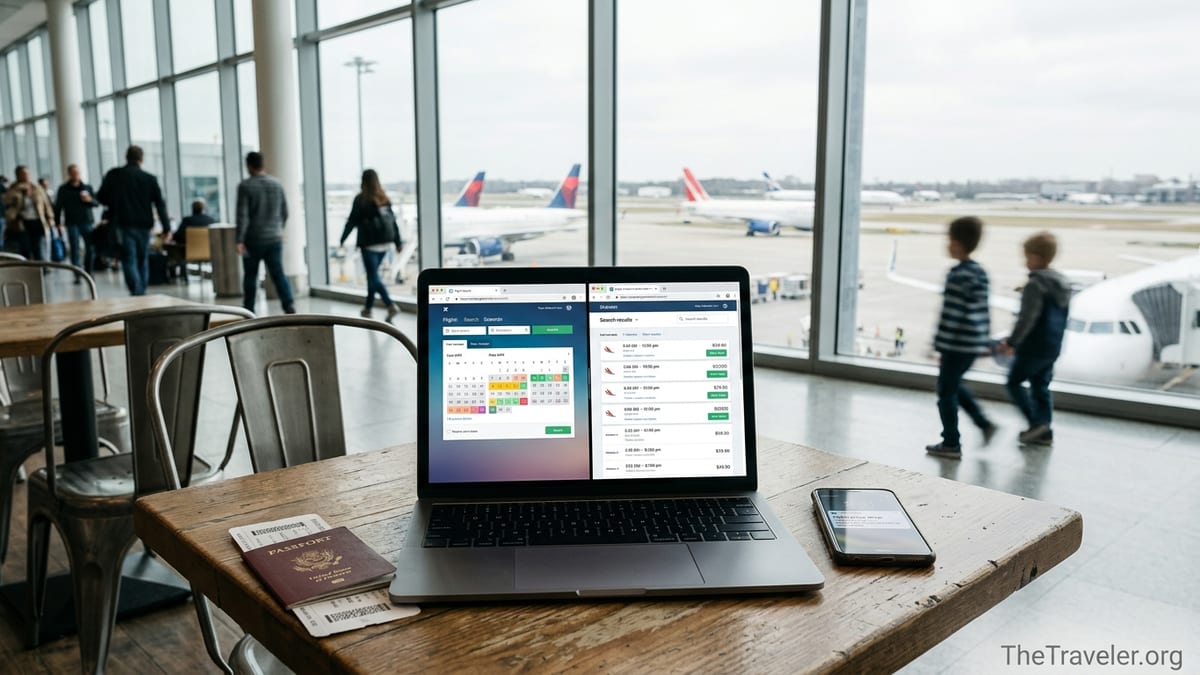
How Google Flights and Aviasales Actually Work
Both Google Flights and Aviasales are metasearch engines, not online travel agencies. They do not sell you a ticket directly. Instead, they query dozens of sources in real time, show you prices and itineraries, and then send you to an airline or an online travel agency to complete the booking. That basic similarity often hides an important difference: which sources they tap and how aggressively they surface low-cost intermediaries.
Google Flights leans heavily on data feeds from airlines and global distribution systems. In practice, that means it tends to prioritize direct airline links and larger, well-known agencies. Travel industry analyses in 2026 still describe Google Flights as one of the most comprehensive tools for major carriers, especially in North America and Europe, and praise its calendar, date grid, and price graph for helping travelers see when fares are cheapest across weeks or months at a glance. At the same time, Google does not show every budget airline or every small regional agency, particularly in markets where those partners choose not to pay for distribution or data sharing.
Aviasales sits at the other end of the spectrum. Originating in Eastern Europe and now operating globally, it was built to query a very wide network of online travel agencies, consolidators, and low-cost carriers that do not always appear in mainstream Western tools. Company and third-party guides note that Aviasales’ strength is precisely this breadth of coverage: it includes lesser-known regional OTAs and some small carriers in Europe and Asia that either do not appear, or appear less prominently, on Google Flights. In practical terms, that often means Aviasales can display a rock-bottom fare from a secondary agency that Google does not list at all.
Understanding that structural difference is key: Google is optimized for clarity and reliability with major airlines, while Aviasales is optimized for breadth and the chance of uncovering an outlier low fare. That is the main reason travelers report Aviasales occasionally beating Google Flights by a noticeable margin on the same route and date.
Real-World Price Comparisons: When Aviasales Wins
Independent testers and travel bloggers in 2025 and 2026 have started to include Aviasales in their flight search benchmarks. A typical pattern emerges when you look at real examples. Consider a popular route like New York to Istanbul in shoulder season, where both full-service airlines and several online agencies compete. In recent tests, Google Flights might surface a round-trip fare for around 620 dollars on a major European carrier, while Aviasales showed options as low as roughly 560 to 580 dollars on the same travel dates by routing the booking through a lesser-known European online agency. On paper, that is a saving of around 40 to 60 dollars per ticket.
On routes in and around Eastern Europe or Central Asia, the gap can be larger. Travelers on forums have shared examples such as Warsaw to Tbilisi in October, where Google Flights showed the cheapest itinerary in the 210 to 230 dollar range with one connection, while Aviasales turned up a 170 to 180 dollar fare through a regional consolidator the traveler had never heard of. In Southeast Asia, routes like Bangkok to Bali or Kuala Lumpur to Sydney often display a similar pattern: Aviasales sometimes pulls in an extra low-cost carrier or agency that simply does not appear in the Google Flights results, shaving 10 to 15 percent off the lowest Google price.
These examples are not outliers. Several comparison articles from early 2026 describe a repeatable trend: Aviasales rarely beats Google Flights on straightforward domestic routes in the United States, where the big three carriers and Southwest dominate and distribution channels are tight. But on international itineraries that involve mix-and-match segments, smaller European or Asian carriers, or markets where regional OTAs are strong, Aviasales has a credible edge. Travelers who fly frequently between, say, Berlin and Tbilisi, Bangkok and Almaty, or Prague and Dubai often report that their absolute rock-bottom tickets came from an Aviasales search, even after checking Google Flights first.
The catch is that these cheaper options are almost always tied to smaller third-party agencies. You are not saving 40 dollars by booking New York to Istanbul directly with a flagship airline. You are saving that money because a consolidator in another market is reselling the same underlying fare with different margins, currency strategies, or promotional discounts. Aviasales’ strength is in surfacing those resellers. Whether that tradeoff is worth it depends on your tolerance for complexity and potential hassle if something goes wrong.
Where Google Flights Still Comes Out Ahead
Google Flights may sometimes show higher prices than Aviasales, but it compensates with tools and coverage that are hard to beat in certain situations. For travelers planning complex trips months in advance, Google’s calendar and “price graph” features make it easy to see how a New York to Rome fare changes across an entire month or even multiple months. You might discover, for example, that flying out on a Tuesday in late March instead of a Friday in early April drops the price from around 750 dollars to 540 dollars without changing airlines or connections. That kind of long-range, visual flexibility is still a strong point of Google’s platform.
Google Flights also excels on domestic routes in markets like the United States, Canada, and parts of Western Europe where it has direct data feeds from major carriers. If you are flying Chicago to Phoenix or Paris to Barcelona, Google tends to show airline fares that closely match what you will find on the airline’s own website, often within a few dollars. In these markets, even if Aviasales pulls in a slightly cheaper OTA option, the difference may be trivially small once you factor in baggage, seat fees, and card surcharges. Many travel writers still recommend using Google Flights as the primary planning tool for trips involving major carriers and hub-to-hub routes.
Price tracking and predictive messaging are another area where Google has an advantage. When you track a Los Angeles to Tokyo route on Google Flights, the platform can alert you if the fare spikes or drops, and in some cases shows a message like “Prices are unlikely to drop before departure” based on historical data. While predictions are never perfect, this at least gives budget-conscious travelers a data-backed prompt on whether to buy now or wait. Aviasales offers regular fare alerts, but it does not yet match Google’s sophistication in visually modeling fare history and expected movements across months.
Finally, Google Flights is selective in the online travel agencies it shows. That is not a guarantee of perfection, and there are still stories of “ghost fares” where a price disappears at checkout. But compared with meta engines that aggressively list every small seller, Google results skew more toward booking directly with airlines or with widely known agencies. If you prioritize reliability, refund options, and the ability to manage disruptions directly with a carrier, Google Flights plus direct booking often remains the safer path, even if it is not always the absolute cheapest.
Why Aviasales Sometimes Shows Fares Google Never Displays
The reason Aviasales can undercut Google Flights on some routes is not magic. It comes down to different partnerships, markets, and pricing strategies among the online travel agencies that Aviasales includes. Many of these agencies are based outside North America and actively target price-sensitive travelers in Eastern Europe, Asia, and Latin America. They sell tickets with thinner margins, local promotions, or bundled services in local currencies. Aviasales integrates these agencies into its search results, so when a consolidator in, say, Poland or Turkey decides to run a short promotion on Qatar Airways tickets, Aviasales is more likely to surface that promotional fare than Google Flights.
Some of the cheapest fares you will see on Aviasales involve “constructed” itineraries that mix separate fare components in ways airline websites would never show. For example, an Istanbul to Bangkok ticket might pair a discounted one-way on a Gulf carrier with a separate regional ticket to create a through itinerary with a long layover. On an airline site, each piece would price separately, often at a higher combined total. Consolidators that Aviasales queries can sometimes stitch those segments together under a single ticket, yielding a price that looks dramatically cheaper than buying each leg on your own.
There is also the issue of distribution. Not every low-cost carrier pays for full integration with Google Flights. Some regional low-cost airlines in Europe and Asia are more likely to appear via partnerships with other metasearch platforms and regional OTAs. Aviasales has invested heavily in these markets, so you might see, for instance, an ultra-cheap Warsaw to Bergamo connection involving a smaller low-cost carrier coupled with a separate leg, all sold through a local agent. Google, serving a broader global audience, does not always have those niche carriers or agencies in its default feed, so the fare never appears in your Google Flights search.
All of this helps explain why seasoned travelers sometimes report Aviasales finding a 130 dollar fare where Google’s cheapest is 170 dollars on the same dates, especially on cross-border routes with mixed carriers. The gap is real in these cases. What is equally real is the added complexity and potential fragility of itineraries constructed through multiple intermediaries, which is why you should weigh the savings against the risks before simply clicking on the lowest number on the screen.
The Hidden Costs Behind the Cheapest Fare
When you see Aviasales undercut Google Flights by 40 or 60 dollars, it is tempting to declare a clear winner. But the headline fare is only one part of the total cost of a trip. Smaller agencies often quote base fares that exclude common extras. For instance, an Aviasales result for London to Bangkok might link to an OTA advertising 520 dollars in economy, while Google Flights shows 560 dollars booked directly with a major airline. Once you click through to that OTA, you may discover a 25 dollar fee for checked baggage, a 15 dollar surcharge for using a credit card that is not local to the agency’s home country, and a 10 dollar “service fee” added at the final payment stage. Suddenly your 520 dollar ticket is effectively the same price as, or even more than, the 560 dollar direct option.
Service and support are another invisible cost. If you book a Paris to Tokyo ticket through a secondary agency shown on Aviasales and your flight is canceled or rescheduled, you may need to deal with that agency’s support in a different time zone, possibly in another language. Airlines sometimes refuse to handle changes directly, insisting that you work through the original issuing agency. By contrast, if you find your preferred flight on Google Flights and then book directly with the airline, you can usually handle schedule changes, seat selection, and refunds directly through the airline’s app or call center. That convenience has value, even if it does not appear in the fare breakdown.
There is also the issue of fare reliability. Both Google Flights and Aviasales can show cached or “ghost” fares that disappear at checkout, but the risk tends to rise with agencies that update prices less frequently. Travelers on forums regularly describe scenarios where an incredibly cheap fare shown on a meta search engine jumps by 50 to 150 dollars once the agency refreshes the price, especially on volatile routes. Aviasales is not unique here, but by surfacing a broader set of small sellers, it may expose you more often to stale prices that never make it to the payment screen.
When deciding whether Aviasales has truly found a cheaper deal than Google Flights, the best practice is to compare the final, all-in cost for the exact same flights. That means clicking through, adding baggage and seat selection if you will need them, and reaching the last payment stage on both the airline’s site and any OTA you are considering. Only then can you judge whether Aviasales has uncovered a real saving or merely a lower-looking base fare that vanishes under fees.
A Practical Strategy: Using Both Tools Together
In real travel planning, the most effective strategy is rarely choosing one platform and ignoring the other. Many experienced travelers now combine Google Flights and Aviasales as complementary tools. A common pattern looks like this: start with Google Flights to understand the route landscape, identify the cheapest travel days using the calendar and price graph, and narrow down airlines and connection preferences. Once you know, for example, that flying New York to Athens on a Wednesday in late April is consistently cheaper than a Friday, you lock in those dates and target carriers.
Next, run the same search on Aviasales for those specific dates. This is where the platform can shine. If Aviasales shows the same major airline itinerary that you saw on Google Flights but offers it via a reputable OTA for 20 to 30 dollars less, you can decide whether that saving is worth booking through the agent. In some cases, Aviasales might reveal an entirely different combination of carriers that saves even more. If a route like Berlin to Bangkok comes up at 690 dollars on Google and 640 dollars via a European consolidator on Aviasales, you now have a concrete tradeoff to evaluate.
Many travelers follow a further step: they use Aviasales to discover a specific cheap airline or connection pattern, then go directly to the airline’s own website to see if they can replicate or closely match the fare without using an intermediary. Occasionally an airline will match or undercut the OTA price, especially during promotions. Even when it does not, paying a small premium to book direct can be a rational choice when you factor in easier changes and clearer support if disruptions occur.
Over multiple trips, this hybrid approach tends to deliver consistent value. You gain the planning clarity of Google Flights, the bargain-hunting reach of Aviasales, and the operational stability of booking direct whenever the price difference is small. Crucially, you avoid the two extremes: blindly trusting that Google Flights is always cheapest and blindly chasing the very lowest OTA price that appears on Aviasales without considering risk.
The Takeaway
So, can Aviasales really find cheaper flights than Google Flights? In many cases, yes. Especially on international routes that involve smaller carriers, regional online travel agencies, or complex itineraries, Aviasales’ broader partner network can surface fares that Google never shows. Real-world examples from routes like Warsaw to Tbilisi, Bangkok to Bali, or New York to Istanbul suggest savings of 5 to 15 percent compared with the lowest price displayed on Google Flights for the same dates.
However, “cheaper” is not the only dimension that matters. Google Flights still leads in flexible date search, clarity of information, and solid coverage of major airlines, especially in North America and Western Europe. Its price tracking tools and emphasis on airline-direct booking make it exceptionally good for planning and for travelers who prefer reliability over squeezing every last dollar out of a fare.
For most travelers, the smart move is not to crown a single winner but to use both platforms for what they each do best. Start with Google Flights to understand your options and ideal dates. Then check Aviasales to see if a reputable agency can beat those prices in markets where it has strong coverage. Finally, compare the all-in cost, including baggage and fees, and weigh the value of booking direct with an airline against the savings offered by a third-party seller.
If you adopt this layered, realistic approach, you can enjoy the best of both worlds: Google Flights as your planning compass and Aviasales as your deal-finding radar. In that sense, Aviasales does not replace Google Flights so much as sharpen it, turning your next ticket search into a more informed and potentially cheaper hunt.
FAQ
Q1. Does Aviasales always show cheaper prices than Google Flights?
Not always. Aviasales can be cheaper on many international and regional routes, but on simple domestic routes or major hub flights, prices are often similar or even identical to what you see on Google Flights.
Q2. Why do Aviasales prices sometimes change or jump at checkout?
Flight prices are dynamic and many smaller online travel agencies update their fares less frequently. When you click through, the agency refreshes the live price, which can cause a cheap “cached” fare to disappear or increase before payment.
Q3. Is it safe to book with the small online travel agencies Aviasales shows?
Safety varies by agency. Some are reputable regional brands, while others offer limited support and stricter policies. Before booking, search for recent reviews, check their change and refund rules, and consider whether the saving is worth any added risk.
Q4. Can I find the same cheap fare from Aviasales on the airline’s website?
Sometimes. If Aviasales reveals a low fare on a major airline, it is worth checking the airline’s own site with the same dates and airports. The airline may match or come close, letting you book direct with better support and clearer baggage rules.
Q5. Which tool is better for flexible date searches, Aviasales or Google Flights?
Google Flights generally wins for flexible date planning. Its calendar, date grid, and price graph make it easy to see how fares change over weeks or months, then choose the cheapest combination of travel days.
Q6. Are Google Flights prices more reliable than Aviasales?
They are often more consistent, especially for major airlines, but not perfect. Both tools can show outdated fares that vanish at checkout. Google Flights tends to feature larger, more established sellers, which can reduce but not eliminate pricing glitches.
Q7. Does Aviasales include more low-cost airlines than Google Flights?
In many regions, yes. Aviasales has strong coverage of certain European and Asian low-cost carriers and regional agencies, which can help surface itineraries and promotional fares that do not always appear in Google Flights results.
Q8. What is the best way to use both Aviasales and Google Flights together?
Use Google Flights first to identify cheap dates, preferred airlines, and general price ranges. Then run the same search on Aviasales to see if any reputable online travel agency offers a noticeably lower all-in fare for similar or better itineraries.
Q9. When should I avoid booking the absolute cheapest fare on Aviasales?
Avoid the very cheapest option when the agency is unknown, has poor reviews, or adds high fees for changes, refunds, or baggage. If you are on a tight schedule, have complex connections, or need flexibility, paying more to book direct with an airline can be smarter.
Q10. If I only have time to use one tool, which should I choose?
If you prioritize reliability, simple itineraries, and flexible date planning, Google Flights is the better single tool. If your priority is squeezing out every possible saving on international or multi-carrier trips and you are comfortable comparing agencies, Aviasales can offer more ultra-low options.