


Pre-booked airport transfers like Kiwitaxi can turn a stressful arrival into a smooth, door to door experience. Yet plenty of travelers still end up overpaying, standing around confused in arrivals halls or arguing about luggage and waiting time, simply because they overlooked small details when reserving their ride. Understanding how Kiwitaxi works before you confirm a booking can save you money, time and frustration on travel days that are already tiring enough.
Get the latest updates straight to your inbox!
Not Reading What “Fixed Price” Actually Includes
One of Kiwitaxi’s biggest selling points is a fixed price that you see on screen before you pay. Travelers used to metered cabs in cities like Rome, Bangkok or Istanbul love the certainty of knowing roughly what they will spend. But a common mistake is assuming that fixed price automatically covers every possible scenario: extra luggage, late arrivals, detours or multiple pickup stops. In reality, the fixed price applies to a standard route with a defined distance, time window and luggage allowance listed in the car description.
For example, a couple flying into Barcelona El Prat might see a Kiwitaxi quote of around what a local taxi often charges to the Gothic Quarter and assume they can ask the driver to stop at a supermarket on the way or detour via another hotel. Unless such stops are built into the booking, that fixed price can be renegotiated or the driver may decline. Similarly, if you show up with four oversized ski bags for a compact sedan that specifies one suitcase per passenger, the driver may not be able to take you safely, and Kiwitaxi’s terms make clear that incorrect data on luggage can void refunds.
To avoid problems, read the vehicle description during booking and pay attention to phrases like “up to 3 passengers, 3 standard suitcases” or “for hand luggage only.” If you know you will have bulky items like surfboards, golf bags or musical instruments, choose a minivan or bus class instead of the cheapest car. It may add the equivalent of a few euros, but it is far cheaper and less stressful than trying to squeeze everything into a vehicle that is too small or having to order a second car at the last minute from the airport queue.
Another subtle trap is assuming that a fixed price means unlimited waiting time. Kiwitaxi generally includes a set amount of free waiting after your scheduled pickup time, often longer for airport arrivals and shorter for city pickups. If your plan involves clearing immigration, buying a local SIM card, grabbing coffee and exchanging money before you meet the driver, you need to build that into your pickup time. Otherwise, once the free waiting period is over, the driver may leave and the booking can be charged as a no show.
Entering Flight and Time Details Incorrectly
Kiwitaxi’s booking system relies heavily on the travel details you provide. A surprisingly common error is entering the departure time of your flight instead of the arrival time, or mixing up local time zones when you are flying across borders. Their terms explain that the customer is responsible for correct data, and that failures caused by wrong pickup time or place can be non refundable. This sounds obvious, but after an overnight flight with layovers and multiple boarding passes, even seasoned travelers can type the wrong digits.
Imagine you are landing in Istanbul at 06:15 local time after connecting in Doha. If you absent mindedly enter your original Middle Eastern time zone or the departure time from your first leg, your driver could be scheduled for several hours too early or too late. Kiwitaxi drivers monitor arrivals, but they cannot compensate for a booking that lists the wrong day or an obviously mismatched time. In the worst case, your transfer is recorded as a missed ride, you walk out into the arrivals hall expecting a name board and find nothing, and you end up paying twice by grabbing a meter taxi at the curb.
Another real world issue comes when airlines change schedules close to departure. European low cost carriers, for instance, may move flights by 30 to 90 minutes as they reshuffle slots. Kiwitaxi allows changes and cancellations, often free up to a certain time before pickup, but the responsibility to update your transfer lies with you. If you receive an email saying your flight now arrives at 23:40 instead of 22:10, log into your Kiwitaxi booking or contact support to adjust the pickup. Travelers who ignore these notices sometimes arrive to find a frustrated driver who has already waited past the free window and left.
To protect yourself, keep all your flight details in one place and double check them at the payment step. If you are crossing time zones, consciously confirm that the pickup time is in the local time of your arrival airport, not your home city. For very late night or early morning landings, consider padding your pickup time by 30 minutes to cover long immigration lines, especially at busy hubs like London Heathrow, New York JFK or Dubai where queues can spike unpredictably.
Underestimating Luggage and Group Size
Many travelers choose a car category on Kiwitaxi primarily by price without realistically considering how much space they will need. On a screen, a “Comfort” sedan for up to three passengers looks generous when compared to a standard city taxi, but physical luggage dimensions still matter. The terms state that a transfer is carried out with a vehicle that fits a particular number of passengers and pieces of luggage, and that all passengers, including children, require individual seats.
Picture a family of four flying from New York to Lisbon with two large checked suitcases, two carry ons, a stroller and a foldable travel crib. On Kiwitaxi, they might be tempted by a mid range sedan that appears big enough “for 4 people.” In reality, that configuration can be tight even for a European station wagon. If the trunk does not close securely or part of the luggage must be placed on a seat without belts, the driver is entitled to refuse for safety reasons. You then face the stressful task of finding an additional taxi at Lisbon Airport after a long transatlantic journey.
The same applies to group trips. Friends heading to a ski resort in the Alps often underestimate the space that four or five sets of skis, boots and helmets will occupy. A minivan category on Kiwitaxi usually specifies whether it is suitable for such equipment, and in destinations known for outdoor travel, you may find larger vans or minibuses priced competitively against two smaller cars. When you split the fare between six people, the per person cost can resemble, or even beat, taking local airport shuttles or train tickets plus a short taxi ride.
A practical rule is to book one size larger than the bare minimum suggested by the booking engine if you are unsure. Check the description line that mentions suitcases, not just seats. If you already know you will exceed those limits, contact Kiwitaxi support in advance and describe your luggage as you would in a check in counter: number of pieces, approximate dimensions and any oversized items. Clear communication here significantly lowers the chance of awkward conversations in the arrivals hall with a driver whose car is too small.
Ignoring Child Seats, Accessibility and Special Requests
Another frequent oversight is assuming that every transfer automatically comes with child seats, wheelchair access or extra services such as bottled water and onboard Wi Fi. Kiwitaxi, as described in public information, lets you add many of these as options or choose specific vehicle types, but they are not always default. For families, the key mistake is forgetting to request a child seat in advance in destinations where local law requires one. Drivers cannot simply strap a baby onto a parent’s lap if police could stop the car and issue fines.
For instance, a family arriving in Munich with a toddler might be used to rideshare services in their home country that sometimes arrive with a car seat on request but do not strictly enforce it. When you book with Kiwitaxi, the reservation form will typically let you select the number and type of child restraints. If you skip this step, thinking you will handle it on the spot, the driver might not have any seats available. This can lead to delays as you negotiate solutions, or in rare cases, the transfer being canceled if no safe configuration is possible.
Travelers with mobility needs face similar issues. While Kiwitaxi operates in thousands of destinations and uses licensed local partners, not every vehicle is adapted for wheelchairs, walkers or medical equipment. If someone in your party cannot climb into a high step van or requires a ramp, you need to specify this clearly during booking. Relying on a generic “Comfort” or “Minivan” category without additional notes can result in an inaccessible vehicle at pickup, particularly in older European cities where many taxis are standard sedans.
Even smaller special requests, such as bringing a pet, carrying fragile musical instruments or needing a bilingual driver for business travel, should be communicated via the booking form or support chat. In some countries, pets must travel in carriers or specific areas of the car. In others, drivers may decline animals entirely unless this was agreed in advance. Travelers who just assume “it will be fine” sometimes find their carefully planned airport transfer unraveling at the curb when their dog or large instrument case appears unexpectedly.
Overlooking Change and Cancellation Rules
Kiwitaxi promotes flexible changes and often offers free cancellation within a certain period, which is highlighted on many route pages. However, not reading the details can still cost you money. The company’s main conditions explain that changes must usually be made at least 24 hours before the transfer by contacting support, and that cancellations closer to departure may incur penalties aligned with the terms of use. Some travelers, especially those used to fully flexible hotel bookings, assume they can adjust a transfer on the same day without consequence.
Consider a traveler flying from Paris to Marrakech whose plans shift by one day because of a work emergency. They remember that many platforms offer “free cancellation” and cancel their Kiwitaxi booking just a few hours before pickup. Depending on the fare conditions tied to their specific route and vehicle class, they may discover that only part of the fare is refundable or that the booking is non refundable inside a late window. This can be frustrating, but from the operator’s point of view, the local driver has already reserved a time slot and may have turned down other work for that period.
On the flip side, travelers sometimes hesitate to cancel or modify a booking when they should. If your airline has already notified you of a likely cancellation or severe delay due to storms or strikes, it is better to contact Kiwitaxi support early. Explaining the situation and asking which options you have within the rules can sometimes help you recover most of your fare or shift the transfer to a new arrival time. Waiting until you have already missed the pickup window limits what customer service can do, as the transfer might be recorded as used or no show in the system.
The safest approach is to treat your Kiwitaxi reservation like any other time sensitive travel product. Right after confirming, save the booking email and note the deadline for free changes or cancellations on your phone calendar. If you are traveling in a season prone to disruption, such as winter in northern Europe or typhoon months in parts of Asia, check the policy again a few days before departure. That five minute review can make the difference between absorbing a total loss and preserving flexibility.
Not Planning for Communication at Arrival
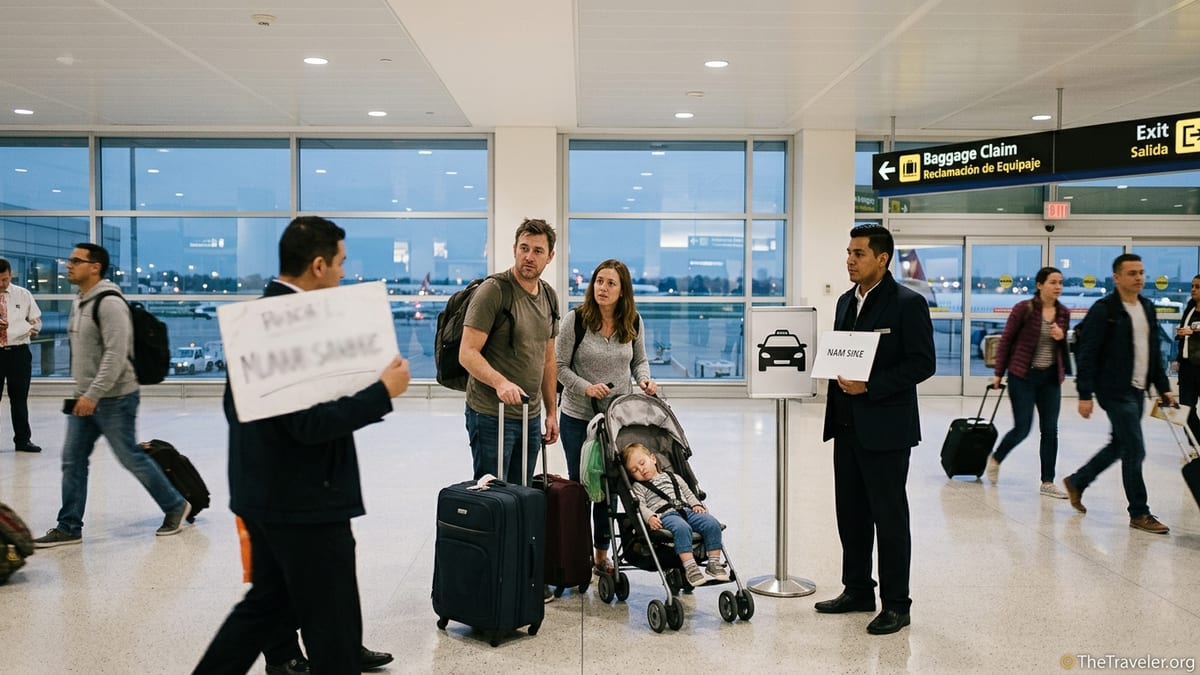
Kiwitaxi emphasizes that drivers meet you with a sign at the pickup point and that you should be reachable on the mobile phone number you provided. A common mistake is entering a number you will not actually be using on the trip, or forgetting that your home SIM will not work reliably for calls and texts abroad. When delays or confusion arise at the airport, the driver and support team may have no way to reach you, and after the standard waiting time, the ride can be marked as unattended.
Imagine arriving in Athens after a long flight, with your Kiwitaxi driver waiting in the arrivals hall. You breeze past the people holding signs because you are focused on an ATM or the restroom, then lose track of time. The driver tries calling the number on file to check your status, but it is a U.S. number with data only, and you have not yet connected to Wi Fi. By the time you realize you cannot see anyone with your name board and attempt to call support, the free waiting period is over and the driver has been reassigned.
Another scenario involves unexpected changes in meeting points. Some airports, such as Rome Fiumicino or Istanbul, occasionally restrict access for private vehicles or direct drivers to specific parking areas. Kiwitaxi support may then send you a text or chat message describing a new location to meet the car, perhaps at a particular exit or column number. If you are not monitoring the contact channel listed in your booking, you can easily wander to the wrong area and assume the driver has not shown, while they are in fact waiting just a short walk away.
To prevent such mix ups, decide in advance how you will be reachable in your arrival country. If you plan to buy a local SIM, you can update your Kiwitaxi booking with the new number via the app or website once it is active. Alternatively, ensure that your home phone plan includes roaming for voice calls and texts in your destination, even if you primarily rely on data. As a backup, print or screenshot the driver’s and support’s contact details from your voucher and connect to airport Wi Fi as soon as you land so you can send a quick message if you cannot immediately locate your name sign.
Comparing Prices Without Considering Context
Travelers often compare Kiwitaxi’s prices directly against local taxis, rideshare apps or public transport, and sometimes expect it to be the absolute cheapest option in every market. In reality, private transfers at fixed prices are usually comparable to, or slightly higher than, standard taxis or rideshares, especially once airport surcharges and night rates are factored in. The added value comes from predictability, comfort and the meet and greet service, which many users appreciate enough to pay a modest premium.
For example, in cities where airport cabs already operate on fixed tariffs, such as a typical airport to downtown run with a posted price at the taxi stand, Kiwitaxi’s quotes may be in the same general range rather than dramatically lower. In other destinations with notorious taxi scams or aggressive touts, like some Mediterranean resorts or Southeast Asian hubs, travelers consider the small difference in cost worthwhile for the security of having a pre arranged driver, clear signage and 24/7 support if anything goes wrong. Reviews often mention this peace of mind as a key reason for choosing the service.
Where some travelers go wrong is focusing only on the face value of the fare without thinking about group size or time of day. A solo backpacker arriving in the middle of the afternoon at an airport well connected by train or bus may be better off financially taking public transport, particularly in cities such as Zurich or Tokyo where rail links are outstanding. On the other hand, a family of four landing late at night or a group of friends with several suitcases may find that a single Kiwitaxi transfer to a central hotel, when divided per person, comes close to or even under the combined cost of airport train tickets plus local taxis from the station.
The key is to compare like for like. When evaluating whether Kiwitaxi represents good value for your trip, factor in baggage, arrival time, number of travelers and your tolerance for handling transfers in a new language or currency after a long flight. Once you do that math holistically, the decision becomes less about chasing the absolute lowest fare and more about optimizing for a smooth arrival experience at a reasonable price.
The Takeaway
Reserving a Kiwitaxi transfer can remove much of the uncertainty from airport arrivals, especially in unfamiliar destinations or when you are traveling with children, elderly relatives or a lot of luggage. Yet the benefits only fully materialize if you take a few minutes to understand how the service works and avoid the most common booking mistakes. Misreading what the fixed price covers, entering incorrect flight times, underestimating luggage, skipping child seats or accessibility notes, ignoring change rules and failing to plan basic communication all have the potential to turn a smooth transfer into a stressful scramble.
By approaching your Kiwitaxi reservation with the same level of attention you give to flights and accommodation, you can secure a reliable meet and greet driver, an appropriately sized vehicle and clear expectations on both sides. Double check your details, choose the right car category, read the conditions that apply to your route and ensure you can be contacted on arrival. These simple steps help you step out of the airport not into chaos or bargaining, but straight into a waiting car that takes you calmly to your next stop, setting the right tone for the rest of your trip.
FAQ
Q1. Is Kiwitaxi usually cheaper than taking a regular airport taxi?
Not always. In many cities the price is similar to or slightly higher than a metered cab or rideshare, but you gain a fixed fare, meet and greet and 24/7 support, which many travelers value.
Q2. How far in advance should I book a Kiwitaxi transfer?
Where possible, book at least 24 hours before pickup so you have full access to standard change and cancellation options and Kiwitaxi can assign a suitable local driver.
Q3. What happens if my flight is delayed?
Drivers generally track flight status and adjust arrival times, but you must provide the correct flight number and stay reachable. Major delays should be reported to Kiwitaxi support as soon as you know about them.
Q4. How much waiting time is included in the price?
Kiwitaxi usually includes a set amount of free waiting time, longer for airport pickups and shorter for city addresses. The exact allowance is shown in your booking conditions and voucher.
Q5. Can I add extra stops during the journey?
Only if they are agreed in advance and reflected in your booking. Unplanned detours, such as supermarket stops or visiting multiple hotels, may incur extra charges or be refused by the driver.
Q6. How do I know which car size to choose?
Use both passenger and suitcase limits as a guide. If you have bulky items or are unsure, pick a larger category like a minivan and describe your luggage in the booking comments.
Q7. Are child seats included automatically?
No. Child seats are typically an added option that you must request during booking. In countries where they are mandatory, drivers may not transport children without appropriate restraints.
Q8. Can I pay the driver in cash instead of online?
On many routes Kiwitaxi allows either online prepayment or cash payment to the driver. Available methods vary by destination and are shown during the booking process.
Q9. What should I do if I cannot find my driver at the airport?
First, check your voucher for the exact meeting point, then look carefully for your name sign. If you still cannot find the driver, call or message the driver or Kiwitaxi support using the contact details provided.
Q10. Is it easy to change or cancel a Kiwitaxi booking?
Yes, as long as you act before the deadline shown in your conditions. Changes and cancellations made less than 24 hours before pickup may be limited or incur fees, so act early whenever plans shift.