


More news on this day
A British Airways flight from London Heathrow to Edinburgh was forced to declare an in-flight emergency and make a priority landing after the co-pilot reportedly fell ill during descent into the Scottish capital.
Get the latest news straight to your inbox!
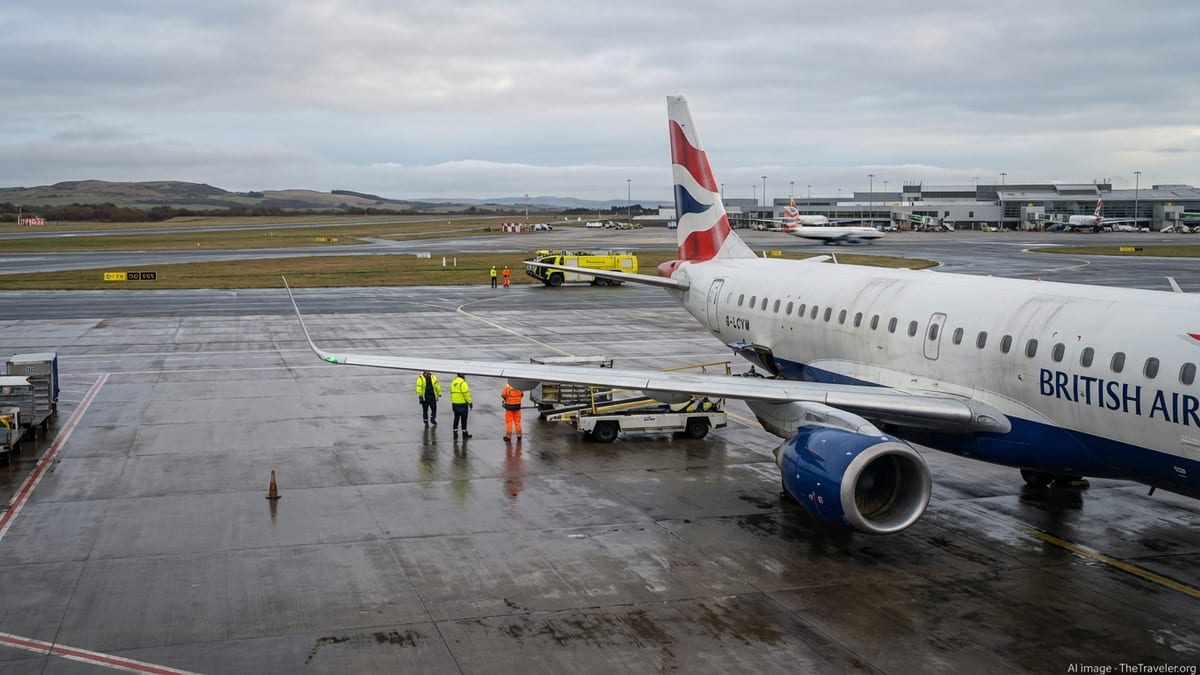
Flight From London Declares Emergency Near Edinburgh
British Airways flight BA1458 was en route from London Heathrow to Edinburgh on Monday, 11 May 2026, when the crew transmitted the emergency squawk code 7700 while approaching its destination. Flight tracking data and aviation incident summaries indicate that the Airbus A320, operating the busy domestic route to Scotland, was already in the descent phase when the situation developed.
The aircraft involved is reported to be an Airbus A320-200 registered G-EUYW, a narrowbody jet commonly used by the carrier on UK and European services. According to publicly available tracking and incident databases, the jet continued towards Edinburgh after the code was set, aligning for a landing on runway 24.
Reports from aviation monitoring platforms show that the flight had followed a largely routine path north from London before the emergency declaration. The use of the 7700 squawk prompted heightened attention from flight-tracking enthusiasts, who noted the change in the aircraft’s status as it neared the Scottish capital.
Despite the alarm implied by the emergency code, data indicates that the jet remained under control and on a stable approach profile throughout the final stages of the flight, with no abrupt course reversals or holding patterns recorded before landing.
Co-Pilot Reported Ill as Captain Continues to Edinburgh
Early incident summaries and specialist aviation coverage state that the emergency was triggered after the first officer became unwell during the descent. These accounts indicate that the captain informed air traffic services of a flight crew incapacitation and requested priority handling into Edinburgh.
In modern commercial operations, pilot and co-pilot incapacitation cases are treated as serious events because they affect cockpit workload and redundancy. Standard crew training includes preparation for flying and landing single-pilot if a colleague becomes ill, supported by checklists and company procedures. Publicly available accounts of the BA1458 event suggest that these protocols were followed as the captain continued the approach.
There are no indications from open sources of technical problems with the aircraft itself or of any wider safety issue involving passengers or cabin crew. The focus of the emergency appears to have remained on obtaining a rapid landing so that the unwell co-pilot could receive medical attention after arrival.
Reports referencing airport operations in Edinburgh state that emergency services were placed on precautionary standby for the arrival of the flight, which is standard practice when an aircraft declares an in-flight emergency related to a medical or operational issue.
Safe Touchdown and Aftermath at Edinburgh Airport
Data from flight tracking services shows BA1458 completed a normal landing on runway 24 at Edinburgh, with no diversions to another airport and no reported runway closure. The aircraft rolled out and taxied to the terminal, where medical support was understood to be available for the crew member.
There have been no public reports of injuries to passengers, and no indications of evacuations or other disruptive safety procedures on the ground. The safe landing and regular taxi to the stand point to a controlled conclusion to the emergency, consistent with an operationally manageable medical incident rather than a technical failure or severe in-flight hazard.
Subsequent schedule data available through airline and airport information systems shows that the return leg, BA1459 from Edinburgh to London, was cancelled following the incident. Cancellations in these circumstances often reflect both crew duty limitations after an emergency and the need for medical assessment or administrative checks before the aircraft and crew re-enter service.
The aircraft’s presence on the ground in Edinburgh after the event, and the absence of immediate follow-on flights, suggests that British Airways operations teams opted to reposition capacity and crews through other services while the situation was assessed.
What Squawk 7700 Means for Passengers and Air Traffic
The emergency transponder code 7700 is the standard signal used by aircraft worldwide to indicate a general in-flight emergency. When this code is entered into a transponder, it alerts air traffic controllers and flight-tracking systems that the aircraft requires priority handling, which can range from a medical urgency to technical issues or other safety-related concerns.
In practice, the use of 7700 allows controllers to clear surrounding airspace, offer direct routing, and coordinate with airport emergency services on the ground. For passengers, this may translate into a quicker-than-planned descent or a diversion, but in most cases the situation remains under control and ends with an uneventful landing, as appears to have happened with BA1458.
According to publicly available aviation safety guidance, crew incapacitation is a recognised contingency covered by training and procedures across commercial airlines. When one pilot is unavailable, the remaining pilot manages both flying and communication tasks, supported by standard operating checklists and, where available, assistance from ground-based operational staff.
The BA1458 incident underscores how the emergency code system is intended to work: flight crew signal their need for priority, air traffic services respond by facilitating a rapid and orderly landing, and ground resources are made ready in case medical or technical intervention is required.
Context of Recent 7700 Alerts in European Skies
The episode involving BA1458 comes amid heightened public awareness of squawk 7700 events, driven by the popularity of flight-tracking apps and social media posts that flag emergency codes in real time. In recent days, separate reports have highlighted other European flights declaring 7700 for reasons ranging from technical checks to medical issues among passengers and crew.
Specialist aviation outlets regularly note that such emergency declarations are a routine part of modern air traffic management, and do not automatically indicate life-threatening danger or severe mechanical failure. Most 7700 events end with standard landings, followed by checks on the aircraft and those on board.
For travellers, the BA1458 case offers a reminder that safety systems in commercial aviation are designed with multiple layers of protection. These include strict medical fitness standards for flight crew, recurrent training for scenarios such as incapacitation, and procedures that allow pilots to obtain immediate priority on approach when circumstances demand it.
As investigations and internal reviews continue around the BA1458 incident, publicly available information so far suggests that the aircraft’s crew and the wider air traffic system worked as intended, ensuring that the co-pilot received timely assistance while passengers completed their journey safely.