


More news on this day
United Airlines is set to make Singapore–San Francisco one of the world’s most premium-heavy corridors, with the carrier confirming that its next-generation Polaris 2.0 business class suites will operate on all flights between Singapore Changi and San Francisco International from August 2026.
Get the latest news straight to your inbox!
Polaris 2.0 Becomes the Standard on a Flagship Pacific Route
Publicly available information shows that United has already begun deploying its “Elevated” Boeing 787-9 Dreamliners, fitted with Polaris 2.0 suites and the higher-end Polaris Studio front-row product, on select long-haul routes out of San Francisco in early 2026. Industry coverage indicates that the Singapore–San Francisco service, which has been earmarked as an early showcase for the new cabin, will shift to an all-Polaris 2.0 operation from the northern summer 2026 schedule.
Reports from aviation and travel outlets describe the new 787-9 layout as markedly more premium-focused than United’s current configuration, with a larger Polaris cabin and expanded Premium Plus section, offset by a reduction in standard economy seating. On the Singapore–San Francisco city pair, the airline currently operates up to 14 weekly flights at peak season; from August 2026, these frequencies are expected to be consistently rostered with the reconfigured Dreamliners, effectively turning every rotation into a full “Elevated” experience in business class.
United’s move places the carrier in direct competition with leading Asian and Gulf airlines that already offer enclosed business-class suites and enhanced soft-product on ultra-long-haul routes. Analysts note that making Polaris 2.0 the baseline on every Singapore–San Francisco flight removes the “aircraft lottery” for high-yield travelers and corporate buyers, a longstanding pain point in premium cabin booking.
For United, locking in a uniform next-generation product on this route also supports its broader trans-Pacific strategy, which has focused heavily on San Francisco as a primary international gateway. Industry commentary suggests that the carrier views Singapore as a cornerstone of its Asia network, linking Silicon Valley and Singapore’s tech and financial hubs with a consistently high-value proposition at the front of the aircraft.
Inside Polaris 2.0: Suites, Studios and Starlink Connectivity
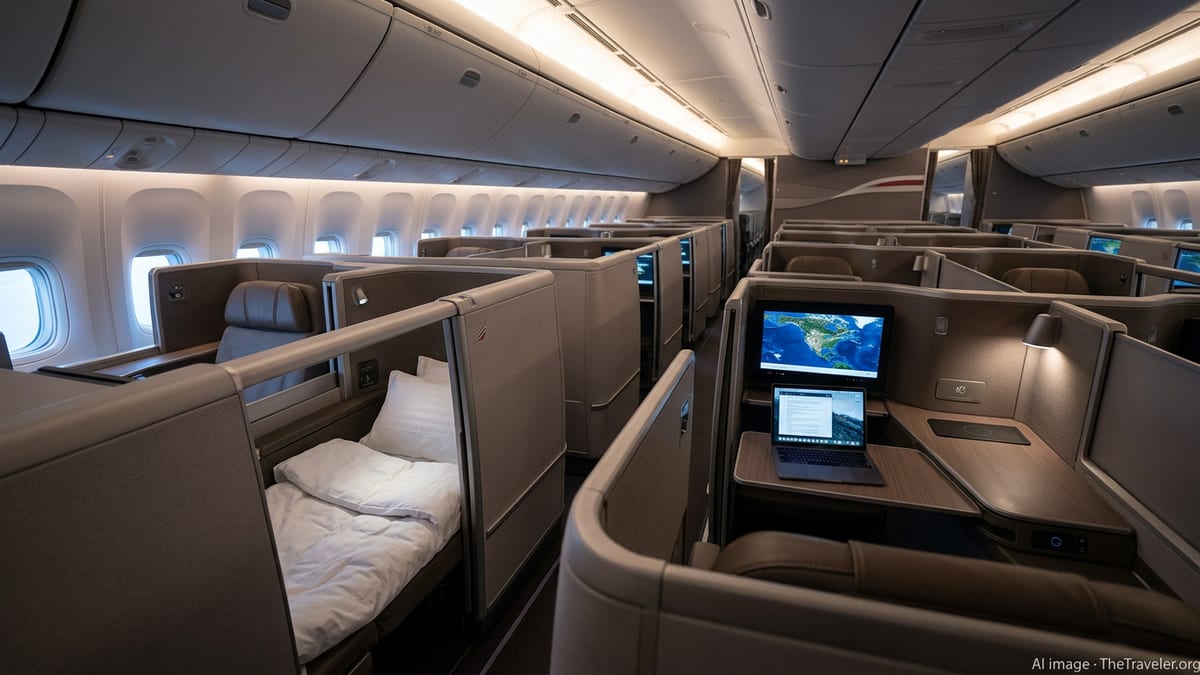
According to recent product briefings and cabin walkthroughs reported by travel media, Polaris 2.0 introduces fully enclosed business-class suites featuring sliding doors, upgraded privacy, and significantly larger 4K seatback screens. Each standard Polaris suite is described as offering lie-flat seating, direct aisle access, multiple charging options including wireless pads, and enhanced digital seat controls designed to simplify transitions between work, dining and sleep modes.
The headline element of the new cabin is Polaris Studio, a “business-plus” concept located in the bulkhead rows of the business cabin. Coverage from airline-focused outlets indicates these Studios are roughly one quarter larger than standard Polaris seats, with oversized 4K OLED displays, additional surface and storage space, and a more expansive ottoman that can double as a companion perch during in-flight dining or meetings. On the Elevated 787-9, these seats are being marketed as a distinct sub-cabin above traditional business class, aimed at travelers who might previously have booked first class on competitors.
United’s Elevated interiors also bring substantial upgrades to the wider cabin environment. Reports describe new lighting schemes, refreshed materials and finishes, and a redesigned self-service snack and beverage area for premium customers on ultra-long-haul segments such as Singapore–San Francisco. The airline is also rolling out satellite-based high-speed Wi-Fi, with Starlink connectivity slated to reach the new Dreamliners by late 2026, positioning the route as one of the most connected long-haul offerings in the United network.
Soft-product refinements are expected to complement the hard-product overhaul. Existing Polaris bedding and amenity partnerships, which have been widely praised by frequent flyers, are being retained and selectively enhanced, while meal services are reportedly shifting toward more restaurant-style plating and expanded on-demand options during the 15- to 17-hour journey between Singapore and San Francisco.
Premium Capacity Ramps Up as Demand Surges
Data and commentary from aviation analysts suggest that United’s Elevated 787-9 brings a double-digit percentage increase in Polaris seats compared with the airline’s earlier configuration, along with a sizable expansion of Premium Plus. On the Singapore–San Francisco rotation, this translates into a meaningful rise in the number of daily flat-bed and extra-legroom seats available, even as total economy capacity declines.
The decision to allocate so much of the cabin to premium products appears tied to structurally strong demand on the route. Both endpoints are major technology and finance centers, and trade and investment flows between the United States and Singapore have remained robust. Publicly available tourism and economic data for 2023 and 2024 already show a steady recovery and then growth in U.S.–Singapore visitor numbers, with industry forecasts pointing to further gains through the middle of the decade as Asia-Pacific travel demand normalizes and then surpasses pre-pandemic levels.
Corporate contracts and high-spend leisure bookings are widely seen as the key revenue drivers here. Travel-management firms and fare-trend reporting point to sustained willingness among multinational companies and affluent travelers to pay for lie-flat and suite-style products on flights exceeding 10 hours, particularly on strategic business routes. By standardizing Polaris 2.0 on every Singapore–San Francisco service, United is positioning itself to capture a larger share of this demand, while giving corporate travel buyers greater predictability around product and pricing.
Industry observers also note that the increased premium capacity could have a knock-on effect on award availability and mileage redemptions. With more Polaris seats on each flight, there is potential for additional saver and upgrade inventory to appear, particularly during shoulder seasons, though actual release patterns will depend on United’s revenue-management strategy once the full Polaris 2.0 schedule is in place.
Tourism Boost for the United States and Singapore
Tourism boards and economic development agencies on both sides of the Pacific have been emphasizing high-yield visitor growth, and the upgauging of United’s Singapore–San Francisco route aligns with that focus. Premium cabins tend to correlate with higher per-trip spending on hotels, dining, events and ancillary travel, and analysts expect the new Polaris 2.0 deployment to support this trend for inbound and outbound tourism.
For Singapore, enhanced premium connectivity to San Francisco reinforces its role as a regional hub for Southeast Asia. Travel-industry commentary suggests that more comfortable and productive long-haul options can encourage longer stays and more complex itineraries, with visitors combining Singapore with side trips to neighboring countries. The perception of an upgraded, globally competitive premium product on United could also help attract more U.S.-based conference and incentive-travel business to Singapore.
On the U.S. side, California in particular stands to benefit. San Francisco and the broader Bay Area remain key gateways for Asian visitors heading to wine regions, national parks and other high-value destinations. With a denser premium cabin and a more clearly differentiated product, United’s Singapore–San Francisco flights are likely to attract additional affluent tourists who might otherwise connect through rival hubs or choose competing carriers.
Travel economists note that premium passengers often spend more than average visitors not only on accommodation and dining, but also on experiential products such as private tours, luxury retail and bespoke cultural experiences. As a result, even a relatively modest increase in high-spend visitor numbers tied to improved air service quality can translate into a disproportionate boost in tourism revenues for both countries.
Competitive Pressure Across the Trans-Pacific Market
United’s decision to make Polaris 2.0 the default on all Singapore–San Francisco flights intensifies an already active premium-class competition across the trans-Pacific. Singapore’s home carrier and several other Asian and Middle Eastern airlines serving the region have been steadily upgrading their own business and first class offerings, rolling out suite-style products, new soft services and next-generation connectivity.
Analysts point out that United’s move signals confidence in its ability to match or exceed these competitors on hard product while leveraging the strength of its San Francisco hub and Star Alliance partnerships. With multiple airlines now fielding enclosed suites, expanded premium cabins and upgraded lounges, the focus is expected to broaden from basic seat comparisons to the overall end-to-end journey, including ground experience, digital services and reliability.
For travelers, the escalation of this premium “arms race” can bring tangible benefits in comfort and choice, though it may also entrench a wider divide between the front and back of the aircraft as airlines reallocate space and investment toward higher-yield seats. On the Singapore–San Francisco route, observers expect United’s all-Polaris 2.0 deployment from August 2026 to act as a catalyst, prompting rivals to highlight or further enhance their own products in response.
As more Elevated 787-9 aircraft join United’s fleet through 2026 and 2027, industry coverage indicates that additional Asia-Pacific routes are likely to receive the Polaris 2.0 treatment. For now, however, Singapore–San Francisco is emerging as a flagship showcase of the airline’s new premium strategy, and a bellwether for how surging demand at the top end of the market is reshaping long-haul travel between the United States and Southeast Asia.