


More news on this day
United Airlines is set to expand its latest Polaris 2.0 business class suites across all Singapore to San Francisco flights from August 2026, signaling a major push to capture premium demand on one of the world’s longest nonstop routes.
Get the latest news straight to your inbox!
Rollout Builds on Early 2026 Debut of Polaris 2.0
Publicly available route data shows that United first introduced its upgraded Polaris 2.0 cabin on select Singapore–San Francisco rotations in April 2026, using newly delivered Boeing 787-9 aircraft configured with the carrier’s “elevated” interior. Initial deployment was limited to the UA1 and UA2 services, which operate as a daily nonstop pair between the two tech and financial hubs.
Industry coverage indicates that from August 2026, United will extend the new configuration to all scheduled frequencies on the Singapore–San Francisco route. This expansion means that both daily flights are expected to feature the revamped Polaris 2.0 cabin, replacing remaining aircraft that still carried the first-generation Polaris layout.
The move positions Singapore as one of the earliest international markets to see United’s next-generation premium product fully standardized across every departure, underscoring the strategic importance of the long-haul link for business travel, corporate contracts, and connecting traffic via San Francisco.
The route, which covers nearly 8,500 miles and can run to more than 17 hours westbound, has been a proving ground for United’s long-range capabilities. Upgrading every rotation to the new cabin is seen by analysts as a statement of intent in the competitive trans-Pacific business class segment.
What Polaris 2.0 Brings to the Business Cabin
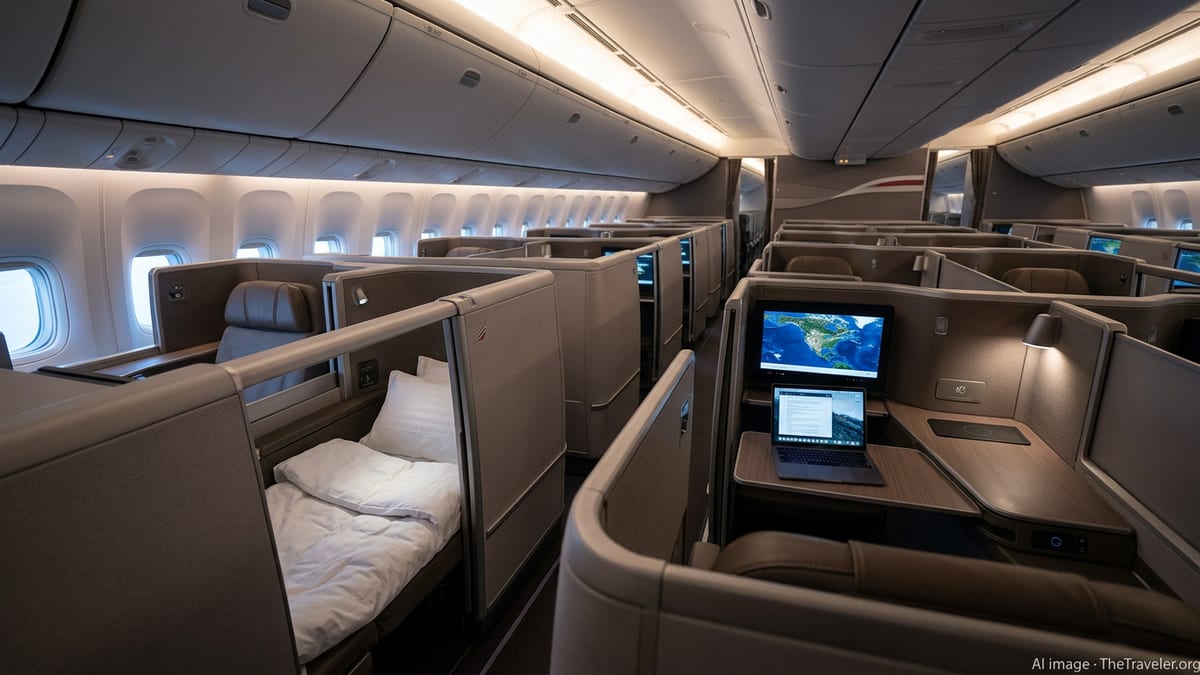
According to published descriptions of the new interior, Polaris 2.0 reimagines United’s flagship business class with enclosed or semi-enclosed suites, enhanced privacy features, and a higher proportion of premium seating compared with earlier 787-9 layouts. All seats convert to fully flat beds with direct aisle access, maintaining the core attributes of Polaris while refining the hard product around passenger feedback and competitive benchmarking.
The refreshed cabins introduce redesigned side tables, expanded personal storage, and larger high-definition seatback screens, aiming to create a more residential ambiance. Reports highlight modern touches such as Bluetooth audio pairing, wireless charging pads at many seats, and updated lighting schemes intended to support circadian rhythm adjustments on ultra-long sectors like Singapore to San Francisco.
Polaris 2.0 also incorporates an exclusive front mini-cabin branded as Polaris Studio, a “business-plus” concept with larger suites featuring sliding privacy doors and an additional ottoman that can double as a companion seat for in-flight dining. While this sub-cabin represents a small subset of the overall business class, its presence signals United’s interest in tiering the premium experience for travelers willing to pay more for extra space and amenities.
Beyond the seats themselves, United has progressively upgraded the broader Polaris experience in recent years with new amenity kits, expanded bedding, and refined in-flight service. The August 2026 expansion of Polaris 2.0 on the Singapore–San Francisco route is expected to integrate these soft-product elements with the latest hardware across every flight.
Fourteen Weekly Flights Move to Next-Generation Suites
Scheduling information compiled by aviation outlets suggests that, from August 2026, United will operate 14 weekly flights between Singapore Changi and San Francisco International equipped with the Polaris 2.0 cabin. This aligns with a pattern of two daily frequencies on the route, giving travelers consistent access to the new product regardless of departure time.
Previously, only one daily frequency regularly carried the updated interior, meaning passengers needed to check specific flight numbers or aircraft assignments to secure the newest seats. With the full-fleet transition on the route, business travelers and mileage redeemers will no longer have to navigate that uncertainty, simplifying booking decisions and strengthening the perceived reliability of United’s premium offering.
Analysts note that standardizing the product across all flights also allows United’s revenue teams to better align pricing, corporate agreements, and upgrade policies on the Singapore–San Francisco corridor. A uniform hard product can support more consistent fare structures and minimize instances where travelers on different flights experience markedly different cabins despite paying similar prices.
The move is also expected to improve schedule flexibility for frequent flyers. With both departures now marketed with Polaris 2.0, passengers can prioritize departure or arrival times and connection windows without sacrificing access to the latest business class suites.
Competitive Pressures on a Flagship Long-Haul Route
Singapore–San Francisco is a high-profile, ultra-long-haul market where carriers are using premium products to differentiate themselves. Singapore Airlines, which operates its own nonstops linking the two cities, has long been regarded as a benchmark in business class service. United’s decision to put Polaris 2.0 on every frequency on the route reflects a broader trend of U.S. airlines investing heavily in international business class as demand for premium travel continues to outpace capacity growth.
Travel industry observers point out that United has been steadily reshaping its long-haul fleet mix and cabin configurations, moving toward more premium-heavy layouts that sacrifice some economy seating in favor of higher-yield business and premium economy cabins. The 787-9s used on Singapore–San Francisco are part of this shift, trading seat count for enhanced comfort and amenities in the forward cabins.
By expanding Polaris 2.0 on the Singapore route, United also strengthens its position at San Francisco, one of its key Pacific gateways. The carrier can funnel high-value traffic from across North America into the upgraded service, while offering Asian travelers a premium one-stop option to numerous U.S. cities via its West Coast hub.
Market watchers suggest that the timing of the August 2026 rollout may enable United to capture incremental corporate demand heading into the northern autumn business travel period, as global conferences, technology events, and regional trade activity pick up across Asia and the United States.
What Travelers Can Expect from August 2026
From August 2026, passengers booking business class on any United-operated Singapore–San Francisco flight can expect the airline’s newest long-haul suite product as standard. This includes the Polaris 2.0 main cabin, with fully flat beds, privacy features, upgraded entertainment, and refreshed amenities, together with a small number of Polaris Studio suites available at a premium.
For frequent flyers and loyalty program members, the uniform product increases the appeal of redeeming miles or applying upgrade instruments on the route. Instead of balancing schedule, aircraft type, and cabin generation, travelers will be able to focus more on fare level and award availability, confident that they will receive United’s latest international business class seat.
Travel planners note that the change may also influence corporate travel policies, particularly for companies with significant ties to the technology and financial sectors that link Singapore and the Bay Area. A standardized, next-generation cabin on every flight can make it easier for travel managers to justify premium bookings on the basis of productivity, rest, and consistency for employees undertaking the long journey.
As United’s broader Polaris 2.0 rollout continues across its Boeing 787-9 fleet through the late 2020s, the full upgrade of the Singapore–San Francisco corridor from August 2026 is being watched as an early indicator of how travelers respond to the airline’s latest investment in premium long-haul travel.