


The Phlegraean Fields west of Naples are a patchwork of volcanic craters, Roman ruins and seaside villages that feel a world away from the city. For many travelers, the real dilemma is not whether to visit, but where to base yourself: atmospheric Pozzuoli, the historic port town, or laid-back Bacoli, wrapped around some of the area’s prettiest beaches and bays. Each offers a different version of coastal Campania. Understanding those differences will help you decide which one fits your travel style, time and budget.
Get the latest updates straight to your inbox!
Understanding the Phlegraean Fields Today
The Phlegraean Fields, or Campi Flegrei, are not a single town but a broad volcanic caldera that includes Pozzuoli, Bacoli, Baia and several smaller communities. Travelers are often surprised to learn that what looks like a gentle coastal landscape dotted with vineyards and pastel houses is actually the rim and floor of an active volcanic system. Scientific studies in 2025 and 2026 note increased ground uplift and frequent small earthquakes, which have led Italian authorities to maintain a yellow alert level for the area. In practice, that means heightened monitoring and clear evacuation plans, rather than day-to-day disruption for visitors.
For tourism, this volcanic backdrop is more than a curiosity. It shapes everyday experiences, from steaming fumaroles on the edge of Pozzuoli’s Solfatara area to naturally heated waters feeding local thermal baths and spa hotels. It also means that plans can be affected by occasional safety checks or temporary closures of specific sites or train sections. When you compare Pozzuoli and Bacoli, it is worth remembering that they share this same geological setting and risk profile, so your choice should be based far more on atmosphere, interests and logistics than on volcano-related concerns.
Both towns sit roughly 20 to 25 kilometers west of central Naples, close enough for day trips yet different enough to feel like destinations of their own. Pozzuoli functions as the practical hub: it has a busy port with ferries to nearby islands, suburban rail connections into Naples and a dense cluster of restaurants and services. Bacoli and neighboring Baia stretch along the coastline beyond Pozzuoli, closer to sandy beaches, low-key resorts and the main access points for the famed underwater archaeological park of Baia.
Whether you are planning a long weekend or a week of exploration, thinking in terms of “hub and spokes” helps. Pozzuoli typically works better as a base for travelers who want to mix city life, archaeology and quick island hops, while Bacoli appeals to those who want a beach-and-boat holiday with archaeology and volcanic scenery as characterful extras.
Atmosphere & Vibe: Port City Energy vs Seaside Village Calm
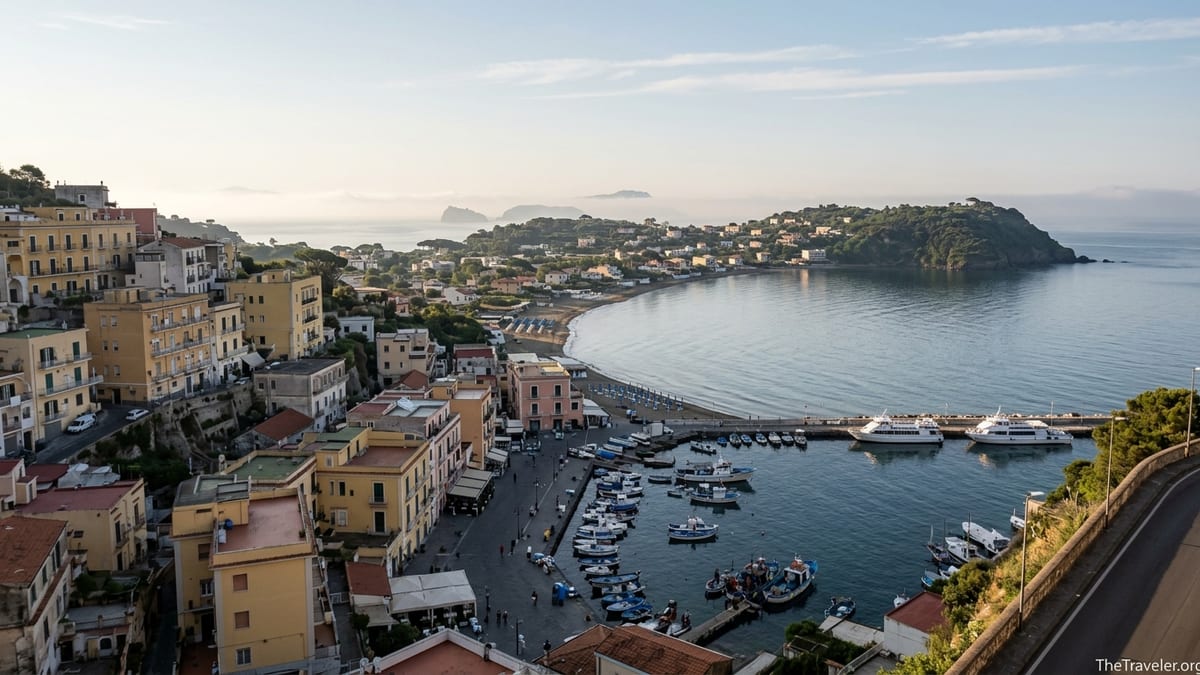
Pozzuoli’s personality is immediately shaped by its port. When you step out near the waterfront, you find harbors lined with fishing boats, hydrofoils departing for Ischia and Procida, and seafood restaurants that fill quickly on weekends. In the evening, locals stroll the seafront promenade, stop for aperitivo on Piazza della Repubblica and linger late over plates of grilled fish and spaghetti alle vongole. The feel is lively but not as intense as central Naples, with a strong sense of everyday life continuing around the visitors who pass through.
Walk a few blocks uphill and you reach the historic center perched on a tuff headland. Here, narrow lanes thread between buildings and open onto viewpoints across the Gulf of Pozzuoli. It is a working neighborhood, with small grocers and laundry hanging from balconies, yet it also hosts some of the area’s most evocative landmarks, including the Tempio-Duomo complex, where a Roman temple was converted into a cathedral. Guides here talk as much about social projects and community revival as about archaeology, giving Pozzuoli a slightly gritty, authentic edge that appeals to culture-focused travelers.
Bacoli, in contrast, spreads quietly along the water, broken into distinct pockets such as the village of Baia, the marina at Miseno and the lakeside area around Fusaro. The pace is slower. On a weekday morning in shoulder season, you might see older residents chatting outside cafes, fishermen repairing nets at the small harbors and only a handful of visitors heading to the archaeological park of Baia. The nightlife revolves more around beach clubs, waterfront bars and gelato stands than dense rows of restaurants.
For many visitors, Bacoli feels like a classic small seaside town that just happens to be layered over some of the most important Roman remains in the Mediterranean. If your ideal evening involves a quiet walk along the bay with a view of the islands, and perhaps a drink on a simple terrace overlooking the water, Bacoli will feel comfortable. If you prefer a bit more urban energy, the sight of commuter trains and ferries coming and going, and a choice of multiple bars and trattorie within a few blocks, Pozzuoli is likely to suit you better.
Beaches, Baths and Time by the Water
When the Phlegraean summer heat sets in, water access becomes a key factor, and here Bacoli usually has the edge. Beyond the town center lies Capo Miseno, where a curving strand of pale sand faces the islands of Procida and Ischia. Along this stretch you will find a mix of free beach sections and stabilimenti balneari, where a day pass might include a sunbed, umbrella and shower access for a moderate fee. On a typical July day, Neapolitan families and small groups of friends fill the sun loungers, and beach bars serve espresso, granita and simple panini.
Closer to Baia, the coast becomes rockier, with small coves and platforms carved into the tuff. Here you can swim in deep, clear water with views of ruined Roman villas on the slopes above. Some seaside clubs operate seasonal decks with ladders dropping straight into the sea, a particularly appealing setup in late afternoon when the sun softens and locals arrive after work. Prices vary, but many travelers report paying less for a full day club pass in Bacoli than at comparable beach setups on the Amalfi Coast.
Pozzuoli does not have the same spread of long sandy beaches immediately at its doorstep, though there are swimmable spots in nearby neighborhoods and along the coastal road toward Arco Felice and Lucrino. Many Pozzuoli-based visitors therefore treat Bacoli and Miseno as their main beach destination for day trips. By local train or bus, you can move from an apartment near Pozzuoli’s port to a lounger on Miseno beach in under an hour, which keeps Pozzuoli a solid choice even for swim-focused travelers who favor urban amenities.
Thermal experiences are another water-centered draw in the Phlegraean Fields. Historically, volcanic heat fed a network of baths and spa facilities scattered between Pozzuoli and Bacoli. In recent years, some have closed temporarily or adjusted operations in response to seismic monitoring, while others continue to operate in updated forms as hotels with spa pools or day-access wellness centers. If hot springs are central to your trip, it is worth checking, shortly before travel, which facilities are operating and whether they require advance booking. Both Pozzuoli and Bacoli can work as bases for visiting these sites, since they are spread across the caldera rather than focused in a single town.
Roman Ruins, Underwater Archaeology and Sightseeing Priorities
For many curious travelers, the question of Pozzuoli versus Bacoli really comes down to which archaeological experiences sit at the top of the wish list. Pozzuoli’s most commanding sight is the Flavian Amphitheater, one of the largest Roman arenas in Italy. Visitors can descend into its remarkably preserved underground passages, where staging and animal cages once stood. It is less crowded than the Colosseum, which makes it a favorite for archaeology enthusiasts and families who want space to explore at their own pace.
Nearby, the Macellum, often called the Temple of Serapis, is an old Roman marketplace whose partially submerged columns became an early scientific case study in how volcanic ground movement can raise and lower the shoreline. Walking among the ruins, you see bands of marine shell marks on the columns that show how the floor subsided and rose over centuries. Pozzuoli also offers layered walking routes beneath its historic center, where guided tours lead along Roman streets and through ancient shops now buried below the modern level of the city. For travelers who like to pack a lot of history into short walks, this density of sites is a clear argument in favor of Pozzuoli.
Bacoli shines in a different way, particularly in and around Baia. Here lies the Parco Archeologico Sommerso di Baia, an underwater park where entire sections of a Roman resort town slipped below the waves due to volcanic subsidence. Modern visitors explore it by glass bottom boat, snorkeling excursions or guided scuba dives. Even a short boat tour might pass over mosaic-floored villas and piers from the Portus Julius area, the ancient naval harbor constructed for the Roman fleet. It is one of the few places in the world where large-scale Roman remains can be seen beneath clear seawater while modern life continues on the hills above.
On land, the archaeological park of Baia preserves terraced bath complexes and palace remains climbing up the hillside, giving a tangible sense of why Roman elites compared the location to a kind of imperial playground. Add in nearby highlights such as the Sacello degli Augustali at Miseno or the grounds around Lake Fusaro, once favored for royal hunting lodges, and Bacoli becomes a strong candidate for travelers whose idea of a perfect day involves ruins with sea views and a boat ride to cap it off.
If you have three or more days in the Phlegraean Fields, you can comfortably see the main sites in both towns, no matter where you sleep. With only one full day, Pozzuoli offers more concentrated archaeology without the need for boat logistics, while a day based around Bacoli and Baia gives you the most iconic blend of ruins and coastline.
Logistics: Getting In, Getting Around and Daily Practicalities
From central Naples, Pozzuoli is easier to reach and better connected. The city is the western terminus of the city’s Line 2 commuter rail, with frequent trains from major stations such as Napoli Centrale and Piazza Cavour. In normal conditions, journey times hover around half an hour from the center to Pozzuoli, with tickets priced in line with regional rail fares that suit even tight budgets. The Cumana railway, operated by EAV, also links Naples’s Montesanto station to the Phlegraean coast, running via neighborhoods like Bagnoli toward Baia and Torregaveta near Bacoli. Work in recent years on tunnels and stations has occasionally altered stopping patterns, so checking the current timetable shortly before you travel remains essential.
Bacoli itself does not sit directly on a high-frequency regional rail line from Naples, so reaching it usually involves taking the Cumana to stops such as Baia or Fusaro and then connecting by bus, taxi or on foot depending on where you are staying. Travel planning apps that integrate local buses and the Cumana line can help visualize the route. In practice, many visitors who choose Bacoli opt for accommodations that offer clear guidance on arrival, and some midrange hotels or guesthouses can arrange private transfers from central Naples or the airport for a pre-agreed fee.
Once you are in Pozzuoli, daily logistics are straightforward. The town is compact enough to cross on foot, and the main points of interest cluster between the port, amphitheater area and historic center above. Buses and local taxis cover the rise to residential districts and nearby sites. Ferry and hydrofoil services from Pozzuoli port to Ischia and Procida make island day trips notably easier here than from Bacoli, since you can walk from your hotel to the pier in minutes and buy tickets in person on the waterfront.
In Bacoli, getting around often means a mix of walking along sections of the waterfront and using short taxi rides or local buses to bridge gaps, particularly if you are moving between Capo Miseno, Baia and the lake area. For some travelers this scattered layout feels charmingly exploratory, encouraging them to discover different corners of the municipality. Others find it less convenient than having everything within a tight radius as in Pozzuoli. If you are not comfortable navigating public transit in Italian or you are traveling with young children or heavy luggage, Pozzuoli’s simpler connections can be a deciding factor.
Costs, Accommodation Styles and Ideal Traveler Profiles
Neither Pozzuoli nor Bacoli is as expensive as well-known coastal hotspots like Capri or Positano, but there are differences in the way costs tend to appear. Pozzuoli offers a wider range of small hotels, guesthouses and apartments within walking distance of the port and amphitheater. Prices vary by season, with higher rates in summer and during local festivals, but you can often find midrange rooms that are competitive with similar options in central Naples, particularly if you book slightly uphill from the waterfront rather than directly on it.
Food budgets in Pozzuoli can scale up or down depending on your choices. Around the port, popular seafood restaurants may charge notably more for elaborate mixed grills or platters meant to share, especially on weekends when Neapolitans drive in for long lunches. Move a couple of streets inland and you will find simpler trattorie and pizzerias with more modest prices and daily specials, as well as bakeries selling takeaway slices of pizza and sfogliatelle. For travelers who enjoy having options at different price points within a few minutes’ walk, this variety is a clear advantage.
In Bacoli, accommodation is more scattered among small hotels, bed and breakfasts and seaside properties that may include pool access or private platforms on the water. Some are former villas or family-run guesthouses, which can give stays a more intimate feel. The most desirable rooms, such as those with direct sea views over Baia or Miseno, can command higher nightly rates in peak months, but in shoulder seasons you may find them surprisingly good value compared with glossier coastal destinations further south.
When you consider who each place suits best, certain traveler profiles emerge. Pozzuoli is ideal if you are using the Phlegraean Fields as a cultural extension of a Naples trip, if you want easy access to ferries for island day trips, and if you prefer an urban environment with plenty of dining options and straightforward transit. Bacoli fits travelers seeking a quieter, beach-centered base, couples planning a romantic stay with sunsets over the bay, and visitors who prioritize boat excursions and underwater archaeology.
Safety, Volcanic Context and How It Affects Your Stay
Any discussion of the Phlegraean Fields in recent years inevitably touches on safety, given the region’s active volcanic nature and the scientific studies suggesting an accelerating phase of ground uplift. Italian civil protection authorities currently classify the area at a yellow alert level, equivalent to a state of scientific attention rather than imminent danger. This translates into enhanced monitoring networks, regular updates from geological institutes and practice drills with local communities to refine evacuation procedures, including those that would use Naples’s main port as a gathering and departure point.
For visitors choosing between Bacoli and Pozzuoli, the key point is that both fall within the monitored area and share the same broad scenario planning. There is no strong argument, on the basis of current data, to say that Pozzuoli is meaningfully safer than Bacoli or vice versa. That said, Pozzuoli’s role as a transport hub with a larger resident population means that in a serious emergency it would likely see more organized movement in and out, which some travelers might find reassuring and others might perceive as potentially more chaotic.
Day to day, the most noticeable effects of the volcanic context are occasional small tremors, informational signage about evacuation routes and periodic media coverage that sometimes uses dramatic language not always mirrored by official statements. Practical steps for visitors are straightforward: before traveling, consult official Italian civil protection channels for the latest status, ask your accommodation how they handle emergency information, and keep basic travel insurance in place as you would for any international trip. Many travelers report that once they arrive, daily life feels normal, with busy cafes, fishermen heading out at dawn and families enjoying evening passeggiate along the water.
If you are particularly sensitive to the idea of staying on an active caldera, you might feel more comfortable basing in central Naples and visiting the Phlegraean towns as day trips. For most visitors, however, the volcanic story becomes part of the fascination of the area rather than a deterrent. Choosing between Pozzuoli and Bacoli then remains largely a question of what you want to see from your window each morning: ferries at the dock or fishing boats on a quiet bay.
The Takeaway
When you strip away the shared volcanic setting and broader Phlegraean identity, Pozzuoli and Bacoli reveal distinct characters. Pozzuoli is the animated port city with major archaeological landmarks, reliable train connections and direct ferries to the islands. It suits travelers who like to fill their days with walking tours, museum visits and spontaneous decisions to hop on a boat, all while returning at night to an environment that feels more like a small city than a beach town.
Bacoli offers a softer rhythm. Its strong points are sandy stretches at Miseno, dramatic coastal views, a close relationship with the underwater wonders of Baia and a general sense of being on holiday by the sea rather than in transit through a transport hub. It is better for travelers whose top priorities are swimming, relaxing in simple seaside bars and combining a few well-chosen archaeological visits with plenty of time in the water or on boats.
If you have four or five days in the Phlegraean Fields, the most rewarding approach may be not to choose at all. Spend a couple of nights in Pozzuoli to focus on amphitheaters, underground routes and a quick island excursion, then shift to Bacoli for the rest of your stay, devoting your energy to beaches and the submerged city of Baia. If your time is shorter and you must decide, opt for Pozzuoli when logistics and variety matter most, and for Bacoli when the call of the sea outweighs everything else.
Ultimately, both towns sit under the same wide Campanian sky, looking out toward the same islands and sharing the same deep volcanic roots. Whichever you pick, you will be staying in one of the Mediterranean’s most unusual coastal landscapes, where conversations at cafe tables can jump effortlessly from fishing conditions and bus timetables to ancient emperors and the hidden movements of the earth far below.
FAQ
Q1. Is Bacoli or Pozzuoli better if I have only one full day in the Phlegraean Fields?
Pozzuoli is usually the better choice for a single day, because most major sights, including the Flavian Amphitheater and the Macellum, sit close together and are easy to reach on foot from the train station and port. You can still add a short trip to a nearby coastal area, but you will spend less time on buses and more time actually exploring.
Q2. Which town is more convenient as a base for visiting Ischia and Procida?
Pozzuoli is more convenient, because ferries and hydrofoils to Ischia and Procida depart directly from its port on a regular basis. Staying in Pozzuoli lets you walk to the pier in minutes and adjust plans according to weather and schedules without having to factor in extra transit from Bacoli.
Q3. Where should I stay if my main goal is relaxing on the beach?
Bacoli is generally better for a beach-focused holiday, thanks to the sandy stretch at Capo Miseno and the mix of free areas and beach clubs along the bay. You can reach these beaches from Pozzuoli as day trips, but having them on your doorstep in Bacoli makes spontaneous swims and sunset walks much easier.
Q4. Is one town safer than the other given the volcanic situation at Campi Flegrei?
Current monitoring places the broader Phlegraean Fields, including both Bacoli and Pozzuoli, under the same yellow alert level. That status reflects scientific attention and planning rather than an immediate threat. There is no clear evidence that one town is significantly safer than the other; visitors should instead follow official updates and local guidance wherever they choose to stay.
Q5. Do I need a car to explore Bacoli and Pozzuoli properly?
You can explore both without a car, using a combination of regional trains, the Cumana line, local buses, taxis and walking. Pozzuoli is particularly easy to enjoy on foot from the station. In Bacoli, some distances between Baia, Miseno and Fusaro are longer, so travelers who dislike public transit or walking in the heat may find short taxi rides or a rented scooter useful, but a car is not essential.
Q6. Which destination is more suitable for families with children?
Both can work well. Pozzuoli offers simple logistics, short walking distances between sights and plenty of casual eateries that welcome families. Bacoli appeals to children who love the beach and boat trips, especially glass bottom boat tours over the submerged ruins at Baia. For a short trip with strollers or very young kids, Pozzuoli’s compact layout can be easier; for older children who love swimming, Bacoli may be more fun.
Q7. How many days should I plan if I want to see the highlights of both towns?
With two full days, you can see the main archaeological sites in Pozzuoli and enjoy at least a half day in Bacoli and Baia. With three to four days, you can add time on the beach, an underwater archaeology excursion and a more relaxed pace. Many visitors find that a three-night stay split between the two towns, or based in one with structured day trips to the other, strikes a good balance.
Q8. Are there good dining options in both Bacoli and Pozzuoli?
Yes. Pozzuoli has a dense cluster of seafood restaurants and pizzerias near the port and in the historic center, ranging from simple trattorie to more polished spots that fill up on weekends. Bacoli offers waterfront restaurants along Baia and Miseno, many with sea views and menus built around fresh fish. In Bacoli the choice is more spread out, so you may need short walks or taxi rides to try different places.
Q9. Which place works best for travelers who want nightlife?
Pozzuoli typically offers more varied nightlife, with bars, cafes and wine bars that stay open late around the port and main squares, especially in summer. Bacoli’s nightlife is more seasonal and concentrated in beach clubs and a handful of waterfront bars. If dancing or bar-hopping is important to you, Pozzuoli is the safer bet.
Q10. Can I visit both Bacoli and Pozzuoli from Naples as day trips without staying overnight?
Yes. Many travelers base themselves in Naples and take separate day trips to Pozzuoli and to Bacoli and Baia, using the regional rail and Cumana services. This approach works well if you prefer a big-city base with more hotel choice while still experiencing the volcanic landscapes, ruins and seaside charm of the Phlegraean Fields.