


On paper, Bacoli should feel intense. It sits inside the restless Campi Flegrei volcanic area, wrapped in Roman ruins, facing busy ferry routes to Ischia and Procida. Yet when I finally stepped off the little Cumana train at Fusaro and wandered toward the water, what surprised me most was how peaceful it felt. The calm here is not dramatic or staged. It is the kind of slow, everyday quiet that seeps in while you walk past vegetable stalls, hear cutlery in family kitchens, and watch the light soften over a still lagoon.
Get the latest updates straight to your inbox!
A Silent Lagoon on the Edge of Naples
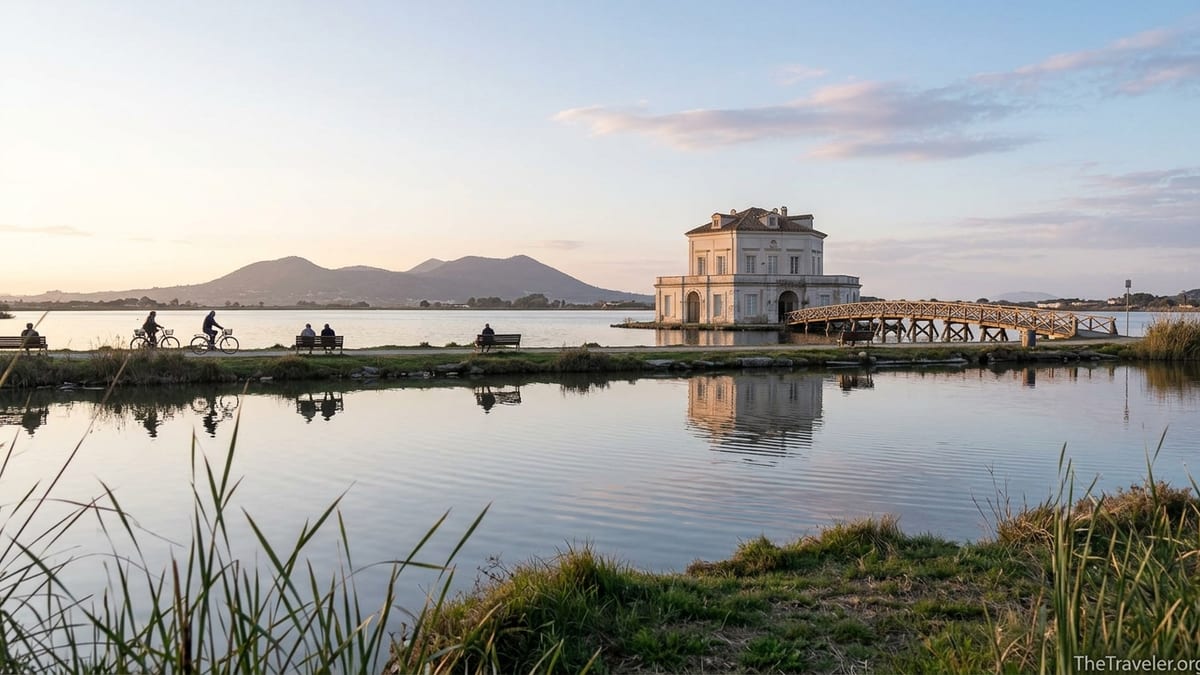
The first hint that Bacoli moves at a different pace comes at Lago Fusaro. From the small Fusaro train station, it is a five minute walk to the Vanvitelliano park. Step through the gate and the noise of metropolitan Naples falls away. In front of you, the lake lies almost perfectly still, separated from the Tyrrhenian Sea by a thin strip of land. In the middle, on its own tiny island, rises the Casina Vanvitelliana, an 18th century hunting and fishing lodge built for the Bourbon royal family. Even on weekend afternoons, you are as likely to hear ducks shuffling through the reeds as car horns.
On a recent late spring visit, the most noticeable sound was gravel underfoot as families cycled along the new pedestrian and bike path that now circles much of the lake. Benches are scattered at intervals, and it is common to see local retirees sitting quietly, watching the ripples around the old wooden bridge. It costs only a few euros to step inside the Casina when it is open for visits, but many people simply linger outside, leaning on the railings while the building’s pale facade reflects in the water.
Despite being less than an hour by public transport from central Naples, the atmosphere around Fusaro is that of a provincial lakeside town. There are no megaphones, no queue marshals, no souvenir stands shouting for attention. A kiosk might sell espresso and a simple cornetto for a few euros, and a nearby bar will offer a glass of local Falanghina wine at a modest price, but commerce stays in the background. What dominates is space and silence.
If you walk the paved path that continues along the edge of the lake, the world narrows to reeds, the creak of bicycles, and the white blur of seabirds overhead. It feels improbable that the bustle of Naples is just across the bay. This dissonance is one of Bacoli’s quietest surprises.
Slow Beaches and Everyday Rituals
From the lake, it is a short bus ride or a half hour walk to the beaches of Miseno and Miliscola, long curves of sand that are technically part of Bacoli. In August the lidos fill with Neapolitans escaping the heat, but outside the peak weeks the shoreline has a gentler rhythm. On a weekday morning in June, for example, you can walk almost the entire length of Miseno beach hearing mostly the murmur of conversations in Italian and the clink of coffee cups from simple beach bars.
Many of the stabilimenti along the sand offer a sunbed and umbrella for a day at prices that are still relatively modest compared with famous Amalfi Coast resorts. You might pay roughly what you would for a pizza and drink in central Naples. The value is not only in the cost but in the lack of pressure. Staff are used to local families who arrive late, leave early for school pickups, and treat the beach as an extension of their living room. No one hurries you off your chair. Children build sandcastles at the waterline while grandparents sit in folding chairs they brought from home.
What struck me most is that even leisure here follows an everyday tempo. Around lunchtime, many people simply pack up and walk the few blocks back to their houses to eat at home, returning later in the afternoon. The result is that the beach never feels like a stage set built solely for outsiders. Travelers become quiet participants in a local routine that has likely looked much the same for decades.
Stay into the evening and the light over Capo Miseno becomes the main event. Locals gather at casual bars just off the sand for an aperitivo. You might find yourself at a small plastic table with a spritz and a plate of lupini beans or marinated anchovies, watching the sky turn copper behind the headland. There is music sometimes, usually from someone’s portable speaker rather than a live band, but the overall tone remains mellow. Bacoli’s coastline is designed more for lingering than performing.
History that Whispers Instead of Shouts
Another surprise in Bacoli is how lightly it wears its extraordinary past. This small municipality encompasses fragments of several ancient settlements, including Baiae and Miseno, once playgrounds and strategic ports of the Roman elite. Yet you will not find the kind of theatrical staging that often surrounds high profile ruins. Sites are folded into the landscape and into daily life, and you often stumble upon them rather than march to them behind a flag-waving guide.
Take the Piscina Mirabilis, a colossal Roman cistern hidden behind a modest residential street in the Bacoli frazione. From the outside, it looks like a simple courtyard behind a gate. Step inside, paying a small entrance fee, and you descend into a forest of stone columns and barrel vaults where the Roman fleet once stored fresh water. There are no flashing panels or multilingual audio spiels. A local caretaker might offer a brief explanation, but mostly you are left alone with the echo of your own footsteps and the occasional drip from the ceiling.
Elsewhere, the remnants of ancient villas appear between modern houses, half swallowed by vegetation. Around Capo Miseno, an old Roman tunnel cuts through the rock like a forgotten secret passage, while above the town the crater ridge has walking paths that locals use for evening strolls with dogs. The contrast with more curated archaeological parks is striking. Here, history feels like part of the neighborhood rather than a fenced off attraction.
For travelers used to queueing for timed entry at blockbuster sites, this understated approach can be disorienting. Yet it adds to the sense of peace. You can sit alone on a low wall by an old brick arch and watch swallows dip in and out of the stones, imagining the naval base that once filled this bay, without a loudspeaker in earshot. Bacoli’s ruins do not shout for attention. They simply wait for you to notice them.
Living with a Quiet Volcano
Look at a geological map and you will see that Bacoli lies within one of Europe’s most watched volcanic systems, the Campi Flegrei. Nearby Pozzuoli has made headlines in recent years due to clusters of small earthquakes and gradual ground uplift. For many visitors, that knowledge arrives before they do, carried by news alerts and dramatic headlines. On the ground in Bacoli, the mood is very different.
Locals talk about the volcano the way other coastal communities discuss storms or tides. It is part of the background, something to respect and monitor but not obsess over. In the main piazza in Bacoli town, older residents play cards or chat on benches. Conversations turn more often to football or family than to magma. Civil protection posters explain evacuation routes in clear diagrams, but they are pinned alongside flyers for dance classes and local festivals.
As a visitor, this calm is quietly reassuring. You may notice the occasional civil defense exercise or read about updated risk assessments, but daily life carries on at a measured pace. Children walk to school, fishermen mend nets along the quays of nearby Baia, and cafe owners discuss the day’s catch with regulars. The volcano is a presence, yet it does not dominate. It teaches a form of acceptance that shapes the town’s psychology: live fully in the present, stay informed, but do not let hypothetical scenarios steal the joy from a sunny afternoon on the water.
Walking the gentle slope up toward the viewpoints on Capo Miseno, you see the whole volcanic landscape spread around you: craters softened by greenery, lagoons like Fusaro and Miseno shining below, and the profile of Vesuvius on the horizon. It is a reminder that this apparent calm sits on complex geology, but the scene itself is tranquil. Couples sit quietly on low walls, teenagers take photos, and a vendor sells cold drinks from a cooler. Bacoli’s peace is not ignorance of risk. It is familiarity with it.
Seafood, Siestas and the Pleasure of Doing Very Little
Food in Bacoli reflects the same unhurried character. This is a town that still draws much of its identity from the sea and the lagoons. Lake Fusaro has been used for shellfish cultivation since antiquity, and local restaurants take pride in serving mussels and clams harvested nearby. You might find a plate of spaghetti alle vongole that tastes intensely of the local water, the clams tossed with little more than garlic, parsley, and good olive oil.
Unlike in heavily touristed coastal resorts, menus here tend to be short and seasonal. One small trattoria near the main church in Bacoli might list only three or four seafood pastas, a grilled fish of the day, and a simple contorno of local vegetables. Prices are usually more aligned with what local families can afford than with what international visitors might be willing to pay. It is still possible to sit down for a full meal with house wine without worrying about a shock when the bill arrives.
Afternoons are when the town’s peaceful nature becomes most obvious. Between about 2 pm and 5 pm, shutters close along residential streets, and the soundscape narrows to the cry of swifts and the occasional scooter. Bars stay open, but many people retreat home for a rest before emerging again in the early evening. If you use this time for a slow walk between the center and the promenade by the villa comunale, you will likely share the pavements only with a few dog walkers and elderly residents shopping at corner stores.
Even nightlife here feels modest. In summer, there are beach clubs along Miseno and Miliscola that play music into the night, but away from that strip, Bacoli itself stays relatively low key. Families take a passeggiata along the waterfront, stopping for gelato. Teenagers gather on low walls with takeaway slices of pizza. By midnight, many streets are quiet. It is a coastal town that believes in rest, even in high season.
How to Experience Bacoli’s Calm as a Visitor
Reaching Bacoli without a car is more straightforward than many travelers expect, and the journey itself sets the tone. From central Naples, you can take the Cumana commuter railway from the Montesanto station toward Torregaveta and step off at stations like Fusaro or Baia. The ride typically takes around 40 to 50 minutes, passing small suburbs and glimpses of the sea. Trains are functional rather than glamorous, but they are part of local life and a gentle way to leave the city behind.
Once in Bacoli, distances are manageable on foot, but a local bus network links the key areas: the town center, Fusaro lake, Miseno, and the beaches. Services are not as frequent as in a big city, so it is wise to check timetables at stops or in town. Taxis exist, though they are not as plentiful as in Naples, and some visitors opt to book a private transfer if they are carrying heavy luggage. Many Italian travelers combine public transport with short walks, which often yields the most revealing encounters with daily life.
Accommodation choices run from simple family run guesthouses in the town center to small hotels near the sea. Bacoli does not yet have the density of luxury resorts found in places like Sorrento or Positano. Rooms are often furnished in a straightforward, slightly old fashioned style, with tiled floors and balconies that look over internal courtyards or out to the water. It is wise to book ahead in July and August, when Neapolitans flock to the coast, but outside those peak months you may find last minute availability and quieter streets.
To really feel the town’s calm, build spaciousness into your plans. Instead of trying to tick off every archaeological site in a single day, choose one or two, and leave time simply to sit. Watch a local football match by the municipal stadium, linger over a coffee in a bar that has no English menu, or sit on the low sea wall by the villa comunale and listen to the evening gossip of dog walkers. The less you insist on squeezing Bacoli into a checklist, the more its peace will reveal itself.
The Takeaway
Bacoli is not a showstopper in the Instagram sense. It does not have pastel vertical cliffs like the Amalfi Coast, nor the polished spectacle of Capri. What it offers instead is a quieter, more grounded form of beauty. A lake with a small royal lodge at its center, echoing with bird calls. Long beaches where families behave as if they own the shoreline because, in a way, they do. Ancient cisterns and villas that share space with apartment blocks and vegetable gardens.
What surprised me most about Bacoli was not a single view or dish, but the cumulative effect of its calm. The town shows that tranquility in Italy is not confined to remote hilltop villages or secluded monasteries. It can exist just beyond a dense city, in a place where people still know their neighbors, take siestas, and look out onto the same bay where Roman admirals once watched their fleets. For travelers willing to trade spectacle for slowness, Bacoli offers a rare kind of peace that lingers long after the train back to Naples pulls away.
FAQ
Q1. Is Bacoli a good alternative to staying in central Naples?
Bacoli suits travelers who value calm evenings and easy access to beaches and lagoons, and do not mind commuting about an hour by train into Naples for city sights.
Q2. How do I get from Naples to Bacoli using public transport?
The most common route is the Cumana railway from the Montesanto station in central Naples toward Torregaveta, getting off at Fusaro, Baia, or Torregaveta and using local buses or walking from there.
Q3. When is the quietest time to visit Bacoli?
Late spring and early autumn are usually the calmest periods, with warm weather and fewer crowds than in late July and August when Italian holidaymakers fill the beaches.
Q4. Are the beaches at Miseno and Miliscola suitable for families?
Yes, the long sandy beaches and generally gentle water make them popular with local families. Many lidos offer umbrellas, sunbeds, changing cabins, and simple food options.
Q5. Can I visit the Casina Vanvitelliana on Lake Fusaro?
Yes, the Casina is open to visitors on specific days and hours, often on weekends, with a small entrance fee. It is wise to check locally for the current schedule when you arrive.
Q6. Is Bacoli safe to walk around at night?
Bacoli generally feels like a typical small Italian town in the evening, with families and older residents out for a stroll. Usual travel common sense applies, but many visitors find it relaxed and comfortable after dark.
Q7. Do I need a car to explore Bacoli and the surrounding area?
You can experience much of Bacoli on foot and by local bus, especially if you focus on Lake Fusaro, the town center, Baia, and Miseno. A car becomes more useful only if you want to combine Bacoli with wider Campi Flegrei or countryside drives.
Q8. Are there many international tourists in Bacoli?
Compared with places like Sorrento or Positano, Bacoli sees far fewer international visitors. Most people you encounter will be locals or Italians from other regions, which contributes to its everyday, peaceful feeling.
Q9. What kind of accommodation can I expect in Bacoli?
Expect small hotels, guesthouses, and holiday apartments rather than large resorts. Many are family run, with simple, practical rooms and, in some cases, sea or lagoon views.
Q10. Can I combine a visit to Bacoli with other nearby attractions?
Yes, Bacoli works well as a base or day trip combined with sites such as Pozzuoli’s amphitheater, the archaeological park at Cuma, the submerged ruins of Baia, or even boat trips toward Procida and Ischia.