


On the map, Bacoli looks like a coastal afterthought on the edge of the Phlegraean Fields, a place many visitors pass through on their way to Naples, Pompeii or the Amalfi Coast. On the ground, it is something entirely different: a compact peninsula of flooded Roman cities, steaming volcanic hills, mirror-still lakes and tiny beaches under castle walls. Most day-trippers see only a fragment of it. The real Bacoli hides in side streets, down unmarked staircases and behind unassuming gates that lead straight into 2,000 years of history.
Get the latest updates straight to your inbox!
Piscina Mirabilis: A Roman Cathedral Hidden Under a Side Street
If there is one place in Bacoli that still feels startlingly undiscovered, it is Piscina Mirabilis, a vast underground Roman cistern tucked beneath a quiet residential neighborhood. Built to supply fresh water to the imperial fleet once stationed at nearby Miseno, it is the largest known Roman cistern in Italy, yet many visitors to Naples have never heard of it. From street level you see only a small entrance gate; inside, the space opens into a hall roughly the length of a cathedral, with rows of stone pillars disappearing into the half-light.
Stepping down the stairs, your eyes adjust slowly to the cool gloom. Forty massive pillars rise from the floor, supporting barrel vaults scarred by centuries of mineral deposits. In damp corners you can see the carved channels and settling basin that once filtered water arriving from the Serino aqueduct. The silence is broken only by dripping water and the voices of the occasional guide. It feels more like exploring a forgotten temple than visiting an infrastructure project, which is exactly why it stays with travelers long after they leave.
Practical details remain pleasingly low-key. Access is usually through small, timed entries managed locally, often with a modest cash fee at the door rather than a large ticket office. Opening hours can shift with restoration work and local staffing, so it is wise to confirm times with the tourism office in Bacoli or on municipal channels before you walk up the hill. Even in high season, you are more likely to share the space with a handful of architecture students or curious locals than with a bus tour, which only adds to the sense of discovery.
To make the most of a visit, pair Piscina Mirabilis with a slow wander through the surrounding streets. Just beyond the entrance, balconies drip with laundry and neighbors chat in doorways, a reminder that this global archaeological treasure sits quite literally under an ordinary Italian neighborhood. Stop at a nearby bar for an espresso afterward and you will likely be the only foreign visitor in the room.
Casina Vanvitelliana and the Quiet Shores of Lake Fusaro
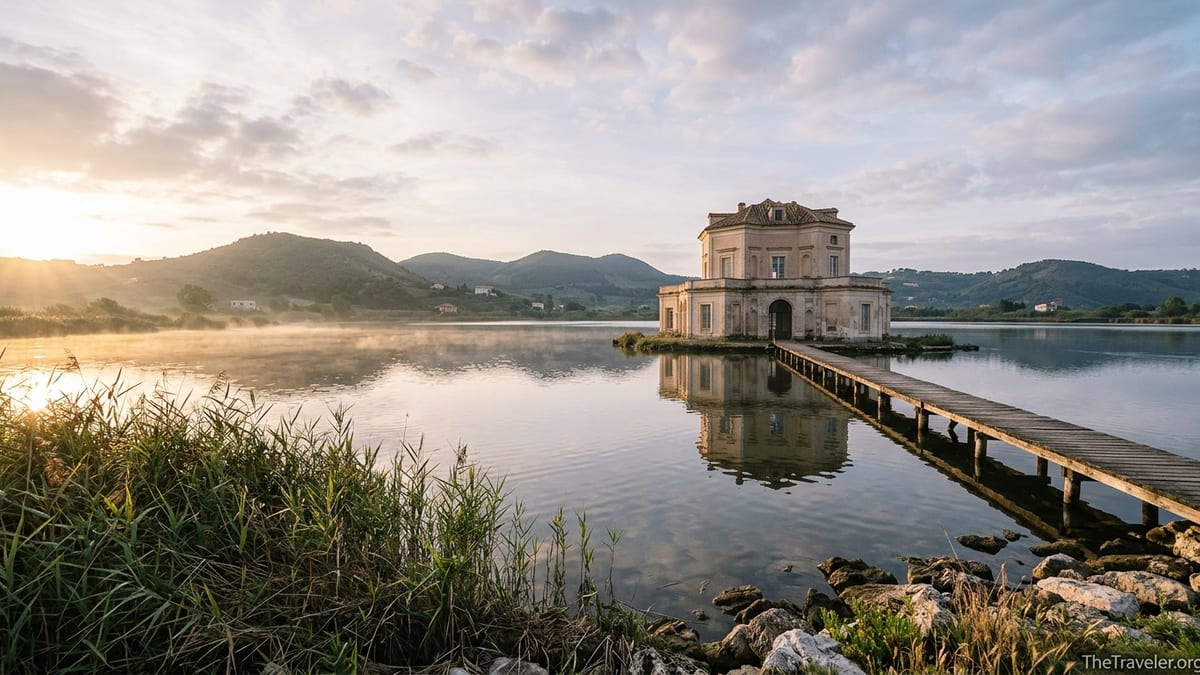
Western Bacoli opens onto Lake Fusaro, a coastal lagoon once lined with Roman villas and later transformed into a royal hunting and fishing reserve by the Bourbon kings. Floating near its shore is Casina Vanvitelliana, an elegant late baroque hunting lodge completed in the 1780s for the royal family. Reached by a narrow wooden bridge, its octagonal shape and large windows reflect in the still water, creating one of the most atmospheric views in the region, yet it remains far quieter than the royal palaces at Caserta or Naples.
From the shore, the building looks almost like a mirage: pale walls, a tiled roof, and delicate staircases curving down toward the lake. Up close, you can appreciate the craftsmanship of the architect Luigi Vanvitelli’s school, from the careful geometry of the façade to the decorative flourishes around doors and windows. On many days, especially outside summer weekends, there are only a few other visitors crossing the bridge, and the main soundtrack is wind moving through the reeds and the occasional train passing in the distance.
The site is managed locally, with basic entry tickets to the interior typically costing only a few euros per person. Inside, small rooms preserve the feel of an 18th-century retreat, with views framed perfectly over the lagoon and the volcanic hills beyond. Even if you skip the interior, a sunset stroll along the lakefront promenade is worth the detour. Simple kiosks sell coffee and snacks, and you can often find fishermen tending to nets or locals cycling home from work across the flat terrain around Fusaro.
For travelers using public transport from Naples, the small Fusaro suburban rail stop leaves you a short walk from the lake. Because tour coaches rarely stop here, facilities are compact and local: a bar next to the station, a few family-run restaurants specializing in seafood and clams, and a scattering of benches along the lake. It is a glimpse of how Neapolitans themselves escape the city without the crowds that fill the better-known coastal resorts.
Baia’s Submerged City: Glass-Bottom Boats and Quiet Archaeological Harbors
Most travelers know Pompeii, but very few realize that an entire Roman resort town lies just under the surface of the sea at Baia, one of Bacoli’s hamlets. Due to gradual volcanic subsidence, parts of ancient Baiae, once a playground for emperors, slipped below sea level. Today they form the Submerged Archaeological Park of Baia, a protected marine zone where mosaic pavements, villa walls and columns lie in only a few meters of water.
Divers come from around the world to explore the underwater ruins, but non-divers can experience the site through small glass-bottom boat excursions that depart from the modest harbor at Baia. These boats typically carry small groups along mapped routes above former streets and courtyards, pointing out submerged columns, garden layouts and modern replicas of statues that replace originals now housed in the Archaeological Museum of the Phlegraean Fields in the castle above. The atmosphere is surprisingly informal: skippers double as guides, and between explanations of Roman engineering they point out fish weaving through the ruins.
Conditions vary by season. In spring and autumn the water can be cool and occasionally murky, while in the hottest summer weeks clarity tends to improve but boat seats should be reserved ahead of time. Prices for short excursions are generally comparable to a mid-range guided tour elsewhere in Campania, but because there is no large ticket hall or slick visitor center, the experience still feels more like a local outing than a mass attraction. If you are a certified diver, local dive centers in Baia and nearby towns can organize guided dives on specific routes such as the so-called “Nymphaeum of Claudius,” where you swim past reconstructed statues and porticoes.
One of the easiest ways to enjoy this hidden world without getting wet is to combine a glass-bottom boat trip with a walk up to the Aragonese Castle of Baia, which houses the regional archaeological museum. From the ramparts you look down over the exact stretch of sea you have just sailed, understanding how much of the ancient shoreline now lies underwater. On your way back through the harbor, stop at a simple waterfront café for a plate of spaghetti alle vongole, watching small fishing boats and dive RIBs share the same limited space. It is a reminder that in Bacoli, everyday life and global heritage literally overlap.
Little-Known Beaches and Swimming Spots Beneath Castle Walls
While the Amalfi Coast battles with chronic overcrowding each summer, Bacoli’s coastline offers more intimate corners where locals swim under the gaze of castles and cliffs. One example is the modest strip of sand often called the beach of the Baia Castle, a small cove tucked beneath the rocky promontory of the Aragonese fortress. Reached by a narrow road and a short walk, it feels like an afterthought when you first see it from above, yet once down at water level the setting is dramatic: stone walls rising behind you, the wide curve of the Gulf of Pozzuoli ahead, and fishing boats rocking just offshore.
Facilities here are deliberately simple. Expect a mixture of free public access and basic lido operations rather than polished beach clubs. A few seasonal kiosks rent sunbeds and umbrellas or sell cold drinks and snacks, but many locals bring their own towels and sit on the rocks at the edges of the sand. The water is usually calm, protected by the shape of the bay, and on clear days you can see across to the outlines of Pozzuoli and, beyond that, the slopes of Vesuvius.
Elsewhere along the Bacoli and Miseno shoreline, small inlets and concrete bathing platforms slip between larger, better-known beaches. Near Capo Miseno, tiny coves appear at the end of staircases squeezed between villa walls, each revealing a few meters of sand and ladders into the sea. They rarely appear in guidebooks and may be signed only with a handwritten notice or not at all. Outside the busiest August weekends, you can often find a quiet corner even in late afternoon, especially if you are willing to accept basic amenities in exchange for space.
For travelers, the key is to think like a local rather than like a resort guest. Instead of asking for the “best beach,” ask a barista where they go for a quick swim after work, or follow neighbors carrying beach bags down side streets. Be prepared with water shoes for rocky entries and a small backpack towel. The reward is the simple pleasure of swimming in clear water beneath castle ramparts or volcanic cliffs, with no hotel logo in sight.
Volcanic Landscapes, Lakes and Viewpoints Few Tourists Reach
Bacoli lies inside the wider volcanic complex of the Phlegraean Fields, and that geology has shaped both its history and its most compelling landscapes. Beyond the coast and lakes, low hills conceal craters, fumaroles and panoramic points that most visitors never see because they stay close to the waterfront. With a bit of curiosity and comfortable shoes, you can climb above the town and trace the outlines of ancient calderas, lagoons and harbors.
One rewarding route is to walk up from the center of Bacoli toward the ridges that separate the town from neighboring Miseno and Cuma. As you climb, glimpses open simultaneously onto Lake Miseno on one side and Lake Fusaro on the other, with the Tyrrhenian Sea beyond. In clear weather, the view stretches from the islands of Ischia and Procida to the faint silhouette of Capri. These are everyday walking routes for locals, used by dog walkers and joggers, but they are almost empty of visitors who arrived just to see one or two specific monuments.
Along the way you pass lesser-known archaeological traces: fragments of Roman walls in roadside cuttings, the remains of ancient cisterns similar in function to Piscina Mirabilis but far smaller, and overgrown terraces that once formed part of elite villas overlooking the bay. Signage is often minimal, so it helps to carry a basic offline map or ask at your accommodation for suggested paths. Because these are urban-edge walks rather than wilderness trails, you are never far from a café or bus stop, yet the perspective you gain on the landscape is entirely different from that at sea level.
Time your walk for the last two hours of daylight if you can. As the sun drops toward the horizon, colors over the water flatten into silver, and the little hunting lodge on Lake Fusaro glows faintly against the darkening lagoon. You may find yourself standing at a viewpoint with only a local couple and a stray cat for company, watching one of the most expansive panoramas in Campania without a tour bus in sight.
Everyday Bacoli: Markets, Bakeries and Seafront Passeggiate
Beyond the obvious historical sights, much of Bacoli’s appeal lies in how genuinely lived-in it feels. This is not a resort built around visitors; it is a medium-sized town where tourism coexists with fishing, small industry and the daily routines of thousands of residents. To understand it, you need to spend at least a few unstructured hours doing what locals do: browsing market stalls, ordering pastries at the counter, and strolling the seafront in the early evening.
In the streets just behind the waterfront you will find small produce markets, fishmongers displaying the morning’s catch on beds of ice, and butchers whose counters look designed for family cooking rather than restaurant supply. Prices are often noticeably lower than in the historic center of Naples; a bag of tomatoes or figs might cost only a couple of euros, and you can assemble an excellent picnic of local cheese, bread and fruit without straining your budget. Shopkeepers may not speak much English, but simple Italian words and a smile are usually enough to navigate a transaction.
Cafés and bakeries provide their own kind of hidden gems. Look for trays of sfogliatelle and babà alongside more local specialties like taralli perfumed with fennel and pepper or savory pies filled with greens and ricotta. Ordering at the counter, sipping an espresso while standing among regulars and watching football highlights on the television tells you as much about Campania as any monument. Many of these places do not appear on international review sites, yet they offer some of the most authentic and affordable food you will eat on your trip.
In the evening, the lungomare, or seafront promenade, fills with families, teenagers and older couples out for a passeggiata. Children play around small carousels, street vendors sell bags of roasted nuts, and conversations drift across café terraces. Join the flow, perhaps pausing for a gelato or an aperitivo spritz. The rhythm is relaxed, and as you look across the water to the lights of Pozzuoli and Naples, you may realize that this ordinary, unhurried scene is one of Bacoli’s most enduring hidden treasures.
The Takeaway
Bacoli is not a single sight but a layered landscape where Roman engineering, royal leisure and everyday Neapolitan life intersect within a few square kilometers. Its most remarkable places, from the cavernous stillness of Piscina Mirabilis to the delicate silhouette of Casina Vanvitelliana and the drowned streets of Baia, remain relatively uncrowded not because they lack interest, but because they sit just beyond the main circuits of mass tourism.
For travelers willing to slow down, ask questions and follow side streets instead of guidebook checklists, Bacoli offers a rare combination: world-class heritage and dramatic volcanic scenery experienced at human scale. You can swim beneath castle walls in the morning, stand in a Roman cistern at midday, cross a royal bridge at sunset and end the day eating seafood in a simple harbor trattoria. None of it requires luxury budgets or elaborate logistics, only curiosity and an extra day stolen from more famous itineraries.
In an age when many coastal destinations in Italy struggle with overtourism, Bacoli’s relative anonymity is itself a luxury. Visit now, while the boats at Baia’s harbor are still mostly for fishermen and divers, while the cistern guards still have time to chat, and while the lakeside sunsets are shared with locals rather than crowds. You may find that the hidden gems you came to see are matched by something harder to capture in photos: a sense of being briefly woven into the ongoing life of a place, rather than merely passing through.
FAQ
Q1. How do I get to Bacoli from central Naples without a car?
From Naples you can take suburban trains toward the Phlegraean Fields, typically changing near Pozzuoli or using local buses that continue to Bacoli and Miseno; travel time is usually around one to one and a half hours depending on connections.
Q2. Is Bacoli a good base for visiting Naples, Pompeii and other major sites?
Bacoli can work as a quieter base if you are comfortable using regional trains and buses, allowing day trips to Naples, Pozzuoli and Cuma, but reaching Pompeii and the Amalfi Coast will require longer journeys and careful planning of connections.
Q3. Do I need to book in advance to visit the Submerged Archaeological Park of Baia?
For glass-bottom boat tours and especially for scuba dives, advance booking through local operators is strongly recommended, particularly in high season and on weekends, because group sizes are limited and departures depend on sea conditions.
Q4. Can I visit Piscina Mirabilis on my own or do I need a guide?
You can usually enter Piscina Mirabilis independently for a modest fee, but local guides are often available or can be arranged through the tourism office, and their explanations greatly enhance understanding of the site’s history and engineering.
Q5. Is swimming allowed near the underwater ruins at Baia?
Swimming and diving within the protected marine area are regulated, so you should only enter the water with authorized operators or within clearly designated zones to respect both safety rules and conservation of the archaeological remains.
Q6. When is the best time of year to visit Bacoli to avoid crowds?
Late spring and early autumn typically offer warm weather with fewer visitors than August, when Italian holidaymakers fill local beaches; outside of peak summer weekends, even popular spots around Baia and Miseno feel more relaxed.
Q7. Are there budget-friendly food options in Bacoli for travelers?
Yes, Bacoli has many affordable cafés, bakeries and family-run trattorie where you can enjoy coffee, pastries, pizza and seafood at prices often lower than those in central Naples, especially if you choose places a block or two back from the waterfront.
Q8. Is Bacoli suitable for families with children?
Bacoli works well for families thanks to small beaches with generally calm water, easy walks along the lakes and promenades, and compact archaeological sites that can be explored in short visits, though very young children will need supervision around steep steps and rocky shorelines.
Q9. Do I need to speak Italian to get around Bacoli?
Basic English is understood in some hotels, restaurants and dive centers, but much of everyday life operates in Italian, so learning a few simple phrases and being patient with communication will make interactions smoother and more enjoyable.
Q10. How long should I plan to stay in Bacoli to see its hidden gems?
A full day allows you to visit one or two major sites such as Piscina Mirabilis and Baia, but two or three nights give you time for a boat trip over the submerged ruins, a lakeside sunset at Casina Vanvitelliana and unhurried swims at lesser-known beaches.