


Landing at Bandaranaike International Airport in Katunayake and heading straight into Sri Lanka’s Cultural Triangle is one of the best ways to start a trip. Sigiriya, with its iconic Lion Rock fortress, sits roughly 150 to 170 kilometers inland, and getting there efficiently sets the tone for the rest of your itinerary. This guide walks you through the real-world options from the airport to Sigiriya and the wider Cultural Triangle, from fixed-price taxis and private drivers to bus and train combinations, how to handle night arrivals, when to route via Dambulla or Habarana, and whether it is wiser to stay near the airport first or push on the same day.
Get the latest updates straight to your inbox!
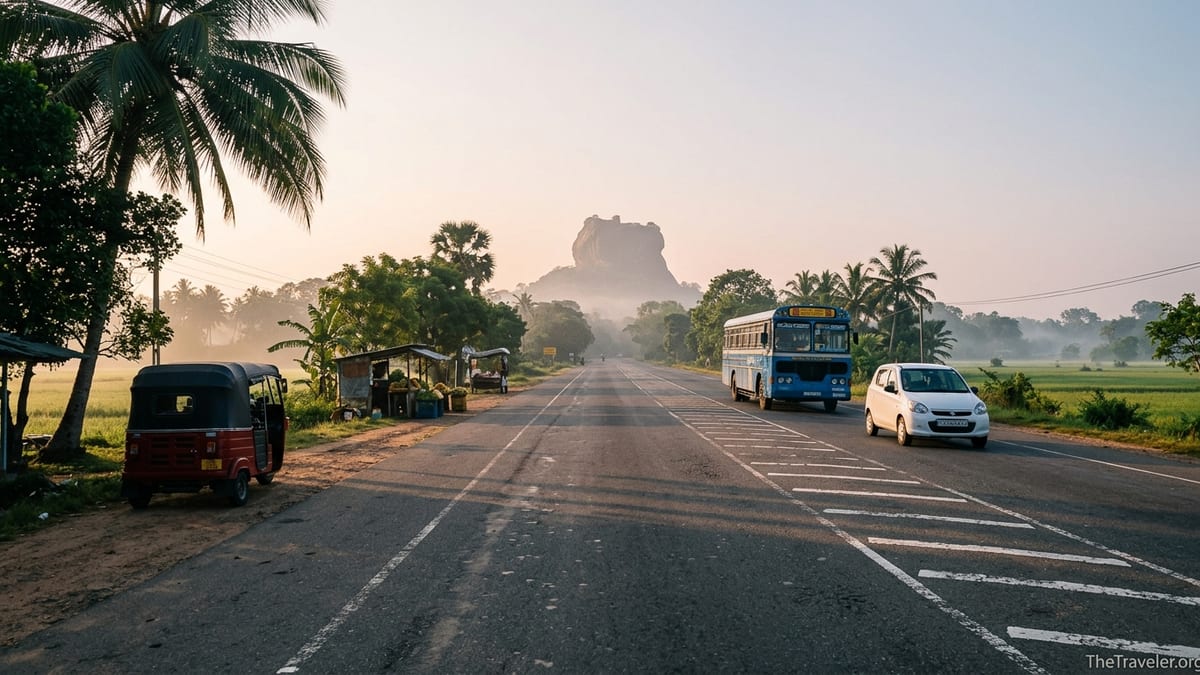
Understanding the Route: Airport to Sigiriya and the Cultural Triangle
Bandaranaike International Airport (CMB) sits just outside Colombo in Katunayake, while Sigiriya lies inland in the north-central dry zone. By road, the distance is usually quoted at around 160 to 180 kilometers depending on the exact route your driver chooses. In practice, a private car or taxi will take about 3.5 to 4.5 hours in normal daytime traffic, longer if you hit Colombo’s rush hour or heavy roadworks. You do not pass directly through downtown Colombo unless you choose to; most drivers head via the main highways through Kurunegala and Dambulla before turning off toward Sigiriya village.
Sigiriya itself is one of the key points of Sri Lanka’s Cultural Triangle, along with Dambulla, Polonnaruwa, Anuradhapura and the safari hubs around Habarana and Minneriya. Many visitors base themselves in Sigiriya or nearby Habarana for two or three nights and make day trips out to the other sites. Habarana in particular is a small crossroads town on the main A6 and A11 highways, with quick road access to Sigiriya, Polonnaruwa, and Minneriya National Park. Dambulla, about 20 to 25 kilometers south of Sigiriya, is a bus hub and the usual interchange point for public transport.
There is no passenger railway station at Sigiriya. The nearest practical rail stop is Habarana on the line from Colombo toward Trincomalee and Batticaloa, while some itineraries also connect via Kekirawa or other nearby stations and continue by road. That means most travelers either go all the way by road from the airport or combine a first leg to Colombo, then a train to the Cultural Triangle with a final tuk-tuk or taxi connection.
Because the Cultural Triangle involves multiple dispersed sites, your first transfer from the airport shapes how simple the rest of the trip feels. Booking a direct car to a hotel in Sigiriya or Habarana gives an easy, if more expensive, landing. Piecing together buses and trains makes the journey cheaper and more local in feel, but demands patience, daylight hours and a bit of flexibility.
Private Drivers and Taxis: Fastest and Easiest Door-to-Door
For most first-time visitors, especially after a long-haul flight, a pre-booked private driver or taxi from Bandaranaike Airport straight to Sigiriya or Habarana is the least stressful option. You meet your driver in the arrivals hall, put your bags in the car and drive directly to your hotel, with a couple of tea or snack stops along the way. The road is mostly two-lane highway, with occasional slow sections behind trucks and buses, but overall it is a straightforward run.
Real-world prices fluctuate with fuel costs and demand, but recent traveler reports and local operators suggest typical one-way rates from the airport to Sigiriya in the region of roughly 15,000 to 20,000 Sri Lankan rupees for a standard air-conditioned car. Some travelers in 2025 and early 2026 reported quotes around 16,000 to 17,000 rupees for a simple airport to Sigiriya drop with no guiding. Larger vans or minibuses for families or groups can be more, and premium tour companies may bundle the transfer into a multi-day package at a higher per-day rate.
You can arrange these transfers in several ways. Many Cultural Triangle hotels in Sigiriya, Habarana and Dambulla will quote an airport pickup price if you email them directly. Independent travelers often use local transfer platforms or message-based services to get fixed-price quotes in advance. Ride-hailing apps sometimes cover airport to Colombo city at competitive fares, but do not always accept long intercity trips to Sigiriya, and coverage can be patchy away from major cities, so they are best treated as a backup rather than the main plan.
An alternative is to use the official taxi counters in the arrivals hall or the metered taxis at the airport rank. These are easy to access and safe, but walk-up intercity fares can be higher than pre-booked prices. Whether you pre-book or hire on arrival, confirm whether the quote includes expressway tolls where relevant, ask about air conditioning, and double-check that the driver knows if you are staying in Sigiriya village, near the Sigiriya rock entrance, or in Habarana or Dambulla. For families with children or travelers carrying sports gear, a direct car is not only more comfortable; it also avoids repeated loading and unloading on public transport.
Bus and Train Combinations: Cheapest, Most Local Option
Travelers with time, daylight and a sense of adventure can travel toward Sigiriya by a combination of buses and, optionally, trains. The first step is usually getting from the airport to Colombo or to one of the junctions on the way north, then moving on to Dambulla and finally to Sigiriya. This is decidedly slower than a private car, but costs a fraction of the price and gives a window into everyday Sri Lankan life.
From Bandaranaike Airport, there is a frequent airport express bus service operated by the state bus company that runs between the airport and Colombo’s central bus terminal in Pettah. The ride typically takes around one hour depending on traffic and costs a small sum compared with taxi fares. From the Pettah bus stand, you can board an intercity bus toward Dambulla, often on routes bound for cities like Trincomalee or Anuradhapura that pass through the town. Recent guide-style information suggests this leg can take roughly 4 to 4.5 hours and costs only a few hundred rupees for a standard non-air-conditioned bus, or a little more for an express or air-conditioned service if available.
Once in Dambulla, you transfer to a local bus or tuk-tuk for the final stretch to Sigiriya. Local buses shuttle between Dambulla and Sigiriya throughout the day and are very inexpensive. Alternatively, many travelers with luggage simply hire a tuk-tuk for the 20 to 25 kilometer run, typically paying a few hundred to around a thousand rupees depending on negotiation, time of day and whether your hotel is further out in the surrounding countryside. This last section usually takes 30 to 45 minutes.
Some travelers prefer to use the rail network for part of the journey. In that case, you would still begin by reaching Colombo Fort railway station from the airport by bus or taxi. From Colombo Fort, there are daily trains that head toward Trincomalee and Batticaloa, stopping at Habarana. Schedules vary and can change, but current traveler reports point to at least a couple of daily services. Second-class tickets are very affordable, and even first-class seats, when available, are often cheaper than the equivalent long-distance bus. From Habarana station it is a short tuk-tuk ride to Sigiriya or on to a lodge near Minneriya or Kaudulla. This method adds complexity, but rail enthusiasts enjoy the chance to see rural Sri Lanka from the train window.
Handling Night Arrivals: Push On or Sleep Near the Airport
Many long-haul flights into Bandaranaike Airport land late at night or in the early hours of the morning. That raises a key practical question: is it wise to travel on to Sigiriya the same night, or better to rest near the airport and continue in daylight. The answer depends on your arrival time, your jet lag and your appetite for long drives in the dark.
Driving at night on Sri Lankan highways is normal for local drivers, but it can feel tiring for newly arrived visitors, especially after an overnight flight. Rural stretches can be poorly lit, with buses and trucks overtaking at speed. If your flight lands before about 18:00, it is realistic to clear immigration, meet your driver and still reach Sigiriya by late evening. In that case, pre-booking a private car direct to your Cultural Triangle hotel is convenient, and you wake up the next morning already in place to climb Sigiriya Rock at sunrise or visit the Dambulla cave temples.
For arrivals after about 21:00, many travelers now choose to spend the first night near the airport. The airport itself has a dedicated transit hotel inside the terminal for passengers who prefer to remain airside between flights, while the Katunayake area outside the airport is dotted with small guesthouses, simple transit hotels and a few mid-range properties that specialize in late check-ins and early checkouts. Several of these offer free or inexpensive shuttle services from the terminal and can arrange onward transfers to Sigiriya the next morning through in-house travel desks.
Staying near the airport has a few concrete benefits. You can get local currency from an ATM without rushing, pick up a local SIM card in the arrivals area while counters are open, have a proper shower and meal, and adjust your luggage before heading inland. The downside is that you spend an extra night on the road instead of waking up already in the Cultural Triangle. A useful compromise is to book a flexible airport-area stay for the first night, then arrange a private car for early departure the next morning, reaching Sigiriya by late morning in time for an afternoon village walk or a relaxed sunset viewpoint instead of tackling the rock climb immediately.
Dambulla and Habarana: Choosing Your Cultural Triangle Base
When planning your route from Bandaranaike Airport, it helps to decide not only how to reach Sigiriya, but also where to base yourself in the Cultural Triangle. The main choices are Sigiriya itself, Habarana about 13 kilometers away, or Dambulla further south on the main road. Each has a slightly different role in the transport network and a different feel on the ground.
Sigiriya village is the classic choice for travelers focused on climbing the Lion Rock fortress at sunrise and exploring nearby sites such as Pidurangala. Accommodation ranges from homestays and budget guesthouses tucked down lanes to mid-range resorts and larger hotels spread among rice paddies and forest. The setting is quiet and rural, and staying here means you can walk or take a short tuk-tuk to the rock entrance early in the morning before day trippers arrive from Kandy or Colombo.
Habarana functions as a small but important hub town at the heart of the Cultural Triangle. Located at the junction of key highways, it is well placed for day trips in multiple directions: north to Anuradhapura, east to Polonnaruwa, south to Dambulla and Sigiriya, and west back toward Kurunegala and Colombo. Several long-established resorts sit around Habarana’s lakes and forest edges, and the town is also a convenient starting point for elephant safaris in Minneriya and Kaudulla. Because the railway line to Trincomalee passes here, travelers using the train to or from Colombo often choose Habarana as their base and connect to Sigiriya by tuk-tuk.
Dambulla, by contrast, is more of a practical bus hub than a destination in itself. The famous cave temple complex just outside town is well worth visiting, but most Cultural Triangle itineraries now favor Sigiriya or Habarana as overnight bases rather than Dambulla town. For transport, though, Dambulla matters. Almost every intercity bus crossing the northern half of the island passes through its main bus stand, which makes it the key interchange point when arriving by bus from Colombo, Kandy or elsewhere and heading on to Sigiriya, Habarana or Polonnaruwa. When coming straight from the airport by road, you will almost certainly drive through Dambulla before turning north.
Realistic Itineraries: From Landing to Lion Rock
Putting all this together, some concrete door-to-door scenarios help show how the options play out in real life. For a couple arriving from Europe at around midday and staying three nights in a Sigiriya guesthouse, the simplest plan is to arrange a private car in advance, meet the driver in the arrivals hall, and drive straight to the guesthouse with one stop at a roadside restaurant for rice and curry. You arrive by late afternoon, can swim or rest, and climb Sigiriya early the next morning.
A budget-minded solo traveler landing in the morning and happy to travel local might instead walk from the terminal to the airport bus stand, catch the express bus into Colombo’s Pettah bus station, then transfer to an intercity bus heading toward Dambulla. After four or so hours, they arrive, buy a snack from the vendors at the bus stand, then hop on a local bus or tuk-tuk for the final leg to Sigiriya. Total ticket costs are likely to be only a small fraction of the price of a private car, at the cost of more transfers and a longer day on the road.
Consider a family of four arriving late at night with children. In this case, booking an airport-area transit hotel, taking the free or inexpensive shuttle from arrivals, and turning in for the night is often the most humane choice. The next morning, after breakfast and perhaps a swim, the hotel’s travel desk arranges an air-conditioned van with a child seat for the ride to Habarana, where the family has booked a mid-range resort with a pool. That afternoon they relax, and on the following day they climb Sigiriya at sunrise, then continue to the Dambulla cave temples in the late afternoon when temperatures cool down.
Another common scenario involves combining the Cultural Triangle with the central highlands and the south coast. A couple might land at Bandaranaike, go directly by private car to a lodge near Habarana for two nights, using tuk-tuks to reach Sigiriya and Minneriya. On the third day they continue by road to Kandy, spend two nights there, then take the scenic train to Ella. Finally, they transfer by road to the south coast beaches and end their route with a last night near the airport before an early flight out. Thinking of the airport to Sigiriya connection as part of a wider loop helps you decide whether to base in Sigiriya, Habarana or Dambulla at the start of the trip.
Practical Tips for a Smooth Cultural Triangle Transfer
Whatever route you choose from Bandaranaike Airport to Sigiriya, a few simple habits can make the journey smoother. First, build in some buffer time. Flights can be delayed, immigration queues can lengthen, and traffic around Colombo can thicken without warning. If you are using public transport, avoid tight onward reservations on the same day. If you are booking a private driver, share your flight number and arrival time and confirm where you will meet inside the terminal.
Second, sort out cash and connectivity as early as possible. Many taxis and smaller guesthouses in the Cultural Triangle prefer cash, so withdrawing some rupees at airport ATMs before leaving is helpful. Local SIM cards provided by the major mobile operators are widely available in the arrivals area and can make coordinating with drivers and hotels much easier, especially if you get delayed at a bus stand or station. Remember that mobile data may be patchy in forested areas around Sigiriya and Minneriya, so downloading offline maps in advance is wise.
Third, be realistic about your comfort level. Bus journeys can be crowded and warm, and trains can be standing-room only if you travel at peak times without a reserved seat. That said, many independent travelers enjoy these experiences and appreciate the chance to chat with locals, buy snacks from vendors at stops, and watch the countryside roll past. In contrast, private cars offer air conditioning and flexibility, but you will see less of everyday transport life. Both approaches are valid; the best choice reflects your budget, time and energy after your flight.
Finally, keep an eye on seasonal conditions. The Cultural Triangle lies in a part of Sri Lanka that can be very hot from around March to September, with midday sun making sightseeing strenuous. Arriving from the airport in the late afternoon and planning early-morning climbs and late-afternoon temple visits can transform the experience. During periods of heavy rain, buses may be slower and some rural roads can develop potholes, so padding the schedule and leaning toward private transfers makes sense if you are on a tight timetable.
The Takeaway
Traveling from Bandaranaike International Airport to Sigiriya sets the tone for your Cultural Triangle journey. A direct private car or taxi offers the fastest, most comfortable door-to-door solution, usually taking 3.5 to 4.5 hours and working particularly well for first-time visitors, families and anyone arriving tired from a long-haul flight. Bus and train combinations slice the cost dramatically and provide a more local-flavored experience, but require more daylight hours, more patience and a willingness to juggle multiple transfers via Dambulla or Habarana.
Night arrivals add an extra decision point: push straight on or sleep near the airport. Sound sleep in a transit hotel, then a fresh morning start toward Sigiriya can be worth far more than the cost of an extra night, especially if you plan to climb Lion Rock at sunrise the next day. Choosing your base in Sigiriya, Habarana or Dambulla further shapes how easy it is to explore the wider Cultural Triangle, from Polonnaruwa and Anuradhapura to Minneriya’s elephant-filled plains.
In practice, there is no single best route, only the route that best matches your budget, arrival time and travel style. Think in terms of daylight versus darkness, cost versus comfort, and how quickly you want to immerse yourself in Sri Lanka’s ancient sites. With a realistic plan, clear expectations and a bit of flexibility, the journey from Bandaranaike Airport to Sigiriya can be more than a transfer; it can be your first, memorable introduction to the rhythms of inland Sri Lanka.
FAQ
Q1. How long does it take to travel from Bandaranaike Airport to Sigiriya by car?
The drive usually takes around 3.5 to 4.5 hours in normal traffic, depending on the exact route and time of day you leave the airport.
Q2. What is a typical taxi or private transfer price from the airport to Sigiriya?
Recent real-world quotes for a standard air-conditioned car are often in the range of roughly 15,000 to 20,000 Sri Lankan rupees one way, with larger vehicles costing more.
Q3. Is it safe to drive from the airport to Sigiriya at night?
Local drivers are used to night driving, but visitors are often tired after long flights and roads can be poorly lit, so many travelers prefer to stay near the airport if they arrive very late.
Q4. Can I go from the airport to Sigiriya entirely by bus?
Yes. You can take an airport bus into Colombo, then an intercity bus to Dambulla, and finally a local bus or tuk-tuk from Dambulla to Sigiriya, though it is slower than a private car.
Q5. Is there a train directly to Sigiriya from Colombo or the airport?
No. There is no railway station at Sigiriya. The closest practical station is Habarana, from which you continue by tuk-tuk or taxi to Sigiriya or nearby hotels.
Q6. Should I base myself in Sigiriya, Habarana or Dambulla for the Cultural Triangle?
Sigiriya is ideal for easy access to Lion Rock, Habarana works well as a central hub for multiple day trips and rail links, while Dambulla is mainly useful as a bus interchange rather than a base.
Q7. Is it better to stay near the airport on arrival or go straight to Sigiriya?
If you land in the daytime and feel energetic, going straight to Sigiriya or Habarana is convenient. For late-night arrivals, an airport-area hotel and onward travel the next morning is often more comfortable.
Q8. How crowded are buses and trains on this route?
Buses and trains toward Dambulla and Habarana can be busy, especially at peak times and holidays, with limited seats and warm conditions, but many independent travelers still find them manageable and rewarding.
Q9. Can Cultural Triangle hotels arrange my airport transfer?
Yes. Many hotels and guesthouses in Sigiriya, Habarana and Dambulla can organize fixed-price transfers from Bandaranaike Airport if you contact them in advance with your flight details.
Q10. Do I need cash, or can I pay by card for transport and in Sigiriya?
Some larger operators accept cards, but many taxis, tuk-tuks and smaller guesthouses prefer cash, so withdrawing rupees at the airport and carrying enough for your transfer is advisable.