


For budget minded travelers landing at Bandaranaike International Airport outside Colombo, route 187 is the classic cheap way into the city. This airport bus connects the terminals with Colombo Fort and the Bastian Mawatha / Pettah bus area, putting you right in the middle of Sri Lanka’s main transport hub for a fraction of the cost of a taxi or ride share. With a little preparation, it is a straightforward and very economical journey.
Get the latest updates straight to your inbox!
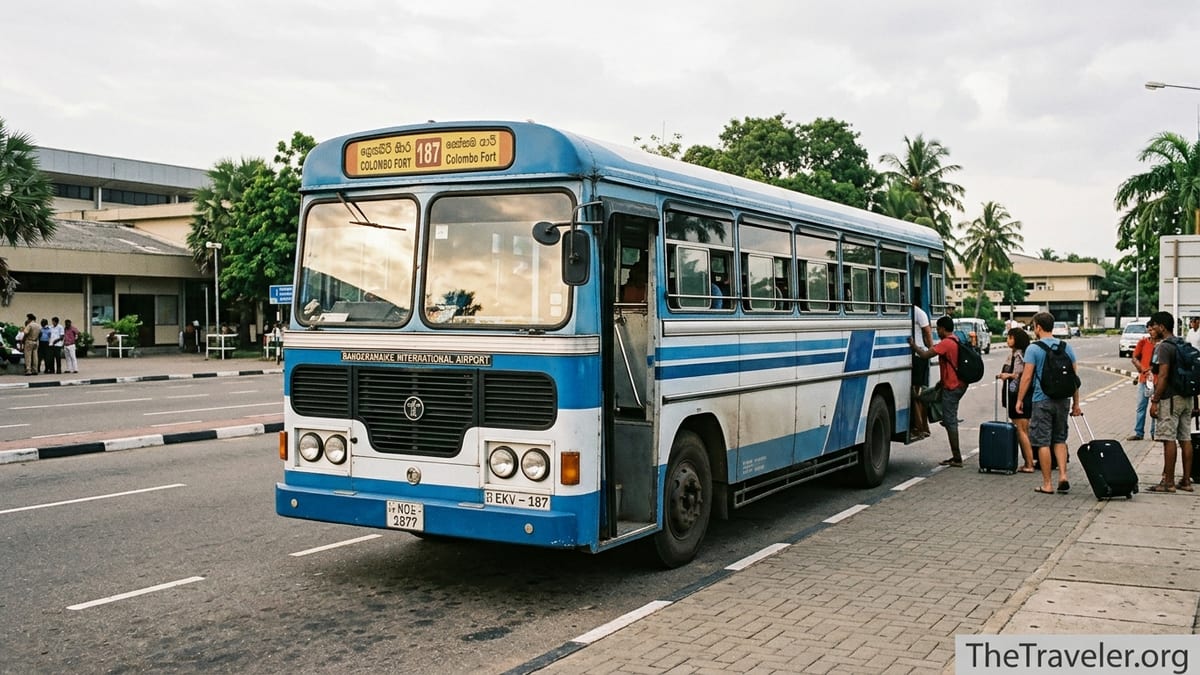
What Exactly Is Bus 187 and Where Does It Go
Route 187 is a licensed public bus service connecting Bandaranaike International Airport, often called Katunayake Airport, with central Colombo. Most services run as 187 or 187 E on the Colombo to Katunayake corridor, with many of the airport focused departures branded as an airport express bus. The line serves Colombo Fort and the Bastian Mawatha / Pettah bus terminals, which sit beside Fort Railway Station and form the main interchange for buses heading across Sri Lanka.
From a traveler’s point of view, the key thing to understand is that there are two broad versions of the service. One uses the older Negombo Road route, stopping often and threading through local traffic. The other is a luxury or semi luxury air conditioned service that uses the Colombo Katunayake Expressway, sometimes labeled 187 E 03. The expressway buses cost slightly more but can cut travel time dramatically by bypassing congested stretches near Ja Ela and Seeduwa.
Most services are regulated by the National Transport Commission, and operations are a mix of state owned Sri Lanka Transport Board coaches and privately operated buses. Buses generally terminate at the Bastian Mawatha bus terminal area in Pettah, a few minutes’ walk from Colombo Fort station. This makes route 187 a natural first step if you are catching onward trains to places like Kandy, Galle or Anuradhapura, or connecting to long distance buses to Matara, Trincomalee or Jaffna.
In recent years, authorities have promoted the airport luxury bus option, including direct access to the airport departure terminal for some services. However, for most backpackers and independent travelers, the defining feature of 187 remains its low cost compared with taxis, airport shuttles and ride hailing cars.
Finding the 187 Bus at Bandaranaike International Airport
Once you exit customs at Bandaranaike International Airport, ignore the taxi counters for the moment and follow signs toward the outer bus and car park area. For many years, passengers had to walk or take a short internal shuttle out to the Katunayake Airport Bus Station at the main road. With the airport focused luxury 187 services, several departures now pick up closer to the terminal, often at or near the outer porch by the departures area. Ground staff at the information desk can confirm where the next 187 bus is boarding on the day you arrive.
If you are directed to the main Katunayake Airport Bus Station, expect a walk of roughly 5 to 10 minutes or a brief shuttle ride, depending on current arrangements. This bus station sits beside the highway interchange. You will see several bays, usually with signs in Sinhala and English showing “187 Colombo – Fort / Bastian Mawatha” or similar. It is normal to find both air conditioned expressway buses and non AC buses using the same general area, so check the front destination board and ask the conductor if you are unsure.
Many travelers arriving on late afternoon flights report that they simply follow other passengers wheeling suitcases toward the bus area. Airport staff, security guards and even shopkeepers near the exit are used to this question and can point you to the 187 stand. Because the route is well known among locals working at the airport and in Colombo, you can confidently ask for “airport bus to Fort, 187” and expect people to understand what you mean.
At busy times, multiple 187 buses may be waiting. You will usually pay for your ticket on board rather than at a counter. If you prefer a quicker ride and see both an air conditioned coach and an older non AC bus, pick the more modern looking, expressway bound option and confirm with the conductor that it uses the highway rather than the old road.
Fares, Tickets and How to Pay
One of the main reasons travelers choose bus 187 is the price. The fare from the airport to Bastian Mawatha or Colombo Fort is typically only a small amount in Sri Lankan rupees, significantly less than even a budget taxi. Regular non AC services following the older road usually charge the standard intercity bus fare set by national regulators, which remains very low by international standards. Luxury and expressway buses add a supplement but still stay firmly in budget territory.
You do not need to buy tickets in advance. Payment is almost always in cash directly to the conductor or ticket inspector once the bus has started moving. They walk through the aisle with a printed ticket roll, ask for your destination, and quote a fare. It is best to carry small denomination notes, ideally under 500 rupees, because conductors may struggle to change large bills for a single passenger, especially if you board at a quiet time.
There is no requirement to validate tickets or tap in with a card, and foreign cards are not accepted on board. Official timetables and fare charts may be published by agencies, but in practice most locals simply know that the airport bus is the cheap option and pay the amount requested. If you ever feel unsure, you can politely ask the conductor “How much to Bastian Mawatha?” before sitting down. Fares are standardized by distance, so significant overcharging is rare, particularly on the regulated airport route.
Budget minded travelers often compare the bus fare with other options at the airport. A metered taxi or ride hailing car from Bandaranaike to Colombo Fort can cost many times more than the 187, even at off peak times. For solo backpackers or couples, the savings are immediate and substantial. The trade off is that the bus will rarely be door to door, and you will need to manage your luggage and onward connection once you reach Pettah or Fort.
Route, Travel Time and What to Expect on Board
The 187 route connects the Katunayake airport area with central Colombo, either via the older A3 Negombo Road or using the E03 Colombo Katunayake Expressway. The expressway opened in the mid 2010s and trims travel times between Colombo and the airport to around 30 minutes in light traffic. However, boarding, disembarking and congestion around Colombo Fort mean that overall door to terminal journey times are usually closer to 45 to 60 minutes for expressway services.
On older road based 187 buses, especially non AC versions that stop frequently to pick up local passengers, travel time can stretch to 90 minutes or beyond. This is particularly true during weekday rush hours and in the early evening when commuters are heading home. Travelers arriving on long haul flights should factor this into their planning. If you land at 16:00 and your onward train from Fort departs at 19:00, the bus is usually a safe choice. For a tight 18:00 departure, a taxi or airport minivan may be more comfortable.
Inside the bus, expect simple functional seating rather than luxury. On the expressway coaches, air conditioning keeps temperatures reasonable and windows are often tinted. Seats are upright with limited legroom. On non AC buses, windows are usually open, ceiling fans may or may not work, and you will share space with airport workers, families, and ordinary commuters. It is common for the bus to fill up quickly near the airport and then gradually empty as people get off in suburbs such as Seeduwa and Ja Ela before reaching Colombo.
There is normally no assigned seating, and standing passengers are allowed on non expressway services. If you are boarding at the airport with a large backpack or suitcase, try to get on early so you can secure a seat toward the middle of the coach. Noise levels can be high, with a mixture of local music, horns and general conversation. Wi fi is not provided, though many passengers pass the time on their phones, and mobile data reception is generally good along the corridor, including on the expressway sections.
Luggage, Comfort and Safety Tips
Route 187 buses are designed primarily for local passengers, but they are widely used by travelers with luggage. There is usually no dedicated luggage hold under the floor as you might find on a long distance coach. Instead, suitcases and backpacks are stored beside you on the seat, in the aisle, or at the front of the bus near the driver. On air conditioned expressway buses, conductors are often used to seeing tourists and may help you find a spot where your bag does not block the door.
If you are carrying a standard 60 liter backpack and a small daypack, simply keep the large bag on the floor between your knees and the seat in front, with the daypack on your lap. For hard sided rolling suitcases, placing them upright in the space near the front steps works well as long as the bus is not packed. In very busy conditions, conductors sometimes encourage passengers to place larger bags in the small open area at the back of the bus, behind the last row of seats.
Security is generally good, but the usual common sense precautions apply. Keep passports, wallets and phones in a zipped inner pocket or money belt rather than an outer backpack pocket that you cannot see. If you need to stow a bag slightly away from your seat, consider looping a strap around your leg or using a small cable lock. Petty theft is not rampant on this route, but the bus can be crowded and tired travelers with loose valuables are easy targets anywhere in the world.
For comfort, dress for a warm, sometimes humid environment, even on air conditioned services. A light scarf or thin hoodie can help if the AC is set very cold, which is common on some luxury buses. Earplugs and a small bottle of drinking water make the ride more pleasant, especially after a long flight. There are no toilets on board, so use airport facilities before boarding. If you are particularly sensitive to motion, remember that buses can brake hard in traffic and sway at speed on the expressway, so an aisle seat in the middle of the coach is usually the most stable location.
Arriving at Bastian Mawatha, Pettah and Access to Colombo Fort
The city terminus for most 187 services is the Bastian Mawatha bus terminal in Pettah, often just called Pettah bus stand. This sprawling complex sits on the edge of central Colombo, beside the canal and a short walk from Fort Railway Station. As your bus approaches the end of the route, you will see a dense cluster of buses, food stalls and small shops. Conductors usually shout the final stop, and many passengers will disembark together. If you are unsure, you can confirm with a quick “Bastian Mawatha, Fort?” as you near the terminal.
Once you step off the bus, take a moment to orient yourself. The area is busy but generally friendly, dominated by working Sri Lankans using local and long distance buses. To reach Colombo Fort railway station on foot, follow the flow of people toward the cluster of colonial era buildings and station signage. The walk typically takes around 5 to 10 minutes, depending on where exactly your bus is parked within the terminal. If you are catching an onward train to Kandy, Galle, Ella via Badulla or the north central region, this is where you will go.
For those continuing by bus rather than train, Pettah is the start or end point of many key routes. From Bastian Mawatha you can find services toward southern towns such as Galle and Matara, eastern destinations including Trincomalee and Batticaloa, and central highlands hubs like Nuwara Eliya via Kandy. You do not need to change terminals for most of these, but you may need to walk from the 187 bay to a different part of the complex. Staff at information kiosks and ticket counters are used to helping foreigners and can direct you to the correct stand number.
If your final destination is within central Colombo, such as a guesthouse near Galle Face Green or a hotel in Colombo 03, you can either walk, take a short taxi or hail a three wheeler from the main road outside the terminal. The area around Pettah is busy with tuk tuks. Agree the fare beforehand or insist on the meter, and remember that you have already saved substantially by using the 187 from the airport, so paying a little extra for a short hop to your accommodation can still keep the overall trip very affordable.
When the Airport Bus Is Worth Using and When to Avoid It
For many travelers, the 187 bus is worth using whenever time is flexible and budget is a priority. Solo backpackers arriving during daylight hours with modest luggage often find it the ideal introduction to Sri Lanka. Paying a low fare for a direct link between Bandaranaike and Colombo Fort, then walking to the train station for an onward journey, keeps overall transport costs very low on the first day. It also gives a first glimpse of local life rather than an insulated ride in a private car.
It is especially attractive if you have a midday or afternoon arrival and a hotel booked near Fort or Pettah. For example, a traveler landing at 13:00, clearing immigration by 14:00 and boarding an expressway based 187 at 14:30 can reasonably expect to be at Bastian Mawatha by around 15:30 to 16:00, depending on traffic. From there, a short walk or tuk tuk ride to a nearby guesthouse still leaves time to rest, shower and explore the city before dinner.
However, there are clear situations where the bus may not be the best choice. If you arrive very late at night with young children and multiple heavy suitcases, dealing with steps, crowded aisles and a busy Pettah terminal can be challenging after a long flight. While some airport bus services operate late and even through the night, frequencies can drop and waiting around the bus stand might feel uncomfortable if you are unfamiliar with the setting. In these cases, pre booking a taxi, arranging a hotel pickup, or using a reputable ride hailing app can be worth the extra cost.
The bus is also less ideal when you are facing a very tight connection for an onward train or a fixed departure tour. Traffic conditions between the airport and Colombo can change quickly, especially if there has been heavy rain or an incident on the expressway. If missing a train or bus would seriously disrupt your itinerary, giving yourself a generous buffer or choosing a faster, point to point car transfer is sensible. As a rule of thumb, if the value of your time and peace of mind outweighs the savings of a low fare, the bus is better reserved for other legs of your journey.
The Takeaway
Bandaranaike International Airport’s route 187 bus is one of Sri Lanka’s classic budget friendly connections, linking the country’s main international gateway with the transport heart of Colombo at Fort and Pettah. It is cheap, reasonably frequent and widely used by locals, which makes it both economical and an authentic introduction to everyday travel in and out of the capital.
Using the bus successfully comes down to a few key points: knowing where to board at the airport, carrying small cash for the fare, allowing enough time for possible traffic, and being realistic about luggage and comfort. Travelers who accept the trade offs of a busy public bus in exchange for substantial savings usually find the experience straightforward and rewarding.
For those arriving in the middle of the day with manageable bags and flexible onward plans, 187 is often the smartest way to keep costs down while heading straight to Colombo Fort and the Bastian Mawatha hub. For late night arrivals, tight connections or travelers who value maximum comfort, a taxi, ride share or hotel transfer may be more appropriate. Understanding these options before you land will help you choose confidently at the terminal.
FAQ
Q1. How often does bus 187 run between Bandaranaike Airport and Colombo Fort?
The 187 airport buses typically run throughout the day at intervals that can range from around 15 to 30 minutes at busy times, with reduced frequency late at night and in the very early morning. Schedules can vary slightly with operator and demand, so it is wise to treat any timing as approximate rather than relying on an exact clock face timetable.
Q2. How long does the journey from the airport to Colombo Fort usually take?
On air conditioned 187 services using the Colombo Katunayake Expressway, the journey from the airport area to Bastian Mawatha or Fort often takes around 45 to 60 minutes in normal traffic. On non AC buses following the older Negombo Road with more intermediate stops, travel time can stretch to 90 minutes or more, especially during rush hours.
Q3. Where exactly do I catch the 187 bus at Bandaranaike International Airport?
Most travelers either board at a designated airport bus stop near the terminal’s outer porch or at the nearby Katunayake Airport Bus Station by the main road and highway interchange. Airport information desks, security staff and signage can direct you to the current boarding point, and asking for the “187 bus to Fort or Pettah” is generally understood by staff working in the arrival area.
Q4. How much does the 187 bus cost compared with a taxi?
The 187 bus fare from the airport to Colombo Fort is usually only a small fraction of the price of a metered taxi or ride hailing car for the same journey. Exact fares change from time to time with national fare revisions, but for most solo travelers or couples, the bus fare is so low that even adding a short tuk tuk ride from Pettah to a city hotel still keeps the total cost well below that of a direct private car transfer.
Q5. Is it safe to take the 187 bus at night?
Many locals use the 187 route in the evening and at night, and incidents involving tourists are uncommon, but comfort levels vary from person to person. The bus and terminal areas are busy, noisy environments rather than polished airport style lounges. If you are arriving very late, traveling alone, or carrying expensive equipment, you may feel more at ease with a pre arranged taxi or hotel pickup instead of waiting outside for a late night bus departure.
Q6. Can I take large luggage or a suitcase on the 187 bus?
Yes, it is common to see travelers with backpacks and suitcases on the 187 buses. There is usually no underfloor luggage hold, so bags are stored on the seat, in the aisle or in open spaces near the front or back of the bus. As long as you can lift and maneuver your own luggage up the steps and through the aisle, conductors and fellow passengers are generally accommodating, though space can feel tight on busy departures.
Q7. Does the 187 bus stop directly at Colombo Fort railway station?
The 187 bus typically terminates at the Bastian Mawatha bus terminal in Pettah, which is only a short walk from Colombo Fort railway station. Depending on exactly where your bus parks, the walk can be around 5 to 10 minutes through a busy but straightforward urban area. If you are unsure, you can ask other passengers or terminal staff to point you toward the Fort station entrance.
Q8. Do I need to buy a ticket in advance or can I pay on board?
You do not need to buy tickets in advance for the 187 bus. Simply board the bus when it arrives, find a seat if available, and pay the conductor in cash once the bus is underway. Carrying smaller denomination notes is helpful, as conductors may not always have change for large bills from the airport exchange counters.
Q9. Should I choose the air conditioned expressway bus or the regular non AC bus?
If you value a faster and more comfortable ride, the air conditioned 187 buses that use the expressway are usually the better choice, even though they cost slightly more than regular non AC services. Travelers on very tight budgets, or those arriving when only non AC buses are available, may still find the slower local route acceptable, especially if they are not in a hurry.
Q10. When is it better to avoid the 187 bus and use a taxi or transfer instead?
The bus is less suitable if you arrive late at night with children, have mobility issues, carry multiple heavy suitcases, or face a very tight connection for an onward train or tour departure. In such cases, the predictability, comfort and door to door convenience of a pre booked taxi, hotel transfer or ride hailing car can outweigh the cost savings of the bus, making a private vehicle the more practical option.