


Barcelona’s Josep Tarradellas Barcelona El Prat Airport is one of Europe’s busiest holiday gateways, and recent passenger growth has made security and immigration a real pinch point at peak times. Whether you are flying in from New York, connecting from London or heading out on a budget weekend to Rome, knowing how security and passport control work at El Prat can mean the difference between a smooth journey and a stressful sprint to the gate. This guide explains, in concrete terms, what travelers actually experience at the airport in 2026 and how you can prepare.
Get the latest updates straight to your inbox!
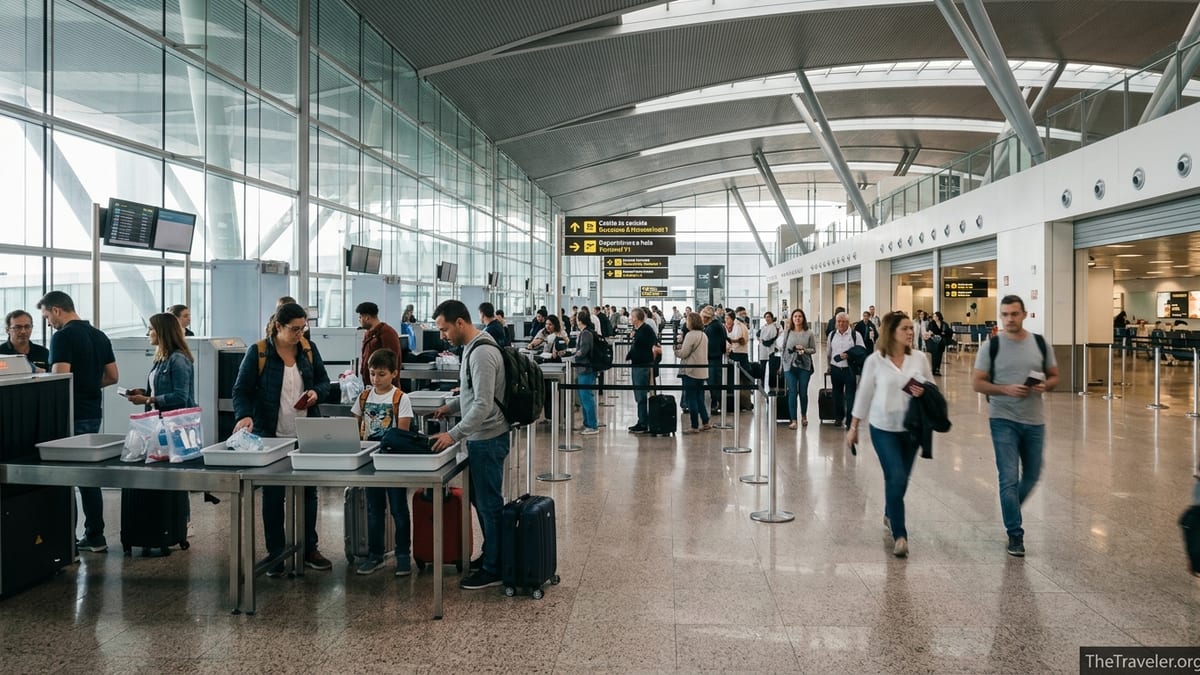
How Barcelona El Prat Airport Is Laid Out
Barcelona El Prat has two main terminals: Terminal 1 (T1) and Terminal 2 (T2, split into T2A, T2B and T2C). They are about four kilometers apart and are not connected airside, which means that if you land in one and need to depart from the other on separate tickets you must exit, take the free green airport shuttle bus and clear security again. Shuttle buses usually run every 5 to 10 minutes, day and night, and the ride takes around 10 to 14 minutes, but you should always build in at least 30 minutes door to door including walking and waiting.
T1 is the larger, more modern building and handles most full‑service and long‑haul airlines. For example, flights by Vueling on many European routes, as well as carriers such as Iberia and long‑haul services to destinations like New York or Dubai, typically use T1. Security and passport control here are designed for high volumes but can feel crowded in the morning and evening peaks, especially during summer school holidays and major events such as Mobile World Congress.
T2 is older and physically smaller, but it remains very busy because it is the base for many low‑cost airlines. Ryanair mainly uses T2B, while easyJet often operates from T2C, and charter flights may use different sub‑terminals. The compact layout means walking distances from check‑in to security are shorter than at T1, which some travelers prefer when traveling with children or heavy cabin baggage. On the other hand, departure halls at T2 can feel cramped when several budget flights close together start boarding at the same time.
From a security and immigration perspective, both terminals follow the same Spanish and Schengen rules, but your experience can differ depending on which building you use. A traveler catching an early Ryanair flight to London from T2B will typically face different crowd patterns and queue behavior than someone boarding an afternoon transatlantic service from T1. Knowing which terminal your airline uses before you travel lets you plan your arrival time and route through the airport more realistically.
Security Screening: Wait Times and Fast Track
Security wait times at Barcelona El Prat change significantly by terminal, time of day and season. Independent tracking tools and recent traveler reports suggest that on ordinary weekdays most passengers clear security in around 15 to 25 minutes. In T1, however, queues of 30 to 45 minutes are common between roughly 7:00 and 10:00 in the morning and again around 17:00 to 20:00, particularly in July and August when leisure traffic peaks. On busy summer Saturdays, some travelers have reported waiting close to an hour when arriving less than two hours before a flight.
At T2, waits are often shorter in the early afternoon, sometimes dropping below 15 minutes for standard lanes, but spikes occur when low‑cost carriers have banked departures. A concrete example is a cluster of morning flights to cities like Dublin, Manchester and Milan leaving between 6:00 and 8:00; the security area can quickly fill with carry‑on‑only passengers, and queues can stretch back to the check‑in hall. Budget airlines also enforce earlier bag‑drop deadlines, so arriving only 90 minutes before departure can feel tight if lines are long.
To manage these fluctuations, the airport operator Aena sells Fast Track and Fast Lane access that allows travelers to use a dedicated security queue. The latest Aena price schedule shows that Fast Track at Barcelona El Prat is typically charged at just over 13 euros per adult when bought as a standalone service, while a separate “Fast Lane” product at the airport is priced slightly above 10 euros. Some airlines include fast security in business‑class tickets or sell it as an add‑on; for instance, a full‑service carrier might bundle Fast Track with flexible economy fares on busy routes to major European capitals.
Fast Track does not change the actual security checks you undergo; you still pass through the same type of scanner and hand‑baggage X‑ray. What it does is sharply reduce the time spent queuing. A family of four catching an 8:30 departure to Amsterdam from T1 in August, for example, might see that the standard queue snakes across the hall with a posted wait of 35 minutes, while Fast Track moves continuously and clears them in under 10 minutes. For solo travelers departing at quieter times, paying extra may not be necessary, but for large groups, tight business connections or peak‑season weekend flights it can act as a valuable buffer.
Liquids, Electronics and What Happens at the Scanner
In 2026, Barcelona El Prat still broadly follows the familiar European 100‑milliliter hand‑luggage liquids rule. Travelers should assume that each liquid container in cabin baggage must be 100 milliliters or less, and that all containers must fit comfortably inside a single, transparent, resealable plastic bag of around one liter. Items like shampoo, face cream, perfume and contact lens solution fall under this rule. There are standard exemptions for baby food when traveling with an infant and for necessary medications, which can be carried in reasonable quantities and may be checked visually by security staff.
There has been a gradual rollout of newer 3D scanners at El Prat, especially in some priority lanes, which occasionally leads to mixed experiences. Some recent passengers describe being able to leave liquids and laptops inside hand luggage in certain Fast Track lanes, while others in regular lines are still asked to remove them. The safest approach for now is to pack as if you will need to separate both liquids and large electronics, but be ready to follow the specific instructions posted on the lane you use or given by the officers on duty.
In practical terms, this means organizing your bag before you reach the trays. For example, if you are flying from Barcelona to Berlin with only a cabin suitcase and a backpack, place your laptop sleeve and liquids bag near the top of the backpack rather than buried under clothes. As you approach the X‑ray belt, take a moment at the preparation tables to empty pockets, remove belts with large buckles and place metal items in a tray. This reduces the risk of repeated passes through the metal detector or body scanner, which can easily add several minutes per person when queues are long.
Travelers with unusual items should expect extra scrutiny. Sports equipment such as skateboards or hiking poles, bulky camera gear with multiple batteries, and food items like large wedges of cheese or jars of spreads can all trigger secondary inspection. A common real‑world example is the traveler who stocks up on vacuum‑packed cured meats or jars of Romesco sauce in the city and then forgets that many of these exceed liquid or gel limits for carry‑on. Security officers may open your bag, swab items for explosive traces and, if necessary, ask you to discard or check in non‑compliant goods. Allowing an extra 10 minutes in your schedule for this possibility is wise if you know your hand luggage is out of the ordinary.
Passport Control: Arrivals, Departures and EES
Spain is part of the Schengen Area, and Barcelona El Prat follows Schengen rules for immigration control. The process you face at passport control depends primarily on whether you are arriving from or departing to a Schengen country and on your nationality. Travelers from other Schengen states such as France, Germany or Italy usually have their identities checked only at the departure point and enter Spain without further passport control, though random checks inside the Schengen zone remain possible.
For travelers arriving from outside Schengen, such as a flight from New York, London or Dubai, passport control in Barcelona can be a significant bottleneck. In the last two years, some arriving passengers have reported waits of more than an hour, especially when several wide‑body flights land close together early in the morning. A concrete scenario is a 7:30 arrival from the United States reaching T1 at the same time as flights from Latin America and the Middle East; the immigration hall can become packed, and lines for “All Passports” may extend back into the corridor.
European Union and Schengen nationals, including Spanish citizens, often have access to automatic e‑gates that scan their biometric passports. When these lines are open and functioning well, EU passengers frequently clear in under 10 minutes even when non‑EU lines are visibly slower. However, if e‑gates are closed for maintenance or there are staffing shortages, officers may manually process EU and non‑EU travelers in mixed booths, which can slow everyone down. Families with young children sometimes cannot use e‑gates and must go through manned desks even if all hold EU passports.
For non‑EU travelers, especially from countries such as the United States, Canada, Australia and many in Asia, the European Union’s Entry/Exit System is gradually changing how border crossings are recorded. The system, which electronically logs biometric data and entry and exit dates, is being rolled out across Schengen external borders, including Spanish airports. In practical terms, this may mean that on your first arrival after full implementation you are asked to provide fingerprints or facial scans and answer routine questions about your stay. Future entries should be faster as your records are already stored, but initial queues can be longer as officers guide travelers through the process. Keeping your passport ready, knowing the address of your first night in Spain, and having proof of onward travel on hand will help speed things up.
Entry Rules and Documents for Different Travelers
Although this guide cannot replace official advice, there are some broad patterns that most travelers to Barcelona in 2026 will recognize. Citizens of fellow Schengen and European Union countries typically enter Spain with either a passport or, in many cases, a national identity card. They do not face routine immigration questioning about length or purpose of stay. However, they are still expected to carry valid ID and may be subject to security checks or document verification at the border or within the territory.
Many visitors from outside the EU, including most North American tourists, currently enjoy visa‑free short stays in the Schengen Area. A US citizen, for example, arriving in Barcelona for a two‑week holiday can typically enter without a visa for up to 90 days within any rolling 180‑day period. At the border they may be asked to show proof of accommodation, such as a hotel booking near Plaça de Catalunya, and a return ticket, such as an outbound flight from Barcelona to New York in two weeks’ time. Border officers also have the right to ask about travel funds and plans, though in normal tourist cases this is usually a brief conversation or no questions at all.
Travelers from countries that require a Schengen visa must apply in advance at the Spanish consulate or an external visa center, and they must carry the visa sticker in their passport when they arrive. In a real‑world example, a traveler from India flying from Delhi to Barcelona via Istanbul would need to show their issued Schengen visa at check‑in in Delhi and again at passport control on arrival in Barcelona. Without it, the airline would likely deny boarding. Visa‑required travelers are also more likely to be asked detailed questions about the purpose of their trip, supporting documents and travel history.
Regardless of nationality, all travelers should carry travel insurance, especially given the volume of passengers and occasional disruptions at major hubs like El Prat. Delays at security or immigration can lead to missed connections, and having documentation that shows you can support yourself and exit the Schengen Area on time is always helpful. Because rules can change, particularly as new EU‑wide systems come online, it is important to double‑check the latest entry requirements with official government or consular sources before you fly.
Realistic Timing: Arriving at the Airport and Making Connections
Given current passenger volumes and Aena’s own warnings about capacity pressure at Barcelona, realistic timing is essential. For departures to Schengen destinations from T1 or T2, arriving at the airport at least two hours before scheduled departure is generally sensible in low and shoulder seasons. In high summer or over long holiday weekends such as Easter, travelers on early morning or evening flights should strongly consider arriving closer to 2.5 to 3 hours before take‑off, especially if they need to check luggage, queue for tax‑free paperwork or buy last‑minute items.
For non‑Schengen departures, such as flights to the United Kingdom, the United States or North Africa, adding an extra 30 minutes is advisable. Here the sequence is check‑in, security, and then an outbound passport check at certain gates, so bottlenecks can appear at both security and immigration. A concrete example would be a 12:00 flight to London from T1: passengers who arrive at 10:30 on a busy Saturday in July may find a 25‑minute check‑in line, a 30‑minute security queue and then a short but slow passport line before boarding begins at 11:20.
For connections, Barcelona is not as heavily used as a transfer hub as some other European airports, but same‑ticket transfers operated by the same airline or alliance are common, particularly within Spain and Europe. If your connection keeps you within the Schengen zone and on the same ticket, you will usually remain airside and only pass through security once at your origin. However, if you arrive from outside Schengen and connect to a Schengen destination in Barcelona, you must clear passport control at El Prat before proceeding to your onward gate. Airlines normally schedule at least 75 to 90 minutes for such connections; self‑connecting travelers on separate tickets should aim for longer, especially at peak times.
Changing terminals between T1 and T2 during a self‑made connection is where many travelers underestimate the time required. Landing in T2 on a low‑cost carrier from Lisbon at 9:00 and hoping to catch a 10:30 long‑haul flight from T1 on a separate ticket is risky. You will need to disembark, possibly wait for a bus to the terminal, exit into the public arrivals hall, walk to the inter‑terminal shuttle stop, ride to T1, check in, pass security and, for some destinations, go through outbound passport control. Even if everything goes smoothly, this can easily consume 70 to 90 minutes. Building a buffer of at least three hours between separate tickets is a safer strategy.
Special Situations: Families, Night Flights and Secondary Checks
Families with children often face unique challenges in Barcelona’s security and immigration queues. Strollers and prams generally need to be folded and sent through the X‑ray machine, which can feel chaotic if you are also managing liquids bags, toys and snacks. Many parents find it easier to pack all liquids for the family into one or two shared plastic bags and to keep essential items in a small backpack that can be quickly opened at the tray tables. Security officers at El Prat are usually patient with children, but queues do not stop for family repacking, so having a practiced system helps.
Night flights and very early departures (before 6:30) can give a false sense of security. While overall passenger numbers are lower, staffing can also be lighter and some lanes may be closed. A traveler taking a 5:45 flight to a European hub might arrive at T1 at 4:30 expecting an empty terminal, only to find that several first‑wave departures share a limited number of open security lanes. In those circumstances, even a 20‑minute queue feels stressful when boarding is called at 5:15. Arriving at least 90 minutes early for the first flights of the day remains sensible.
Secondary security or immigration checks do occur at Barcelona, as at any major international airport. At security, bag swabs or manual inspections become more frequent when the X‑ray image is unclear or items resemble prohibited objects. At immigration, officers may pull out individuals randomly or because their names match entries in certain databases. One traveler describing a 2025 experience at El Prat, for example, reported being taken aside for additional questions because their name resembled that of a person involved in previous immigration fraud. While such cases are relatively rare, they highlight why you should never pack essential medicines, valuables or critical documents in a way that would be difficult to access if an officer asks you to open your bag.
For overnight layovers or very late arrivals, travelers sometimes choose to rest in the terminal rather than book a hotel. Seating is easier to find in T1’s large departures hall, and lighting and announcements can remain bright and frequent well into the night. Security only opens to departing passengers within a few hours of each morning’s flight wave, so if you arrive at the airport at midnight for a 7:00 flight, you will likely have to wait landside for several hours before being allowed through screening. This is another reason to avoid arriving excessively early, particularly with checked baggage that cannot yet be accepted at the counter.
The Takeaway
Barcelona El Prat is a busy, sometimes crowded but generally efficient airport when you approach it with realistic expectations. Security queues that average around 15 to 25 minutes on normal days can swell to 45 minutes or more at predictable peaks, and passport control can alternate between quick and frustratingly slow depending on how many long‑haul flights land at once. None of this is unique to Barcelona, but the airport’s rapid passenger growth and physical constraints mean that poor planning can easily translate into missed flights or anxious dashes through the terminal.
By knowing which terminal you are using, arriving at sensible times, organizing your liquids and electronics before you reach the belt, and understanding how Schengen entry rules apply to your passport, you can significantly reduce the stress of departure or arrival. Considering Fast Track for peak‑season trips, allowing generous buffers for self‑made connections between T1 and T2, and preparing for the gradual introduction of EU‑wide border technology such as the Entry/Exit System will help you stay ahead of the crowds.
Barcelona is a city that rewards curiosity and calm, and approaching its main airport in the same spirit makes a difference. A little preparation before you leave your hotel near Passeig de Gràcia or your apartment in El Born will turn the airport from a potential bottleneck into a straightforward final step on your journey.
FAQ
Q1. How early should I arrive at Barcelona El Prat before my flight?
For most European Schengen flights, plan to arrive at least 2 hours before departure. For non‑Schengen flights, especially in summer or over holidays, 2.5 to 3 hours is safer to account for both security and passport control.
Q2. Are security queues really that bad at Barcelona, and when are they worst?
On average days, you might clear security in 15 to 25 minutes, but queues often reach 30 to 45 minutes during morning peaks around 7:00 to 10:00 and evening waves from about 17:00 to 20:00, particularly in July and August.
Q3. Is it worth paying for Fast Track security at Barcelona Airport?
Fast Track can be good value on busy days, for tight connections or for families. It typically costs a bit over 13 euros and can reduce a 30‑minute queue to under 10 minutes, but at quiet times the benefit may be marginal.
Q4. Do I still need to follow the 100‑milliliter liquids rule at El Prat?
Yes. Even with newer scanners being introduced, you should assume the standard 100‑milliliter rule applies and pack liquids in a one‑liter transparent bag, unless staff on the day clearly instruct otherwise.
Q5. Will I need to take out my laptop and liquids at security?
In many regular lanes you are still asked to remove laptops and liquids, while some newer or Fast Track lanes may allow them to stay in your bag. Prepare as if you will need to remove them, then follow the instructions posted at your lane.
Q6. How long does passport control take when arriving in Barcelona from outside Schengen?
It varies widely. At quiet times it can be 10 to 20 minutes, but when several long‑haul flights arrive together it can exceed an hour. Early morning and early afternoon long‑haul banks are often the slowest.
Q7. I am a US citizen visiting Barcelona for tourism. Do I need a visa?
Most US tourists can currently visit Spain and the wider Schengen Area visa‑free for up to 90 days in any 180‑day period, but you must still pass immigration checks and may need to show proof of accommodation and onward travel.
Q8. How much time should I allow if I am changing from Terminal 2 to Terminal 1?
For separate tickets, you should allow at least 3 hours between flights. This covers disembarking, waiting for the free inter‑terminal shuttle, riding to the other terminal, checking in again, passing security and, if relevant, outbound passport control.
Q9. Is Barcelona El Prat a good airport for overnighting before an early flight?
Some travelers do sleep in T1 or T2 before early flights, but lighting and announcements stay on, and you cannot pass through security many hours in advance. If comfort matters, an airport hotel or a hotel near the airport is usually a better option.
Q10. What is the most important thing to do to avoid problems at security and immigration?
The key steps are to check your terminal in advance, arrive with generous time, organize your liquids and electronics for quick screening, and have your passport, boarding pass and basic trip details ready for inspection at every stage.