


More news on this day
Carnival Cruise Line has pulled the curtain back on its biggest cruise ship to date, unveiling a new mega-vessel that sharply escalates the size and capacity race with Royal Caribbean’s Icon Class, currently home to the world’s largest cruise ships.
Get the latest news straight to your inbox!
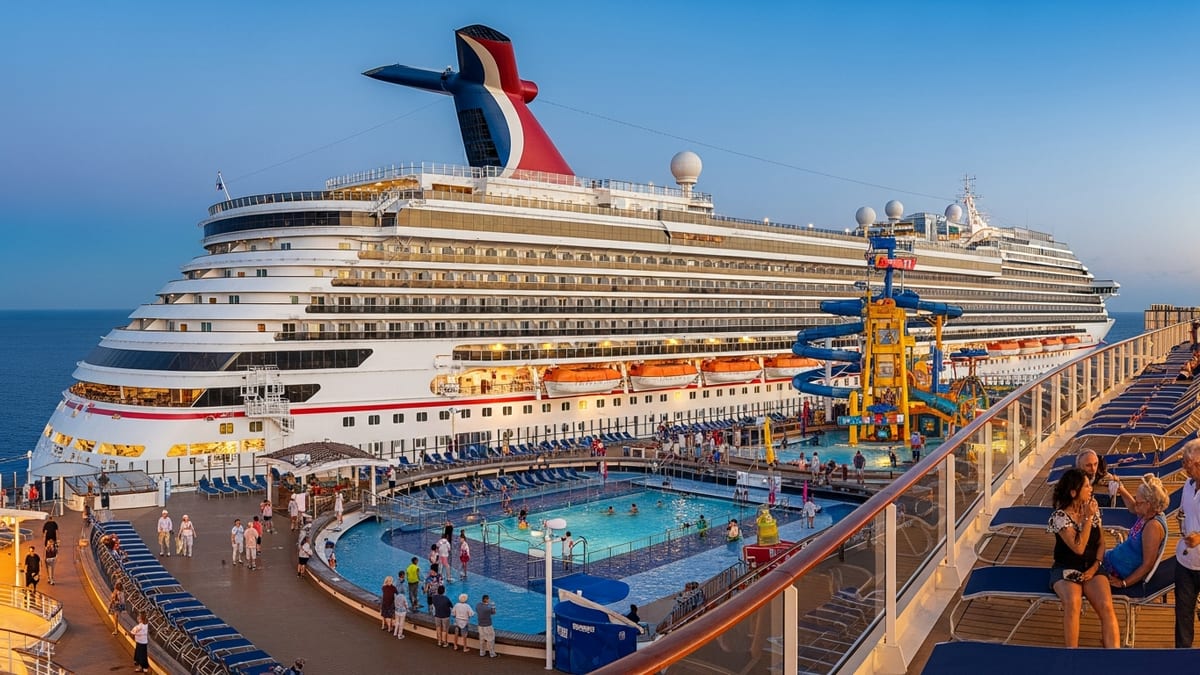
A New Class of Giant for Carnival
Publicly available order books and industry reports indicate that Carnival’s next generation of ships will introduce a new class designed to carry as many as 8,000 passengers, a dramatic leap beyond the line’s existing Excel-class vessels of around 180,000 gross tons and roughly 5,400 guests at double occupancy. The new build, to be constructed at an Italian yard, is expected to become both the largest ship in Carnival’s fleet and the most guest-capacity-heavy vessel the brand has ever deployed.
The reveal marks a strategic pivot for Carnival, which has traditionally focused on slightly smaller, mass-market ships that emphasize value pricing over headline-grabbing size records. While the Excel class brought Carnival into the modern mega-ship era, this new design moves the company much closer to the ultra-large segment that Royal Caribbean has dominated for more than a decade.
Early commentary in cruise industry coverage notes that the new Carnival ship will pack more cabins into a slightly smaller hull compared with Royal Caribbean’s Icon Class. That sets the stage for a different kind of mega-ship experience: potentially higher density and livelier public spaces, but also fresh questions about crowding and how the line will manage passenger flow at this unprecedented scale.
How It Measures Up Against Royal Caribbean’s Icon Class
Royal Caribbean’s Icon Class, which includes Icon of the Seas, Star of the Seas and the newly introduced Legend of the Seas, currently holds the title of the world’s largest cruise ships by gross tonnage. Industry data places the trio at around 248,000 to just over 250,000 gross tons, with a double-occupancy capacity of about 5,610 guests and room for well over 7,000 passengers at maximum load.
In sheer volume, Carnival’s new flagship is not expected to overtake the Icon hulls, which remain the benchmark for size, height and onboard amenity footprint. Where Carnival’s design appears to challenge Royal Caribbean most directly is in passenger capacity: reports circulating among cruise analysts and enthusiast communities suggest the new ship could accommodate around 8,000 guests when fully booked, surpassing even the people-moving potential of the Icon Class.
That contrast points to two distinct strategies. Royal Caribbean’s Icon vessels prioritize large open-air neighborhoods, expansive water parks with multiple slides and resort-style pool decks that spread crowds over a vast footprint. Carnival’s upcoming giant, by comparison, appears positioned to maximize berths and appeal to cost-conscious travelers who prioritize value and entertainment variety over record-breaking tonnage.
Design, Amenities and Onboard Experience
Royal Caribbean’s Icon ships have drawn attention for their neighborhood concept, highlighted by areas such as the open-air Central Park, the indoor AquaDome with high-diving shows, and the Pearl, a dramatic multi-story structural centerpiece. These ships also feature multiple pools, dedicated family zones, extensive suites-only areas and some of the biggest water parks ever installed at sea, with a strong emphasis on immersive, resort-like environments.
Carnival’s largest ships to date, including the Excel-class trio, lean into themed zones, casual dining and bold top-deck attractions such as roller-coaster-style rides and large poolside entertainment spaces. Early indications are that the new mega-ship will build on that formula with expanded family facilities, more specialty venues and an intensified focus on high-energy fun that matches the brand’s reputation.
Because Carnival’s upcoming vessel is expected to carry more guests within a footprint that remains smaller than Icon, the design challenge is likely to center on traffic management, elevator capacity and efficient use of indoor and outdoor square footage. Cruise industry observers will be watching to see how Carnival balances additional cabins with sufficient dining seats, pool space and entertainment venues to keep crowding in check on sea days.
Environmental and Technical Stakes
Royal Caribbean has framed the Icon Class as a major step toward its broader decarbonization targets, deploying ships powered by liquefied natural gas and equipped with advanced energy-efficiency systems. The line has publicly detailed features such as waste-heat recovery technology, optimized hull design and shore-power connectivity where ports can support it, positioning Icon as a bridge toward future net-zero-emission vessels later in the decade.
Carnival Corporation, the parent company of Carnival Cruise Line, has also committed to fleetwide efficiency improvements, and the new mega-ship is expected to follow the industry trend toward cleaner-burning fuels and more sophisticated emissions-control technology. The vessel is anticipated to feature LNG propulsion along with modern wastewater treatment and energy-saving systems that exceed current regulatory baselines.
With both companies racing to offer ever-larger ships, environmental performance has become more central to the competitive narrative. The question for regulators and destination ports will be whether gains in per-passenger efficiency on these floating resorts offset the sheer increase in total visitors arriving on a single call, especially in environmentally sensitive regions of the Caribbean and Mediterranean.
What the Capacity Race Means for Travelers
The unveiling of Carnival’s largest-ever ship underscores how quickly the upper end of the cruise market is evolving. Within just a few years, Royal Caribbean’s Icon Class moved the size ceiling upward, and now Carnival is preparing to deploy a rival design that narrows the gap in scale while potentially surpassing its competitor in headcount.
For travelers, that competition is likely to translate into more choice at the mega-ship level. Guests drawn to Royal Caribbean’s Icon Class may prioritize expansive neighborhoods, marquee entertainment and cutting-edge onboard hardware, while Carnival loyalists could find appeal in a ship that delivers similar headline size with the line’s familiar, informal atmosphere and often lower entry pricing.
The trade-offs are becoming clearer. Larger ships can offer more dining, shows and attractions without significantly raising per-passenger operating costs, but they can also bring longer embarkation queues, busier pool decks and more congestion at popular venues. As Carnival’s new flagship moves from reveal to construction and, eventually, to its debut season, many travelers will be weighing whether the promise of more onboard choice outweighs the realities of sailing with thousands of fellow passengers on what is set to be one of the most densely populated cruise ships ever built.