


Few day trips from Barcelona are as rewarding, or as simple to organise independently, as Girona. With frequent trains, a compact historic centre and enough sights for a full, satisfying day, Girona lends itself perfectly to independent travel. The only real decision you need to make is whether to pay extra for the fast AVE or AVANT high-speed trains, or to save money by taking the slower Rodalies R11 regional service.
Get the latest updates straight to your inbox!
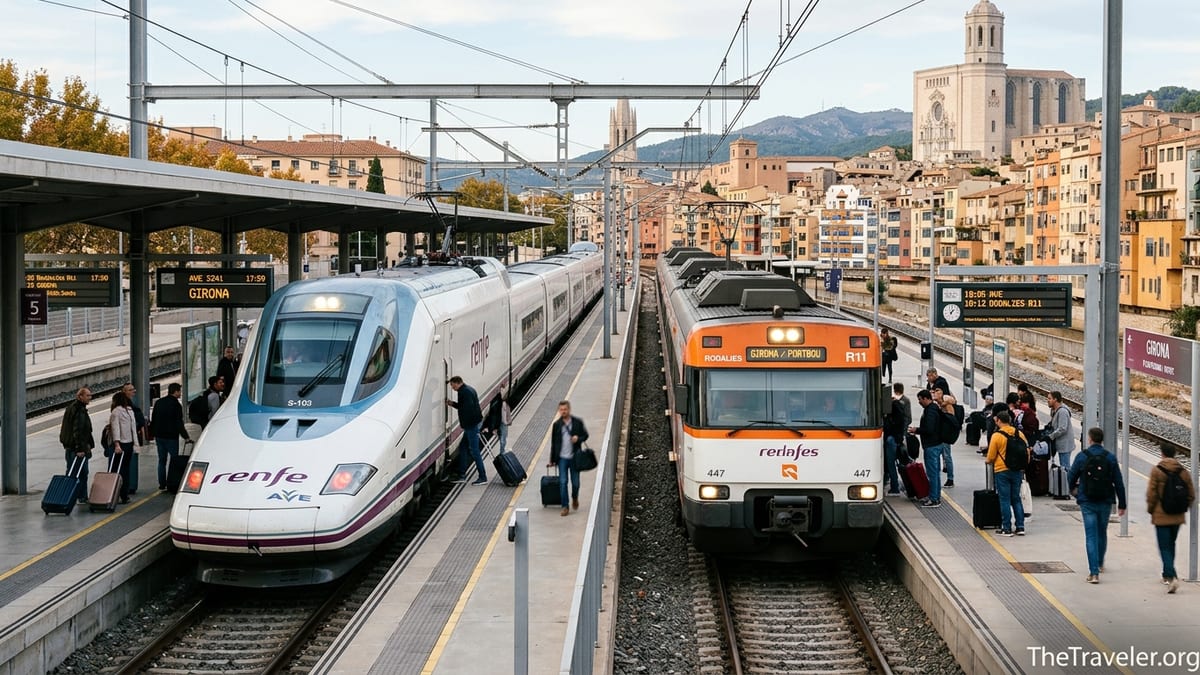
Fast AVE and AVANT vs Rodalies R11: Which Train Should You Take?
The key trade-off between Barcelona and Girona by rail is time versus money. High-speed AVE and AVANT trains link Barcelona Sants with Girona in about 38 to 45 minutes, while regional Rodalies R11 and Media Distancia services generally take around 70 to 100 minutes depending on the stopping pattern. Recent sample timetables for a weekday in November 2026 show AVE and AVANT departures from Barcelona Sants at 08:05, 11:27, 13:14, 16:31, 17:59, 18:29 and 19:54, all taking roughly 40 to 47 minutes, while R11 and Media Distancia trains from El Clot to Girona typically need about 1 hour 10 minutes.
Pricing reinforces this contrast. On sale through major booking platforms in late 2026, advance high-speed tickets between Barcelona Sants and Girona often start around 10 to 21 euros each way for AVE, with AVANT fixed-fare tickets commonly in the 18 to 21 euro range for the same route. By contrast, Rodalies R11 or Media Distancia fares between Barcelona and Girona are around 8.95 to 14 euros one way depending on the specific train and class. For a same-day return, a solo traveller might pay roughly 20 to 40 euros using high-speed services, or 18 to 28 euros using the slower R11 or Media Distancia trains.
For most day trippers, the high-speed trains justify their premium when time is tight or you want a longer day on the ground. Cutting the journey to about 40 minutes each way can add roughly 1 to 1.5 extra hours of sightseeing compared with the slower options. That can mean enough time for a relaxed lunch, an unhurried visit to Girona Cathedral and the Arab Baths, and a late-afternoon stroll along the city walls before catching an evening return to Barcelona. Travellers comfortable with an earlier start and a slightly later arrival back in Barcelona may find the R11 regional trains offer better value, especially for budget-conscious visitors or families.
Another factor is comfort and crowding. High-speed services are reserved-seat trains, mostly used by long-distance passengers, so you know you will have an allocated seat and luggage space. R11 and Media Distancia trains operate as regional services, so there are no seat reservations and commuting peaks can feel busier. If you are visiting in high season or on a Saturday during the spring flower festival, paying a little more for a guaranteed seat and a shorter ride often feels worth it.
Understanding Barcelona Departures, Timetables and Tickets
Barcelona has three practical departure points for Girona: Sants, Passeig de Gràcia and El Clot-Aragó. High-speed AVE, AVANT and most Euromed services leave only from Barcelona Sants. Rodalies R11 regional and Media Distancia trains run through the Aragó tunnel, serving Sants, Passeig de Gràcia and El Clot-Aragó before continuing north to Girona. That means you can board the same regional train at whichever of these stations is most convenient for where you are staying in Barcelona.
Current R11 and Media Distancia timetables published for 2026 show around 40 to 46 trains per day along the Barcelona to Portbou route, with many of them stopping at Girona. On a typical weekday, first departures from Barcelona toward Girona leave shortly after 6:00 from Sants and El Clot, with services then running about every 30 to 60 minutes until around 23:00. High-speed AVE and AVANT services from Sants are less frequent but still convenient, with morning, midday, afternoon and evening departures that make Girona easy as a day trip even if you leave Barcelona after breakfast.
Ticket rules differ sharply. High-speed AVE and AVANT tickets are sold with compulsory seat reservations and several fare types. The cheapest “basico” or equivalent advance fares are non-refundable or carry change fees, while more flexible options allow date or time changes for a supplement. Because prices vary dynamically, booking at least a few days ahead usually saves money and gives access to the lower promotional fares that can be as low as 10 euros on certain AVE departures between Sants and Girona. AVANT tickets have more stable pricing but can still sell out at popular times.
Rodalies R11 and Media Distancia tickets are simpler. Fares are set by the regional authority and are relatively predictable, with standard one-way prices into the low-teens of euros and occasional promotional passes for frequent users. Tickets can be bought on the day from ticket machines or staffed counters at Sants, Passeig de Gràcia and El Clot without advance reservation. There are no compulsory seat reservations, and if you miss one R11 train you simply board the next service on the same route, as long as your ticket date is valid. Travellers who value flexibility over rock-bottom high-speed promo fares often prefer this option.
Arriving in Girona: Stations, Walking Times and Luggage
Girona is served by a single integrated railway complex that combines the conventional station used by Rodalies R11 and Media Distancia with underground platforms for high-speed AVE and AVANT services. Whether you arrive on a fast or regional train, you emerge into the same general station area on the city side of the tracks. From the station entrance it is about 10 to 15 minutes on foot to the edge of the historic centre and around 20 minutes to reach the Cathedral and the highest part of the old town, depending on your pace and luggage.
The conventional R11 and Media Distancia services use surface-level tracks and platforms that open directly into the main concourse. High-speed AVE and AVANT trains use fenced-off, controlled-access platforms reached via ticket checks and security screening. After arrival on a high-speed train you pass through a barriered exit into the main hall, then out into the same public square in front of the station used by regional commuters. Navigating between the two is straightforward, and there is clear signage in Catalan, Spanish and English.
Luggage storage is a practical concern for visitors combining Girona with onward travel to the Costa Brava or France. In 2026, independent luggage-storage operators offer lockers and bag drop services directly opposite Girona station and in adjacent streets, with published prices starting from around 4.50 euros per day for a small item and higher rates for larger bags or private storage rooms. These facilities typically provide secure electronic lockers, CCTV and optional charging points for devices. While precise prices can change, it is safe to plan on spending roughly 5 to 8 euros per bag for a full day’s storage near the station.
From the station, most visitors walk straight towards the river and the old town. The route is flat as far as the Onyar River, then becomes progressively steeper as you climb into the Barri Vell and up towards the Cathedral and city walls. Travellers with mobility issues or pushing strollers can manage the riverside and lower streets without difficulty, but should be prepared for cobbles and some steep steps in the upper historic quarter. Taxis wait outside the station and can take you to the Cathedral area in a few minutes for a modest fare, which can be worth it if you are carrying luggage or visiting with small children.
A Self-Guided Walking Route through Girona’s Historic Heart
A realistic full-day itinerary on foot starts with Girona’s most photographed sight: the colourful houses lining the Onyar River. From the station, walk about 10 minutes along Avinguda de Jaume I to reach the riverfront. From here you can cross the red iron Pont de les Peixateries Velles, often called the Eiffel Bridge because it was designed by Gustave Eiffel’s workshop. This pedestrian bridge offers classic views of the pastel-toned river houses and is a perfect early-morning photography stop before the light becomes harsh.
On the far side of the bridge you enter the Barri Vell, Girona’s old town. Spend some time wandering the lanes around Carrer de la Força and the medieval Jewish Quarter, known as El Call. Today this area is a warren of narrow stone alleys, stairways and small courtyards, home to independent boutiques and quiet residential doorways. Although few physical traces of the medieval Jewish community remain, the layout and scale of the streets convey a strong sense of how densely packed and enclosed the quarter once was. The Museum of Jewish History, housed in a former synagogue complex, provides context on the community that lived here until the expulsion of the Jews from Spain in 1492 and is an important stop for visitors interested in Jewish heritage.
From El Call, continue uphill to Girona Cathedral. The broad baroque staircase leading up to the façade is familiar to many visitors from its role as a filming location for Game of Thrones, but the building’s real interest lies in its mix of Romanesque and Gothic architecture and its vast single-nave interior. As of late 2026, a combined cultural-visit ticket covering both Girona Cathedral and the nearby Basilica of Sant Feliu is advertised at around 7 to 10 euros per adult, with opening hours generally from 10:00 until late afternoon or early evening depending on the season. Ticket offices usually close 30 minutes before final entry, and there can be reduced access during religious services, so planning a midday or early-afternoon visit works best.
After visiting the Cathedral, continue a short distance along the old streets to the Arab Baths, a 12th-century bathhouse inspired by Roman and Islamic models. The Arab Baths are compact, so a visit typically takes 20 to 30 minutes, but the site is atmospheric and photogenic, especially the central octagonal pool hall with its ring of slender columns. Official tourism information in 2026 lists adult entry at a few euros per person, with free or reduced admission for children, students and Girona residents, and opening hours usually spanning late morning to late afternoon with closures on certain Mondays and major holidays. Check the schedule locally, but you can realistically include both the Cathedral and the Baths within a single late-morning or early-afternoon block.
City Walls, Sant Feliu and Game of Thrones Locations
One of Girona’s great pleasures is walking its medieval defensive walls, the Muralles de Girona, which have been restored and partially reconstructed to create an elevated footpath around much of the old town. Access points lie a short walk from the Cathedral and from the Jardins de la Muralla. The walls are free to access and typically open from morning to late afternoon, though city and regional heritage authorities recommend checking seasonal times as certain sections can close during poor weather or for maintenance. The best time to walk the walls is usually mid-morning or late afternoon, when the sun is lower, temperatures are more comfortable and the light is kinder for photography.
From the walls you gain sweeping views over Girona’s terracotta rooftops, church towers and the distant Pyrenean foothills. The route includes towers and narrow staircases, so it is important to wear footwear with good grip and to take care on damp or very hot days when the stone can become slippery. Families with older children typically enjoy the adventure of climbing the towers and spotting city landmarks from above, though it is not ideal terrain for strollers or visitors with vertigo.
Another key monument is the Basilica of Sant Feliu, located close to the river at the lower edge of the hill below the Cathedral. Its slender bell tower forms part of Girona’s skyline, and the interior houses Roman and early Christian sarcophagi. The combined ticket with the Cathedral generally includes entry to Sant Feliu on the same day, so many visitors stop here either before climbing up into the old town or on their way back down towards the river in the late afternoon.
For fans of Game of Thrones, Girona offers several recognizable backdrops. The Cathedral staircase, narrow streets around the Jewish Quarter and parts of the Arab Baths area appeared in the series as parts of Braavos and King’s Landing. Local tourism maps and private walking tours highlight these filming locations, but it is worth treating them as an added layer of interest rather than the main reason to visit. Girona’s history stretches back more than two millennia, and the city’s Roman, medieval and modern stories are richer and more complex than any fictional representation.
Seasonal Crowds, Flower Festival and When to Visit
Girona rewards visits in every season, but conditions vary significantly. Spring and autumn usually offer the most pleasant balance of temperatures and crowd levels. The standout spring event is Temps de Flors, Girona’s flower festival, typically held over about nine days in May. During this period, historic courtyards, church steps and even sections of the city walls are decorated with elaborate floral installations, and many otherwise closed patios open to the public. Accommodation and trains can book up quickly at weekends, and visitor numbers surge, especially on Saturdays. If you plan to come during Temps de Flors, it is wise to secure high-speed train tickets in advance and to arrive early in the morning to avoid the biggest crowds.
Summer brings hotter weather and more intense sun, with daytime temperatures often exceeding 30 degrees Celsius in July and August. The stone streets and staircases of the old town can feel particularly warm in mid-afternoon. To cope, consider taking an early high-speed train from Barcelona, exploring the Cathedral and Arab Baths before lunch, then resting in a shaded café during the hottest hours before tackling the city walls after 17:00 when the light softens. Train services run as normal in summer, but interiors can become busy around local holiday periods when residents travel to the coast.
Ordinary weekends outside major events see a noticeable but manageable increase in visitors from Barcelona and nearby towns. Saturdays are busier than Sundays, and crowds concentrate in the central streets around the river, Cathedral and Arab Baths. If you prefer quieter experiences, a weekday visit in March, April, October or November can feel especially relaxed. High-speed fares may also be lower midweek with more availability of discounted tickets.
Winter is the quietest time. From late November through February, you can often wander the old town with minimal crowds, and hotel prices in Girona drop compared with peak months. Short days and the risk of rain or chill winds are the main trade-offs. Certain heritage sites and museum sections sometimes operate reduced hours in the low season or close on non-holiday Mondays, so check timetables locally and aim to schedule indoor visits such as the Cathedral or the Museum of Jewish History for the middle of the day when it is warmest.
A Practical Day-Trip Itinerary from Barcelona
A realistic morning-to-evening plan for a first visit might start with a high-speed train from Barcelona Sants around 08:00, arriving in Girona just before 09:00. After leaving the station, walk into the centre and pause on the Eiffel Bridge to photograph the Onyar houses in the soft morning light. Spend the rest of the morning exploring the Barri Vell and the Jewish Quarter on foot, stopping for a coffee in a small square or bakery as you weave through the side streets towards the Cathedral steps.
Plan to visit Girona Cathedral late in the morning, using the combined ticket to include the Basilica of Sant Feliu either before or after lunch. Allow at least an hour for the Cathedral interior and cloister. For lunch, the streets around the river and Plaça de la Independència offer plenty of mid-range options where a set daily menu might cost around 15 to 20 euros per person, including a starter, main, dessert and drink. Couples sharing dishes or opting for tapas-style portions can adjust costs up or down depending on appetite, but budgeting 20 to 25 euros per person for lunch with a drink gives comfortable margin.
After lunch, head to the Arab Baths for a short visit, then climb to the city walls for a late-afternoon walk. This timing avoids the brightest midday sun and gives you atmospheric views as the light softens. Photography enthusiasts will appreciate the elevated angles over the Cathedral and the patchwork of terracotta roofs. Descend back towards the river in time for a final drink or ice cream before strolling back to the station for your evening train.
For the return journey, consider booking a reserved high-speed departure around 18:30 to 20:00 if you arrived on AVE or AVANT. That returns you to Barcelona Sants in about 40 to 45 minutes, putting you back in the city in time for a late dinner. If you are using Rodalies R11 or Media Distancia, keep an eye on the schedule so you target a direct evening service from Girona to Sants, Passeig de Gràcia or El Clot. Having a backup train in mind is useful in case of crowds or minor delays.
Costs, Accessibility and Family Travel
For a solo traveller in late 2026 using this day-trip plan with high-speed trains, a realistic budget might look like this: around 20 to 35 euros for a same-day return on AVE or AVANT depending on how far in advance you book and which departure you choose, about 7 to 10 euros for the combined Cathedral and Sant Feliu ticket, a few euros for the Arab Baths and roughly 20 to 25 euros for lunch and drinks. Add a coffee, ice cream and local bus or metro fares in Barcelona, and a solo day trip could come in around 55 to 80 euros in total. Using Rodalies or Media Distancia instead might reduce total train costs to around 18 to 28 euros for the round trip and bring the overall day closer to 45 to 65 euros.
For a couple, double the attraction and dining costs, but train fares can sometimes be reduced if you find promotional high-speed fares at around 10 euros per person each way. In that case, two people might spend roughly 40 euros on trains, 15 to 20 euros each on lunch, and 20 to 25 euros combined on sites and extras, totalling in the region of 100 to 130 euros for the day. These examples are based on publicly listed prices in late 2026 and should be treated as indicative, since actual fares and menu prices can change without notice.
Families should weigh train costs carefully. Reserved high-speed seats for three or four people can quickly add up, although occasional child discounts and special offers appear on AVE and AVANT routes. Rodalies R11 offers more predictable pricing, and younger children often travel at reduced fares. In Girona itself, the old town is very walkable for school-age children, but the steep steps, cobbled surfaces and narrow walls mean that strollers and very young toddlers may be more comfortable if parents plan shorter loops, use baby carriers or take a taxi up to the Cathedral to save some climbing.
Accessibility is mixed. The station concourse, bridges and main streets to the river are step-free, and there are ramps or alternative routes in parts of the old town. The Cathedral’s monumental staircase and some sections of the city walls present challenges, though interior access points and local assistance can sometimes mitigate this. Travellers with limited mobility may prefer to focus on the riverfront, lower Barri Vell streets, the Basilica of Sant Feliu and selected viewpoints that can be reached by taxi or via gentler gradients.
Extending Your Stay: Overnight in Girona and the Costa Brava
While Girona is ideal for a day trip, it also works well as a base for an overnight stay, especially for travellers heading on to the Costa Brava. Spending the night allows you to experience the old town after day trippers have left, when the streets around the Cathedral and Jewish Quarter become quieter and restaurants feel more local. Accommodation ranges from simple guesthouses in historic buildings to design hotels overlooking the Onyar River, with off-season double rooms often available for less than a typical mid-range hotel in central Barcelona.
An overnight plan might use a mid-morning regional R11 or Media Distancia train from Barcelona, check into a hotel or guesthouse near the old town, then follow the walking route at a slower pace, with time for the Museum of Jewish History or additional churches and museums. In the evening, you could book dinner at a restaurant focusing on seasonal Catalan cuisine, spending perhaps 30 to 40 euros per person for a three-course meal with wine. The next day, buses or regional trains connect Girona with coastal towns such as Blanes, Lloret de Mar or more northern Costa Brava resorts, although precise services and journey times should be checked locally for your travel dates.
For those heading north towards France, high-speed AVE services from Girona continue to Figueres Vilafant and across the border to cities like Perpignan, Narbonne and Lyon. This makes Girona a convenient intermediate stop on a broader rail journey through Spain and southern France. In such cases, using high-speed trains both to and from Girona saves time and simplifies reservations, although a mix of high-speed and R11 services is also feasible for more budget-conscious itineraries.
Seasonal closures are modest but worth noting. Heritage sites sometimes close on non-holiday Mondays, and both the Cathedral and Arab Baths observe reduced hours or full closure on major religious and national holidays such as 25 and 26 December and 1 and 6 January. In summer, some restaurants close for staff holidays for a week or two, particularly outside the peak period, so it is wise to have a backup dining option in mind if you are relying on a specific address.
Final Verdict: Regional vs High-Speed and Day Trip vs Overnight
Choosing between high-speed AVE or AVANT and the slower Rodalies R11 or Media Distancia services ultimately comes down to your priorities. If your time in Catalonia is limited and you want to maximise hours on the ground in Girona with minimal hassle, the high-speed option from Barcelona Sants is the most comfortable and efficient choice. A 40-minute journey each way, reserved seats and smooth connections make it easy to fit Girona’s riverfront, Cathedral, Arab Baths, Jewish Quarter and city walls into a relaxed yet complete day trip.
If you are travelling on a tighter budget, already staying near Passeig de Gràcia or El Clot, or simply prefer flexible, turn-up-and-go travel, the R11 and Media Distancia trains offer excellent value. Journey times of around 80 to 100 minutes are manageable for a full day out, especially if you board an early morning departure. Buying tickets at the station, without worrying about reservations, appeals to independent travellers who like to keep their plans open and do not mind a slightly longer ride.
As for whether Girona deserves a day trip or an overnight stay, the answer depends on your wider itinerary. In a short Barcelona-focused visit of three or four days, Girona shines as a single full-day excursion that feels both easy and substantial, offering a strong sense of medieval Catalonia and a very different atmosphere from the Catalan capital. If you have a week or more in the region, plan to stay at least one night, especially if you are continuing to the Costa Brava or travelling north by train into France. That extra time allows Girona’s quieter evening streets, local restaurants and layered history to leave a deeper impression.
Whichever option you choose, Girona rewards thoughtful planning. Checking current train times and fares, deciding clearly between high-speed and regional services, and sketching out a simple walking route from the station through the riverfront, Jewish Quarter, Cathedral, Arab Baths, Sant Feliu and the city walls will ensure your independent visit feels smooth, efficient and memorable.