


More news on this day
A passenger rail collision near Bedford, around 60 miles north of London, has left nine people fighting for their lives and one train driver dead, in what published coverage is describing as Britain’s worst train crash in two decades.
Get the latest news straight to your inbox!
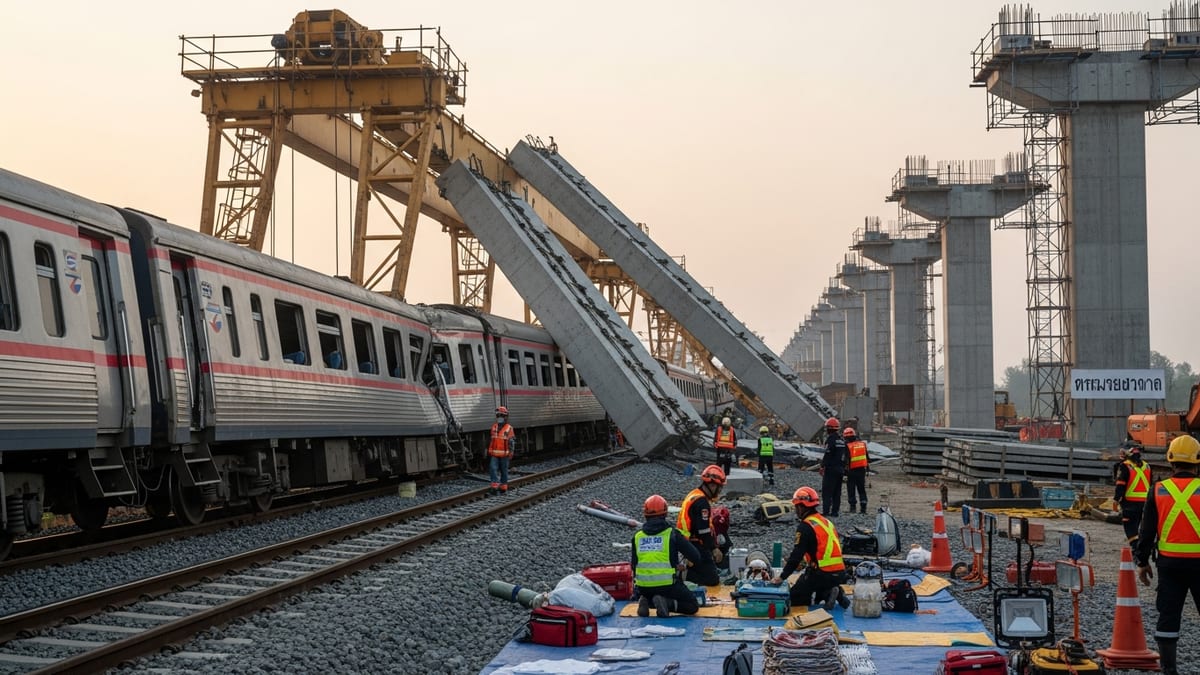
High speed collision on busy London route
Reports indicate that two East Midlands Railway services bound for London St Pancras collided on Friday evening on the busy north–south main line just south of Bedford. One train had departed from Corby and the other from Nottingham, both heading toward the capital during the late afternoon peak.
The impact occurred at around 17:15 local time, when the southbound services made contact on the same section of track. Images and video taken shortly afterward show at least one high speed train set badly damaged and tilted, with debris scattered along the railway and a number of carriages visibly crumpled at the point of impact.
Publicly available information shows that the driver of one of the trains died at the scene, while more than 80 passengers and crew required medical assessment following the crash. Emergency responders established a large exclusion zone around the tracks as rescue teams worked to reach people trapped in the most badly damaged carriages.
British Transport Police and regional emergency services declared a major incident as dozens of ambulances, specialist rescue teams and air ambulances converged on the site. Rail traffic between London St Pancras and the East Midlands was immediately suspended, stranding evening commuters and long distance travellers across the route.
Casualty toll among highest on UK railways in years
According to figures reported on Saturday, nine people remain in critical condition in hospital after sustaining life threatening injuries in the collision. Published coverage indicates that a further group of passengers are being treated for serious trauma, with dozens more assessed for less severe wounds including fractures, cuts and shock.
Transport industry commentators note that, while the United Kingdom has one of the safest rail networks in Europe, this event represents the most serious passenger train crash on Britain’s mainline network in roughly 20 years. The scale of the casualty toll recalls the major rail disasters of the late 1990s and early 2000s, rather than the far lower fatality figures typically recorded on British railways in recent years.
The extent of the injuries is being linked to the forces involved in a collision between two fast moving intercity services. Initial descriptions from the scene refer to a high speed impact rather than a low speed shunt, with several coaches suffering significant structural damage and passengers reportedly thrown from their seats.
Hospitals across the wider Bedfordshire and north London region activated mass casualty plans to handle the sudden influx of patients on Friday evening. Publicly available updates from health services describe complex surgery and intensive care treatment continuing through the weekend for the most severely injured.
Travel disruption across East Midlands and London corridor
The crash has triggered extensive disruption on one of the main rail arteries linking London with the East Midlands and northern England. East Midlands Railway and infrastructure owner Network Rail have advised that services between London St Pancras, Bedford, Luton and Leicester are severely reduced while investigators and engineers work at the scene.
Trains that are able to run are subject to diversions, extended journey times and last minute cancellations, affecting not only long distance intercity passengers but also airport travellers using the route to reach Luton Airport. Replacement buses have been brought in on some stretches, though capacity remains significantly constrained during what is usually a busy summer weekend.
For travellers, the knock on effects include crowded alternative routes via other London terminals and the Midlands, with some passengers advised to postpone non essential journeys. Accommodation providers along the corridor have reported an uptick in emergency bookings from stranded travellers, while taxi and coach operators are experiencing increased demand.
Rail operators are urging passengers to check live journey planners before setting out and to allow additional time if travel cannot be deferred. Industry analysts suggest it may take several days before a more stable interim timetable is possible, and longer before full normal service can resume on the affected section of track.
Early focus on signalling, train protection and infrastructure
Investigations are in their early stages, but attention is already turning to the performance of signalling systems and train protection technology on the line where the collision occurred. The route south of Bedford is part of a heavily trafficked corridor that has seen substantial investment in recent years, including modern signalling upgrades and capacity enhancements.
According to published coverage, rail safety specialists will examine whether one of the trains passed a signal at danger, whether there were any failures in automatic train protection systems, and how track layouts and points may have influenced the paths of the two services. The condition of the rolling stock, braking systems and onboard safety features will also form part of the technical analysis.
Comparisons are being made with past incidents such as the Ladbroke Grove crash of 1999, which prompted sweeping reforms to signalling, driver training and the introduction of new safety systems across the network. Observers note that a key question for the current inquiry will be whether existing protections functioned as designed and, if so, what chain of events still allowed two high speed trains to converge on the same stretch of line.
Infrastructure engineers are additionally assessing potential damage to the tracks, overhead power lines and embankments at the crash site. Their findings will determine how quickly the route can be repaired and safely reopened, and whether any longer term engineering work will be required to mitigate future risks.
Public reaction and renewed scrutiny of rail safety
News of the collision has prompted widespread public concern in a country where serious rail crashes have become comparatively rare. Extensive media coverage has highlighted both the severity of the Bedford incident and the dramatic improvements in rail safety that had been achieved in the decades since Britain’s last major fatal train disasters.
Travel commentators suggest the crash is likely to renew debate over investment in infrastructure, the pace of safety technology deployment and the capacity pressures on key intercity routes. Questions are already being raised over whether traffic volumes, timetable intensity or operational practices on the approach to London may have contributed to the conditions in which the collision occurred.
For regular rail users, the images from Bedford are a stark reminder of the residual risks inherent in high speed transport, even on networks with strong overall safety records. Advocacy groups are expected to press for clear communication of investigation findings, transparent timelines for any recommended improvements and continued support for those affected by the crash.
As formal inquiries progress, the Bedford disaster is set to become a defining moment in contemporary British rail safety, shaping how infrastructure managers, train operators and policymakers approach risk on one of Europe’s busiest passenger rail systems.