


More news on this day
New aerial and bystander videos emerging from Bensalem, Pennsylvania, are shedding light on the scale and impact of a freight train derailment that disrupted travel and briefly raised fears over hazardous materials on Tuesday.
Get the latest news straight to your inbox!
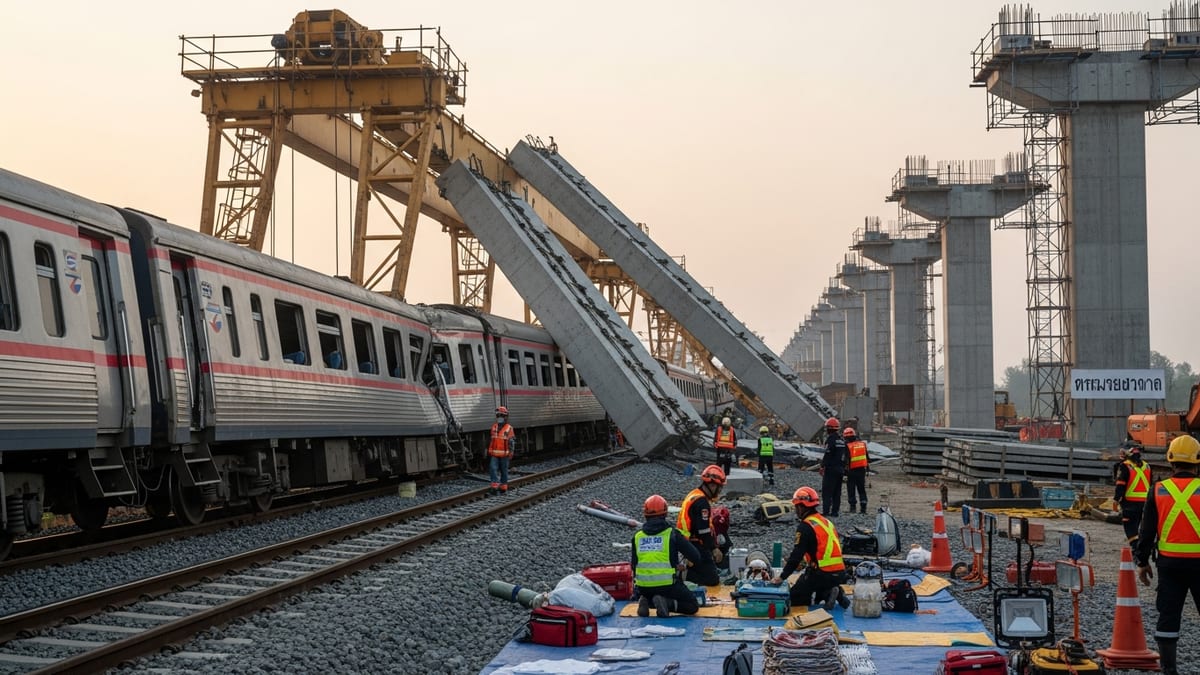
Freight train derails near Neshaminy Falls station
According to published coverage, a freight train left the tracks on the afternoon of June 30, 2026, between Street Road and Neshaminy Falls station in Bensalem Township, Bucks County. Early reports described more than a dozen cars strewn across the right of way, prompting local agencies to mobilize fire, medical and hazardous materials teams.
Initial information from regional outlets indicates that 13 to 16 cars from a train of more than 70 cars derailed. Some of the affected cars carried hazardous materials, which led to immediate concern in nearby residential and commercial areas and triggered precautionary safety measures.
The derailment occurred along a busy freight corridor that runs parallel to passenger rail infrastructure, causing ripple effects for commuters even though the train itself was not a passenger service. Service on the nearby West Trenton commuter line was temporarily suspended while responders assessed the scene.
As of the morning of July 1, publicly available information shows that no injuries had been reported, and rail traffic in the wider region was gradually being adjusted around the affected section of track.
Videos capture toppled cars and emergency response
Video has played a central role in shaping public understanding of the incident. Aerial footage from regional television helicopters shows at least ten freight cars off the rails, some tilted at sharp angles and others lying sideways across multiple tracks. The images highlight how the derailed consist folded along the curve of the line, with several cars crumpled close together.
Bystander videos shared on social platforms and rebroadcast by national and local outlets show long lines of emergency vehicles converging on the corridor, with plumes of dust rising from the disturbed ballast. In several clips, tank cars bearing hazardous material placards are visible among boxcars and other rolling stock, underscoring why officials initially treated the situation as a potential hazmat emergency.
In one widely circulated clip, the camera pans along a string of derailed cars that appear twisted but largely intact, with no visible smoke or fire. The lack of flames or vapor clouds contrasts with memories of past high profile derailments elsewhere in the United States, and has been a key detail in calming early speculation about a major chemical release.
Additional footage taken from nearby overpasses and parking lots shows temporary road closures, rail maintenance trucks arriving with heavy equipment, and hazmat personnel surveying the scene in protective gear. These videos provide a sense of how quickly the response scaled up in the minutes and hours after the cars left the tracks.
Hazmat scare eases as inspections find no leaks
Publicly available statements and local coverage indicate that the most pressing question in the derailment’s first hours centered on whether any of the tank cars containing hazardous materials had been breached. Early alerts urged people in a section of Bensalem to shelter in place, particularly in an area bounded by nearby arterial roads around the tracks.
Hazmat teams conducted inspections of the derailed cars through the afternoon and early evening. Regional news reports later stated that three of the derailed cars were identified as carrying hazardous materials but that none showed evidence of leaking cargo. Monitoring around the site did not detect signs of a chemical release.
On that basis, the shelter in place advice and earlier evacuation of a small number of nearby homes and businesses were lifted after several hours. Local businesses reported reopening later in the day, and residents were allowed to return to properties that had been cleared during the initial response.
Coverage from multiple outlets emphasizes that, despite the severity of the derailment itself, the absence of leaks and injuries has shifted the narrative from an active public safety emergency to a complex cleanup and infrastructure recovery challenge.
Travel disruptions and wider rail network impact
While freight traffic bore the brunt of the incident, the derailment also caused significant knock-on effects for passenger and commuter travel in the region. Nearby tracks used by the West Trenton commuter line were temporarily taken out of service as a precaution, interrupting service for riders traveling between Philadelphia suburbs and New Jersey.
Passengers posting on transit forums on the evening of June 30 and into July 1 described extended delays and train cancellations, as well as trainsets being held at terminal stations while dispatchers worked around the closure. Some travelers reported being stuck on board for extended periods as operators awaited clearance to move on altered routes.
The freight corridor itself is expected to experience restricted operations while investigators and maintenance crews work at the site. Rail incident analysts note that derailments of this size can require days of careful rerailing, track repair and signal testing before full freight capacity is restored.
For travelers heading through eastern Pennsylvania by rail, the incident serves as a reminder that freight disruptions can quickly cascade to passenger timetables and intercity connections, leading to missed connections and last minute itinerary changes even when no passenger trains are directly involved.
Investigation and next steps visible on new footage
In the hours after the site was stabilized, new video clips have begun to show the next phase of the response: documentation and cleanup. Footage taken on July 1 appears to show rail workers and contractors using heavy cranes and specialized equipment to lift derailed cars, along with teams walking the right of way to photograph track components and wheelsets.
Transportation safety investigations in the United States typically focus on factors such as track condition, train speed, equipment maintenance history and potential issues with components such as wheels, axles or bearings. While no official cause has yet been released, observers note that detailed inspection of both the track and the affected rolling stock will be critical to determining what went wrong in Bensalem.
For residents and travelers watching from afar, the growing library of aerial and ground level videos functions as an informal chronicle of that process, charting the evolution from emergency response to technical investigation. Each new clip offers additional context about the layout of the derailed cars, the condition of the surrounding infrastructure and the pace of the cleanup.
As rail services gradually normalize and road closures ease, attention is likely to turn to how quickly the corridor can be restored to full operation, what remedial work will be required, and whether any recommendations emerge that could affect future freight and passenger movements through this key suburban stretch north of Philadelphia.