


By 2027, many of Europe’s star attractions will remain magnets for cruise ships, budget flights and viral social media itineraries. Cities such as Venice, Dubrovnik and Barcelona are already experimenting with visitor caps, protest-hit neighborhoods and new tourist taxes, while islands like Mallorca and the Canaries are debating how far is too far. At the same time, data from European tourism bodies shows travelers starting to “spread out,” choosing emerging destinations that offer lower prices and more space, especially in Central and Eastern Europe and along lesser-known coasts. For travelers planning 2027 trips, that opens the door to a different style of European journey: one that swaps bucket-list bottlenecks for side-by-side alternatives with room to breathe.
Get the latest updates straight to your inbox!
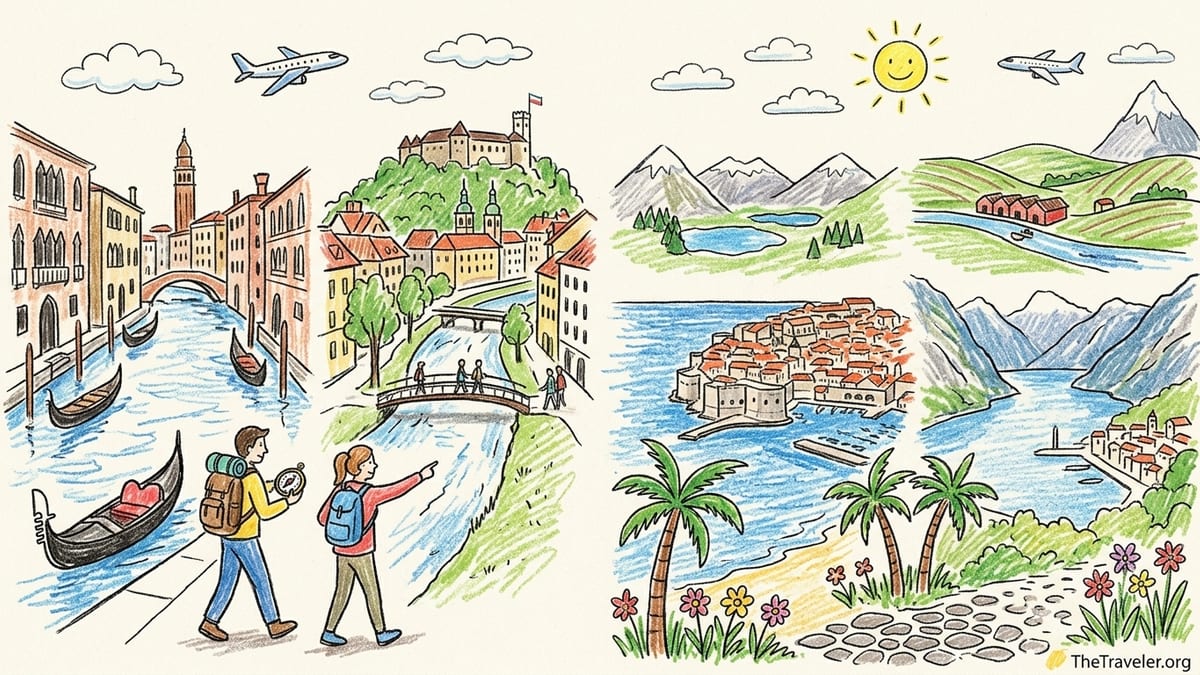
Venice vs. Ljubljana: Canals and Old Town Without the Crush
Venice remains a symbol of overtourism, with authorities introducing an entry fee for day trippers on selected peak days in 2024 in an attempt to manage crowds around St Mark’s Square and the Rialto Bridge. Reports from Italian tourism officials indicate that the measure has not meaningfully reduced visitor numbers, and hotel and rental prices in central Venice remain high, especially from late spring through early autumn. Travelers in 2027 can expect packed vaporetto boats on the Grand Canal and dense day-trip crowds arriving from beach resorts and cruise ships.
Ljubljana, the capital of Slovenia, offers a much calmer version of waterfront city life. Instead of a lagoon, its historic center sits along the Ljubljanica River, with outdoor cafe terraces and pedestrian bridges framing a compact Old Town. In recent summers, travelers have reported that even in July it is possible to find uncrowded side streets a few minutes from Prešeren Square. Average nightly rates for a central mid-range hotel often hover around 90 to 140 euros in high season, noticeably below central Venice, where similar accommodation can run from around 180 euros upward depending on dates and canal proximity.
Access is straightforward. Venice’s Marco Polo Airport will remain one of Italy’s main international gateways, but Ljubljana is increasingly well connected too, with direct flights from several European hubs and easy rail links from neighboring Austria and Italy. From Venice, travelers can reach Ljubljana in roughly three and a half to four hours by a combination of train and bus, making it realistic to pair both cities on a longer itinerary or to choose Ljubljana as a primary base and visit Venice as a day or overnight excursion.
The trade-offs are clear. Venice’s Renaissance palaces, lagoon islands and world-famous art will not be replicated elsewhere, and travelers intent on seeing St Mark’s Basilica or the Doge’s Palace may still build them into a shoulder-season visit. Ljubljana offers a different appeal: a lived-in university city with a strong cafe culture, a hilltop castle, and easy day trips to Lake Bled and the Julian Alps. For many visitors, the chance to stroll along the river at dusk without pushing through tour groups is worth more than any gondola photo.
Dubrovnik vs. Kotor and Bosnia’s Coast: Adriatic Walls Without the Markups
Dubrovnik’s walled Old Town has become one of Europe’s most cited examples of overtourism. Croatian tourism statistics show that the country welcomed well over four times its population in foreign visitors even before the pandemic, and pressure on a few coastal hotspots has only intensified since. Researchers tracking local prices found that grocery costs in Croatia’s tourism-intensive coastal municipalities now climb faster than inland areas during peak months, a small but telling sign of how saturated the coast has become. Dubrovnik has experimented with limiting cruise ship calls and capping visitor numbers for its city walls, yet on a July afternoon, narrow streets like the Stradun can still feel shoulder-to-shoulder.
Travelers looking for stone walls and sea views without the same pressure increasingly focus on alternatives nearby. In neighboring Montenegro, the Bay of Kotor offers a dramatic fjord-like setting with a fortified Old Town at Kotor itself and smaller waterfront villages such as Perast. Hotel prices in Kotor’s core can rise in high season, but many visitors find mid-range rooms between roughly 80 and 130 euros per night, frequently cheaper than equivalent stays inside or immediately adjacent to Dubrovnik’s Old Town. Local reports and traveler accounts suggest that while cruise days can be busy, the overall vibe remains more relaxed, especially in the evenings once day trippers depart.
A second alternative lies just a short distance from Dubrovnik across the border in Bosnia and Herzegovina. The small coastal town of Neum, Bosnia’s only access to the Adriatic, has been slowly developing its tourism infrastructure with mid-range hotels and family-run guesthouses. Travelers who have compared it with Croatian resorts consistently note that it remains significantly less crowded and more affordable, particularly for food and basic services. While Neum lacks the medieval walls of Dubrovnik, it provides beach time and sea views at a fraction of the price, and it can serve as a quieter base for day trips into Croatia’s Pelješac peninsula for wine tasting or to Mostar for its famous Ottoman-era bridge.
From a logistics perspective, Dubrovnik Airport will likely continue as the main international entry point to the southern Adriatic, with shuttle buses and private transfers connecting quickly to both Kotor and Neum. Road travel times from Dubrovnik to Kotor are typically around two to three hours depending on border queues, and less than two hours to Neum. In 2027, travelers weighing their options may choose Dubrovnik for a short, intensive city break focused on the old walls, while using Kotor or Bosnia’s coast as longer-stay bases where crowds thin out and restaurant reservations are easier to secure.
Barcelona vs. Valencia: Mediterranean Culture Without the Protests
Barcelona has become a flashpoint in Europe’s overtourism debate. During 2024, Spanish and European media widely covered resident protests against mass tourism, with demonstrators targeting neighborhoods such as Barceloneta and the Gothic Quarter. By 2025, hotels, cruise arrivals and short-term rentals were again surpassing pre-pandemic figures, prompting tighter regulations on new tourist accommodation and renewed scrutiny of how visitor numbers affect housing and daily life. Travelers arriving in 2027 should expect crowded pavements around La Rambla, Sagrada Família ticket slots that sell out days or weeks ahead in high season, and hotel rates that peak during major events and summer months.
Valencia, around three and a half hours south by train, offers a gentler Mediterranean experience. The city has a historic center of its own, a distinctive food culture centered on rice dishes such as paella, and major attractions like the City of Arts and Sciences complex and the restored Turia riverbed park. Tourism has grown quickly, and short-term rentals have become a point of debate, but Valencia still handles noticeably fewer international visitors than Barcelona. Travelers checking 2026 and 2027 price comparisons often find that mid-range central hotels in Valencia run roughly 100 to 150 euros per night in high season, frequently lower than similar categories near Barcelona’s key sights or beachfront.
Access is straightforward for both cities. Barcelona El Prat Airport remains a major European hub, with extensive long-haul connections. Valencia’s airport, smaller but well connected to European cities, often offers competitively priced flights from low-cost carriers and national airlines. For itineraries starting in Barcelona, high-speed trains reach Valencia in about three hours, making it realistic to split a week between the two cities or to base fully in Valencia and visit Barcelona on a tightly focused overnight stay that avoids peak weekend crowds.
The compromise for choosing Valencia is that you will not find Gaudí’s landmark architecture in every neighborhood, and cruise ship traffic is more limited, which in this context is a plus. In exchange, visitors enjoy wide sandy beaches that are busy but usually not overwhelmed, a more local-feeling bar and cafe scene in areas like Ruzafa, and easier access to less crowded wetlands and rice fields in the Albufera Natural Park. For travelers sensitive to protests, rising visitor caps and the sense of being unwelcome, Valencia can deliver much of the Catalan and Mediterranean atmosphere without the same level of political tension.
Cinque Terre vs. Liguria’s Quieter Coast and Inland Villages
Italy’s Cinque Terre, the cluster of five villages clinging to steep cliffs on the Ligurian coast, has reached a point where regional and national studies describe exponential growth in visitor numbers. One academic analysis of tourist flows reported around 4 million visitors in 2023 concentrated in a tiny coastal strip of roughly one square kilometer. Italian regional authorities have noted hotel occupancy around 90 percent in peak periods in villages such as Vernazza and Corniglia, and there is ongoing discussion about how to regulate hiking trail access and cruise ship day trips. For travelers in 2027, that means crowded trains between the villages, long waits for popular viewpoints and significant pressure on small-town infrastructure.
The broader Liguria region, however, offers many coastal and inland alternatives that share similar scenery without the density of social-media fame. Towns like Camogli, Sestri Levante and Lerici feature colorful waterfront houses, narrow caruggi alleyways and access to protected bays. While they are by no means undiscovered, regional tourism reports emphasize that visitor growth and hotel occupancy are more evenly distributed here than in Cinque Terre’s five villages. Summer rates for family-run three-star hotels in these towns may sit in the range of 110 to 160 euros per night for a double room, often with breakfast included, slightly under equivalent lodging in the most in-demand Cinque Terre villages in July and August.
Inland, Liguria’s hilltop borghi and valleys provide an even quieter alternative. Vine-covered terraces, chestnut forests and small stone villages offer hiking, cycling and agritourism stays without the crush of coastal day trippers. Regional data shows that the interior continues to receive a much smaller share of overnight stays compared with the coast, suggesting that even in a record tourism year there is still capacity. Travelers renting a car can reach many of these villages within an hour of coastal hubs such as La Spezia or Genoa, pairing sea views with rural farm-to-table stays where fixed-price dinners are often better value than restaurants in the most photographed towns.
For international visitors, Genoa’s airport and rail station serve as the main gateways, with frequent regional trains along the coast. In practice, a 2027 traveler could fly into Genoa, spend a single night in Cinque Terre at the start or end of a trip, and devote the remainder of their time to places like Camogli, Sestri Levante, or the valleys of the Ligurian Apennines. The trade-off is that coastal transport may require a little more planning, and English is less dominant in some smaller communities, but the reward is the opportunity to swim or hike without jostling for space on narrow paths.
Paris vs. Lyon and Strasbourg: Culture, Food and Fewer Queues
Paris will remain near the top of global city rankings by visitor numbers in 2027, boosted by legacy coverage from the 2024 Olympics and its central role in European rail and air networks. This means that the Louvre, Eiffel Tower and key arrondissements around the Seine will continue to experience dense crowding from late spring through early autumn and during major holiday periods. Accommodation costs in central neighborhoods have trended upward in recent years, with mid-range hotels often commanding upwards of 200 euros per night in popular districts during peak times, particularly for flexible bookings and short stays.
Lyon presents a compelling alternative. Known within France as its gastronomic capital, Lyon combines two rivers, a Renaissance Old Town and a strong cultural calendar without quite the same level of global tourism pressure. National tourism data positions Lyon among the country’s most visited cities, but still well below Paris in both international arrivals and overnight stays. In 2026 price comparisons, travelers often found that nice mid-range hotels in central Lyon could be booked for around 120 to 170 euros per night in many periods, undercutting similar options in central Paris. High-speed trains connect Lyon to Paris in roughly two hours, making it practical to route a longer journey through both but base more nights in the smaller city.
Strasbourg, on the border with Germany, offers a different style of alternative. Its half-timbered houses, canals and mix of French and German influences give it a distinct identity, and as the seat of European institutions it has a cosmopolitan feel despite its relatively modest size. Visitor numbers spike during December’s Christmas markets, but for much of the year the city is busy without being overwhelming. Hotel rates in 2026 and early 2027 often showed comfortable mid-range rooms in central Strasbourg priced roughly between 110 and 180 euros, depending on season and events, again generally cheaper than comparable areas in Paris.
The main trade-off involves world-famous landmarks. Travelers who dream of climbing the Eiffel Tower or viewing the Mona Lisa up close will still need to factor in pre-booked time slots and crowd management systems in Paris. Those who are more interested in cafe culture, neighborhood markets and regional food may find their time and budget go further in Lyon’s bouchon restaurants or Strasbourg’s winstub taverns. Either alternative allows for a richer sense of everyday French life, fewer airport-style security lines and more flexibility for last-minute plans.
Lisbon vs. Porto: Portugal’s Postcard Hills at Lower Daily Cost
Portugal has seen sustained growth in international arrivals, with Lisbon and Porto at the center of that boom. In recent years, short-term rentals, rising restaurant prices and crowded historic neighborhoods have become a point of debate in both cities. Price tracking from Portuguese tourism bodies and independent travel researchers suggests that average hotel room rates in Lisbon have climbed steadily, and that high-season mid-range accommodation now often sits around 120 to 180 euros per night in central districts. Food and transport remain relatively good value by Western European standards, but Lisbon’s iconic viewpoints, tram routes and nightlife areas can feel saturated in summer and during major events.
Porto, while firmly on the tourist map, generally offers a less crowded and slightly more affordable alternative. Comparisons published in 2026 indicate that a typical daily budget in Lisbon, including lodging, food and local transport, often falls in the range of about 70 to 110 euros per person, whereas Porto tends to land closer to 55 to 90 euros for similar standards. Mid-range central hotels in Porto are frequently priced around 80 to 130 euros per night in high season, which is commonly 25 to 30 euros less than equivalent categories in Lisbon. Portions of the historic Ribeira district can be busy on summer afternoons, but visitors report that it is still relatively easy to find quiet streets in areas like Miragaia or the upper town.
From an access perspective, both cities are viable entry points into Portugal. Lisbon’s airport remains the main international hub, especially for long-haul flights from North America and Brazil, while Porto’s airport has expanded its European network through both national carriers and low-cost airlines. The two cities are linked by regular rail services taking around three hours, and advance-purchase fares often remain reasonable, allowing travelers in 2027 to comfortably fly into one, leave from the other and favor Porto for the bulk of their stay if they want to stretch their budget.
Choosing Porto over Lisbon involves some trade-offs. Lisbon offers more extensive museum collections, a larger choice of nightlife districts and day trips to globally recognized sights such as Sintra’s palaces. Porto counters with port wine cellars across the river in Vila Nova de Gaia, a compact center that rewards walking, and easy access to the Douro Valley’s terraced vineyards. For visitors prioritizing cost, atmosphere and manageable crowds over a checklist of famous monuments, spending more nights in Porto while limiting Lisbon to a shorter, carefully timed visit can provide a better overall experience.
Alpine Icons vs. Slovenian and Slovak Mountains: Space to Hike
Alpine regions straddling Switzerland, France, Italy and Austria have long attracted hikers, skiers and sightseers. In recent years, icons such as Switzerland’s Jungfrau region and Italy’s Dolomites have experienced noticeable crowding on popular hiking routes and at viewpoint platforms, particularly in July and August. Cable car tickets, mountain railway journeys and hotel rates in famous villages frequently reflect global demand, with summer nightly prices in marquee destinations easily passing 200 euros for standard double rooms in comfortable properties. Environmental concerns, including erosion on steep trails and pressure on small mountain towns, are prompting local authorities to consider stricter visitor management.
Across the border in Slovenia, the Julian Alps and Triglav National Park offer a quieter alternative. Bled and Bohinj are increasingly popular, but once travelers venture onto less publicized trails or stay in smaller valley towns, they often find open space and easier access to affordable guesthouses. Nightly rates at simple, well-reviewed mountain lodges and rural bed and breakfasts can start around 60 to 90 euros for two people, with more comfortable hotels in nearby towns priced higher but still often below comparable Swiss or Italian resorts. National park rules limit construction and vehicle access in core areas, which indirectly helps manage mass tourism.
Farther east, Slovakia’s High Tatras provide another overlooked mountain option. Served by the small city of Poprad and its regional airport, as well as rail services from Bratislava and Prague, the Tatras combine jagged peaks, glacial lakes and well-marked hiking networks. While the region draws domestic and neighboring-country visitors, international tourist pressure is lighter than on the Western Alps or Dolomites. Travelers booking 2026 and early 2027 stays commonly find mid-range hotels and guesthouses around resort towns such as Tatranská Lomnica or Štrbské Pleso priced near 80 to 140 euros per night in high season, sometimes including breakfast and wellness facilities.
The trade-off in shifting from Europe’s most photographed alpine destinations to these alternatives is mainly about iconic branding. A postcard from the Tatras or the Julian Alps may not be as instantly recognizable as the Matterhorn or Dolomites, and transport routes may involve an extra train or bus compared with direct links to major Swiss hubs. In return, hikers gain more flexibility in choosing routes on the day without worrying that a trail will feel like a procession, and budgets stretch further, leaving more room for guided activities, mountain hut stays or extra days in nearby cities such as Ljubljana or Kraków.
Planning for 2027: How to Choose the Right Alternative
Recent travel industry reports for 2024 and 2025 highlight a clear shift in traveler behavior. Large hotel groups and European tourism organizations note that protests, new visitor caps and highly publicized crowding are influencing trip planning: in one survey, a large majority of Europeans said overtourism concerns would affect where or how they travel in 2025. At the same time, smaller or less famous destinations, including parts of the Balkans and Central Europe, report double-digit percentage growth in international arrivals from a relatively low base, suggesting a long-term trend toward dispersal rather than a temporary blip.
Looking ahead to 2027, travelers weighing crowded icons against emerging alternatives can start by clarifying what matters most: marquee sights, comfort, budget or atmosphere. A traveler who has never visited Europe may still choose a short stay in Venice or Paris but opt to base longer stretches in Ljubljana, Lyon or Porto. Someone more interested in uncrowded hikes and local food markets may skip the biggest names altogether in favor of Slovenia, Slovakia, inland Liguria or Montenegro’s smaller bays.
Costs should be considered in concrete terms. Before booking, it is worth checking current average hotel prices for specific dates in both the headline destination and its proposed alternative, using reputable comparison tools and official tourism data. Travelers can compare, for example, a typical July week in Lisbon against the same week in Porto or measure Dubrovnik’s high-season Old Town hotel prices against those in Kotor or Neum. By 2027, inflation and demand may push rates higher in both, but the relative gap between the most saturated hotspots and their neighbors is likely to remain.
The final trade-off involves personal expectations. Some travelers thrive on big-city energy, long museum hours and global dining options, even if that means higher prices and crowded streets. Others value slower evenings along a riverfront, easier dinner reservations and the absence of protest banners. The European tourism landscape in 2027 will offer room for both, but choosing a thoughtful mix of classic stops and less pressured alternatives will make it easier to enjoy the continent without contributing unnecessarily to its most visible overcrowding challenges.