


Few travel experiences rival gliding along a European river at walking pace, watching vineyard-clad hills, medieval villages and storybook castles slide quietly past your cabin windows. Among Europe’s river operators, Avalon Waterways has built a strong reputation for scenic, well curated itineraries, especially for travelers who want a balance of comfort, culture and outdoor time. This guide breaks down the most beautiful Avalon river cruise routes in Europe and what to expect on each, with concrete examples to help you choose the itinerary that fits your travel style and budget.
Why Choose Avalon for Scenic European River Routes
Avalon Waterways focuses heavily on Europe’s classic rivers, including the Danube, Rhine, Main, Moselle, Seine and Rhône. Most itineraries are built around slow travel and scenery, often cruising through UNESCO-listed stretches such as the Upper Middle Rhine Valley in Germany or the Wachau Valley in Austria. On many routes, the most photogenic stretches are scheduled in daylight hours, so you are not sleeping through the best views.
One distinctive feature is Avalon’s Panorama Suites. On most Suite Ships sailing in Europe, beds are positioned facing floor-to-ceiling, wall-to-wall windows that slide open to create a French balcony. Instead of stepping out onto a narrow balcony, you sit or lie facing the river, with fresh air and a nearly seven-foot-wide opening. For scenic routes along the Rhine Gorge or the Danube’s river bends, that design means you can enjoy the landscape even when you are taking a break in your cabin.
Avalon also leans into themed routing. Active & Discovery itineraries on rivers such as the Danube, Rhine, Seine and Rhône focus on immersive, often more scenic excursions like guided hikes through vineyards or cycling along towpaths. Festive itineraries target Christmas markets along particularly atmospheric stretches of the Rhine and Danube in late November and December, when towns like Cologne, Nuremberg and Vienna are lit with seasonal decorations and riverbanks can be dusted with snow.
From a pricing standpoint, most mainstream Avalon European river cruises start in the ballpark of about 250 to 350 US dollars per person per night in the lower categories if you book early in shoulder seasons, with peak-season balcony-level Panorama Suites often running 450 to 650 dollars per person per night depending on exact itinerary, ship, date and promotions. Prices typically include shore excursions, most meals, wine and beer with lunch and dinner, and in many cases airport transfers, so when you compare to land trips you should factor in that bundled value.
The Danube: Castles, Capitals and Wachau Vineyards
The Danube is Avalon’s flagship river and arguably its most scenic overall route in Europe. Classic itineraries such as “Magnificent Europe” between Amsterdam and Budapest or shorter “Danube” sailings between Vilshofen and Budapest combine big-name capitals like Vienna and Budapest with smaller baroque towns and vineyard valleys. The most famous scenic window is Austria’s Wachau Valley, a UNESCO-listed stretch between Melk and Krems lined with terraced vineyards, apricot orchards and hilltop ruins such as the castle at Dürnstein.
On a typical 8-day Danube route between Germany and Hungary, you might pay somewhere around 3,000 to 4,500 US dollars per person in a Panorama Suite in high season, with lower categories often available for several hundred dollars less. In return, you get walking tours in cities like Vienna and Bratislava, guided visits to abbeys such as Melk, and optional excursions including Wachau wine tastings or bike rides along the river. Many sailings time the Wachau segment for a long, slow morning or afternoon of daylight cruising so guests can crowd the top deck with cameras and glasses of local Grüner Veltliner.
For more outdoors-oriented travelers, Avalon’s “Active & Discovery on the Danube” focuses on a slightly shorter stretch but adds activities like guided hiking in the Austrian countryside, canoeing sections of the river when water conditions and regulations allow, or cycling from one port to the next on flat riverside paths. These itineraries usually run in the warmer months, roughly late spring to early autumn, when daylight is long and river levels are more favorable for such activities.
The Danube also shines as a winter route. “Christmastime on the Danube” sailings include atmospheric stops at Christmas markets in cities such as Vienna, Regensburg and Nuremberg, where you can step straight from the ship into market squares lined with wooden stalls, mulled wine and seasonal street food. Cabin rates in late November or early December can be lower than high summer, though demand for Christmas-market weeks has grown and those departures often sell out 12 to 18 months in advance.
The Rhine: Storybook Castles and Wine Villages
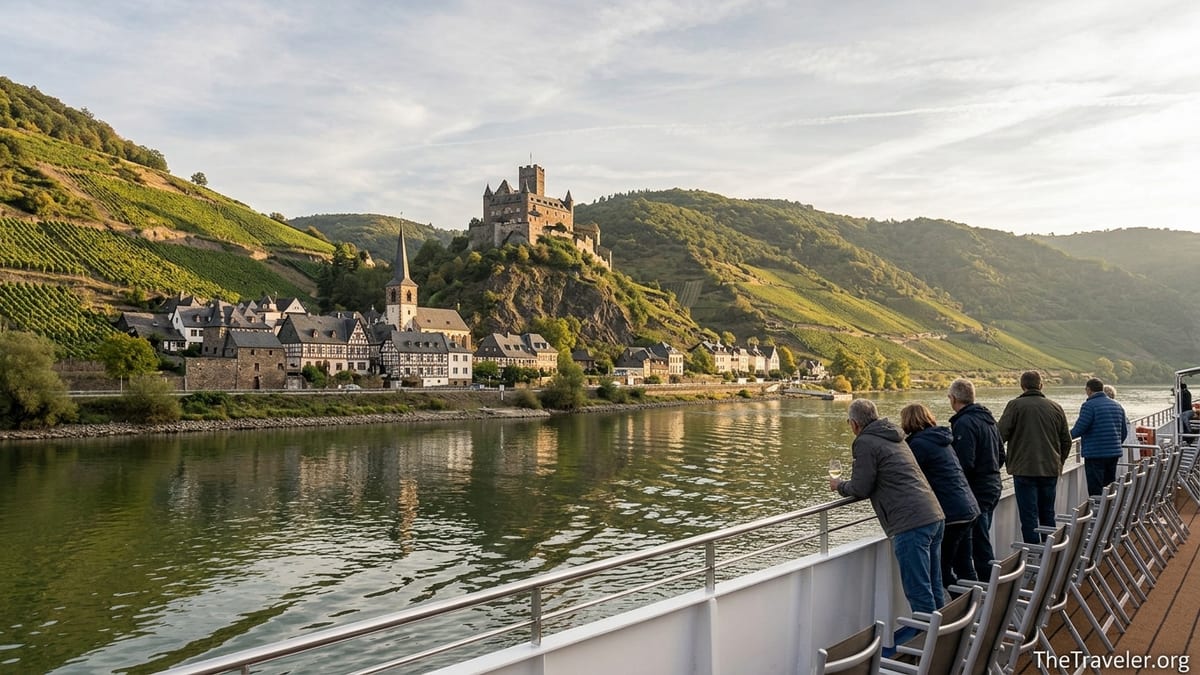
If your idea of scenic travel is craggy hills topped with castles and half-timbered villages clinging to the banks, Avalon’s Rhine routes are hard to beat. Classic itineraries between Amsterdam and Basel typically include the Upper Middle Rhine Valley, a short but spectacular UNESCO-listed stretch between roughly Rüdesheim and Koblenz where castle silhouettes appear at almost every bend. Avalon often schedules commentary on deck here, pointing out landmarks like Marksburg Castle and the Lorelei Rock while you sail.
On standard Rhine cruises, daily life alternates between panoramic cruising and stops in cities such as Cologne, Strasbourg and Basel. A typical 8-day Amsterdam to Basel sailing might start around 3,000 US dollars per person in a French balcony or Panorama Suite if booked early in shoulder season, with peak summer departures and prime mid-ship cabins running higher. Since the Rhine touches Switzerland, France, Germany and the Netherlands on many itineraries, it is a good choice for travelers wanting to sample several countries in one trip.
Scenic highlights extend beyond the castles. Many routes include Alsace, where you might take an excursion along the Alsace Wine Route, tasting Riesling in small cellar-door spaces surrounded by rolling vineyards. Others feature the Black Forest from ports like Breisach, with coach rides into pine-covered hills, stops at cuckoo-clock workshops, or short forest walks to waterfalls. These excursions make the surrounding landscapes feel as central to the cruise as the river itself.
Avalon also runs signature holiday itineraries along this river, including “Christmastime on the Romantic Rhine,” which pairs the Rhine Gorge scenery with markets in Cologne, Strasbourg and other riverside cities. Some longer variants bolt on stays near the Swiss Alps or Lake Como, creating photogenic combinations of snow-covered mountains, lakes and river valleys in a single trip. Winter rates can sometimes be similar to shoulder season on the Rhine because these Christmas departures have become highly sought after among repeat river cruisers.
Seine & Rhône: Scenic France from Paris to Provence
For travelers drawn to French landscapes, Avalon’s Seine and Rhône routes offer a different kind of scenic appeal. On the Seine, itineraries often start and end in Paris, then meander northwest through Normandy. The scenery shifts from city skylines to chalk cliffs, apple orchards and half-timbered villages around ports like Rouen and Honfleur. While the river itself is gentler in profile than the Rhine, the combination of riverside abbeys, farm fields and coastal excursions makes these itineraries quietly photogenic.
Avalon’s “Active & Discovery on the Seine” uses the river primarily as a backdrop for local experiences. Depending on the date and exact departure, you might kayak on a calm stretch near Les Andelys, cycle through the countryside outside Rouen, or join an artist-focused walk in Giverny, where Monet’s gardens still draw painters and photographers. These trips typically run as 8 or 9-day itineraries with prices often starting in the mid-3,000 to low-4,000 US dollar range per person in standard balcony-level cabins, though exact figures vary by season.
Farther south, Avalon’s Rhône cruises between Lyon and Arles or between Lyon and Port-Saint-Louis trace the Saône and Rhône through Burgundy and Provence. Here the ship glides past golden hillside vineyards, stone villages and lavender fields that bloom in early summer. Ports such as Viviers and Tournon feel more rural than the Rhine’s industrial stretches, and the climate is usually warmer and sunnier, particularly from late May through September.
On a typical Rhône itinerary, you might visit a working vineyard in the Côte du Rhône, join a guided walk through the Roman amphitheater in Arles, or take a food-focused tour of Lyon’s markets. Cabins on these routes often price similarly to the Seine, though high-demand dates during lavender season or French holidays can command a premium. For many travelers looking for a mix of scenery, wine and historic towns without the crowds of central Europe’s biggest river hubs, these French itineraries are an appealing alternative.
Moselle & Main: Vineyard Meanders and Fairytale Towns
While the Rhine and Danube get most of the attention, some of Avalon’s prettiest days unfold on the Moselle and Main, often as parts of longer combined itineraries. The Moselle, a sinuous tributary of the Rhine, runs through one of Europe’s steepest wine valleys, with terraced vineyards and towns like Cochem and Bernkastel-Kues. When Avalon itineraries dip into the Moselle, you are likely to spend long, slow days sailing among vine-covered slopes at close range.
Many longer cruises marketed as “Iconic Rivers of Europe” or “Magnificent Europe” string together sections of the Rhine, Main and Danube, and sometimes the Moselle. For example, a 15 to 22-day journey might take you from Amsterdam through the Rhine Gorge, along the Main through towns like Würzburg and Bamberg, and onward to the Austrian and Hungarian stretches of the Danube. These extended itineraries are ideal for travelers who want a single, in-depth trip covering multiple river landscapes without changing hotels.
The Main River itself is more understated but no less engaging. Scenic highlights include the Main Valley wine region and the historic architecture of cities like Würzburg and Nuremberg. Main–Danube Canal sections are slower and more engineered than wild, but watching the ship rise and fall through locks can be fascinating, especially if you are interested in engineering and infrastructure. Avalon cruise directors often use these stretches for commentary and on-board lectures, while passengers relax on deck with views of quiet countryside.
Because combined itineraries are longer, total ticket prices are higher. It is common to see 15-day routes priced somewhere from the upper 5,000s to well over 8,000 US dollars per person in mid-range categories, depending on season and cabin type. However, on a per-night basis, these longer trips can sometimes be more economical than booking two separate shorter itineraries, especially when promotions or included air offers are available through Avalon or a travel advisor.
Specialty Routes: Active & Discovery and Festive Seasons
Beyond standard sightseeing-focused cruises, many of Avalon’s most scenic routes are variations within its Active & Discovery and festive-season portfolios. Active & Discovery itineraries now operate on key rivers such as the Rhine, Danube, Seine and Rhône. These sailings typically include at least one more active excursion option most days, like e-bike rides along levees, vineyard hikes, or guided running tours in cities, alongside gentler cultural options for those who prefer museums or food tastings.
On an Active & Discovery Rhine cruise between Amsterdam and Basel, for instance, you might spend a morning on a guided bike ride in the Dutch countryside before rejoining the ship, or hike up to hilltop castles above German wine towns for expansive river views. Travelers who choose these itineraries often report higher daily step counts and more varied scenery, simply because they are outdoors and on foot or bike more often while still enjoying the ship’s comforts in the evenings.
Festive-season routes offer a different visual appeal. Lights from Christmas markets reflect on the river, and many towns decorate their waterfront facades. Avalon operates a range of Christmas and “Cozy Season” cruises on the Rhine and Danube that focus specifically on markets, seasonal concerts and regional winter dishes such as gingerbread in Nuremberg or hearty stews in small Austrian towns. Evening sailing past illuminated cathedrals and bridges becomes a scenic highlight in itself.
Seasonal pricing patterns apply here as well. Expect that peak-market weeks in late November and the first half of December can be surprisingly competitive in price compared with shoulder-season spring cruises because demand is strong and ships are often close to full. On the other hand, less Christmassy weeks in late October or early November on the same rivers may offer better value if your priority is riverside foliage rather than holiday markets.
Choosing the Right Scenic Route for Your Travel Style
When comparing Avalon’s European river routes, the best choice comes down to your priorities. If you want big-name capitals with classical architecture and plenty of museums, the Danube between Germany and Hungary delivers Vienna, Budapest and often Bratislava, layered over scenic stretches such as the Wachau Valley. Travelers who prefer a stronger focus on castles, wine villages and hillside scenery tend to gravitate toward the Rhine and Moselle, where the landscape feels more concentrated and dramatic across shorter distances.
For lovers of French culture and cuisine, the Seine and Rhône itineraries trade some of the Rhine’s fortress silhouettes for riverside abbeys, vineyards, lavender fields and market towns. These routes can be especially appealing to repeat river cruisers who have already done the classic Rhine or Danube and now want something a bit quieter and more food-focused. Because many French itineraries start or end in cities such as Paris or Lyon, they are also easy to pair with independent pre- or post-cruise stays in apartments or smaller hotels you book yourself.
Budget and timing play a major role. High summer school holiday periods in July and early August tend to be the most expensive and busiest on all rivers. Shoulder seasons in April, May, September and early October often strike a balance between price, weather and crowds. For example, a Panorama Suite on a mainstream 8-day Rhine sailing in late April might be several hundred dollars per person cheaper than the same cabin in peak July, while still offering green landscapes and relatively long daylight hours.
Your comfort with cooler temperatures also matters. If you are willing to bundle up in layers and a good waterproof jacket, late autumn and early winter sailings can deliver atmospheric scenery and lower prices in some weeks, especially outside the core Christmas market dates. In December, you will trade leafy green hills for bare vineyards and, some years, a dusting of snow on castle roofs, which many travelers find even more beautiful from the warmth of the Panorama Lounge.
Practical Planning Tips for Avalon’s Scenic Itineraries
Booking timelines for Avalon’s most scenic routes have stretched earlier as demand for river cruising has grown. For popular departures on the Danube and Rhine between May and September, many travelers now book 12 to 18 months in advance to secure mid-ship Panorama Suites. That said, it is not uncommon to find remaining cabins or shoulder-season promotions closer in, especially on less saturated itineraries or outside of major holidays.
If you are flying from North America, aim to arrive at least one day before embarkation to recover from jet lag and buffer against flight disruptions. Many Avalon packages offer optional pre-cruise nights in gateway cities such as Amsterdam, Budapest, Paris or Lyon, sometimes bundled with airport transfers and local tours. A night in Amsterdam before a Rhine cruise, for instance, gives you time to adjust, stroll the canals and possibly visit the Rijksmuseum or Van Gogh Museum at your own pace.
Closets in river ship cabins are compact, so pack light but thoughtfully. Scenic deck time is central on these itineraries, so focus on layered clothing, a windproof jacket, comfortable walking shoes and, for Active & Discovery routes, workout clothing that can double as casual daytime wear. Binoculars can enhance castle-spotting along the Rhine Gorge or bird-watching in quieter stretches of the Danube and Moselle.
River levels can affect routing, particularly during periods of exceptional drought or flooding. Avalon, like other operators, may occasionally need to adjust schedules, use motorcoaches for some segments, or perform ship swaps if sections of a river become temporarily impassable. While such changes are not the norm, it is wise to build some flexibility into your expectations and to ensure you have comprehensive travel insurance that covers trip interruption and weather-related disruptions.
The Takeaway
Across Europe’s great rivers, Avalon Waterways has curated a portfolio of routes that place scenery right at the center of the experience. Whether you are floating through the Wachau Valley on the Danube, passing beneath castle-crowned cliffs on the Rhine, drifting past Normandy villages on the Seine or gliding through Provence on the Rhône, the views from deck and from your bed-facing windows are more than just a backdrop. They are the main event.
If castles and dramatic hillsides are your dream, start with the Rhine and Moselle. If you want capital cities and a broad mix of landscapes, look to the Danube, especially itineraries that include the Wachau and extend into Hungary. For a slower, food-forward journey in France, the Seine and Rhône give you village scenery and vineyard landscapes paired with strong culinary traditions. Whatever you choose, planning a bit ahead and matching the route to your interests will help ensure that the river scenes you imagine now are the ones you actually wake up to on board.
FAQ
Q1. What is the most scenic Avalon river cruise route for first-time travelers?
Many first-time travelers gravitate toward the Rhine between Amsterdam and Basel because it offers castles, vineyards and charming towns in a relatively compact stretch, along with easy flight connections to and from major airports.
Q2. How far in advance should I book a popular Avalon river cruise?
For high-demand scenic routes on the Rhine and Danube during late spring, summer and Christmas market weeks, booking 12 to 18 months ahead gives you the best choice of cabin type and deck position.
Q3. Are Avalon’s Active & Discovery cruises more expensive than standard itineraries?
Pricing varies by date and river, but Active & Discovery itineraries are often similar in base fare to standard cruises on the same route, with the main differences being the style of included excursions and the activity level rather than a major price premium.
Q4. Which Avalon river is best if I want to see several countries on one trip?
The Rhine and Danube are ideal for multi-country itineraries. A single cruise can easily include Germany, Austria, Hungary, Slovakia, the Netherlands, France and Switzerland depending on the specific route you book.
Q5. Is a winter river cruise with Avalon still scenic if there is no snow?
Yes. Even without snow, winter cruises offer views of misty hills, bare vineyards, illuminated town centers and Christmas markets, which many travelers find just as atmospheric as summer greenery.
Q6. How much walking should I expect on Avalon’s shore excursions?
Standard excursions often involve relaxed city walks of one to two miles on cobblestones, while Active & Discovery options can include longer hikes or bike rides. Daily programs clearly indicate the activity level so you can choose accordingly.
Q7. Are balcony cabins worth the extra cost on scenic river routes?
For many travelers, Avalon’s Panorama Suites or French balcony cabins feel worthwhile on routes like the Rhine Gorge or Wachau Valley, since you can watch the scenery from bed with wide open windows, especially in cooler months when you may spend less time on deck.
Q8. What is the best time of year for vineyard scenery on Avalon’s European cruises?
Late May through early October usually offers lush vineyard views, with grapevines particularly full in late summer and early autumn. Harvest season in September and early October can be especially picturesque along the Rhine and Moselle.
Q9. Do Avalon cruises include wine and beer with meals?
Yes. On most European river itineraries, Avalon includes complimentary wine, beer and soft drinks with lunch and dinner, while additional drinks from the bar are charged to your onboard account.
Q10. Can I easily add extra nights before or after my Avalon cruise?
Yes. Avalon sells pre- and post-cruise extensions in many gateway cities, and you can also book your own hotel nights independently. Many travelers add at least one or two nights in cities such as Amsterdam, Budapest, Paris or Lyon before or after their sailing.