


For 2027 city breaks in Europe, the easiest weekends will be the ones where you never touch a car. More cities are extending pedestrian zones, investing in frequent public transport and packaging airport transfers into visitor cards. With a bit of planning, you can step off a plane or train on Friday evening and be walking cobbled streets ten minutes later, instead of queueing for hire cars on the edge of town. The destinations below are chosen for three things: fast rail or flight connections from major European hubs, simple airport or station transfers, and compact centres that reward two nights on foot.
Get the latest updates straight to your inbox!
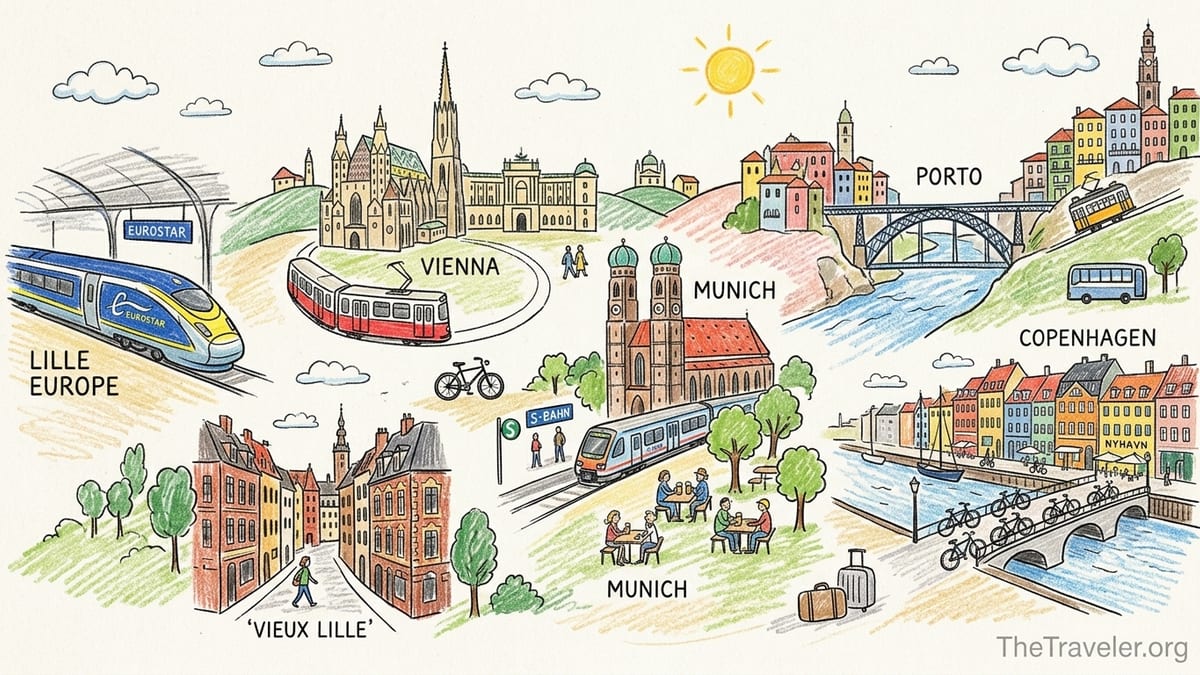
Lille: High Speed Rail Gateway for a Compact French Weekend
Lille is one of the most efficient car free weekends you can plan in 2027, especially if you are starting from London, Brussels or Paris. Eurostar runs from London St Pancras to Lille Europe in around 1 hour 25 minutes in 2027 schedules, and French high speed services connect Lille with Paris in about 1 hour. The key advantage for a short break is geography: Lille Europe, where most international trains arrive, sits a short walk from the historic centre, so you avoid suburban transfers entirely.
From Lille Europe it is roughly a 10 minute walk into Vieux Lille if you are travelling light, or a quick hop on the city metro that runs directly beneath the station. Many mid range hotels such as chains around Lille Flandres station sit between the old town and both main terminals, so you can reasonably check in within half an hour of stepping off the train. Travellers flying into Lille Airport can use the shuttle bus to the city, which normally runs to Lille Flandres; the journey is usually under 30 minutes in regular traffic and avoids the need for taxis for most visitors.
Two night budgets in Lille can be kept under control. In 2026 and early 2027, simple but well rated city centre hotels often price standard doubles from about 110 to 150 euros per night for weekend dates outside major events, while bistro main courses in the old town tend to start around 18 to 22 euros. A realistic estimate for a couple who choose a central hotel, use local transport lightly and eat in mid range brasseries would be around 500 to 650 euros for two nights excluding travel to Lille.
For a Friday to Sunday itinerary, plan to arrive by late afternoon. Spend Friday evening walking Grand Place and the streets around Rue de la Monnaie before dinner in a traditional estaminet. Saturday can be a museum and market day: the Palais des Beaux Arts, one of France’s largest art museums outside Paris, sits an easy tram or 15 minute walk from the centre, and the covered market at Wazemmes is lively in the mornings. On Sunday, many visitors take a final stroll through the Citadelle park before catching an afternoon Eurostar or TGV home. All of this is comfortably done on foot with occasional use of the metro, so there is no realistic reason to hire a car.
Vienna: Seamless Airport Links and Culture on a 48 Hour Pass
Vienna has spent the last decade making short stays work without private cars, and by 2027 that infrastructure is well established. Vienna Airport sits about 20 kilometres from the city centre and is linked by several overlapping rail and bus options. Recent fare tables in 2026 show the dedicated City Airport Train product, which now runs as a bus connection to Wien Mitte, priced around 15 euros one way, while standard suburban rail services and regional trains cost noticeably less but take a little longer. Fixed price taxis or pre booked transfers from the airport into central districts are usually advertised from roughly 40 to 45 euros per car in 2026.
The more interesting development for weekend visitors is how airport transfers are bundled into city cards. Current Vienna City Card variants combine free travel on local public transport with airport transfers and attraction discounts. Information published in 2026 indicates that these cards are available for different durations such as 24, 48 or 72 hours, with the higher priced options including both public transport and airport connections via services like Railjet, the S7 line or airport buses. For a two night break arriving Friday and leaving Sunday, a 48 or 72 hour version that includes the airport can remove nearly all ticket decisions from the trip.
Pure transport tickets changed in 2026 when the local operator stopped selling 48 and 72 hour passes. Visitors now combine 24 hour tickets at around 9 to 10 euros each or consider the 7 day ticket, which is economical if you expect heavy use. For most weekenders staying in the Innere Stadt, Leopoldstadt or Neubau, two consecutive 24 hour tickets for a couple would come to just under 40 euros total and cover unlimited metro, tram and bus travel across both full days.
For a sample two night itinerary, arrive on Friday afternoon and use your card to reach a hotel within or just outside the Ringstrasse. Walk the pedestrian Kärntner Strasse, step into St Stephen’s Cathedral and choose a classic coffee house for an early evening break. Saturday can combine major museum visits in the MuseumsQuartier or Hofburg complex with a tram loop on the Ring for a quick orientation. On Sunday, many flights leave late enough to allow a morning stroll in the Prater or a visit to Belvedere. Because metros run frequently and the city centre is compact, there is no practical advantage to having a car; in fact, parking in historic districts is tightly regulated and expensive, making public transport the obvious choice.
Munich: Airport to Altstadt on One Card
Munich is one of the few big cities in Europe where a single product can combine airport transfer, local transport and museum discounts in a way that genuinely simplifies a two night stay. The official Munich Card and Munich City Pass, updated regularly through 2025 and 2026, offer options that include the airport zone. Price lists for current years show a two day Munich City Pass with public transport across the wider zone, including the airport, priced in the range of about 45 to 50 euros per adult, with slightly cheaper versions that cover only the central “M” tariff area.
Arrivals at Munich Airport can reach the city centre by S Bahn suburban trains, regional expresses and dedicated buses. The S1 and S8 lines connect the airport with central stations such as Marienplatz and Hauptbahnhof, and the ride is usually around 35 to 45 minutes depending on the service. If you hold a Munich Card or City Pass that includes the airport zone, you simply validate once and ride without needing separate airport tickets. Travellers who prefer to pay per journey can look at day tickets for the entire network, which cost less than a typical taxi fare into town. Taxis from the airport to central hotels are often quoted around 80 to 90 euros per car as of 2026, a significant difference for budget conscious visitors.
For budgeting, a central mid scale hotel around Sendlinger Tor, Karlsplatz or near the main station can often be found between 150 and 220 euros per night for weekend dates outside trade fairs, based on current 2026 pricing. Add a two day transport and discount pass at about 50 euros and a realistic food and drink budget of around 60 to 80 euros per person per day if you are mixing beer halls with bakeries, and a couple can expect a total spend in the region of 650 to 800 euros for two nights excluding travel to Munich.
In itinerary terms, Munich works well for a Friday to Sunday stay without a car because its main sights cluster tightly. After arriving on Friday evening, use the S Bahn and U Bahn to reach your hotel then walk into the Altstadt for the evening atmosphere around Marienplatz. Saturday can be split between the Residenz complex, the Viktualienmarkt food market and a stroll through the Englischer Garten, all easily reached by metro or tram. Those keen on modern art can add the museums in the Kunstareal district, a short U Bahn ride from the centre. On Sunday morning, the transport pass still covers a final wander to Nymphenburg Palace before you ride the S Bahn back to the airport. At no point does a hire car add speed, but it would add parking charges and stress.
Porto: Hills, Trams and a Walkable Douro Weekend
Porto is one of Europe’s most rewarding small city breaks for travellers who prefer to explore on foot and by tram. The city’s hills, tight streets and bridge views make driving inconvenient even for locals, while the network of metro lines, buses and trams covers most districts a visitor will want to see. For 2027 planning, it is relevant that Francisco Sá Carneiro Airport is connected to the city by Line E of the metro, with journey times into Trindade station typically around 30 minutes and tickets priced far below taxi fares.
The local Andante ticketing system sells 24 hour passes that work across metro and buses in the chosen zones. While pricing can change, recent 2026 examples list day passes for central zones at well under 10 euros, allowing unlimited rides. Taxi and app based rides from the airport into central Porto are commonly quoted around 25 to 30 euros, which can still be reasonable when shared, but most budget conscious weekenders will find the purple metro line perfectly adequate.
Two night budgets in Porto are often lower than in central Europe. Double rooms in tidy guesthouses in neighbourhoods like Cedofeita or near São Bento station can regularly be found between about 80 and 130 euros per night outside peak August dates, according to current booking patterns. A simple lunch of soup and a main dish in traditional restaurants can come in at 10 to 15 euros, and even speciality cafes rarely exceed big city northern European prices for coffee and pastries.
For a car free Friday to Sunday itinerary, arrive on Friday afternoon and ride metro Line E into Trindade, changing once if needed to get close to your hotel. Spend the evening walking the Ribeira waterfront and crossing Dom Luís I Bridge on foot at sunset. Saturday can combine a morning visit to São Bento station’s tile covered hall, an optional tram ride out towards Foz, and afternoon port lodge tours in Vila Nova de Gaia across the river. On Sunday, ride the metro up to Casa da Música for a modern contrast before heading back to the airport. The combination of steep streets, limited parking and pedestrian friendly riverside paths makes Porto a place where not having a car feels like a clear advantage.
Copenhagen: Compact, Cyclist Friendly and Perfect for 48 Hours
Copenhagen frequently appears in rankings of Europe’s most car independent cities, and by 2027 the infrastructure that earned those rankings will matter even more to short break travellers. Copenhagen Airport sits around 8 kilometres from the city centre and is directly connected by both metro and regional trains, with typical journey times of 15 minutes or less to stations like Kongens Nytorv or Copenhagen Central. Single tickets on these services are usually only a fraction of taxi fares, and both are integrated into the wider transport network.
The introduction of Copenhagen’s fully automated metro lines has made car free movement particularly simple for visitors staying around the harbour and central districts. Trains run at short intervals throughout most of the day and night, and common tourist ticket products cover unlimited metro, bus and suburban rail for periods such as 24, 48 or 72 hours. While prices are updated regularly, recent information suggests that 48 hour city passes remain in the broad range of 25 to 40 euros equivalent depending on zones, which is competitive given Denmark’s high taxi costs.
Copenhagen is also one of the easiest cities in Europe for visitors who want to cycle without navigating heavy traffic. Well separated cycle lanes, clear signage and plentiful rental options make it reasonable to pick up a bike from a staffed store or hotel and explore neighbourhoods like Vesterbro, Nørrebro and Østerbro within a short ride of the centre. For a two night stay, budgeting around 200 to 260 euros per night for a mid range room near the centre is realistic in 2027 terms, while casual meals and coffees will generally push a couple’s total weekend spend towards 700 to 900 euros excluding travel to Denmark.
For a sample itinerary, arrive on Friday using the metro from the airport to a central station near your hotel. Spend the evening around Nyhavn and the harbour, which are easy to reach on foot from several metro stops. On Saturday morning, take the metro to Nørreport and walk through the Torvehallerne food halls before renting bikes for a loop that takes in the lakes, the Meatpacking District and the Little Mermaid. Sunday morning can be kept simple: a final stroll through Christianshavn or across the bridges around Islands Brygge before riding the metro back to the airport. At every stage, public transport, cycling and walking replace the need for a car.
Geneva: Swiss Precision for Short Stays without a Car
Geneva is one of several Swiss cities where airport transfers and local public transport are tightly integrated, which is exactly what a two night car free getaway needs. Geneva Airport lies only a few kilometres from the city centre and is linked by frequent trains that usually take less than 10 minutes to reach the main station, along with buses that serve other districts. According to recent fare examples, standard one way train tickets between the airport and central Geneva cost only a few Swiss francs, far below local taxi fares that often exceed 35 Swiss francs for the same journey.
A notable extra is that many Geneva hotels issue guests with a public transport card covering buses, trams and trains within certain zones for the duration of their stay, funded through a small nightly tourism tax. This practice, which was well established before 2026, effectively turns your hotel key into a transit pass and removes the need to weigh up day tickets. Combined with a short airport journey, it means a Friday evening arrival can turn into an early dinner beside the lake with minimal friction.
Switzerland is rarely a budget destination, so weekend costs must be planned. Central three and four star hotels within walking distance of the lakefront or the Old Town commonly quote rates starting around 200 to 260 Swiss francs per night for weekend stays outside major conferences. Restaurant main courses often fall between 25 and 40 Swiss francs, and even a simple takeaway lunch can exceed 15 francs per person. Allowing for two nights of accommodation, local meals and occasional museum fees, a couple may expect a two night car free stay in Geneva to fall somewhere between 800 and 1,000 Swiss francs excluding travel to Switzerland.
For an efficient itinerary, arrive on Friday afternoon, ride the airport train into town using your initial ticket or hotel transport card, and spend your first evening walking the lakefront and the streets of the Old Town. Saturday can be dedicated to museums such as the Red Cross Museum or the Patek Philippe Museum, both accessible by tram or bus, followed by a boat trip on the lake that is often included or discounted with local passes. On Sunday morning, wander through Carouge’s boutiques or the Plainpalais flea market if dates align, then use your hotel card to ride the train back to the airport. Geneva’s dense public transport network and small footprint mean a hire car would mainly be a parking problem.
How to Budget and Choose the Right Car Free Weekend
Planning a 2027 weekend without a car is ultimately about matching your expectations to how local transport works. In cities like Vienna and Munich, airport transfers wrapped into visitor cards can reduce decision fatigue and save money compared with separate tickets and taxis. In compact centres such as Lille and Porto, the focus is on booking accommodation close to a main station or historic district so that you are never more than a fifteen minute walk from where you want to be. In places like Copenhagen and Geneva, the payoff for higher hotel and restaurant prices is a level of public transport frequency and coverage that makes the whole city feel accessible.
When sketching a two night budget, it helps to break costs into travel to the city, accommodation, local transport and daily spending money. Using 2026 and early 2027 prices as a guide, a couple staying in mid range hotels in these cities might expect two night accommodation totals between roughly 220 euros in cheaper markets such as Porto and 500 euros or more in higher priced cities such as Copenhagen or Geneva. Adding city cards or day tickets usually adds about 40 to 80 euros for two people over a weekend, while modest restaurant and cafe spending will often land between 60 and 100 euros per person for the whole trip, depending on destination.
Equally important is time. Train timetables on routes like London to Lille or Paris to Munich show that journeys under five hours door to door are realistic on Friday afternoons, meaning you can often be checked into a central hotel by early evening if you leave work a little early. Flights into airports with direct rail links into the centre, such as Vienna, Copenhagen or Geneva, can achieve similar timings if you travel with hand luggage only. The goal is to choose city pairs where your total time on the move is proportionate to 48 hours on the ground; if you will arrive near midnight and leave at dawn, look for closer options before committing.
Most importantly, committing to a car free weekend changes the character of the trip. Without a vehicle waiting outside, you are more likely to spend evenings strolling rather than driving across town, to pick one or two neighbourhoods and explore them in depth, and to notice details on trams and pavements that you might otherwise speed past. Europe’s investment in rail, metro and tram systems over the last decade means that in many places, leaving the car keys at home no longer feels like a sacrifice. For 2027, the best weekend getaways are those that put good public transport and walkable streets at the centre of the plan.
Conclusion: Designing Your 2027 Car Free Escape
By 2027, Europe offers more truly car optional weekends than ever before. Cities such as Lille, Vienna, Munich, Porto, Copenhagen and Geneva combine fast connections, straightforward transfers and human scale centres where two nights are enough to feel the rhythm of local life. Visitor cards and integrated tickets turn airports and mainline stations into simple gateways, while compact districts make walking and cycling the natural ways to explore.
When choosing your own itinerary, start with the journey time from your home city to a central station or core metro stop, then check how airport or rail transfers work and what they cost at current 2026 and 2027 rates. Confirm whether a city card that includes public transport and airport access matches your plans, and look for accommodation within a short walk of a main square or transport hub. With those pieces in place, you can focus less on logistics and more on cafés, museums and waterfront walks.
Above all, treat the decision to skip a hire car not as a restriction but as a design principle. The destinations highlighted here show that a car free weekend can be smoother, cheaper and more enjoyable than a traditional driving break, especially over just two nights. In a region where infrastructure is increasingly built around rail, trams and pedestrians, the most memorable 2027 weekend getaways are likely to be the ones where the only keys you carry belong to your hotel room.