


More news on this day
Stormy skies over Johannesburg have prompted a disruption warning for travelers using OR Tambo International Airport, as summer thunderstorms and lightning in the area begin to affect flight schedules.
Get the latest news straight to your inbox!
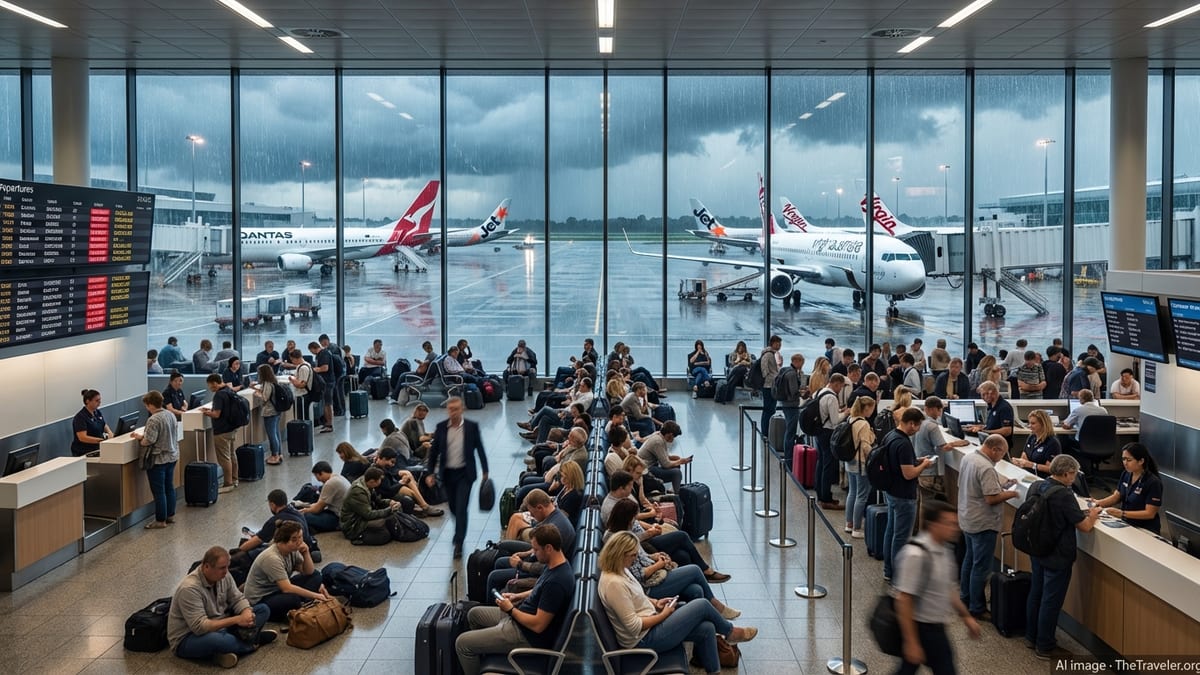
Advisory issued as thunderstorms build over Johannesburg
Publicly available updates from Johannesburg’s OR Tambo International Airport indicate that a formal travel advisory was issued on 2 November 2026, warning that adverse weather conditions could disrupt operations. The notice highlighted the risk of delays to both arriving and departing flights as storm cells developed across the Highveld.
Coverage in South African media reports that at least one scheduled service from Cape Town to Johannesburg on Monday afternoon was unable to land and diverted to Gaborone in Botswana, underscoring the operational impact of the unsettled conditions. While the number of affected flights remains limited, the advisory signals that further disruption is possible as storms intensify into the evening peak.
Real-time aviation data services show lightning in the vicinity of OR Tambo, with current conditions described as thunderstorms with rain and nearby electrical activity. Average departure delays of around 15 to 20 minutes and similar arrival hold-ups are being recorded, although the majority of flights are still operating rather than being cancelled outright.
Airport users are being urged, via publicly accessible channels, to monitor flight status through airline communication tools and airport information platforms before setting out, particularly for late afternoon and early evening departures when convective storms are typically at their strongest.
Highveld storm season meets one of the world’s highest major hubs
OR Tambo sits on Johannesburg’s Highveld plateau at an elevation of about 1,694 metres above sea level, making it one of the highest major international airports worldwide. Meteorological guides for the airport explain that this altitude combines with local climate patterns to produce hot, stormy summers and crisp, dry winters.
From November through March, daytime temperatures at OR Tambo commonly reach the mid to high 20s Celsius, with intense afternoon thunderstorms a frequent feature. These storms often build rapidly from mid afternoon, bringing towering cumulonimbus clouds, heavy downpours and frequent lightning in a relatively short window.
Aviation-specific weather forecasts for Johannesburg on 3 November 2026 flag periods of thunderstorms and rain around the airport, with probabilities assigned to temporary thunderstorm activity through the afternoon and early evening. Forecasts also caution about cumulonimbus clouds in the terminal area, which are closely monitored by pilots and air traffic controllers because of the turbulence, wind shear and hail they can bring.
Historical summaries from the South African Weather Service describe summer thunderstorms as the primary cause of weather-related disruption at OR Tambo, more significant than the winter fog episodes that occasionally slow traffic. Storm-related pauses to ground handling, as well as in-flight holding or diversions, are recurrent features of the Highveld’s wet season.
How the weather is impacting operations today
Operational tracking platforms for 3 November show OR Tambo in a status category described as experiencing “minor issues,” rather than a full-scale disruption. Data indicates that roughly half of departures in the current reporting window are running behind schedule, with most delays clustered in the 10 to 30 minute range. Arrivals show a similar pattern of modest but noticeable holdups.
The live weather snapshot for the airport this evening reports a temperature in the mid teens Celsius, thunderstorms with rain and visibility in the region of 9 to 10 kilometres. Winds are reported at around 19 kilometres per hour, with conditions still qualifying for visual flight rules, meaning that, despite the storms, visibility and cloud ceilings remain acceptable for many operations.
Aviation weather bulletins for OR Tambo highlight the presence of cumulonimbus clouds and the possibility of temporary reductions in visibility during thunderstorm cells, alongside gustier winds around the most active storm periods. These bulletins also note that cumulonimbus clouds are associated with strong updrafts, downdrafts and rapidly changing wind directions, factors that can lead crews and controllers to adjust approach and departure profiles or to implement holding patterns until it is safe to continue.
In addition to the weather, current notices to airmen for OR Tambo reference temporary issues with certain stop-bar lights on multiple taxiways and at a holding point on runway 21R, with alternative procedures and escort vehicles in use. While unrelated to the storms, these technical limitations can add further complexity when traffic is already being slowed by weather.
What today’s advisory means for passengers
For passengers flying into or out of Johannesburg, the advisory signals that journey times may be extended, particularly for those travelling in the afternoon and evening peaks when the most active storm cells are expected. Public information suggests that, at this stage, cancellations remain limited, but a higher-than-usual risk of delay and occasional diversion is present.
Given the developing thunderstorm pattern, travelers heading to OR Tambo are being encouraged by airlines and airport information channels to check their flight status close to departure, either through official airline apps, airport flight boards or third-party tracking tools. In some cases, check-in or boarding times may be adjusted, and passengers may be held at the gate or on board if lightning activity temporarily suspends ramp operations.
Those with tight onward connections at OR Tambo face the greatest risk of disruption. Even modest arrival delays of 20 minutes can cascade into missed links on busy late afternoon banks of regional and domestic departures. Some carriers may respond by rebooking affected customers onto later flights or by adjusting minimum connection times during periods of repeated thunderstorm activity.
Travel insurance policies that cover weather-related disruption may be relevant for visitors connecting through Johannesburg over the coming days, although coverage varies and travelers are advised to review policy wording carefully. Where storm-related interference is anticipated rather than purely unexpected, some providers may treat claims differently.
Looking ahead to the rest of the stormy week
Forecast charts for the Highveld region suggest that the current pattern of afternoon and early evening thunderstorms is likely to persist through much of the week, in keeping with the start of the South African summer rainy season. While exact timing and intensity vary from day to day, the broader signal points to continued convective activity around Johannesburg and its main air hub.
Thunderstorm probabilities in aviation forecasts for OR Tambo over the next 24 to 36 hours remain elevated, especially in the window from around midday to early evening. Meteorological guidance indicates that, outside of these storm pulses, conditions are expected to be relatively benign, with good visibility and moderate winds, allowing airlines to recover schedules between active cells.
Past case studies from the South African Weather Service describe how severe afternoon thunderstorms have previously forced multiple diversions and extended holding patterns at OR Tambo, with knock-on effects rippling across the domestic and regional network. Observers note that similar dynamics can occur during any particularly active storm sequence, even if only a fraction of flights are directly affected at any given moment.
For now, publicly accessible operational dashboards categorize the airport’s status as one of manageable disruption rather than widespread chaos. Nonetheless, with lightning already nearby and more storms forecast, travelers using OR Tambo in early November are being advised to factor extra time into their plans and to stay closely informed as conditions evolve.