


Portugal has become one of Europe’s most mature locations for digital nomads and remote professionals. For relocation decisions, however, the relevant question is not whether Portugal works in general, but which specific cities offer the most robust digital infrastructure, workspaces, and professional ecosystems to sustain long-term remote work. This briefing examines the main Portuguese destinations for digital nomads through a relocation lens, comparing connectivity, coworking capacity, and the depth of remote work communities.
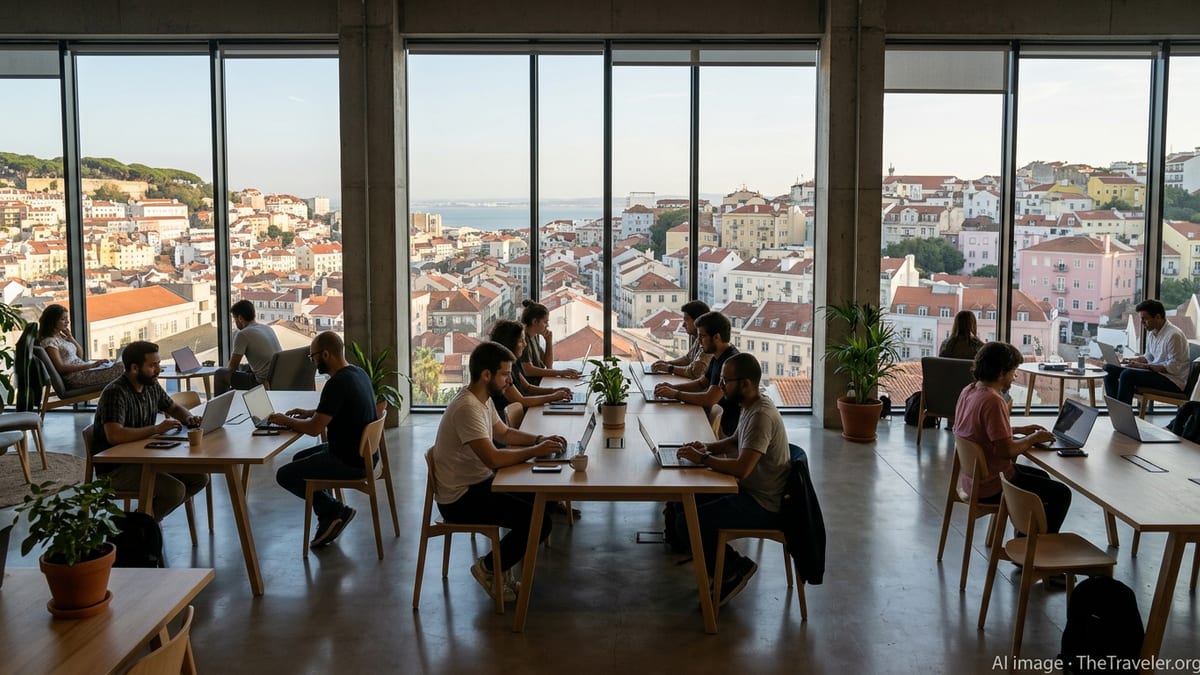
Methodology and Key Evaluation Criteria for Portuguese Cities
This analysis focuses strictly on work-enabling factors for digital nomads and remote workers, rather than tourism or lifestyle appeal. Cities and regions are compared on three primary dimensions: quality and reliability of internet connectivity, availability and diversity of workspaces, and the strength of local remote work and tech ecosystems, including networking opportunities and events.
Portugal’s overall fixed broadband penetration reached close to 90 percent of households by the end of 2024, indicating nationwide access to at least basic high-speed internet in urban areas. Mobile networks have also improved, with leading operators recording average mobile download speeds above 130 Mbps in 2025, giving cities a strong baseline for reliable remote work across both fixed and mobile connections.([telecompaper.com](https://www.telecompaper.com/news/portuguese-broadband-access-reaches-90-household-penetration-at-end-2024--1531634?utm_source=openai))
Within this national context, certain cities differentiate themselves through higher workspace density, more mature startup and tech ecosystems, and more established digital nomad communities. The ranking below highlights the most relevant locations for decision-grade relocation assessment, not a complete list of all possible towns suitable for remote work.
The selected cities and regions are: Lisbon, Porto, Madeira (with a focus on Funchal and Ponta do Sol), Braga, Coimbra, and the Algarve region’s main urban centers. Fundão is referenced as an example of an emerging inland hub that specifically targets remote workers, illustrating a secondary category of smaller but strategically positioned locations.([nomada.co](https://nomada.co/portugal/best-coworking-spaces-portugal/?utm_source=openai))
Lisbon: Primary National Hub for Remote Work
Lisbon is Portugal’s leading city for digital nomads from a work infrastructure perspective. It concentrates the country’s largest number of coworking spaces, including corporate-style offices, flexible hot-desk environments, and niche tech hubs. Estimates from local coworking guides indicate that hot-desk memberships often fall in the range of roughly 100 to 200 euros per month, with dedicated desks commonly between about 150 and 300 euros, reflecting significant supply and competitive pricing in the capital.([getnifportugal.com](https://getnifportugal.com/coworking-portugal-a-complete-guide-for-2024/?utm_source=openai))
Connectivity in Lisbon is generally strong. As part of a country that ranks in the upper tier globally for fixed and mobile speeds, Lisbon benefits from widespread fiber coverage to residential buildings and business districts. National data indicates average fixed broadband download speeds above 150 Mbps for major providers, while mobile speeds above 100 Mbps are typical in dense urban areas, more than sufficient for video conferencing, cloud-based workflows, and bandwidth-intensive professional tasks.([speedgeo.net](https://www.speedgeo.net/statistics/portugal?utm_source=openai))
Lisbon’s role as Portugal’s primary tech and startup hub complements this infrastructure. The city hosts major international tech events and a concentration of accelerators and venture-backed companies, which indirectly benefits remote workers by ensuring consistent demand for modern office space, stable network infrastructure, and a continuous calendar of professional meetups. Digital nomads who rely heavily on networking, client acquisition, or collaboration with startups will generally find Lisbon the most resource-rich environment in Portugal.([portugalbuyersagent.com](https://portugalbuyersagent.com/wp-content/uploads/2025/09/Goldcrest-Complete-Guide-to-Living-in-Portugal-Depending-on-Your-Lifestyle.pdf?utm_source=openai))
However, the scale and density that make Lisbon attractive for opportunity-driven remote workers also result in higher workspace utilization and more competition for the most popular coworking venues. For professionals prioritizing quieter work environments over ecosystem intensity, secondary cities may offer a better balance.
Porto: Secondary Tech Center With Strong Remote Work Foundations
Porto is Portugal’s second major hub for digital nomads, combining solid infrastructure with a slightly smaller scale than Lisbon. Coworking availability has expanded in recent years, with international and local operators offering flexible desks, dedicated spaces, and private offices. One large international provider lists flexible workspace access in Porto starting at just over 100 euros per month, with dedicated desks from the low 180s, comparable to mid-range Lisbon pricing but in a more compact market.([regus.com](https://www.regus.com/en-us/portugal/porto/coworking?utm_source=openai))
Internet connectivity in Porto aligns closely with national averages. Available data suggests typical fixed broadband speeds in urban Portugal often exceed 150 Mbps for leading providers, and remote worker reports commonly reference real-world speeds in the range of roughly 80 to 100 Mbps in coworking spaces and modern apartments in Porto. This performance is sufficient for most remote professionals, including those working with large file transfers, development environments, or streaming.([speedgeo.net](https://www.speedgeo.net/statistics/portugal?utm_source=openai))
Porto’s growing role as a regional tech hub is evidenced by inclusion in European rankings for mid-sized cities with strong investment strategies and a visible cluster of technology and creative companies. This translates into a stable pipeline of business tenants for coworking providers and a consistent schedule of meetups, hackathons, and professional communities that remote workers can tap into.([bpcc.pt](https://bpcc.pt/files/Guide-PT-TechHub-Where-work-meets-quality-of-living-web.pdf?utm_source=openai))
For digital nomads who seek a work-focused environment with substantial but not overwhelming community size, Porto often functions as a practical alternative to Lisbon. The combination of solid connectivity, diverse workspace options, and a recognizable tech scene makes it suitable both for short stays and longer remote work arrangements.
Madeira: Atlantic Remote Work Cluster Centered on Funchal and Ponta do Sol
Madeira, and particularly its capital Funchal along with the town of Ponta do Sol, has positioned itself as an Atlantic base for remote workers. Dedicated initiatives explicitly targeted at digital nomads have been launched in recent years, including the creation of a nominal “nomad village” concept in Ponta do Sol, which combines coworking facilities with structured community events for remote professionals.([portugalbuyersagent.com](https://portugalbuyersagent.com/wp-content/uploads/2025/09/Goldcrest-Complete-Guide-to-Living-in-Portugal-Depending-on-Your-Lifestyle.pdf?utm_source=openai))
Internet infrastructure on Madeira has been prioritized as part of these initiatives, with fiber connectivity available in key urban zones and coworking operators marketing high-speed, stable connections as a central feature. While island geographies can sometimes present latency issues, practical reports from remote workers typically note sufficient performance for standard professional use, including video calls and cloud collaboration. Madeira benefits from Portugal’s overall investment in broadband and mobile connectivity, with national mobile speeds now competitive within Europe.([telecompaper.com](https://www.telecompaper.com/news/portuguese-broadband-access-reaches-90-household-penetration-at-end-2024--1531634?utm_source=openai))
For digital nomads, Madeira’s advantage is not only connectivity but also the concentration of purpose-built remote work infrastructure in a relatively small area. Several coworking spaces, coliving facilities, and project-based communities coordinate events, mentorship, and networking circles focused on remote work topics. That structure can be particularly valuable for professionals looking to rapidly integrate into a pre-existing community where nearly everyone is working remotely.
However, the island context limits choice compared with Lisbon or Porto. The number of independent coworking brands and the scale of the startup ecosystem remain smaller, and professionals reliant on frequent in-person client meetings with mainland companies may find the flight connection overhead material. For location-flexible digital nomads, though, Madeira’s focused initiatives create a concentrated, work-friendly environment.
Braga and Coimbra: Medium-Sized Knowledge Hubs
Braga and Coimbra represent medium-sized cities that combine solid digital infrastructure with strong academic and innovation profiles. Both are part of the country’s northern and central knowledge corridors and host established universities and research institutions, which helps sustain a market for modern office infrastructure, labs, and high-speed connectivity.
Coimbra, as Portugal’s fourth-largest urban agglomeration, benefits from its role as a regional capital and home to a major university. The presence of a science and technology park, Coimbra iParque, indicates a deliberate effort to cluster innovative companies and digital activities, which indirectly supports remote workers by raising the baseline for connectivity and professional services.([en.wikipedia.org](https://en.wikipedia.org/wiki/Coimbra?utm_source=openai))
Braga, frequently mentioned among remote workers seeking alternatives to larger capitals, has gained recognition as an emerging digital hub with growing coworking supply and a tech-oriented labor market. While coworking density is lower than in Lisbon or Porto, digital nomads can typically access modern shared offices, incubators, and flexible spaces geared toward startups and freelancers, often at more moderate occupancy levels.
In both Braga and Coimbra, fixed broadband coverage is in line with national penetration, meaning that most urban neighborhoods can expect access to fiber or high-speed cable. For digital nomads, these cities offer a compromise: enough work infrastructure and connectivity to operate effectively, with smaller-scale communities that may appeal to those who prefer a less saturated nomad environment while still needing meaningful networking opportunities.
Algarve Urban Centers: Regional Hubs for Long-Stay Remote Work
Within the Algarve, cities such as Faro, Portimão, Lagos, and Tavira function as regional nodes for remote workers who prioritize a southern Portugal base but still require structurally sound work conditions. Although the region is better known internationally for tourism, recent years have seen an increase in coworking spaces, remote worker meetups, and dedicated events in its main towns, targeting long-stay remote professionals as well as seasonal visitors.([reddit.com](https://www.reddit.com/r/digitalnomad/comments/1mbecjz?utm_source=openai))
From a connectivity perspective, Algarve’s principal cities are integrated into the same national broadband and mobile networks that serve the rest of Portugal. As a result, core urban areas regularly offer fiber connections suitable for professional use. Rural pockets can be more variable, but for digital nomads who position themselves in or near city centers, connectivity is typically reliable enough for day-to-day remote work.
Workspace supply in Algarve remains more limited than in Lisbon or Porto but has become more diverse, with a mix of independent coworking venues, serviced offices, and hotel-based work lounges that sell day passes or monthly memberships. For nomads prioritizing medium-term stays, this can provide sufficient options, although those who rely heavily on highly specialized facilities (for example, recording studios or large event spaces) may find fewer choices than in the major metropolitan hubs.
Overall, Algarve’s primary relevance to this analysis lies in its ability to support long-stay remote workers who want a regional base without sacrificing reliable internet and at least basic coworking access. Digital nomads who prioritize deep integration into large-scale tech ecosystems, however, are more likely to view Algarve’s cities as secondary work locations rather than primary professional hubs.
Fundão and Other Emerging Inland Remote Work Hubs
A notable trend in Portugal’s remote work landscape is the emergence of smaller inland cities that explicitly position themselves as digital nomad and remote worker destinations. Fundão, in central Portugal, is an example: the municipality has promoted an expanding network of coworking spaces and innovation projects, actively marketing itself as a hub for technology, investment, and remote work communities in the country’s interior.([websummit.com](https://websummit.com/wp-media/2024/11/City_of_Fundo_-_Press_Release.pdf.pdf?utm_source=openai))
These initiatives typically combine repurposed municipal buildings, partnerships with national telecom providers, and incentives to attract startups and remote teams. For digital nomads, they offer an alternative to the coastal and metropolitan focus that defines most of Portugal’s established nomad hubs. In practice, this can mean access to modern coworking spaces with adequate connectivity, but in cities with much smaller populations and fewer pre-existing digital communities.
Connectivity in these emerging hubs remains fundamentally tied to national infrastructure. Since overall broadband penetration is high, inland urban centers usually have at least one or two fixed-line providers offering service at speeds sufficient for remote work. Mobile coverage can be slightly less dense than in major cities, making workspace-based connections more attractive for bandwidth-intensive tasks.
Digital nomads considering these emerging hubs should view them as highly focused environments: strong potential for productivity, immediate access to coworking infrastructure developed with remote workers in mind, and fewer distractions, but also smaller and less diversified professional networks compared with Lisbon, Porto, or Madeira.
The Takeaway
Portugal provides a nationally robust platform for digital nomads, with high broadband penetration and competitive mobile speeds, and several cities and regions stand out as particularly suitable for remote work. Lisbon is the primary choice for those who prioritize maximum coworking density, tech ecosystem depth, and networking potential. Porto offers a strong second hub with similar infrastructure at a slightly smaller scale, appealing to remote workers seeking a more compact environment without sacrificing work capabilities.
Madeira, centered on Funchal and Ponta do Sol, serves digital nomads through targeted programs and concentrated coworking ecosystems, making it attractive for professionals who value curated communities and do not mind an island context. Braga and Coimbra provide mid-sized knowledge hubs with reliable connectivity and growing workspace options, suitable for remote workers who want solid professional infrastructure in smaller cities. Algarve’s main urban centers and emerging inland hubs such as Fundão round out the landscape, offering viable alternatives for long-stay remote work with varying levels of community depth.
For relocation decisions, the critical differentiators among Portuguese cities are not basic availability of internet and coworking, which is broadly adequate nationwide, but the density of workspace options, maturity of tech and remote work ecosystems, and the scale of professional communities. Digital nomads should align city choice with their specific work patterns: whether they prioritize intensive networking, quiet productivity, or participation in curated remote work programs.
FAQ
Q1. Which city in Portugal offers the strongest overall ecosystem for digital nomads?
Lisbon offers the most comprehensive ecosystem, with the highest concentration of coworking spaces, mature startup and tech communities, and consistently strong connectivity across central districts.
Q2. How reliable is internet connectivity for remote work across Portuguese cities?
Internet reliability is generally high in urban Portugal, with national residential broadband penetration close to 90 percent and leading providers offering average fixed speeds well above typical remote work requirements.
Q3. Is Porto a viable alternative to Lisbon for long-term remote work?
Yes. Porto combines robust internet infrastructure, a growing coworking market, and an expanding tech ecosystem, making it a practical long-term base for remote workers who prefer a slightly smaller city.
Q4. What makes Madeira attractive specifically for digital nomads?
Madeira, especially Funchal and Ponta do Sol, hosts dedicated digital nomad initiatives, including organized coworking and event programs, providing a highly focused environment for remote professionals.
Q5. Are mid-sized cities like Braga and Coimbra suitable for remote workers?
Braga and Coimbra are suitable for remote work, offering solid broadband coverage, emerging coworking spaces, and knowledge-based economies supported by universities and innovation parks.
Q6. Can digital nomads work effectively from the Algarve region?
Yes, provided they base themselves in main urban centers such as Faro or Portimão, where fiber connectivity and coworking options are more readily available than in rural coastal areas.
Q7. Do smaller inland cities like Fundão have infrastructure for remote work?
Fundão illustrates how inland municipalities are developing coworking networks and innovation-focused initiatives to attract remote workers, backed by national broadband and mobile networks.
Q8. How important are coworking spaces for digital nomads in Portugal?
Coworking spaces provide stable high-speed connections, ergonomic work setups, and networking opportunities, which are particularly valuable for long-term digital nomads and fully remote employees.
Q9. Are mobile networks in Portuguese cities sufficient for working on the go?
Yes. Mobile networks in Portugal are competitive within Europe, with leading operators offering average download speeds above 100 Mbps in many urban areas, sufficient for calls and cloud-based tasks.
Q10. How should digital nomads choose among Portuguese cities for relocation?
Choice should be guided by work needs: Lisbon and Porto for dense ecosystems and networking, Madeira for curated nomad communities, mid-sized cities for balance, and Algarve or inland hubs for quieter, focused work environments.