


The United Arab Emirates has become a major destination for internationally mobile families seeking safety, education quality and stable urban environments. Within the federation, conditions vary significantly by city in terms of educational ecosystems, perceived safety and family-oriented infrastructure. This briefing evaluates the main UAE cities that feature most prominently in global safety rankings and host substantial expatriate populations, with specific focus on factors that matter to families moving abroad.
Methodology and Key Family Assessment Criteria
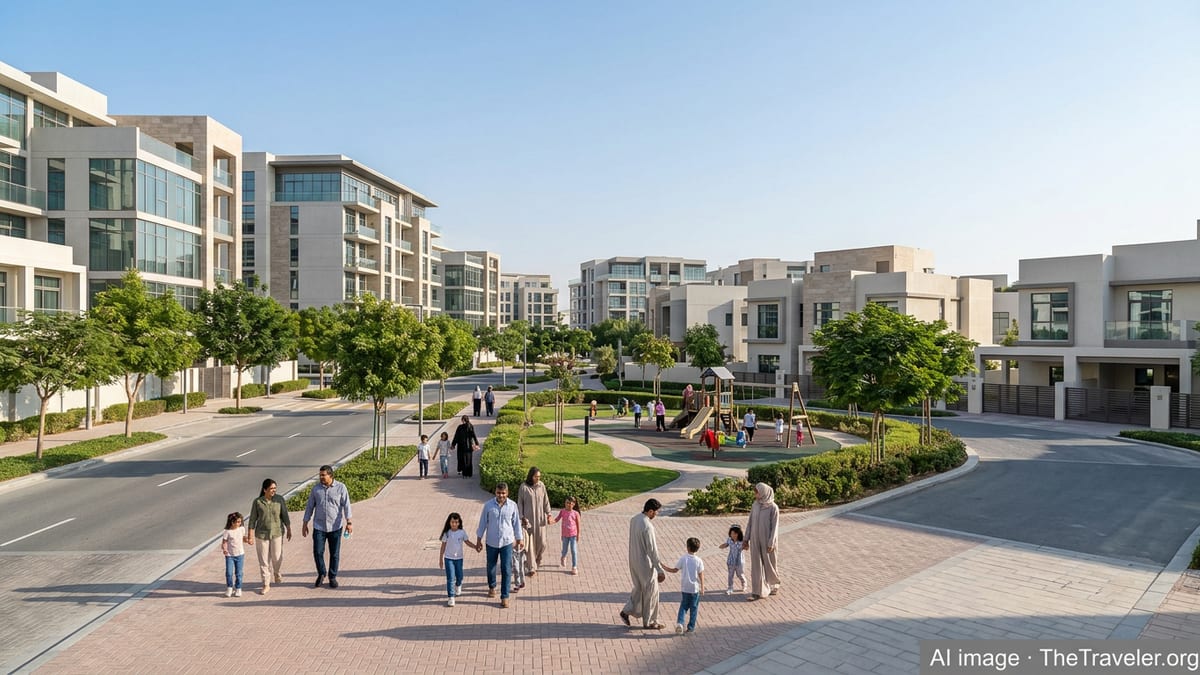
For globally mobile families, the suitability of a UAE city largely depends on three structural pillars. The first is safety and public order, including low crime rates and perceived security in public spaces. The second is access to regulated, quality-assured education from early years through secondary level, with sufficient capacity and curriculum choice. The third is the availability of family-oriented urban infrastructure including planned neighborhoods, parks and accessible daily services. This article compares key UAE cities against these dimensions.
Recent international safety indices consistently place multiple UAE cities in the top tier worldwide, with Abu Dhabi, Dubai, Sharjah, Ras Al Khaimah and Ajman all recording safety scores in the mid-80s or higher on a 0 to 100 index, where higher figures indicate stronger perceived safety and lower crime. Abu Dhabi’s safety index is reported around 88 to 89, with Ajman, Dubai, Ras Al Khaimah and Sharjah clustered roughly between 83 and 86. These benchmarks position several UAE cities among the safest globally for expatriate families.
The UAE’s private education sector is extensive and heavily regulated at emirate level. Dubai’s private school sector alone serves close to 400,000 students across more than 220 schools and at least 17 curricula, while Abu Dhabi and Sharjah also maintain sizable regulated private school markets. Oversight authorities such as Dubai’s Knowledge and Human Development Authority and Abu Dhabi’s Department of Education and Knowledge publish regular inspection outcomes, enabling families to benchmark school quality.
Urban-planning policies in the major emirates strongly emphasize master-planned residential communities, road connectivity and access to amenities. That said, the distribution of parks, walkable streets and neighborhood schools differs by city, which directly affects daily life for families. The following sections analyze the main candidate cities in more detail, identifying practical advantages and trade-offs for relocating households.
Dubai: Largest Education Hub and Diversified Family Ecosystem
Dubai is the primary entry point for many expatriate families and hosts the country’s largest concentration of international schools. According to recent private-school landscape data, Dubai now has more than 220 private schools serving close to 390,000 to 400,000 students, with enrolment having more than doubled since the late 2000s. The city offers at least 17 different curricula, including British, American, Indian, International Baccalaureate, and several national systems, allowing families to align schooling with home-country standards or future university destinations.
Education quality control is formalized through annual or biennial inspections, with schools graded on a multi-level scale ranging from weak to outstanding. Recent aggregated results indicate that roughly four out of five students in Dubai’s private sector attend schools rated good or better, reflecting a generally high baseline academic environment by regional standards. This gives relocating parents a relatively wide band of acceptable options, although places in the most sought-after schools can be competitive in specific year groups.
From a safety perspective, Dubai consistently places in the global top three of urban safety rankings, with a safety index near 84 and a corresponding low crime index in the mid-teens. For families, this translates into high perceived security in residential areas, shopping districts and public transport. Strict regulation, visible policing and extensive surveillance infrastructure contribute to the low reported incidence of violent crime compared with many global metropolitan areas of similar size.
For daily life, Dubai offers a broad range of family-oriented master communities such as villa compounds and mid-rise suburbs designed around schools, nurseries and local retail. The city’s extensive network of international early childhood centers and after-school activities supports dual-career households and structured child development. The main trade-offs for families considering Dubai relate to congestion on key commuting corridors and intense competition for places at top-tier schools, which requires early planning.
Abu Dhabi: High Safety Index and Planned Family Neighborhoods
Abu Dhabi, the federal capital, is another strong candidate for families prioritizing safety and structured urban development. In recent global city safety indices, Abu Dhabi ranks number one worldwide with a safety score close to 89 on a 100-point scale and an extremely low crime index slightly above 11, indicating one of the lowest recorded crime levels for any major city. This reinforces Abu Dhabi’s positioning as one of the most secure environments globally for raising children.
The emirate’s private school sector is overseen by the Department of Education and Knowledge, which operates an inspection framework commonly known as Irtiqaa. Schools are evaluated and rated on academic performance, leadership, student welfare and other parameters, which assists relocating families in identifying institutions that meet specific quality thresholds. The private education market here is smaller than Dubai’s but still diverse, with British, American, IB and Indian curricula well represented, especially on Abu Dhabi Island and key suburban districts.
Abu Dhabi’s urban layout is characterized by a mix of central high-rise districts and low-density planned communities on surrounding islands and mainland corridors. Family-friendly neighborhoods have been developed around schools, local malls and open spaces, with particular attention to road networks and parking. The city regularly appears in global quality-of-life and healthcare access rankings at or near the top tier for the Middle East, complementing its safety profile.
The pace of growth in Abu Dhabi is slower and somewhat more controlled than in Dubai, which can appeal to families seeking a quieter atmosphere and slightly less density. The main consideration for relocating households is the spatial dispersion of schools and workplaces, which often necessitates car commuting and careful selection of residential districts to manage travel times, especially for children attending schools off-island.
Sharjah: Conservative Family Environment and Interlinked Metro Area
Sharjah sits directly north of Dubai and functions as part of a larger conurbation while retaining a distinct identity. It also features prominently in global safety indices, ranking within the top five cities worldwide for safety, with a safety index in the low to mid 80s and a low crime index similar to its neighboring emirates. This positions Sharjah as a secure environment from a public-order perspective, a core requirement for expatriate families.
The emirate operates a regulated private-education sector that includes schools following British, American, Indian and national curricula. While the overall number of schools and students is smaller than in Dubai, families can still access a range of mid-market and higher-performing institutions, particularly in the more established residential districts. Local stakeholders frequently highlight perceived strengths in school discipline and academic focus, though top-tier international-brand schools are less numerous than in Dubai or Abu Dhabi.
Sharjah’s urban planning emphasizes residential neighborhoods, cultural institutions and green spaces, with numerous parks and libraries serving local communities. For many families, Sharjah’s appeal lies in its more traditional and community-oriented environment combined with comparatively lower housing and schooling costs relative to Dubai. However, a significant proportion of Sharjah residents commute daily to Dubai for work, which creates traffic congestion on main inter-emirate routes during peak hours.
For relocating families, Sharjah can be particularly interesting where one or both parents work within the emirate itself or can manage hybrid working patterns. It offers a high level of safety and a more conservative social environment that some households favor for child-rearing. The main operational challenge is managing cross-border commuting to Dubai if workplaces or specialist schools are located there.
Ras Al Khaimah: Smaller-Scale City With Strong Safety Metrics
Ras Al Khaimah, located in the northern part of the UAE, combines smaller-city scale with very strong safety metrics. In recent safety rankings it sits in the global top ten, with a safety index in the mid 80s and a very low crime index slightly above 16, broadly comparable to Dubai and Sharjah. This statistical profile indicates that serious crime is rare and public spaces are generally perceived as secure.
The city’s education infrastructure is more limited in size but includes a mix of national and international schools, with British, American and Indian curricula present alongside UAE national schools. Class sizes and campus density are typically lower than in Dubai, which some families find advantageous. However, specialist programs such as full International Baccalaureate pathways or niche language options may be less widely available, so parents with specific curricular requirements need to verify options carefully.
From an urban structure perspective, Ras Al Khaimah offers low to mid-rise residential districts and emerging master-planned communities. The road network is less congested than in the larger emirates, which can reduce daily commuting stress for families. Access to outdoor spaces is relatively straightforward, which supports child-friendly recreational routines, though high summer temperatures across the UAE still shape outdoor usage patterns.
Ras Al Khaimah is particularly relevant for families employed by local industrial, tourism or services employers in the emirate or nearby northern territories. It offers a strong safety backdrop and a quieter environment, but families whose employment or educational priorities are centered on the larger emirates may find the reduced number of high-end school choices a limiting factor.
Ajman: Compact City With High Safety Scores
Ajman, one of the smaller emirates by area, has risen in recent safety indices to a top-three global position, recording a safety index around the mid 80s and a crime index in the mid-teens. On raw safety metrics, this places Ajman on par with or slightly ahead of several larger UAE cities, confirming its strong performance in public security and low reported crime.
The emirate’s expatriate population often spans professionals working in Ajman itself as well as in neighboring Sharjah and Dubai. Ajman maintains a network of private schools, including schools following British, Indian and other international curricula. The sector is narrower than in Dubai, but it covers mainstream options adequate for many families, particularly at primary and lower secondary levels. For specialized high school programs or certain international brands, some households opt for daily commutes to Sharjah or Dubai.
Ajman’s compact size contributes to relatively short intra-city travel times, which can be a practical advantage for school runs and activities. Residential areas typically offer a mix of low to mid-rise buildings and villa districts. Public infrastructure and services are less extensive than in Dubai or Abu Dhabi but have expanded steadily alongside population growth, supported by inter-emirate road links.
For families evaluating Ajman, key considerations include the balance between strong safety performance and more limited top-tier education choice locally. Households whose employment base is in Ajman or western Sharjah may find the city an efficient and secure option, while those reliant on high-end schools may prefer to reside closer to the larger education hubs or plan for cross-emirate schooling.
Comparative View: How Leading UAE Cities Rank for Families
When viewed side by side, the principal family-relevant cities of the UAE share a common strength in public safety but diverge in education capacity and urban scale. The table below summarizes selected structural indicators that matter most for relocating households. Figures for school numbers and students are rounded estimates to illustrate scale rather than precise totals.
| City | Approximate safety index (0-100) | Relative private school scale | Education diversity | Urban scale and density |
|---|---|---|---|---|
| Abu Dhabi | ~89 | Large | Multiple major curricula | Large city, moderate density |
| Dubai | ~84 | Very large (220+ schools, ~400k students) | Highest curriculum diversity | Large, high-density metro |
| Sharjah | ~84 | Medium | Core international curricula | Mid-size, integrated with Dubai |
| Ras Al Khaimah | ~84 | Small to medium | Mainstream curricula | Smaller city, lower density |
| Ajman | ~86 | Small to medium | Core curricula | Compact urban area |
On safety alone, all of these cities perform strongly, with safety indices above 80 and crime indices in the mid-teens or lower. This consistency means that for most internationally mobile families, differences in safety are marginal compared with the much larger variation seen between the UAE and many other global destinations. The more decisive variables usually relate to schooling choice, enrollment capacity and the compatibility of urban scale with a family’s preferred lifestyle.
Dubai stands out for depth and breadth of education, with well over 200 private schools and nearly 400,000 students, which translates into extensive choice by curriculum, fee band and pedagogical approach. Abu Dhabi offers a slightly smaller but still substantial ecosystem with stringent quality oversight and very strong safety scores. Sharjah, Ras Al Khaimah and Ajman provide secure environments with more moderate school ecosystems that can be suitable for families whose employment and curriculum needs align with what is available locally.
Relocating families should therefore begin their evaluation by clarifying three priorities: preferred curriculum and education pathway, tolerance for urban density and commuting patterns, and acceptable range of school quality ratings. Once these parameters are defined, the choice between Dubai, Abu Dhabi or one of the smaller emirates often becomes significantly clearer.
The Takeaway
The UAE offers a rare combination of very high urban safety levels, extensive private education infrastructure and a policy focus on planned residential communities. For expatriate families, these structural features translate into a generally favorable environment for raising children, provided that decisions on city selection and school enrollment are made with accurate expectations and lead times.
Dubai and Abu Dhabi emerge as the primary choices for families prioritizing broad curriculum selection, higher-end international schools and large-scale urban amenities. Dubai provides the deepest and most diversified school market, while Abu Dhabi pairs slightly smaller scale with top global safety scores and a more measured growth profile. These cities are particularly suited to families in sectors with headquarters or regional offices located in the main business districts.
Sharjah, Ras Al Khaimah and Ajman offer appealing alternatives for households seeking a quieter, often more community-focused setting within a similarly safe national framework. Their education markets are more compact but still viable for many families, especially at primary levels and for mainstream curricula. They can be especially suitable when at least one parent works locally or when families are comfortable coordinating cross-emirate commuting to access specialized schools.
Overall, the best city in the UAE for any given family will depend less on safety, which is uniformly high, and more on the nuanced alignment between education offerings, commuting patterns and desired urban scale. A structured pre-move assessment that maps school options, inspection ratings and realistic travel times against employment locations will provide the most reliable foundation for a successful family relocation to the UAE.
FAQ
Q1. Which UAE city is generally considered safest for families?
Abu Dhabi consistently ranks first globally in safety indices, with a safety score close to 89 and one of the lowest crime indices worldwide, making it a leading choice for safety-focused families.
Q2. Which city offers the widest choice of schools and curricula?
Dubai has the largest and most diverse private school sector in the UAE, with more than 220 schools and at least 17 curricula, giving families the broadest range of international education options.
Q3. Are safety levels very different between Dubai, Sharjah, Ajman and Ras Al Khaimah?
Differences exist but are relatively small; all four cities record safety indices above 80 and low crime indices, putting them in the global top tier for urban safety.
Q4. Is Sharjah a practical option for families working in Dubai?
Yes, many families live in Sharjah and commute to Dubai, but rush-hour congestion on inter-emirate roads can significantly extend travel times, so commuting patterns should be assessed carefully.
Q5. How does Ras Al Khaimah compare for schooling?
Ras Al Khaimah offers a smaller but growing mix of national and international schools covering mainstream curricula; however, it has fewer top-tier international-brand schools than Dubai or Abu Dhabi.
Q6. Is Ajman suitable for families with school-age children?
Ajman maintains a network of private schools, particularly in British and Indian curricula, and offers high safety scores; families needing highly specialized or premium schools may need to look to nearby emirates.
Q7. Do inspection ratings exist for schools across the UAE?
Yes. Regulatory authorities in major emirates, such as Dubai and Abu Dhabi, publish regular inspection reports and school ratings, which families can use to compare education quality.
Q8. Which city suits families seeking a quieter environment?
Ras Al Khaimah and Ajman, along with certain parts of Sharjah, generally offer a smaller-scale, quieter urban environment compared with the more intensive metropolitan setting of central Dubai.
Q9. How important is city choice if safety is strong across the UAE?
Because safety is uniformly high, city choice is driven more by education availability, commuting times and preferred urban scale rather than by major safety differentials.
Q10. What is the most important first step when selecting a UAE city as a family?
The most effective first step is to define preferred school curricula and quality thresholds, then map rated schools and realistic commuting times in each candidate city against employment locations.