


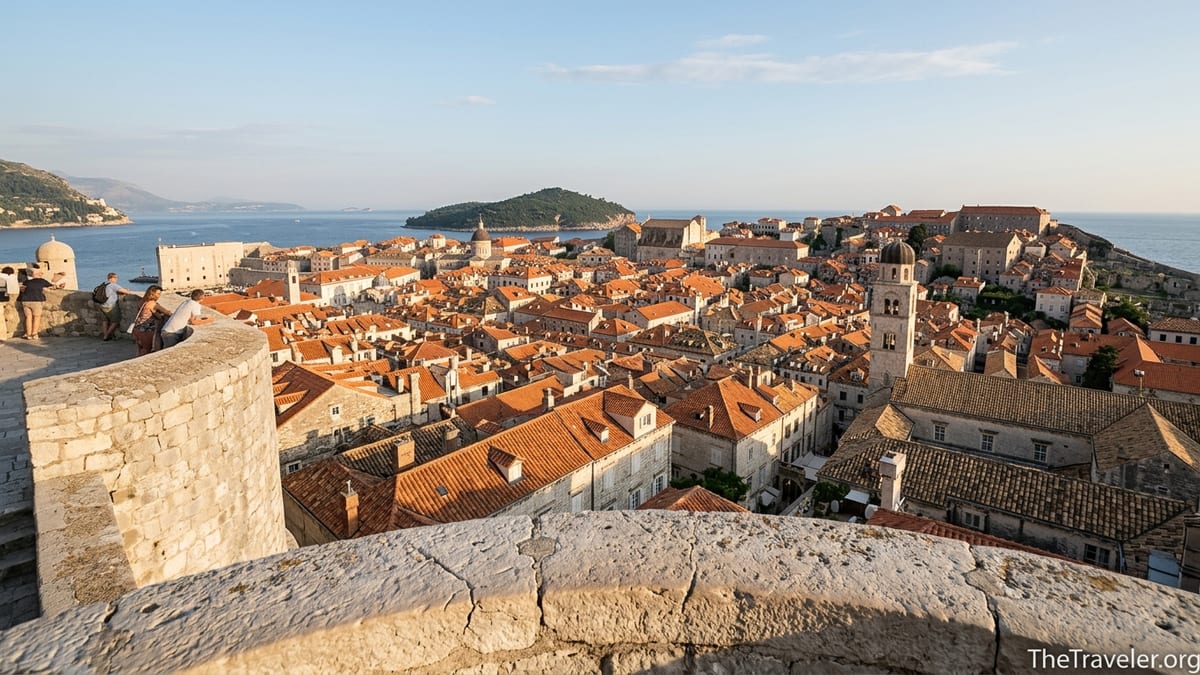
Rising above Dubrovnik’s medieval walls, Minčeta Tower is more than a defensive stronghold. It is the city’s stone crown and one of the finest vantage points on the Adriatic for photographers. From its circular ramparts, you look down on a tight mosaic of terracotta rooftops, church domes and narrow lanes, with the Adriatic Sea and distant islands framing the scene. Whether you travel with a phone, a compact camera or a full kit of lenses, understanding where and how to shoot around Minčeta can turn a quick visit into a portfolio-worthy session.
Get the latest updates straight to your inbox!
Why Minčeta Tower Matters for Photography
Minčeta Tower sits at the highest point of Dubrovnik’s city walls, about 25 meters above the defensive circuit and roughly 37 meters above the Old Town streets. It was completed in its current circular form in the mid-15th century and has long symbolized the city’s resilience. For photographers, its height and position on the north side of the walls translate into almost uninterrupted 360-degree views over the Old Town, the slopes of Mount Srđ and the Adriatic Sea beyond.
From the top platform you can frame classic Dubrovnik scenes in every direction. To the south, terracotta roofs pack together in an intricate pattern broken by the bell towers of the Franciscan and Dominican monasteries. To the east, you can include the Old Port, small boats and the outline of Lokrum Island. Looking west, Fort Lovrijenac stands on its separate rocky outcrop across a narrow channel, giving you a strong focal point for more dramatic compositions.
Minčeta is also instantly recognizable to fans of popular culture. It appeared as the House of the Undying exterior in the second season of Game of Thrones, which means many visitors arrive with a specific shot in mind. The good news is that even if you are not recreating a film still, the combination of curved ramparts, stone textures and layered rooftops makes it hard to come away with a dull frame.
Access to Minčeta Tower is controlled through the Dubrovnik City Walls circuit. As of spring 2026, a standard adult walls ticket costs around 40 euros and includes Minčeta along with the full 2-kilometer loop. That price may feel steep if you are only thinking of a quick look, but for serious photographers the variety of angles, including those at the tower, usually makes it one of the best-value expenses in the city.
Reaching the Tower and Planning Your Light
You typically access Minčeta Tower by starting the walls walk at Pile Gate on the western side of the Old Town. The route snakes along the sea-facing walls first before turning inland and gradually climbing toward the north side, where Minčeta dominates the skyline. Expect a mix of gentle ramps and staircases; by the time you reach the tower you will have climbed several hundred steps. Independent travelers and photographers on blogs and forums often estimate roughly 750 total steps on the full circuit, with a noticeable concentration around Minčeta.
In high season, Dubrovnik’s walls open in the morning and close around late afternoon or early evening, with exact hours shifting slightly month to month. Recent visitors in 2025 and 2026 mention first entries typically around 8:00 in summer and later in the off season, with the last entry time set so that visitors can clear the walls before dusk. It is smart to verify daily hours on arrival in Dubrovnik, but as a rule of thumb, sunrise light is best caught by entering as early as the ticket office allows, while late afternoon visits give you warm side light and long shadows across the roofs.
For most photographers, two times of day stand out for Minčeta. Early morning in summer brings soft light from the east, which gently illuminates the Old Town and reduces contrast between sunlit roofs and shaded alleys. Crowds are also thinnest then, meaning it is easier to grab a clean composition of the tower itself from neighboring viewpoints without lines of people on the ramparts. Late afternoon and the run-up to sunset cast a warm glow across the rooftops and can paint the north-facing slopes of Mount Srđ in golden tones, though the light can be quite strong, so bracketing exposures or using your camera’s HDR mode can help retain detail.
Weather also plays a big role. On hazy days, far-off islands will recede into pale blue, giving your backgrounds a more painterly quality but less crisp detail. After a rain shower, the terracotta tiles and stonework of the tower darken slightly, which can add richness and contrast in photos. Summer heat can push temperatures well into the 30s Celsius, so if you are carrying gear, consider a lightweight sling bag and bring water; there are small cafes on sections of the walls, but you will not find one directly on top of Minčeta.
The Signature Views From the Top Platform
The main photography reward at Minčeta is the circular top platform, reached by a calm but narrow spiral staircase. When you emerge at the summit, you step onto a stone ring with a low parapet that allows you to walk all the way around. From here, you can shoot in any direction, but three angles tend to produce the most compelling images.
Facing south, you get the quintessential Dubrovnik roofscape. With a standard zoom lens at around 24 to 35 millimeters on a full-frame camera, you can frame a dense field of orange tiles leading toward the main street of Stradun, with bell towers and church domes breaking the pattern. Many photographers choose to shoot at f/8 to f/11 here, keeping everything sharp, and then stitch several frames into a panoramic image later. Even with a smartphone, the built-in panorama mode used from this position often yields a sweeping, high-resolution image suitable for large prints.
Turn east and you can bring in the Old Port and Lokrum Island. A focal length of roughly 35 to 50 millimeters lets you balance the top of the walls in the foreground, the curve of the harbor and the forested island in the background. In late afternoon, this direction can be especially attractive because the low sun reflects off the water, creating a glittering path past the moored boats. If you prefer a more compressed look, a short telephoto around 70 to 100 millimeters works well to stack layers of masts, walls and the island into a tighter frame.
Looking west, you will find one of the most dramatic compositions: the bold profile of Fort Lovrijenac on its rocky headland. From Minčeta’s platform, use the parapet as a leading line that curves out of the frame toward the fortress. At around 70 millimeters, you can fill the upper part of the frame with the fort and the sea beyond, while the lower portion holds the rhythm of rooftops and alleys. Photographers planning editorial-style images often choose this direction for magazine spreads because it captures both the human scale of the city and the stark mass of its defenses.
Photographing the Tower Itself From Nearby Walls
Some of the best photos around Minčeta do not come from the top of the tower but from viewpoints that include the structure as the subject. As you approach along the northern stretch of the walls, the tower’s rounded profile and Gothic crown appear ahead, rising above the lower sections like a stone mushroom. This segment of wall runs roughly parallel to the base of Mount Srđ, which means the light often hits Minčeta from the side, bringing out the textures in the stonework.
One popular spot lies just east of the tower, where the ramparts bend slightly and offer a partially unobstructed view of Minčeta framed by a sequence of lower battlements. With a mid-range focal length around 50 millimeters, you can place the tower slightly off-center and use the line of the wall as a natural guide leading the eye toward it. Because this is on the route every visitor takes, patience is key: wait for a lull in foot traffic or embrace the presence of a few figures in the frame to convey scale.
Another angle sits west of Minčeta, where the path rises and narrows alongside crenellated walls. From here you can capture the tower in profile with the sea barely visible in the distance. Travel photographers often favor this view when illustrating the defensive system as a whole. Shooting at f/4 to f/5.6 gives a shallow enough depth of field to keep Minčeta crisp while gently softening the background, which can help separate the tower from busy rooftop patterns.
If you are equipped with a longer lens, such as a 70–200 millimeter zoom, you can also extract tighter architectural studies as you move around the northern walls. Details like the small arrow slits, stone corbels and the thick base of the tower become subjects in their own right. In softer light, especially on overcast days, these close-ups can be surprisingly effective in black and white, highlighting the play of light and shadow in the masonry.
Framing Rooftops, Courts and Everyday Life Below
Beyond grand panoramas, Minčeta Tower offers many chances to document the everyday life of Dubrovnik from above. Directly beneath the northern side of the walls, a modern basketball court has become something of a minor icon itself, with bright markings set against worn stone and cafes. From specific notches along the tower’s lower levels, you can aim straight down onto the court, capturing players as small figures surrounded by the geometry of fences and backboards. This contrast between medieval fortifications and contemporary recreation makes for one of the more memorable images you can bring home.
Looking back toward the center of the Old Town, lenses in the 85 to 135 millimeter range are excellent for finding small scenes on terraces and in courtyards. You might spot laundry hanging between windows, a restaurant terrace preparing for the lunch rush, or a narrow lane with only a single pedestrian crossing sunlit cobblestones. A fast prime lens, even an affordable 50 millimeter f/1.8, lets you isolate these details by opening up to wider apertures while still keeping shutter speeds high enough to avoid blur from hand shake.
The height of Minčeta also makes it a good place to experiment with layered compositions. For example, you can place a row of chimneys or a section of crenellations out of focus in the foreground, then render a church tower or harbour detail sharply in the middle distance. Smartphone photographers can mimic this by physically moving closer to a foreground element on the parapet and tapping on the distant subject to focus. The resulting depth adds sophistication to images that might otherwise feel like straightforward postcards.
Finally, be ready for fleeting light. Late in the day, narrow shafts of sun can slip between taller buildings and strike a single facade or dome while the surrounding roofs fall into shadow. Shooting in aperture priority mode with exposure compensation control makes it easy to quickly adjust and preserve highlight detail when these moments appear. If your camera offers it, enabling highlight warnings and briefly reviewing critical shots on the LCD can save you from discovering blown-out patches when you get back to your hotel.
Gear, Settings and Practical Tips for the Climb
While it is perfectly possible to capture strong images of Minčeta Tower with nothing more than a recent smartphone, bringing a considered kit can expand your options. Many photographers visiting Dubrovnik in 2025 and 2026 report using a full-frame or APS-C mirrorless camera with a standard zoom such as a 24–70 millimeter lens as their main tool on the walls. This range covers almost all of the classic compositions from the top platform and neighboring walls without the need to change lenses in crowded, often windy conditions.
If you want to go further, a lightweight telephoto zoom in the 70–200 millimeter range is extremely useful for compressing the roofscape and picking out details like the Old Port, Lokrum Island or Fort Lovrijenac. On the other hand, an ultra-wide lens, such as a 16–35 millimeter zoom, can help when space is tight on the ramparts and you want to exaggerate the curve of the walls or include both the parapet and a dramatic sky in a single frame. For minimalist travelers, a single 28 or 35 millimeter prime lens can encourage more thoughtful composition while remaining discreet and easy to carry.
In terms of camera settings, daylight around Minčeta is generally abundant, so you can safely keep ISO at 100 or 200 for optimal quality. Apertures between f/5.6 and f/11 provide plenty of depth of field for cityscapes, while shutter speeds will usually remain faster than 1/250 of a second, even at mid-range focal lengths. For hand-held panoramas, lock your exposure by using manual mode or exposure lock so that the brightness remains consistent across the sweep, making stitching easier in post-processing.
Tripods are not practical on the city walls. The paths are narrow, there is constant foot traffic and staff may ask you to fold or remove anything that obstructs movement. Instead, rely on image stabilization and careful hand-holding technique: tuck your elbows in, exhale gently as you press the shutter and use railings or parapets for support when possible. Filters can occasionally be useful, particularly a circular polarizer to manage reflections on the sea and deepen the blue of the sky, but be cautious about over-polarizing, which can create uneven patches in wide-angle shots.
Comfort matters as much as gear. Wear non-slip shoes, especially in summer when stones can become slick with dust and sunscreen. In July and August, when midday temperatures often exceed 30 degrees Celsius, consider starting your walls walk as soon as the gates open or in the late afternoon, allowing yourself time to reach Minčeta without rushing. A small microfiber cloth in your pocket is handy for wiping sweat or sea mist from lenses and phone screens, which can otherwise soften your images.
The Takeaway
Minčeta Tower rewards photographers who take the time to understand its many angles. From the top platform’s all-around panorama to the more intimate frames of rooftops, courtyards and the basketball court below, it offers a compact but varied portfolio of scenes that capture both Dubrovnik’s grandeur and its everyday life. Careful timing, thoughtful lens choices and a willingness to pause and observe rather than simply pass through can transform a standard sightseeing stop into the highlight of a photographic trip along the Adriatic.
With a single walls ticket you gain access not just to Minčeta but to a continuous balcony above one of Europe’s most photogenic old towns. Make space in your itinerary to walk slowly, circle the tower more than once and experiment from different heights and directions. Whether you leave with a stitched panorama destined for your living room wall or a set of subtle details for a personal photo essay, the climb to Minčeta Tower is likely to be one of the most productive hours you spend in Dubrovnik.
FAQ
Q1. Do I need a separate ticket for Minčeta Tower?
Entry to Minčeta Tower is included in the Dubrovnik City Walls ticket, which also covers the full circuit around the Old Town. There is no separate ticket specifically for the tower.
Q2. How long should I plan for photographing Minčeta Tower?
If you are mainly interested in the tower and a few nearby viewpoints, allow at least one to one and a half hours. Photographers who want to walk the entire walls circuit and stop frequently for images often spend two to three hours in total.
Q3. Is Minčeta Tower suitable for travelers afraid of heights?
The tower is high, but the parapets are solid and reasonably tall. Many visitors with mild discomfort around heights manage it without trouble, though those with severe vertigo may feel uneasy on the narrow sections of wall and spiral staircase.
Q4. Can I visit Minčeta Tower at sunset?
City walls opening hours change through the year, and closing time is usually set before full darkness. In summer, late-afternoon and early-evening light can still be excellent, but you are unlikely to stay for true night photography from the tower itself.
Q5. Are tripods allowed on Minčeta Tower?
Large tripods are generally discouraged on the city walls because the walkways are narrow and busy. Staff may ask you to fold or remove anything that blocks the path. A compact travel tripod that stays close to your body or hand-held techniques are more practical choices.
Q6. What is the best lens for photographing from Minčeta?
A standard zoom, such as a 24–70 millimeter lens on a full-frame camera, covers most classic views. If you have room in your bag, adding a telephoto lens up to 200 millimeters helps for tighter compositions of rooftops, the harbor and distant forts.
Q7. Can I get good photos from Minčeta with just a smartphone?
Yes. Modern smartphones handle the bright daylight on the walls well, and their panorama modes are excellent for sweeping roofscape shots. Using the built-in wide and telephoto lenses thoughtfully can give you a surprising variety of perspectives.
Q8. Is there shade or seating near Minčeta Tower?
The top of the tower is fully exposed, and shade is limited. Some sections of the nearby walls have small shaded recesses or cafes, but plan for strong sun and bring water, especially in summer.
Q9. How crowded does Minčeta get during peak season?
In July and August, the city walls can be very busy from mid-morning through mid-afternoon, and the spiral staircase to the top of Minčeta may form a short queue. Early entry when the walls first open or visits later in the afternoon usually mean fewer people in your frame.
Q10. Are there alternative viewpoints of Minčeta Tower from outside the walls?
Yes. Certain spots on nearby hillsides and streets to the north provide views back toward the walls with Minčeta prominent in the skyline. Locals sometimes recommend small parks and streets just outside the landward side of the Old Town for photographing the tower from below.