


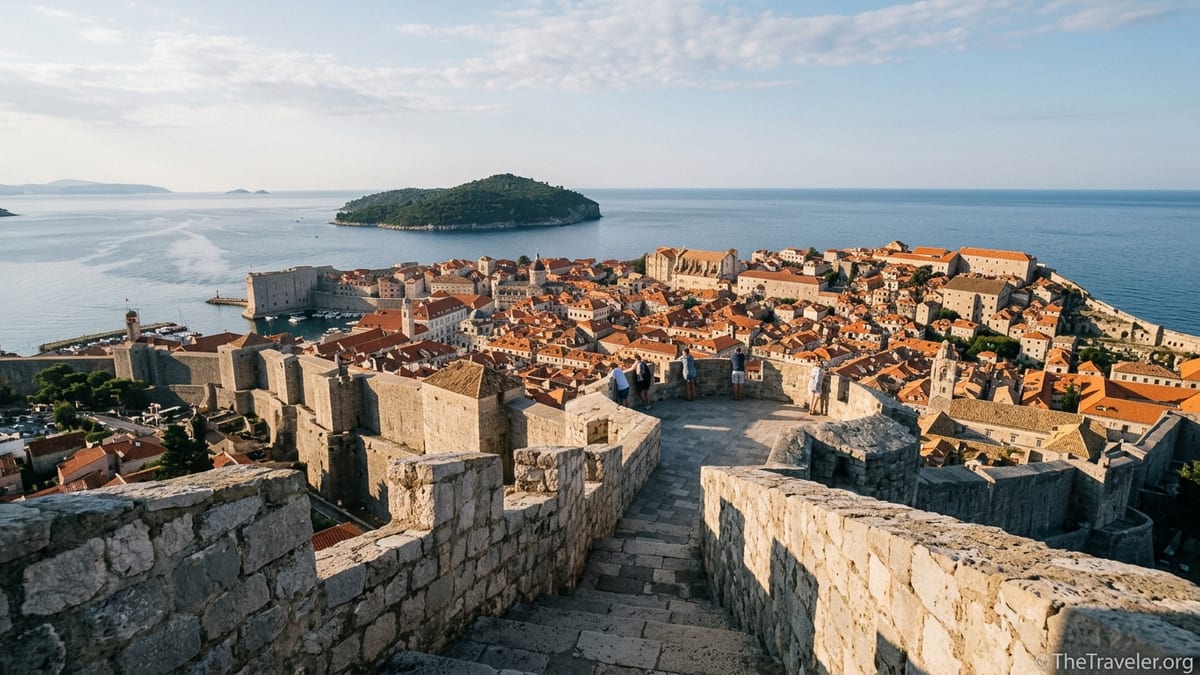
Seen from the sea, Minčeta Tower looks impregnable, crowning Dubrovnik’s medieval walls with a perfect stone halo. Up close in summer, it can feel just as impenetrable, with slow‑moving lines of visitors on the staircase and barely enough space at the top for a quick photo. Yet with a little timing strategy, you can experience this spectacular viewpoint with room to breathe, even in a city that has become a symbol of overtourism.
Get the latest updates straight to your inbox!
Why Timing Matters So Much at Minčeta Tower
Minčeta Tower is not a standalone attraction. It is the highest point on Dubrovnik’s city walls, and you can only access it as part of the full circuit around the Old Town ramparts. That means your crowd experience at Minčeta will always mirror what is happening on the walls in general. When the walls are heaving with tour groups and cruise passengers, the narrow spiral staircase inside Minčeta can bottleneck, and the top platform becomes shoulder‑to‑shoulder with selfie sticks.
Dubrovnik is one of the most seasonal destinations in Europe, with visitor numbers in peak summer many times higher than in January. Local tourism reports and airline data show that the bulk of arrivals are concentrated from June to early October, with the heaviest pressure in July and August. In those months, the difference between walking the walls at midday and walking them at 8 in the morning can feel like visiting two different cities entirely.
Because Minčeta is the symbolic “high point” of the circuit, many people stop for longer here than at other bastions. They queue for the exact corner where the classic photo is taken, looking south across terracotta roofs toward the island of Lokrum. As a result, crowding feels more intense here than along most other stretches of the walls. Understanding the daily and seasonal rhythms of Dubrovnik is the key to claiming a quieter moment.
Best Seasons to Visit for Fewer Crowds
If your dates are flexible, the single most effective way to enjoy Minčeta Tower with smaller crowds is to avoid the peak season of late June through August. Local and regional guides consistently describe November to March as Dubrovnik’s low season, with April, May, late September and October forming a gentler “shoulder” period. In practical terms, this means fewer cruise calls, more availability in hotels and apartments, and noticeably thinner lines at the city walls entrances.
Winter, from December to February, offers the quietest overall experience. You might share the top of Minčeta with just a handful of other visitors on a weekday morning. Accommodation prices are generally lower than in summer, and the Old Town has more of a local feel. The trade‑off is shorter daylight, cool temperatures that can drop near freezing at night, and a real possibility of rain or a brisk north wind. You will want a warm layer and non‑slip shoes on the often smooth stone steps leading up to the tower.
The sweet spot for many travelers is spring and early autumn. In April and May, daytime highs typically sit in the mid‑teens to low 20s Celsius, warm enough for a coffee at an outdoor terrace but not so hot that climbing the walls feels punishing. Restaurants, ice‑cream stands, and boat tours are open, yet crowd density is still moderate except around Easter and major holidays. Similarly, the weeks from mid‑September to mid‑October combine warm sea temperatures with noticeably lighter foot traffic on the ramparts compared with August. In these months, a morning visit to Minčeta can feel almost leisurely.
Summer remains attractive for many visitors, thanks to long days, swimming weather and the Dubrovnik Summer Festival in July and August. If you are tied to school holidays and must travel then, you can still have a rewarding visit to Minčeta by leaning hard on time‑of‑day tactics and being selective about which days to climb the walls, as outlined below.
Time of Day: The Single Biggest Crowd Hack
Regardless of month, time of day will shape your experience at Minčeta Tower more dramatically than almost anything else. In high and shoulder seasons, most organized groups and day‑trippers from cruise ships converge on the walls from about 9:30 or 10:00 in the morning, peaking around late morning and again in mid‑afternoon. Independent travelers who stroll up after a lazy breakfast tend to join this same window, creating dense, slow‑moving traffic on the steps and along the viewpoints.
By contrast, the first hour after opening is usually the quietest. In recent seasons, the walls have typically opened at 8:00 in the morning during the main visitor months, with slightly shorter hours in winter. Exact times can vary by month, so it is worth checking the latest schedule shortly before your trip or confirming with your accommodation. If you are at the Pile Gate entrance a few minutes before opening, you will often find yourself among the first twenty or thirty people onto the circuit.
Walking clockwise from Pile, you will need roughly 25 to 35 minutes at an unhurried pace to reach Minčeta, including a few photo stops along the way. That puts you on the tower still within the first hour of opening, when the stone is cool, the light is soft, and the bulk of groups have not yet arrived. Many travelers who follow this pattern report that they had time to linger, take photos from several angles, and even sit quietly along the parapet to absorb the view without feeling jostled.
An alternative is to aim for the last 90 minutes before closing. In summer, this often means starting your circuit around 17:30 or 18:00. By then, day‑trippers are drifting back to their buses or cruise ships, and the sun is lower in the sky, giving Minčeta a warm, side‑lit glow. Heat radiating from the stone can still be intense in July and August, but crowd levels are usually lower than midday. What you should avoid, whenever possible, is starting between about 10:00 and 16:00 on days when several large ships are in port. That is when the tower staircase can clog, and you may find yourself queuing just to move a few meters forward.
Picking the Right Day: Cruise Ships, Weekends and Events
Because Dubrovnik’s visitor load is heavily influenced by cruise arrivals, the day you choose for Minčeta Tower can make almost as much difference as the time you go. On days when two or three large ships are docked, several thousand passengers descend on the Old Town between mid‑morning and mid‑afternoon, often as part of guided city walls tours. Local residents and repeat visitors often plan their own walls walk on days with fewer or no cruise calls, and shift to island or countryside excursions on heavy ship days.
Before your trip, it is worth checking a recent cruise schedule for Dubrovnik for your planned dates. These are typically published by the port authority and mirrored on various travel sites. For example, if you see that a 3,000‑passenger vessel is due in port on Wednesday and Friday, but Tuesday has only a small ship or none at all, book your walls visit for the Tuesday if your itinerary allows. Travelers who follow this approach often report a noticeably more relaxed experience, both on the circuit and at the top of Minčeta.
Weekends in peak season can bring additional pressure as regional visitors and Croatians from other parts of the country join international tourists. Public holidays, such as national days or religious feasts, may also bring local crowds into the Old Town in the evening. While these festivals can be a highlight, they are not ideal times to look for solitude at Minčeta’s viewpoint. If your stay overlaps with major events like the Dubrovnik Summer Festival in July and August or New Year celebrations in December, consider visiting the tower on a regular weekday morning rather than on opening or closing nights when the city is particularly busy.
Finally, keep an eye on weather forecasts. A forecast of showers or strong winds can deter some visitors, occasionally leading to a quieter morning even in middle season. The walls can close or restrict access in severe weather for safety reasons, but light rain or overcast skies often mean more space at the railings. Pack a lightweight waterproof layer, and you may be rewarded with atmospheric photos of the red roofs beneath dramatic clouds and very few people in frame.
Practical Ticket Strategies and Access Tips
To reach Minčeta Tower you must have a valid ticket for Dubrovnik’s city walls. In 2026, prices have continued to be relatively high by regional standards, with adult tickets costing the equivalent of several dozen euros. Many visitors now opt for the Dubrovnik Pass, a city card that includes entrance to the walls along with selected museums, galleries, and local bus rides for a set number of days. The card typically costs only slightly more than a standalone walls ticket, and can represent good value if you plan to visit even a couple of the included sites.
There are multiple entry points to the walls, but the most commonly used is near Pile Gate, just outside the western entrance to the Old Town. This is also where queues can be longest in high season. If you arrive close to opening time, you will usually find only a short line. By late morning on a busy July day, you can easily wait 20 to 30 minutes to buy a ticket and climb the initial stairs. To streamline the experience, consider purchasing your ticket or city pass online in advance if the current system allows, or the day before in person when you walk past the kiosk in the evening.
Once on the walls, follow the one‑way system and resist the temptation to stop for extended photos at the very first viewpoints. You will encounter equally spectacular panoramas later on, and pushing ahead of the initial cluster of people can leave you with more open space at Minčeta. If you are prone to vertigo, keep in mind that some sections of the walls are relatively high and narrow, with low parapets on the sea side. The interior steps inside the tower itself are confined and spiral upward, which can feel challenging during very busy times. Another advantage of early or late visits is that these stairs are less congested, giving you time to climb at your own pace.
Wear supportive footwear with good grip. The stone can be polished smooth from centuries of footsteps, and in hot months the surface gets very warm. Carry water, especially in summer, since shaded spots are limited and there is no elevator access. There are small cafes and kiosks along the circuit where you can buy drinks, but prices are often higher than in the streets below. Having a bottle with you allows you to pause on the quiet side of Minčeta, away from the main photo corner, and simply enjoy the view without needing to hurry to the next refreshment stop.
What to Expect on the Tower at Different Times of Year
In winter, your experience atop Minčeta Tower will likely be shaped by weather rather than crowds. On a clear day in January, the low sun gives the Old Town a pale golden light and the Adriatic a steel‑blue tone. You might encounter a couple of small tour groups and a scattering of independent travelers, but you can usually find a stretch of parapet all to yourself. The main thing to watch for is wind chill. Even if the air temperature reads 10 degrees Celsius, a northerly breeze funneled along the ramparts can feel much colder, so gloves and a hat are a good idea.
In spring, especially in April and early May, Minčeta tends to feel lively but manageable. School and university groups appear, yet there are usually gaps between them. If you time your visit for 8:00 or 8:30 in the morning, you may find that you share the tower only with a few photographers and dedicated early risers. Wildflowers and greenery begin to soften the stone around the base of the walls, and the light is often crisp and clear, ideal for capturing the grid of terracotta roofs without harsh shadows.
Summer transforms the tower into one of the hottest spots in the city, quite literally. By midday in July, temperatures frequently climb well above 30 degrees Celsius, and the stone underfoot radiates heat. At this time, crowd density can be such that you need to wait for a turn at the most popular angles, such as the north‑facing view back over the sea of rooftops. Travelers who must visit in July or August often plan their walls circuit for as close to opening or closing time as possible and pair it with a cooling swim at nearby Banje Beach or a shaded lunch in the Lapad district later in the day.
By late September and into October, the mood shifts again. Daytime temperatures soften, cruise calls thin somewhat, and the angle of the sun gives the city a mellow, honeyed tone in the late afternoon. This can be an ideal time for photographers, with fewer heat hazes and more locals going about their routines in the streets below. A weekday visit at 17:30 on a calm October evening can deliver the classic Dubrovnik skyline with only a small cluster of people at the parapet, leaving you free to frame your shots of Lokrum Island and the inland hills without constant jostling.
The Takeaway
Minčeta Tower rewards careful timing. Although Dubrovnik has become a textbook example of seasonal overtourism, you do not have to accept a crowded, rushed experience at its most famous viewpoint. By combining an off‑peak season visit with an early morning or late afternoon start, choosing a day with fewer cruise arrivals, and buying your ticket or pass in advance, you dramatically increase your chances of stepping onto the tower platform with space to move and time to linger.
If your schedule locks you into the height of summer, set expectations realistically, but know that strategy still pays off. Aim for the first or last hour of opening, carry water and sun protection, and avoid starting your circuit in the middle of the day. Even in August, there are brief windows when the walls fall quiet between tour groups, and a little patience can win you a few minutes almost alone with the view.
Whichever month you travel, consider Minčeta not just as a photo stop, but as a place to pause and connect with Dubrovnik’s deeper story of resilience, trade, and maritime power. Looking out from the highest point of the fortifications in relative calm, it is easier to imagine the centuries of sailors, merchants and defenders who once depended on these walls. For many visitors, that quieter moment at the top turns out to be one of the most lasting memories of their time in the city.
FAQ
Q1. What is the least crowded month to visit Minčeta Tower and the walls?
November through March are generally the least crowded months, with January and February often the quietest. Spring and autumn are busier but still far calmer than July and August.
Q2. What time of day is best to avoid crowds at Minčeta Tower?
The first hour after opening is usually the quietest, followed by the last 60 to 90 minutes before closing. Midday, especially between about 10:00 and 16:00 in summer, is typically the most crowded.
Q3. Do I need a separate ticket for Minčeta Tower?
No. Minčeta Tower is part of the Dubrovnik city walls circuit, so a standard walls ticket or a valid Dubrovnik Pass includes access. There is no separate tower ticket.
Q4. How long does it take to walk from the entrance to Minčeta Tower?
From the main entrance near Pile Gate, most visitors reach Minčeta in about 25 to 35 minutes at a relaxed pace, including a few short photo stops along the way.
Q5. Is Minčeta Tower suitable for people with mobility issues?
Access involves multiple staircases, including a narrow spiral staircase inside the tower. There are no lifts, so it can be challenging or impossible for travelers with significant mobility limitations.
Q6. How hot does it get on the tower in summer?
In July and August, temperatures often climb well above 30 degrees Celsius, and the stone surfaces radiate additional heat. Early morning or late afternoon visits are far more comfortable than midday.
Q7. Are there toilets or cafes near Minčeta Tower?
There are small cafes and kiosks along sections of the walls where you can buy drinks and sometimes use facilities, but options directly beside Minčeta are limited. It is best to use toilets in the Old Town before you start.
Q8. Can the walls or Minčeta Tower close unexpectedly?
Yes. In severe weather such as high winds or storms, access to the walls can be restricted or temporarily closed for safety. Reduced hours are also common in winter, so always confirm the current schedule locally.
Q9. Is it worth visiting Minčeta Tower if I only have one day in Dubrovnik?
Many travelers consider a walk on the walls, including Minčeta, a highlight of a short stay. If you have just one day, aim for early morning or late afternoon to make the most of your limited time.
Q10. Should I book my ticket in advance in 2026?
Booking in advance is increasingly recommended in 2026, especially for peak months, because it can help you avoid ticket queues and adapt to any new capacity or time‑slot systems introduced to manage crowds.