


Stand anywhere in Dubrovnik’s Old Town and your eyes are drawn upward: to the thick stone ramparts and to the round, defiant bulk of Minčeta Tower crowning the city’s highest point. Both promise unforgettable panoramas, but if you only have time or budget for one experience, which viewpoint actually delivers the better view? This guide breaks down Minčeta Tower and the full Dubrovnik City Walls walk in practical detail so you can decide what works best for your trip, your fitness level, and your camera roll.
Get the latest updates straight to your inbox!
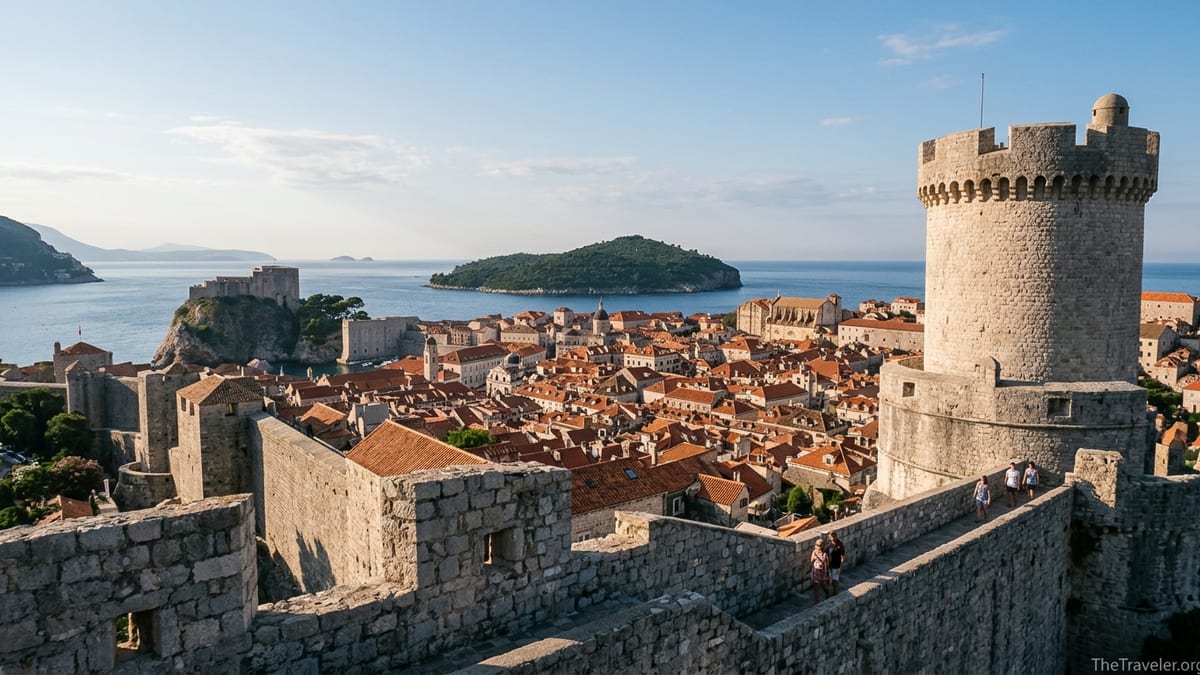
Understanding the Difference: Tower vs Entire Walls
Minčeta Tower is the highest point on Dubrovnik’s medieval fortifications and sits on the northern, landward side of the Old Town. You reach it as part of the one-way loop along the city walls; there is no separate entrance and no separate ticket for the tower alone. In practice, visiting Minčeta always means doing at least part of the City Walls walk, and usually most of it.
The Dubrovnik City Walls, by contrast, are a full circuit of nearly 2 kilometers encircling the Old Town. A standard visit involves a single lap that typically takes 60 to 120 minutes depending on how often you stop for photos. Along the way you pass major viewpoints such as Minčeta Tower in the north, Fort Bokar and the sea walls in the west, and St. John’s Fortress above the Old Port in the southeast. The experience is not one viewpoint but a constantly changing panorama.
From a ticketing perspective, the decision is simple. The City Walls ticket, now around 40 euros for adults in peak season with reductions in winter and for children, includes access to the entire circuit and Minčeta Tower as part of that route. Many visitors instead buy the Dubrovnik Pass, which costs roughly the same as a wall ticket alone but adds public bus rides and museum entries while still including the walls. If you have already decided to invest in either of these, you are effectively paying for both the tower and the walls in one go.
So the real question is not a strict “either–or” purchase, but a practical one: if you are short on time, energy, or patience for crowds, is it enough to focus your effort on Minčeta, or does the full walls circuit give you a significantly better overall experience and variety of views?
The Case for Minčeta Tower: Dubrovnik’s Highest Vantage Point
Minčeta Tower is often described as the single best viewpoint on the Dubrovnik City Walls, and there is good reason for this. Standing on its open upper platform, you enjoy a complete 360-degree panorama. To the south, the Old Town spreads out like a terracotta map, with the Stradun running straight down the middle, church domes rising above the roofs, and the bell tower marking the skyline. To the east, the Old Port and Lokrum Island are framed by the Adriatic. To the north and west, you see the city’s inland defenses, the modern suburbs climbing the hillside, and the road up to Mount Srđ.
This all-around perspective makes Minčeta the spot where many travelers finally understand the layout of Dubrovnik. Photographers often use it as a “master shot” location: a wide image capturing the entire Old Town inside its ring of walls. On a clear afternoon, you can pick out details such as rooftop terraces, tiny courtyards, and the pattern of narrow streets fanning out from the Stradun. If you are interested in architecture and city planning as much as scenery, Minčeta rewards a slower visit where you simply stand and observe how the city fits together.
Minčeta is also appealing for travelers chasing iconic scenes from popular culture. Exterior shots of the tower doubled as a key location in the fantasy series Game of Thrones, and guides still point out the angle where fans can roughly recreate frames from the show. Even without any interest in television, the visual drama of a circular fortress rising above a sea of red roofs makes this one of the most photogenic spots in town.
However, the climb is steep. The approach to Minčeta involves a succession of narrow stone staircases that can feel relentless in summer heat. Travelers report roughly 750 steps to reach the top from the lower sections of the wall, though most people experience it as a gradual series rather than one single staircase. If you have limited mobility or struggle with heights, this may be the most demanding part of the entire circuit. In exchange for that effort, you get the highest and most comprehensive single view inside the city.
The Case for the City Walls: A Moving Panorama
While Minčeta offers the highest single viewpoint, the Dubrovnik City Walls as a whole deliver something different: variety. The circuit is a moving panorama that alternates between three main types of scenery. On the northern side you look down into the dense grid of the Old Town, with laundry lines, stone courtyards, and everyday life unfolding below. On the western and southern sea walls you gaze out across the open Adriatic and toward Fort Lovrijenac, which rises from a cliff face outside the city like a stone ship. On the eastern side you see the harbor, boats coming and going, and Lokrum Island just offshore.
Some of the most famous photos of Dubrovnik come not from Minčeta itself but from lower stretches of the wall. Near Fort Bokar, for example, you can look back toward the Old Town framed by the round fortress in the foreground and Fort Lovrijenac across the bay. This angle appears regularly in travel magazines and is instantly recognizable. On calm days, the water below is a deep cobalt blue, kayaks trace bright lines along the cliffs, and small tour boats weave in and out, adding a sense of movement to your pictures.
The eastern walls above the Old Port offer very different scenes. From here you can frame the harbor entrance, fishing boats, and the stone arches of the old shipyard. In the late afternoon, the light softens on the water and the green of Lokrum Island contrasts with the orange roofs of the Old Town. Many visitors pause here for longer than they expect, simply watching the constant activity below.
Another advantage of the full walls route is storytelling. As you walk, information boards, local guides, and the architecture itself reveal how Dubrovnik defended itself from the sea and from land. You see cannon openings, watchtowers, and the changing thickness of the walls at different points. A quick climb up and down the steps of Minčeta alone gives only a partial sense of this; the complete walk lets you understand why Dubrovnik’s fortifications are considered some of the best preserved in Europe.
Comparing the Views: What You Actually See From Each
If your main goal is photographs of the Old Town’s rooftops, Minčeta will likely satisfy you more than any other single spot. From the top platform you can capture sweeping shots that include the entire walled city, with the Stradun, the cathedral dome, and multiple church towers all in the frame. Because the tower sits on the highest point of the landward wall, you are looking slightly down at everything, which makes the city feel like a model laid out at your feet.
On the other hand, if you want dramatic coastal scenery, the City Walls walk outside Minčeta is stronger. The sections curving around the cliffs near Fort Bokar and the southern sea walls offer classic Adriatic views: waves breaking against the rocks, kayakers in red and yellow boats hugging the base of the walls, and sunset light catching the open sea. These angles are impossible to see from Minčeta itself because the tower is located on the inland side of the fortifications.
Travelers who enjoy watching local life may also prefer the lower stretches of the walls. From the northern wall between Buža Gate and Minčeta, you look straight down into backyards, rooftop gardens, and narrow residential alleys where people hang laundry or sit on small balconies. From above the Stradun, you can observe the constant stream of walkers, street performers, and café terraces without having to push through the crowds yourself. Minčeta gives a broader picture but less of this close, human-scale detail.
For those interested in maritime history, the southeastern segment around St. John’s Fortress is particularly enlightening. It overlooks the entry to the Old Port, where centuries of traders and sailors would have passed. Today you still see excursion boats, water taxis to Lokrum, and sometimes even small cruise tenders shuttling passengers to shore. None of these angles are visible from the crown of Minčeta, where the port appears much farther away.
Time, Effort, and Practicalities: Which Fits Your Day?
A full circuit of the Dubrovnik City Walls, including the climb to Minčeta Tower, usually takes between one and two hours. Fit travelers who walk briskly and make only short photo stops sometimes finish in about 60 minutes. Most people, especially in summer when the heat slows the pace, end up closer to 90 minutes, and some families or photography enthusiasts stretch it to two hours or more.
The route is one way and includes many staircases, some of them steep and narrow. Once you have entered and climbed up, there are only a few exit points where you can leave early. This means that choosing the walls is committing to at least a moderate physical effort. There is practically no shade on the higher sections, so visiting in the middle of the day in July or August can feel punishing. Water is sold at small cafés and kiosks along the walls, but at noticeably higher prices than in supermarkets below.
Reaching Minčeta requires tackling one of the steeper sections of the circuit. If you start the walls at Ploče Gate on the eastern side and walk counterclockwise, you will encounter Minčeta in the final part of the loop, when you are already somewhat tired. Some local guides, however, recommend starting at Pile Gate, moving more quickly along the early northern stretches, and prioritizing your energy for the climb to the tower. Either way, if you know you may not manage the full loop, consider entering, walking directly toward Minčeta, and exiting at the next available staircase after you descend.
For travelers with knee problems or significant mobility issues, neither option is straightforward, but the full circuit will almost always be more demanding than choosing a shortened walk that includes only the approach to Minčeta and then a quick descent. If accessibility is a major concern, it may be worth enjoying the city views from alternative spots at street level or from viewpoints such as the basketball court above the Old Town or the cable car to Mount Srđ, which involve fewer uneven steps.
Cost and Crowds: Getting the Best Value From Your View
By far the biggest complaint visitors voice about the Dubrovnik City Walls is the ticket price. In recent seasons the standard adult ticket has risen to around 40 euros during the main tourist months, with reduced tariffs in winter and discounts for children. This price is the same whether you walk ten minutes or make the full circuit, and it includes Minčeta Tower as well as access to Fort Lovrijenac across the bay. Several travelers therefore feel that to get solid value, you should plan enough time and energy to enjoy a good portion of the walls.
If you plan to visit several museums and use public buses during your stay, buying the Dubrovnik Pass often makes more sense. It usually costs about the same as a wall ticket but covers the walls plus multiple attractions and transport. For example, a traveler staying two full days might use the pass to walk the walls and climb Minčeta on the first morning, then later visit the Rector’s Palace, a couple of smaller museums, and Fort Lovrijenac without paying extra at each site.
Crowds are another key factor in deciding how you want to experience the views. Cruise ship days, especially when multiple large vessels are in port, can flood the walls with tour groups between late morning and mid-afternoon. In those hours, bottlenecks form at narrow sections and at Instagram-famous viewpoints, including the staircases up to Minčeta. If you are sensitive to crowds or want more contemplative photos, early morning openings around 8:00 or visiting closer to closing time in the evening are usually better. The light is also softer then, which helps your images.
Because Minčeta is such a highlight, it can feel particularly congested during peak periods. Groups line up along the parapet to take photos, and moving around the circular platform slowly can require patience. On quieter days in shoulder season, by contrast, you may share the tower with only a handful of other visitors and have time to walk the full circle, trying different angles over the town and sea.
Which View Is Better for Different Types of Travelers?
For first-time visitors with a typical half-day in Dubrovnik, the full City Walls walk including Minčeta is usually the most rewarding choice. It combines the star view from the tower with multiple other angles, gives a better sense of the Old Town’s layout, and includes the thrill of walking atop the fortifications themselves. If you can handle stairs and summer heat reasonably well, this is the experience that most travelers look back on as their highlight.
For photographers focused on capturing the “postcard” shot, Minčeta deserves special effort. The broad, top-down view of roofs and walls is ideal for wide lenses in the 16 to 24 millimeter range on a full-frame camera, while the ability to walk around the tower lets you experiment with different compositions. Pair this with a slower stroll along the northern wall just before or after Minčeta, where you can get more intimate frames of chimneys, courtyards, and church towers.
Families with young children or travelers who tire easily may want to prioritize a shorter segment of the walls that still includes good views but avoids the most challenging climbs. In that case, walking from Pile Gate toward Fort Bokar and along part of the sea wall can be a smart compromise. You will still see the Old Town from above and enjoy views of Fort Lovrijenac and the open sea without necessarily committing to the full circuit or the steep steps up to Minčeta.
For travelers on a tight budget or those skeptical about the high ticket price, it is worth considering whether you truly value the experience of being on the walls themselves. Some free or cheaper viewpoints, such as the cliffside café terraces outside the seaward wall or the public sports court above the Old Town, offer surprisingly strong panoramas without the same cost. They cannot replicate the feeling of walking the ramparts, but they may be sufficient if you mainly want to see the city from above for a few photos.
The Takeaway
In a strict visual contest, Minčeta Tower probably offers the single most impressive all-in-one view of Dubrovnik. From its rooftop platform, the Old Town, the harbor, the sea, and the inland hills all come together in a single panorama that makes sense of the city at a glance. If you had to choose just one spot to show a friend what Dubrovnik really looks like, this would be a strong candidate.
Yet the Dubrovnik City Walls as a whole still win for overall experience. The constant shift from inland rooftops to sea cliffs to harbor activity, the chance to pause at places like Fort Bokar or above the Stradun, and the physical sensation of tracing the fortifications around the city make the full circuit more than just a string of viewpoints. It is a walk through history, scenery, and daily life all at once.
If you have the time, budget, and energy, the best answer is not to choose between Minčeta and the walls but to see the tower as the highlight of a complete wall walk. Enter early or late to avoid crowds, bring water and sun protection, and give yourself at least ninety minutes to move slowly, stop for photos, and appreciate how each section offers something slightly different.
If circumstances force you to compromise, let your priorities guide you. For sweeping cityscapes and the feeling of standing on Dubrovnik’s highest fortification, focus on reaching Minčeta. For coastal drama, sea views, and a gradual unfolding of perspectives, concentrate on the western and southern stretches of the City Walls. Either way, the effort to get above street level will reward you with some of the most memorable views in the Adriatic.
FAQ
Q1. Is Minčeta Tower a separate attraction from the Dubrovnik City Walls?
Minčeta Tower is part of the Dubrovnik City Walls route and is reached only from the walls. There is no separate entrance or separate ticket just for the tower.
Q2. Which has the better overall view, Minčeta Tower or the City Walls?
Minčeta offers the best single panoramic viewpoint, but the full City Walls walk provides a richer variety of scenes, including sea cliffs, the harbor, and close-up rooftop views.
Q3. How long does it take to walk the Dubrovnik City Walls including Minčeta Tower?
Most visitors take between 60 and 120 minutes for the full circuit, including the climb to Minčeta, depending on walking speed, heat, and how often they stop for photos.
Q4. Are the Dubrovnik City Walls and Minčeta Tower suitable for people with limited mobility?
The route includes many stairs, uneven stone surfaces, and narrow sections, and the climb to Minčeta is particularly steep, so it can be challenging for anyone with mobility or knee issues.
Q5. What is the best time of day to visit for views and photos?
Early morning and late afternoon or early evening usually offer softer light, slightly cooler temperatures, and fewer crowds compared with the busy midday period in summer.
Q6. Do I need to pay twice if I only want to see Minčeta Tower?
No. Access to Minčeta is included in the standard City Walls ticket and in the Dubrovnik Pass, so you pay once and can choose how much of the route you walk.
Q7. Are there good alternatives to the walls if I cannot manage the stairs?
Yes. The cable car to Mount Srđ, the public sports court above the Old Town, and several cliffside cafés outside the walls all offer strong views with fewer or easier steps.
Q8. Can I exit the City Walls early after visiting Minčeta Tower?
There are a few exit points along the walls, but they are spaced out and may still require walking a reasonable distance before you can descend to street level.
Q9. Is the Dubrovnik Pass better value than a single City Walls ticket?
For travelers planning to use city buses and visit several museums or fortresses as well as the walls, the pass often offers better overall value than buying separate tickets.
Q10. Do the walls and Minčeta Tower ever close due to weather?
In periods of very strong wind, heavy rain, or storms, authorities may temporarily close the walls for safety, so it is wise to check conditions locally on the day you plan to visit.