


Standing guard over Dubrovnik’s terracotta rooftops, Minčeta Tower is the highest point on the city walls and one of the most photographed spots in Croatia. It is also, increasingly, where unprepared visitors run out of steam, patience, or time. From arriving in the worst heat of the day to buying the wrong ticket or getting stuck in a Game of Thrones selfie jam, the same avoidable mistakes play out here day after day. With a little foresight, you can turn Minčeta from an exhausting ordeal into the highlight of your Old Town visit.
Get the latest updates straight to your inbox!
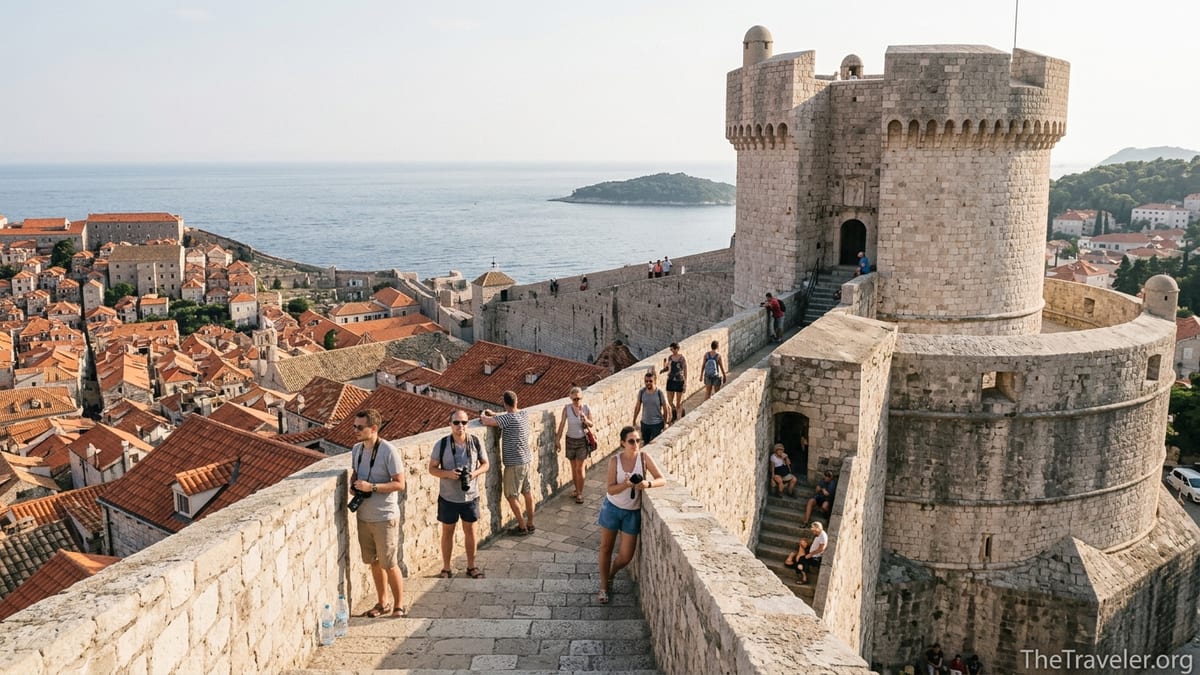
Forgetting Minčeta Is the High Point of a Demanding Walk
Many visitors treat Minčeta Tower as a simple photo stop, forgetting that it crowns a full circuit of Dubrovnik’s city walls. The walls run for roughly 2 kilometers around the Old Town and involve hundreds of steps; a normal visit with photo breaks usually takes 90 to 120 minutes. By the time you wind up to Minčeta, which is the highest section, your legs may already be tired, especially in summer heat. Travelers who start the walk casually in flip-flops with a small bottle of water often arrive at Minčeta flushed, dehydrated, and in no mood to enjoy the views.
The climb inside Minčeta itself is steeper than many expect. Online trip reports frequently mention that the last spiral staircase up to the very top feels “never-ending” and can be claustrophobic when crowded. One recent wall-walker counted around three-quarters of the total steps on the circuit by the time they reached Minčeta’s summit, which gives a sense of the cumulative effort. If you have knee issues, limited mobility, or you are visiting with very young children, attempting the full loop plus the tower without planning rest stops is a mistake that can turn a beautiful experience into a forced march.
The smarter approach is to treat Minčeta as the physical high point of a mini hike rather than a quick detour. Wear proper walking shoes with grip for the polished stones, and plan to take short breaks on the shaded inner side of the ramparts before you start the final push up the tower. Families often find it better to walk the walls in segments, stopping for a drink at one of the wall cafés before finishing at Minčeta, instead of rushing the whole circuit in one go.
If you know that you are not up for the steepest stairs, the mistake is trying to push to the very top at all costs. The terrace just below Minčeta’s summit already provides sweeping views over the northern side of the Old Town and the hills above Dubrovnik. It is entirely acceptable to skip the final spiral staircase and still feel you have experienced the essence of Minčeta.
Arriving at the Worst Possible Time of Day
Timing is the single biggest factor that determines whether Minčeta feels magical or miserable. In July and August, midday on the walls is notoriously punishing: stone surfaces radiate heat, there is almost no shade, and cruise ship excursions flood the circuit. Local guides often warn that midday in peak summer can feel 5 to 8 degrees Celsius hotter on the ramparts than down by the harbor, simply because the walls trap the sun and reflect light back onto visitors.
Despite that, many first-timers to Dubrovnik make the mistake of walking the walls between about 10:30 a.m. and 3 p.m., slotting it between breakfast and an afternoon swim. That is exactly when large cruise tours arrive from Gruž port and when day trippers from Split or Kotor reach the Old Town. As a result, Minčeta’s upper platform narrows to a slow-moving queue of people waiting for their turn at the parapet. It is common to see families abandon the climb halfway, choosing to step aside on a lower terrace rather than endure the combination of heat, bottlenecks, and selfie sticks.
To avoid this, treat Minčeta Tower as either the very start or the very end of your day. In high season, the best plan is usually to line up at the main Pile Gate entrance a few minutes before the walls open. For the first hour, the light is soft, temperatures are cooler, and organized tour groups have not yet fully hit the circuit. Travelers who do the loop clockwise from Pile report reaching Minčeta with plenty of space to move, often sharing the top with only a handful of others.
If early mornings are not realistic for you, the next best window is late afternoon into early evening, after many cruise passengers have reboarded and day trippers are heading for dinner. Summer closing times often stretch into the early evening; arriving a couple of hours before last entry still gives you enough time for a relaxed circuit and a relatively uncrowded sunset at Minčeta. The key is to check the current season’s timetable at your hotel reception or the tourist office and plan around it, instead of simply turning up “whenever we get there.”
Underestimating Weather, Heat, and Hydration
Visitors regularly underestimate how exposed Minčeta and the rest of the walls are. There is almost no natural shade along the northern side of the circuit, where Minčeta sits, and the pale stone reflects sunlight aggressively. Local travel information sites note that dehydration and heat exhaustion are more common problems for tourists here than petty crime. Every summer, staff see guests sit down on the steps beneath Minčeta feeling faint or dizzy, having misjudged conditions because there was a fresh breeze at sea level earlier in the day.
The most basic error is arriving with too little water. Some people start the walk with a single 0.5 liter bottle between two adults, assuming they can buy more on the way. While there are a few vendors and small cafés along the walls, they are spaced out and prices are higher than in supermarkets. In peak season it is not unusual to pay the equivalent of several euros for a chilled bottle at a stand near Minčeta. For a family of four, that turns a simple hydration stop into an unplanned expense. Carry at least one full bottle per person from the Old Town, and top up before you climb.
Clothing and sun protection are just as important. Because Dubrovnik is a relaxed Mediterranean city, people often show up in minimal beachwear with no hat. Several recent travelers commented that even in late May, they got noticeable sunburn on their shoulders during a single lap of the walls. At the top of Minčeta, there is no canopy: you are exposed to wind and sun from all sides. A light, long-sleeved shirt, a brimmed hat or cap, and high-SPF sunscreen reap outsized rewards here. For children, UV-protective clothing and a neck flap hat can make the difference between happy photos and a cranky retreat.
If there is a forecast for extreme heat, adjust. Locals advise visitors to postpone wall walks to early morning or evening during heatwaves. Trying to “push through” a 35-degree afternoon on the walls is not only unpleasant, it can be unsafe for older travelers or anyone with health issues. In those conditions, it is better to rearrange your schedule: escape by ferry to Lokrum Island or one of the beaches during the hottest hours, then come back to tackle Minčeta after the sun has dropped.
Buying the Wrong Ticket or Misunderstanding Rules
Another frequent mistake happens before visitors even set foot on the steps: confusion about tickets and entry rules. Minčeta Tower is part of the Dubrovnik City Walls, managed by the local heritage society, and you cannot buy a separate ticket just for the tower. The standard adult walls ticket in 2026 is around 30 euros, with discounted prices for students and children. Children up to about age seven typically go free with a paying adult, while older kids pay a reduced fee. Many travelers only learn these details at the Pile Gate booth, which can be a stressful way to make a decision for a group or family.
Some visitors also overlook the option of the Dubrovnik Pass, a city card that includes walls access plus several museums and public transport for a set period. If you plan on visiting the Rector’s Palace, a couple of museums, and using local buses, buying individual tickets at each stop can end up costing more than a one-day or multi-day pass. On the other hand, if you are arriving on a cruise for just a few hours and only want to walk the walls, the standalone ticket may be more sensible. The mistake is not thinking this through in advance and then wasting time in line trying to do the math at the ticket window.
Rules about entry and re-entry can also trip people up. The walls operate on a single-entry system: once you exit, you cannot re-enter on the same ticket, even if you have not completed the full loop. This applies to Minčeta too. Some travelers mistakenly hop off the circuit near the tower to “grab lunch and come back later,” only to be told at the gate that their tickets are no longer valid. If you want to linger at Minčeta for photos, do it during your one continuous visit rather than planning to return.
Finally, be aware that the circuit is essentially one-way. From the main entrance near Pile, most visitors walk counterclockwise. You cannot simply take a lift or shortcut straight to Minčeta. That misconception occasionally leads to arguments at staircases, with people trying to backtrack against the flow to reach “the GOT tower” faster. Accept that part of the experience is the gradual build-up to Minčeta as you circle the city, and you will have a calmer visit.
Ignoring Practicalities: Footwear, Gear, and Photography Etiquette
Conversation around Minčeta often focuses on the panoramic views and Game of Thrones connections, but the everyday practicalities matter just as much. Inappropriate footwear is one of the simplest and most visible mistakes. The stones on the walls and within Minčeta are worn smooth by centuries of use, and in places they are polished enough to feel slick even when dry. Add a light drizzle or sweat-slicked steps in high season, and flimsy sandals or wedge heels become a genuine hazard. Local safety advice routinely recommends closed shoes with rubber soles; trail-style trainers are ideal, but any sturdy sneakers are a big step up from beach flip-flops.
Carrying the right gear also makes the experience smoother. A small daypack keeps your hands free for railings on the steepest parts of Minčeta’s staircase. If you are a photographer, bring a lens cloth and be prepared for sea spray or dust on windy days. Drone use is tightly regulated over Dubrovnik’s Old Town, and attempting to launch from the walls or Minčeta is not only inconsiderate but likely illegal without a permit. Staff have been known to intervene when visitors try to fly drones from the parapets, which can cut your visit short.
Photo etiquette on the narrow top of Minčeta is another overlooked point. Travelers often report “selfie gridlock” where one or two visitors monopolize the best corner spots for extended photoshoots. It is tempting to set up a mini tripod or spend ten minutes recreating a Game of Thrones still, but this quickly causes tension in a tight space. A more considerate strategy is to have your camera ready, take a few quick shots, then step back to a lower terrace if you want to check them or retake. Not only does this help keep the atmosphere pleasant, it also means you can focus on the 360-degree views rather than fighting for a single angle.
Lastly, think about carrying a light layer even on warm days. At the top of Minčeta the wind can be surprisingly strong, especially in shoulder seasons. Several visitors who climbed in April and October mention being caught by a chill despite bright sun. A compact windproof jacket or scarf adds little weight but makes it far more comfortable to linger and enjoy the view over the Elaphiti Islands and the mountains inland.
Overlooking Accessibility Limits and Family Needs
For travelers with mobility challenges or very young children, one of the biggest mistakes is assuming that Minčeta and the walls are accessible in the same way as many modern attractions. In reality, there are no elevators up to the walls from the Old Town and no lift within Minčeta. The approach involves steep staircases, uneven steps, and narrow passages. Local visitor guidance is clear that the walls are not suitable for wheelchairs, and even for those with mild mobility issues, the experience can be demanding.
Parents often push strollers as far as the entrance and then realize they will need to carry them up long staircases. On the walls, steps up and down are frequent, and trying to maneuver a buggy through crowds near Minčeta is stressful for everyone. Families who enjoyed their visit typically mention using a baby carrier instead, leaving strollers at their accommodation, and accepting that older children may not complete the entire circuit. It is better to aim for a half loop with plenty of breaks than to insist on reaching Minčeta at all costs with an exhausted toddler.
Managing expectations within your group is also crucial. Teenagers excited by Game of Thrones may rush ahead, while grandparents lag on the shaded inner side. Agree on a meeting point at a café or a specific tower before you start. Near Minčeta there are a few slightly wider terraces where slower members of the group can wait while others climb the final stairs. Without that plan, families can get separated in the one-way flow, leading to stress and missed photo opportunities when someone reaches the top alone.
If Minčeta simply is not an option for you physically, do not mistake skipping it for missing Dubrovnik altogether. There are accessible viewpoints outside the walls, such as the Ploče Gate area or the lookout by the cable car station on Mount Srđ, that deliver spectacular panoramas with far less strain. Some visitors with limited mobility report choosing a harbor cruise or sea-kayak tour instead, enjoying Minčeta from below silhouetted against the skyline.
Expecting a Pure Game of Thrones Set Instead of a Living Monument
Minčeta Tower shot to global fame as one of the key Game of Thrones filming locations around Dubrovnik, appearing as part of the fictional King’s Landing. Many fans understandably arrive with that association foremost in mind. The mistake is to view Minčeta only as a television backdrop and overlook its long, complicated history as part of a serious defensive system dating back centuries.
Guides in Dubrovnik often mention that people queue at Minčeta to “do the GOT pose,” then leave without reading a single panel about the fortifications or looking at how the defenses link together around the city. That reduces a layered cultural experience to a single pop-culture snapshot. You will have a richer visit if you balance fandom with curiosity: take your photos, then spend a few minutes walking the whole circumference of the platform, noticing the views north to the hills, east toward the old harbor, and south over Stradun. Try to imagine the vantage point not just as a fantasy set, but as the watchtower it once was.
This mindset also affects how you behave on site. Clambering onto fragile edges, climbing where signs clearly tell you not to, or sitting on parapets for dramatic shots disrespects the monument and can be dangerous. Staff have become increasingly vigilant about asking visitors to step down from unsafe spots, especially near Minčeta where the drop on the outer side is sheer. Instead of pushing boundaries for a unique angle, look for creative compositions that still respect barriers: frame the red roofs through battlements, capture people walking along the walls below, or wait for a seagull to glide through your shot.
Finally, remember that locals still use the Old Town streets beneath Minčeta every day. Shouting reenactments, playing music loudly from speakers on the walls, or blocking narrow stairs with props for cosplay shoots might seem fun in the moment, but they contribute to the sense of overtourism that residents and city officials are actively trying to manage. Viewing Minčeta as part of a living city rather than an isolated fantasy set helps you make choices that keep the welcome warm for future visitors.
The Takeaway
Minčeta Tower offers one of the great viewpoints of the Adriatic, but it demands respect: for the climate, for your own limits, for the rules, and for the historic structure itself. The visitors who come away glowing about their experience typically do a handful of simple things right: they time their wall walk for early morning or late afternoon, wear sensible shoes, carry water and sun protection, make a deliberate choice about tickets, and approach the site as both a cultural monument and a cinematic icon.
Those who do not plan tend to repeat the same patterns: turning up at noon on a cruise-ship day, dressed for the beach, with one small bottle of water, expecting an easy stroll. Crowded, overheated, and rushed, they reach Minčeta too tired to enjoy it or skip it altogether to dive back into the shade. With a bit of foresight, you can avoid that scenario entirely. Let the climb up Minčeta be a slow, deliberate ascent that builds anticipation with every step, rewarding you at the top with a calm moment above Dubrovnik’s rooftops that feels fully earned.
FAQ
Q1. Do I need a separate ticket for Minčeta Tower?
Minčeta Tower is included in the Dubrovnik City Walls ticket; you cannot buy a standalone ticket for the tower only.
Q2. How long does it take to reach Minčeta Tower on the walls?
Most visitors reach Minčeta about 45 to 60 minutes into a relaxed clockwise walk from the main Pile Gate entrance, including photo stops along the way.
Q3. What is the best time of day to visit Minčeta?
Early morning at opening time or late afternoon before closing is best, when temperatures are lower and cruise ship crowds are lighter on the walls.
Q4. Is Minčeta Tower suitable for people with limited mobility?
Unfortunately not. Access involves steep and uneven stairs with no lift, and the walls themselves are generally unsuitable for wheelchairs or severe mobility issues.
Q5. Can I visit Minčeta with a stroller?
Strollers are very impractical on the walls due to constant steps and narrow passages. A baby carrier is a much better option for infants and toddlers.
Q6. Are there places to buy water near Minčeta?
There are a few vendors and small cafés along the walls, but they are spaced out and more expensive, so it is wise to bring plenty of water from the Old Town.
Q7. Is Minčeta Tower very crowded?
In peak summer and during busy cruise days, the top can be crowded, especially around midday. Visiting early or late in the day offers a much calmer experience.
Q8. What should I wear to climb Minčeta?
Wear sturdy, closed-toe shoes with good grip, light breathable clothing, a hat, and sunscreen, and bring a light windproof layer in cooler seasons.
Q9. Can I take Game of Thrones-style photos at Minčeta?
Yes, many fans do, but it is important to be quick and considerate, avoiding blocking narrow areas or ignoring safety barriers for the sake of a dramatic shot.
Q10. Is it worth walking the entire walls if I mainly care about Minčeta?
Most travelers feel the full circuit is worthwhile because the views constantly change, but if time or energy is limited, prioritizing the section around Minčeta still delivers a memorable panorama.