


Stradun, the polished limestone spine of Dubrovnik’s Old Town, is one of the most photographed streets in Europe. Yet if you only pause here for a few snapshots before rushing to the city walls, you miss much of what makes the street the city’s true living room. From centuries old pharmacies and tucked away galleries to coffee rituals and late night gelato, Stradun rewards travelers who slow down and engage with it beyond the camera lens.
Get the latest updates straight to your inbox!
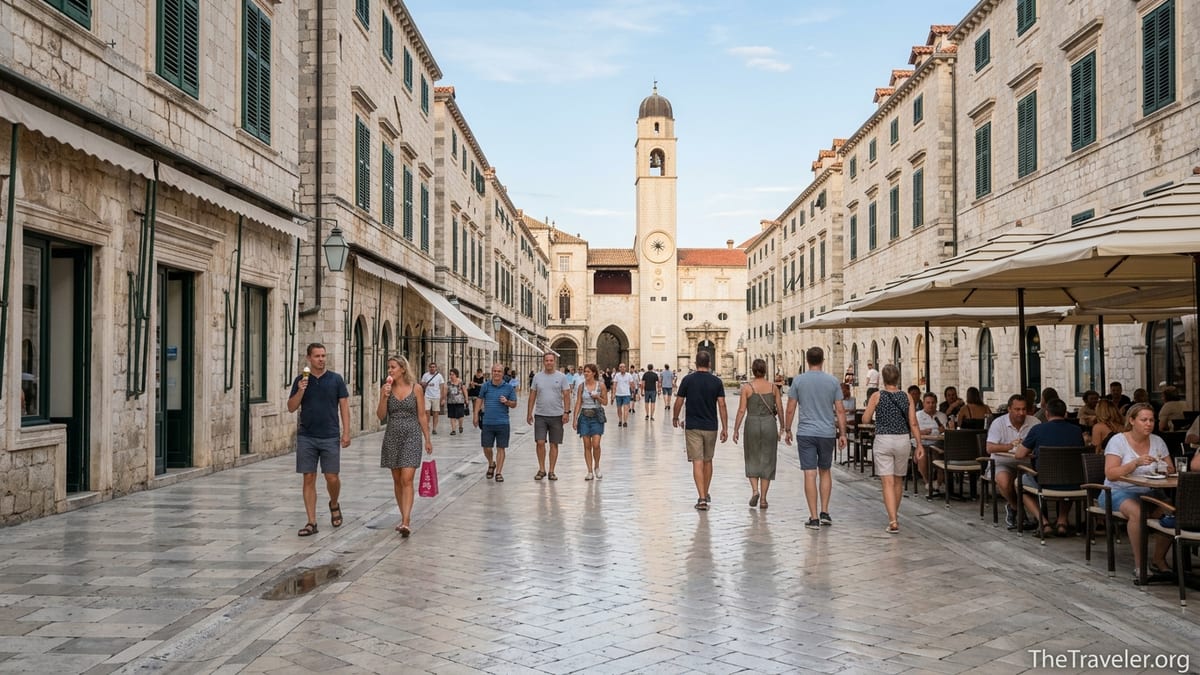
Walk Stradun Like a Local, Not a Sightseer
The simplest way to experience Stradun beyond photos is to treat it as locals do: as a daily promenade. The 300 meter stretch from Pile Gate in the west to Luža Square in the east is where residents have met, traded, argued, and celebrated for centuries. Try walking it at different times of day. Early morning, before cruise ship arrivals, the street is almost quiet, with delivery carts clattering over stone and café staff setting out chairs. Late at night, after groups have gone back to their buses, you share the space with Dubrovnik families out for an ice cream and teenagers leaning on the stone wells to chat.
Start at Pile Gate and move slowly down the gentle slope, noticing how every ground floor space follows the same pattern: a door and window cut into a single stone frame with a low sill that once acted as a counter. Many of these units still function as shops, bakeries, or small groceries, and peeking in gives you a sense of how commerce has worked here since the 17th century rebuilding of the city. Rather than racing toward the next landmark, take ten minutes simply to observe how people move, where they pause, and how the street itself organizes everyday life.
In the evening, consider joining the unofficial local ritual of the šetnja, the slow, social stroll up and down Stradun. Pick up a gelato from one of the small stands closer to Luža Square, then walk a loop from the square back to Onofrio’s Fountain and return. You will notice elderly couples walking arm in arm, parents pushing strollers, and youth groups drifting between side streets and the main drag. This is Dubrovnik using Stradun as a living room, not a film set, and it changes the way you read the space.
If you have two or three days in the city, repeat this walk more than once. Different light, tides of visitors, and small details you missed the first time give the street new character each pass. It becomes less an attraction to tick off and more a reference point, the place you naturally cross on your way to lunch, a museum, or your rented apartment.
Step Inside History: The Franciscan Monastery and Old Pharmacy
Just a few steps inside Pile Gate, on the left of Stradun, a relatively plain stone façade hides one of the street’s most rewarding detours: the Franciscan Monastery and its still operating pharmacy. Many people walk past it twice without realizing that through the doorway lies a tranquil cloister, a compact museum, and one of Europe’s oldest continuously working pharmacies, in operation since the early 14th century.
The monastery visit usually costs around 8 to 10 euros, and many versions of the Dubrovnik city card include entrance, which turns it into one of the best value indoor stops in the Old Town. Once inside, step into the cloister and slow your pace. The garden at the center is planted with herbs that recall the friars’ medicinal work, while Romanesque and Gothic arches frame quiet corners where you can sit in the shade. It is an ideal place to cool down on a hot August afternoon and to see how monastic life coexisted with the commercial bustle of Stradun only a few meters away.
The small museum rooms hold pharmacy jars, copper stills, and handwritten prescription books that show what treatment looked like when the Republic of Ragusa was a Mediterranean trading power. Nearby, the working pharmacy counter sells creams and tinctures based on old recipes, including rose and lavender products that many travelers buy as practical souvenirs. Rather than grabbing a random tourist trinket on the street, ask the pharmacist to explain one or two of these items and choose something you might actually use back home.
Before leaving, stand under the late Gothic Pietà relief above the portal that faces Stradun and look up. This sculpture survived the devastating 1667 earthquake, and passing underneath it is a small but tangible brush with the city’s layered history. Combined with the hushed cloister and the smell of herbs, it offers a deeper understanding of Stradun as more than a polished backdrop.
Make Café Culture Your Main Activity
Stradun is lined with cafés and bars spilling tables onto the stone. While many visitors treat them as quick refreshment stops between sights, locals use them as extensions of their living rooms. If you want to go beyond photos, pick a café, sit down, and let an hour pass with no agenda except to watch life unfold. You pay for the seat and the view as much as for the drink, so embrace that as part of the experience.
Prices vary, but expect to pay in the region of 3 to 4 euros for an espresso or macchiato and a bit more for cappuccinos or iced coffee on the main stretch in peak summer. If you move a few meters into a side street, the prices often dip slightly. Order like locals do: a simple espresso in the morning, and perhaps a small beer or a glass of local white wine such as Pošip or Malvasija later in the day. Bars fronting Stradun often carry Croatian brands alongside international ones, so asking for a Croatian craft beer by name is a small way to connect with the country rather than defaulting to a global label.
Mornings are best for coffee watching as shopkeepers sweep their thresholds and city workers hurry through in uniforms and business clothes. Late afternoon brings a different scene, as tour groups thin out and the soft golden light makes everything feel more relaxed. If you can, choose a table with a clear angle toward Luža Square or Onofrio’s Fountain, where the flow of people is constant, and resist the urge to scroll on your phone. The act of simply sitting and observing is one of the most rewarding things to do here.
If you are concerned about budget, treat one café stop on Stradun as a highlight rather than an everyday habit, and balance it with coffees from bakeries or smaller bars just off the main street. That way you enjoy the quintessential Stradun terrace experience without feeling that every drink is a splurge. The key is intention: when you sit down, decide that you are here to soak in the atmosphere, not just refuel.
Dive Into Side Alleys for Galleries, Bookshops, and Everyday Errands
One of the most overlooked activities on Stradun is simply turning left or right into the narrow alleys that branch off like ribs from the main spine. Signboards at eye level list what lies up each lane, from tiny guesthouses and family owned restaurants to art galleries and wine bars. Spending half an hour ducking in and out of these side streets loosens Stradun from its postcard image and reveals it as part of a lived in grid.
On the north side, alleys climb sharply toward the city walls, and along the steps you will find small galleries showing contemporary Croatian artists, jewelry workshops selling pieces made from Adriatic coral and olive wood, and bookshops that stock both glossy coffee table volumes and slim local history titles. Picking up a short history of Dubrovnik or a translated novel by a local author can enrich your walks far more than another souvenir magnet.
One particularly thought provoking stop only a minute’s walk off Stradun is the War Photo Limited gallery on Antuninska Street. This independent exhibition space focuses on photojournalism from conflicts in the Balkans and around the world. The displays change, but they usually include material related to the siege of Dubrovnik in the 1990s, which helps ground the perfect Old Town scenery in very recent history. Admission is typically under 10 euros, and the gallery is compact enough to see in an hour, yet intense enough to stay with you long after.
Other side street discoveries might be more mundane but no less revealing. Step into a small supermarket for bottled water and snacks and note how locals shop and what is on the shelves, from Dalmatian olive oil to regional wines and Croatian chocolates. Pop into a baker’s shop for a burek or a sweet pastry when queues for sit down lunches on Stradun feel long. These errands nudge your experience away from performance and toward participation.
Sample Local Flavors Without Leaving the Main Street
Stradun’s restaurants and snack bars cater heavily to visitors, yet you can still use the street to taste something of Dalmatia rather than defaulting solely to pizza and burgers. Menus at many places along and just off Stradun share a familiar lineup of grilled fish, risottos, seafood pastas, and meat dishes, but how you order can make the difference between a forgettable and a memorable meal.
Look for traditional dishes like black cuttlefish risotto, grilled Adriatic fish served simply with chard and potatoes, or slow cooked peka style meats advertised for two people, which are typically ordered a day in advance and sometimes promoted by restaurants around the eastern end of Stradun. While many establishments advertise these on signs, asking staff which dishes they feel most proud of can lead to better choices than picking the most photogenic plate. Expect main courses on Stradun to run from roughly 18 to 30 euros in high season, with seafood at the upper end of that range.
If you are watching costs, consider having your main sit down meal at lunchtime rather than dinner. Some bistros just off Stradun offer daily light lunch specials at gentler prices than evening menus, especially outside July and August. You can then turn dinner into a more informal affair: perhaps a slice of pizza from a takeaway window, a paper cone of fritule (bite sized doughnuts) from a street counter, and a gelato from a trusted local chain near Luža Square.
Drinks are another way to keep your experience grounded in Croatia. Instead of ordering a generic house wine without asking, inquire which local varietal they are pouring by the glass that day. If you drink spirits, try a small glass of travarica or another herb brandy as a digestif while lingering at your table and watching the promenade. These small choices turn an otherwise standard tourist meal into a more rooted encounter with the region.
Connect With Everyday Rituals: Water, Bells, and Local Events
Beyond its shops and cafés, Stradun is a stage for small daily rituals that are easy to miss if you are focused only on big ticket attractions. One of the oldest is the simple act of filling bottles at the 15th century Onofrio’s Fountain near Pile Gate. Dubrovnik’s tap water is safe to drink, and locals often stop here to refill bottles on hot days. Joining them not only saves money on bottled water, which can be expensive from kiosks along the street, but also connects you with a centuries old piece of urban infrastructure that still works as intended.
Another subtle rhythm is marked by the bells of the Church of St Blaise and the nearby clock tower at the eastern end of Stradun. If you time your walk to coincide with the top of the hour, stand for a moment in Luža Square and listen. The sound reminds you that the Old Town is not just scenery but a functioning parish and civic center. At certain times of year, especially around major religious festivals, processions begin or end here and spill onto Stradun, turning the street into a carpet of color and formal dress.
Seasonal events also transform Stradun from a static backdrop into an active venue. In December, the Dubrovnik Winter Festival decorates the street with lights and wooden stalls selling sausages, mulled wine, and sweets, making evening walks feel cozy instead of simply quiet. In summer, concerts and performances tied to the Dubrovnik Summer Festival sometimes use the square or sections of Stradun as their stage, so it is worth checking local listings when you arrive. Even if you do not have tickets, you might catch rehearsals or free segments while wandering.
For travelers who enjoy people watching, local rituals around socializing provide endless quiet entertainment. Look for groups of older men in pressed shirts claiming the same table every evening, or children playing impromptu games around the fountain as their parents chat. These habits persist regardless of how many photos are being taken nearby, and noticing them is a way of respecting that you are walking through someone else’s everyday environment.
The Takeaway
Stradun rewards travelers who approach it as a living street rather than a pretty corridor to hurry through. By stepping into its monastery and pharmacy, lingering in its cafés, exploring its side alleys, and tuning into water fountains, bells, and seasonal festivals, you discover that Dubrovnik’s main drag still functions as more than a movie backdrop. It is where history, commerce, faith, and simple daily routines intersect under the same shining stones.
On a practical level, this means planning time on Stradun that is not tied to your camera or a checklist. Give yourself an unstructured morning coffee, an hour in a gallery, or a slow evening stroll with gelato in hand. Balance the occasional splurge on a terrace seat with simple snacks from bakeries and refills at Onofrio’s Fountain. You will leave with more nuanced memories and a sense that you briefly took part in the life of the city instead of only photographing it from the outside.
FAQ
Q1. Is it worth spending more than an hour on Stradun if I have limited time in Dubrovnik?
Yes. Even with a short stay, planning at least an hour or two spread across different times of day lets you see Stradun as a living street rather than just a quick photo stop.
Q2. Are the cafés and restaurants on Stradun very expensive compared to side streets?
They tend to be a bit pricier, especially in peak summer, but not dramatically more than nearby alleys. Treat a terrace table on Stradun as an occasional splurge and balance it with meals just off the main street.
Q3. Can I visit the Franciscan Monastery and old pharmacy directly from Stradun?
Yes. The entrance is a few steps inside Pile Gate on the left side of Stradun. You can walk in, buy a ticket at the small desk, and visit independently without a guided tour.
Q4. How much time should I set aside for the Franciscan Monastery and pharmacy?
Most visitors spend about 45 to 60 minutes exploring the cloister, small museum, and working pharmacy, plus a little extra time if you want to sit quietly in the garden.
Q5. Is War Photo Limited suitable for children or sensitive visitors?
War Photo Limited contains powerful images of conflict that some children and sensitive visitors may find intense. It is best for adults and older teens, and you might want to discuss its themes before and after the visit.
Q6. Are there genuinely local shops on or near Stradun, or is everything tourist oriented?
Many shops cater to visitors, but there are still locally run galleries, jewelry workshops, pharmacies, and small groceries in the alleys off Stradun where residents shop and work.
Q7. Can I drink the tap water from Onofrio’s Fountain on Stradun?
Yes. Dubrovnik’s tap water is generally safe, and people routinely refill bottles at Onofrio’s Fountain. If you have a sensitive stomach, start with a small amount and see how you feel.
Q8. What is the best time of day to experience Stradun with fewer crowds?
Early morning, before most day trippers and cruise ship groups arrive, is usually the quietest and most atmospheric, while late evening after dinner also feels calmer than midday.
Q9. Do I need a guide to understand the history of Stradun?
A guide can add depth, but it is not essential. You can learn a lot by visiting the Franciscan Monastery, reading short local history booklets from nearby shops, and paying attention to architectural details as you walk.
Q10. Is Stradun accessible for travelers with limited mobility?
Stradun itself is flat and relatively smooth, though the polished stone can be slippery when wet. Many side streets involve steep steps, but you can enjoy the main street, fountain, and several cafés with minimal climbing.