


Every visitor to Dubrovnik eventually finds themselves on Stradun, the polished limestone artery that cuts straight through the Old Town from Pile Gate to Luza Square. Most people hurry along it with cameras raised, stopping briefly at the big fountain or the clock tower before joining a city walls tour. Yet this 300-metre street hides layers of history, craftsmanship and daily life that are easy to miss at a quick-walk, selfie-stop pace. Slow down, step to the side, and Stradun becomes far more than a photogenic boulevard.
Get the latest updates straight to your inbox!
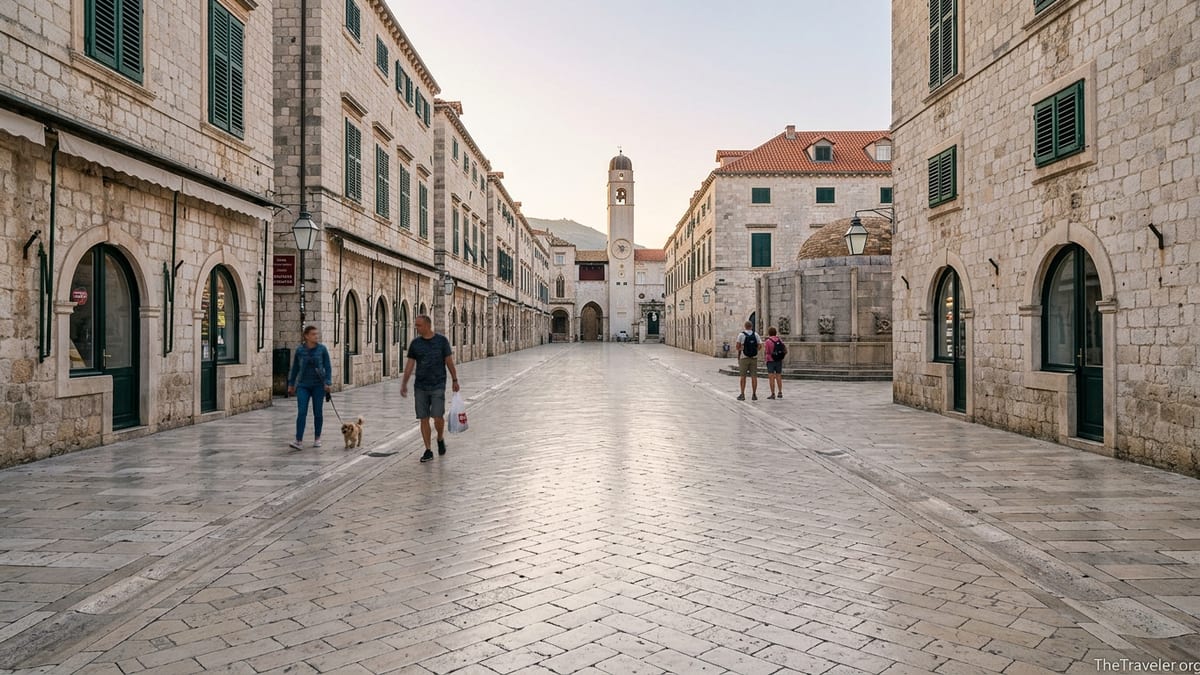
The Shimmering Stone Beneath Your Feet
The first thing almost everyone notices on Stradun is the gleam underfoot, but very few think about why the street shines. The entire length is paved with pale limestone slabs, laid in the 15th century and gradually polished to a glossy sheen by centuries of footsteps rather than machines. On a dry summer afternoon you can see your own reflection ghosted in the stone; after a rain shower, the surface mirrors bell towers and balcony lines like a shallow pool.
Most visitors treat that polished stone as a backdrop for photos, not as an artifact in itself. If you pause near the middle of Stradun and look closely, you will notice subtle variations: some slabs are slightly darker where they were replaced after the 1991–1992 shelling, while others retain faint chisel marks at the edges. Guides sometimes point out that these differences tell a story of damage and careful restoration, but even without a guide you can trace the street’s patchwork like a timeline beneath your shoes.
The stone also shapes the experience of walking here in very practical ways. Locals know to wear shoes with good grip, because the smooth limestone turns slick when it rains. On a wet October evening you will often see residents hugging the building edges and avoiding metal drain covers, while visitors in flat-soled sandals unknowingly skate along the centre. Understanding the street as living infrastructure rather than just scenery makes each step feel more connected to the city’s past and present.
Onofrio’s Fountains: One Famous, One Almost Invisible
Nearly everyone who enters the Old Town through Pile Gate meets the Large Onofrio’s Fountain within seconds. The massive 15th-century stone structure, with its ring of carved faces and spouts of cool drinking water, is a default meeting point and the first refreshment stop for groups. People sit on the fountain’s steps licking ice cream, refilling water bottles and taking wide-angle shots down Stradun, but few think about what the fountain represents: the endpoint of an aqueduct that once carried fresh spring water from several kilometres away, a feat of medieval engineering that helped Dubrovnik thrive.
What most visitors miss is the fountain’s understated twin at the far end of Stradun. At Luza Square, just beneath the city bell tower, the Small Onofrio’s Fountain blends into the surrounding stone so well that you can stand next to it and not realise you are beside a historic water source. Look for a shallow semi-circular basin set into the wall of the former city guard building, decorated with sculpted dolphins and carved heads. It once supplied water to the bustling market that filled Luza Square, and today it still trickles quietly while the crowd’s attention is pulled toward the clock tower and St Blaise’s Church.
To appreciate what most people overlook, try a simple exercise. Start at the Large Onofrio’s Fountain with a refill of your bottle, then walk the length of Stradun and seek out its smaller sibling. Notice the differences in decoration, scale and placement. One dominates a wide space, designed to be seen; the other hides in plain sight, built into the architecture. Together they tell a story about how water, not tourism, once organised life along this street.
Franciscan Monastery and One of Europe’s Oldest Pharmacies
On the left side of Stradun just after Pile Gate, many visitors barely glance at the long stone wall and arched doorway of the Franciscan Monastery. Group tours often pause for a few sentences about it before moving on, and independent travellers are drawn instead to the nearby city walls entrance. As a result, countless people walk past one of Dubrovnik’s most atmospheric interiors without ever stepping inside.
For a modest entrance fee, the monastery opens into a serene 14th-century cloister that feels a world away from the bustle outside. Orange trees grow in a central garden, columns are capped with delicately carved capitals, and the sound of Stradun’s chatter is muffled to a distant murmur. In high season, when café terraces are full and the heat radiates off the stone, this shaded courtyard can be one of the quietest and coolest places in the Old Town.
Tucked inside the complex is the working pharmacy founded in 1317, widely cited as one of the oldest still-operating pharmacies in Europe. The museum exhibits old ceramic jars, scales and handwritten prescriptions, while the modern counter continues to dispense everyday medicines to locals. Many visitors never realise that the plain doorway on Stradun leads into a place where healthcare has been provided continuously for more than seven centuries. If you buy a small jar of herbal cream or rosewater here, you are purchasing more than a souvenir; you are engaging with a living institution woven into Dubrovnik’s daily life since the era of sail.
Reading Facades, Arches and War Scars
At first glance, the buildings along Stradun look almost too uniform, with their neat rows of shuttered windows and stone facades. That apparent sameness leads many people to treat them as a neutral backdrop for café culture rather than as architectural clues. In reality, the regular rhythm you see is the result of deliberate rebuilding after the catastrophic 1667 earthquake, when much of Dubrovnik was destroyed and reconstructed according to strict guidelines that required similar heights and facades.
If you stop in the middle of the street and look up, you can begin to read this history in the stone. Notice how most houses have shops at ground level, a residential floor above, and attic storage under the roof. Many doorways open directly from Stradun into barrel-vaulted spaces that once housed workshops or storerooms, now converted into boutiques and gelato counters. Walking east, you may spot carved coats of arms over some doors, hinting at wealthy families who once lived above the shopfronts.
More recent history is also visible if you know what to look for. During the siege in the early 1990s, Stradun and adjacent streets suffered damage from shelling and fire. Restoration has been thorough, but there are still subtle scars: roof tiles in brighter orange where they were replaced, stone blocks that look slightly newer than their neighbours, and plaques noting buildings that were damaged. Many visitors rush through without raising their gaze above eye level. Taking five minutes to scan facades from ground to rooftop turns a pretty street into a living archive of disaster, recovery and resilience.
Side Streets, Everyday Errands and Cheaper Coffee
One of the easiest things to miss while walking Stradun is how quickly everyday Dubrovnik life reappears if you step a few metres away. The main street concentrates high-rent cafés and souvenir shops, and prices reflect that. A simple espresso at a terrace table directly on Stradun can cost noticeably more than a coffee just two or three side streets back, where locals run errands and catch up with neighbours away from the crowds.
Look for the narrow lanes that peel off to either side, often marked with small signs listing restaurants, apartments and shops tucked uphill. Wander just a minute or two up one of these stair-stepped streets and you are likely to find a bakery selling still-warm burek, a mini market where residents buy fruit and yoghurt, or a café with plastic chairs and more modest prices. Travelers swapping stories online frequently remark how quickly costs drop once you leave the polished main promenade, yet many short-stay visitors never test this themselves.
These side streets also offer striking shifts in atmosphere. While Stradun can feel like an open-air stage on a July evening, with cruise ship groups and street performers competing for space, the cross lanes fill with laundry lines, potted plants and the sound of televisions drifting from open windows. Spending even half an hour exploring them changes your impression of the Old Town from a preserved set to a lived-in neighbourhood. The key is simple: next time you find yourself halfway down Stradun, pick a side alley that catches your eye and follow it until the noise fades.
Hidden Symbols at Luza Square and the Eastern End
Many walks along Stradun end at Luza Square, where visitors crowd around the clock tower and photograph the Baroque facade of St Blaise’s Church. In the rush to capture the scene, smaller details that carry deep meaning for Dubrovnik’s identity go unnoticed. Chief among these is Orlando’s Column, the stone figure of a medieval knight standing on a pedestal near the church steps. For centuries, this column symbolised the city’s freedom and served as a public notice board; proclamations were read from here, and the length of Orlando’s forearm was even used as a standard unit of measurement.
Another easily overlooked element is the way Luza Square functions as a crossroads of civic life. On one side stands Sponza Palace, historically a customs house and trading centre. On another lies the former city guard building with the Small Onofrio’s Fountain set into its wall. During festivals and events, banners are hung from these facades, and processions pass directly from Stradun into the square, creating a stage for rituals that connect Dubrovnik’s past republic to its modern city identity.
If you arrive here late in the evening or early in the morning, when tour groups are scarce, try standing near the column and looking back along Stradun. The long perspective of limestone and shuttered facades pulls your eye toward the distant Large Onofrio’s Fountain. Between them runs the route of countless processions, parades and everyday errands. Most visitors experience this only as a pretty vista at the end of a quick walk; a slower, more intentional gaze reveals it as the city’s ceremonial spine.
Timing Your Walk to Hear and Feel the Street
What most visitors miss on Stradun is not just specific sights, but the way the street’s personality changes across the day and week. Mid-morning when multiple cruise ships are in port, the soundscape is dominated by guides with coloured umbrellas, rolling suitcase wheels and the steady clink of cutlery from breakfast tables. In high summer, you may need to weave through dense clusters of people taking the same photograph from the same central spots.
Arrive just after sunrise, however, and the scene is entirely different. Shop shutters are still down, delivery carts rattle over the stone, and the only people on the benches near the Large Onofrio’s Fountain are a few locals chatting before work. The polished limestone glows softly in the low light, and puddles from overnight street washing catch perfect reflections of the bell towers. A single espresso at a bar that opens early, even if it costs a little more, buys you a front-row seat to the city waking up.
Late at night, especially outside peak season, Stradun relaxes again. The day’s heat has lifted, terraces are quieter, and groups of friends stroll arm in arm, mixing Croatian conversations with the murmur of other languages. Musicians sometimes set up near Luza Square, their sound echoing off the stone. Many day-trippers never experience these gentler moods because their schedules are tied to ships or buses. Planning just one early-morning or late-evening walk gives you a sense of the Old Town as a place where people actually live and socialise, not only a daytime attraction.
The Takeaway
Stradun’s popularity can make it feel like a place to hurry through on your way to the city walls or the harbour, but slowing down reveals a far richer experience. Beneath the reflections on the limestone paving lies a story of medieval planning, earthquake reconstruction and post-war restoration. At each end, fountains that most people treat as photo backdrops speak of ingenious water systems and former marketplaces. Behind long facades that blend together at first glance, monasteries, ancient pharmacies and civic symbols carry quiet testimony to centuries of urban life.
The difference between a typical walk and a memorable one often comes down to attention. Step into the Franciscan cloister for ten minutes, duck into a side street for a cheaper coffee, trace the war-era repairs in the roof tiles, or listen to the bells echo along an almost empty Stradun at dawn. These small choices do not require extra tickets or complex planning, only a willingness to look beyond the most obvious views.
On your next visit, treat Stradun not as a corridor to be crossed, but as a layered space to inhabit. Let your pace slow to match the polished stones, and you will find that the heart of Dubrovnik is not something you simply walk through. It is something you walk with, step by reflective step.
FAQ
Q1. How long does it take to walk the full length of Stradun if I slow down to explore?
Walking Stradun end to end without stopping takes only about five minutes, but allowing 30 to 60 minutes lets you notice details, step into the Franciscan Monastery, and take short detours into side streets without feeling rushed.
Q2. Is there an entrance fee to walk on Stradun itself?
No, Stradun is a public street and free to walk. You only pay for specific attractions just off it, such as the Franciscan Monastery cloister or museums around Luza Square.
Q3. When is the best time of day to experience Stradun with fewer crowds?
Early morning shortly after sunrise and late evening after most day-trippers have left are usually the quietest times, offering a more local atmosphere and softer light for photography.
Q4. Can I drink the water from Onofrio’s Fountains?
The fountains at each end of Stradun typically provide drinking water sourced from the city system, and many locals refill bottles there, but if you are unsure, you can confirm with your accommodation host or a nearby shop.
Q5. Is the polished stone on Stradun slippery?
Yes, the centuries-smoothed limestone can be quite slippery when wet. Closed, non-slip shoes are recommended, and it is wise to avoid walking on metal grates or drains during rain.
Q6. Are there more affordable places to eat near Stradun?
Yes, prices tend to drop as soon as you step into the side streets leading uphill or away from the main promenade. Exploring just a few minutes off Stradun often reveals bakeries, snack bars and cafés with more moderate menus.
Q7. Is the Franciscan Monastery and its old pharmacy worth visiting?
For many visitors it is a highlight, especially if you enjoy quiet historic spaces. The cloister offers shade and calm, and the pharmacy museum showcases centuries of medical history in a still-functioning chemist.
Q8. How can I see evidence of the 1990s war while walking Stradun?
Look for roof tiles in brighter orange where they were replaced, stone blocks that appear newer in otherwise older facades, and plaques on some buildings noting damage and restoration from the early 1990s.
Q9. Are there any special events or ceremonies that take place on Stradun?
Throughout the year, Stradun hosts processions, concerts and festival events, especially around major holidays and during Dubrovnik’s summer festival period, when stages and seating sometimes appear along the street and in Luza Square.
Q10. Is Stradun accessible for travellers with limited mobility?
Stradun itself is flat and step-free, with smooth paving that is generally easy for wheelchairs and strollers, although the polished surface can be slick in wet weather and some side streets quickly become steep and stepped.