


The New Jersey Turnpike is one of the busiest toll roads in the United States, a concrete river carrying commuters, trucks, and long-distance travelers between New York, Philadelphia, and points south. At peak hours on weekdays and summer weekends, traffic thickens, tempers shorten, and small mistakes can snowball into major delays or serious crashes. Yet most of the trouble on the Turnpike does not come from weather or construction. It comes from drivers making the same avoidable errors over and over again.
Get the latest updates straight to your inbox!
Misunderstanding How the Turnpike Is Laid Out
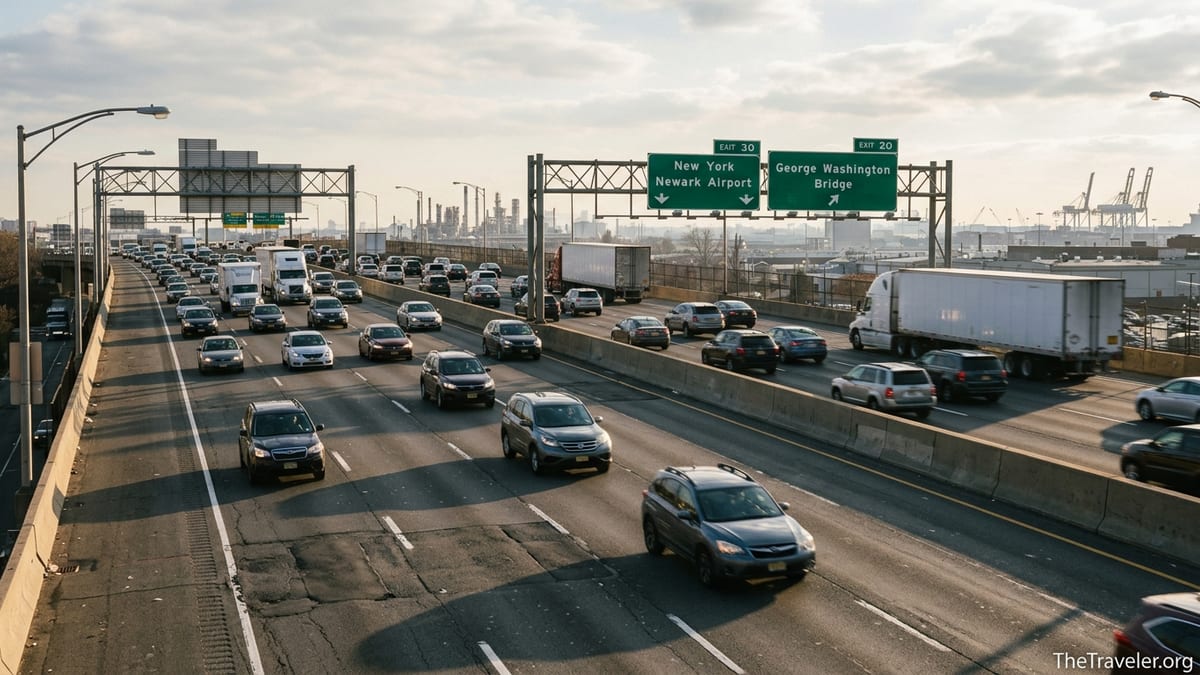
Many of the worst decisions drivers make during busy hours start with not really understanding how the New Jersey Turnpike is organized. North of about Exit 6, the highway splits into different carriageways and lane groups, including separate car lanes and car plus truck lanes, as well as local and express sections. At first glance, it can feel like an impossible choose-your-own-adventure while you are already moving at 60 miles an hour surrounded by tractor-trailers and buses. Confusion here leads directly to sudden lane changes, missed exits, and frantic swerving across multiple lanes.
For example, around the interchanges near Newark Airport and the approaches to the Lincoln Tunnel and George Washington Bridge, the Turnpike can briefly fan out into a bewildering pattern of overhead signs: I‑95 north, Route 1&9, routes to Jersey City, the Holland and Lincoln tunnels, and separate ramps for truck and car roadways. A driver in the wrong set of lanes approaching Exit 15E or 16E can realize at the last second that the ramp for their bridge or tunnel is two lanes over, separated by a wall of traffic. That moment of panic often triggers the exact kind of erratic cutovers that cause fender-benders and chain-reaction slowdowns.
Seasonal travelers heading to the Jersey Shore are especially vulnerable. Someone who only drives the Turnpike a few weekends a year may remember that “the car lanes are faster” or that “the truck lanes are less crowded,” but cannot recall which side to choose for their specific exit. They may dive for the car lanes just before the split, only to realize that their next interchange is actually only accessible from the car plus truck roadway, trapping them in the wrong place until the next opportunity to switch or exit.
The simplest fix is preparation. Before a busy-hour trip, plug your route into a navigation app and zoom in on the interchanges north of Exit 11, where the highway grows most complex. Know in advance whether your exit is served from the car lanes, the car plus truck lanes, or both, and commit to one set of lanes well before the split. Approaching the maze of ramps near Newark Airport or the Meadowlands, staying in a through lane rather than constantly chasing a slightly faster one will almost always be safer and often just as quick.
Picking the Wrong Lanes at the Worst Time
Another common mistake is assuming one set of lanes is always the best choice. Local drivers trade endless opinions about whether the car lanes or the car plus truck lanes are faster north of Exit 8A. In reality, the “right” answer changes by the hour. During weekday morning rush from Exit 11 to the approaches to New York City, the car lanes often clog with commuters while the car plus truck lanes flow a bit more steadily. In the evening, that pattern can flip depending on where incidents or minor crashes happen.
A frequent real-world scenario plays out near Carteret and Linden, where the Turnpike separates into east and west spurs serving different Manhattan crossings. A driver following a generic “northbound I‑95” prompt might drift into the car lanes on the eastern spur because the traffic looks lighter at that moment. A few miles later, congestion near the Lincoln Tunnel or a minor crash can suddenly halt those lanes while the western spur toward the George Washington Bridge keeps moving. The result is that someone who chose solely by appearance ends up stuck in stop-and-go traffic for 30 minutes longer than a driver who stayed in the slightly slower but more reliable lanes a few miles back.
Lane choice becomes especially critical near big interchanges like Exit 11, where the Turnpike meets the Garden State Parkway. In heavy Sunday evening traffic, drivers coming back from the shore often see backups on the car lanes approaching the split and dive into car plus truck lanes at the last possible moment. That last-second move can surprise truckers who have less ability to brake or swerve quickly, increasing the odds of sideswipes and brake‑check waves that ripple backwards for miles.
Instead of reacting to whatever lane looks momentarily better, use your GPS for a lane plan and then commit to it unless there is clear evidence of an incident ahead. Apps like Waze and Google Maps often know when one roadway is badly affected by a crash or stall. If your navigation says “stay in car plus truck lanes for 10 miles” even while the adjacent car lanes seem briefly faster, trust the data. The five minutes you might save by hopping around are rarely worth the extra risk in rush hour density.
Last‑Second Decisions at Toll Plazas and E‑ZPass Lanes
Toll plazas on the New Jersey Turnpike are magnets for trouble during busy periods, especially for drivers who are unfamiliar with how E‑ZPass works or who are unsure whether they are allowed to use certain lanes. At big interchanges such as Exit 18W near the George Washington Bridge or the old-style barrier plazas further south, the road expands from a tight corridor to a fan of booths and express gantries, then narrows again. When traffic is heavy, this design leaves no margin for indecision.
One of the most dangerous mistakes is changing lanes abruptly just before a toll, either to chase a slightly shorter line or to flee an E‑ZPass-only lane at the last moment. Picture a Friday afternoon in July: you are heading south toward Exit 7A for Six Flags Great Adventure, and you realize too late that you have steered into a “E‑ZPass Only” lane even though you planned to pay cash. Slamming on the brakes or cutting across two lanes of already braking vehicles can trigger exactly the sort of low-speed but damaging crashes that keep tow trucks parked next to plazas on busy days.
Another common error is accelerating too quickly out of a toll lane to “win” the merge back into highway traffic. On summer Sundays heading north toward Newark, it is common to see drivers flooring the gas as soon as they pass under an overhead E‑ZPass gantry, determined to beat adjacent vehicles into the narrowing funnel. That drag-race mentality leads to unnecessary fender-benders and near misses, particularly when a slower car or a rental SUV loaded with beach gear hesitates ahead.
Smart drivers treat toll plazas as mandatory slow zones. Decide well in advance whether you have a working E‑ZPass transponder. If you do, look for the overhead signs showing your compatible lanes and commit early. If you do not, stay clearly in the cash or full-service lanes, accepting that you might lose a minute to a longer line but will gain peace of mind and safety. After the toll, accelerate smoothly and use your turn signal when merging, remembering that everyone is in the same hurry you are. Giving a bit of space to the car next to you will not add more than seconds to your trip but can prevent the kind of sideswipe that closes a lane during the evening rush.
Aggressive Weaving, Tailgating, and Speeding in Heavy Flow
Once peak-hour traffic thickens north of Exit 11, many drivers adopt a “fight for every car length” mindset. They dart between lanes whenever they see a slight opening, ride inches from the bumper ahead, and accelerate far beyond the posted limit in any temporary gap. On a wide, straight roadway like the Turnpike, this can feel deceptively safe, but it is one of the biggest contributors to sudden slowdowns and crashes during busy hours.
Consider the eastern spur approaching the Lincoln Tunnel ramps near Exits 16E and 17. During a typical weekday morning, the flow is a dense pack of commuters, buses, and trucks all converging on the city. A single impatient driver in a compact sedan weaving through gaps can force multiple vehicles behind them to brake sharply. Those ripple effects extend hundreds of yards back, turning what might have been a steady 35 mile an hour crawl into a stop-and-go grind that magnifies the risk of rear-end collisions every time the pack lurches forward.
Tailgating is especially dangerous when sudden lane drops or merges appear with little warning. For example, as you travel north near the area where the car and car plus truck lanes reconnect before the Meadowlands, drivers who have been fixated on the left-most lane may not anticipate the need to merge or slow. Following at only a car length or two at 60 miles an hour leaves no room if the vehicle ahead spots brake lights and reacts. In wet weather or winter slush, that margin shrinks even further, yet the culture on the Turnpike too often rewards the driver who “sticks to” the car in front to prevent others from merging.
A safer and ultimately calmer approach is to pick a lane, maintain a consistent speed appropriate for conditions, and allow a comfortable following distance, even if aggressive drivers fill the gap. If you are traveling from Exit 8A to Exit 14 during the afternoon peak, for instance, settle into a middle lane at the prevailing speed and resist the urge to chase every fleeting opening. Studies of congested highways consistently show that hyper-aggressive weaving does little to reduce overall travel time but significantly increases crash risk and the frequency of shockwave slowdowns that ruin the commute for everyone behind.
Overreliance on GPS and Ignoring Real‑World Conditions
Navigation apps are essential tools on the New Jersey Turnpike, but blind faith in the blue line can easily lead to mistakes during rush hour. Routing algorithms often optimize strictly for time, not for simplicity or safety. They may tell you to change from car lanes to car plus truck lanes near one interchange, only to immediately send you back a mile later for a theoretical 60‑second gain. Each of those extra lane changes increases your exposure to near misses in dense traffic.
A common example plays out when apps look for shortcuts between the Turnpike and local roads around industrial hubs like Elizabeth, Bayonne, and Jersey City. During the evening rush, a GPS might decide that exiting at a lesser-known interchange like 15E or 15X and weaving through local streets will beat staying on the mainline toward your ultimate crossing. What the algorithm cannot fully account for is a long freight train blocking a grade crossing or a local crash that police have not yet logged into the data feed. Drivers who obediently follow every instruction, including sudden lane changes across heavy traffic to make an exit, often find themselves no better off and sometimes in riskier environments than if they stayed on the main roadway.
Navigation can also mislead unfamiliar travelers heading to major destinations like Newark Liberty International Airport. In heavy traffic near Exit 13A, a minor difference between taking the north or south ramp into the airport complex may not matter in theory. But in practice, the ramp your app prefers could be backed up due to a spillover from a terminal pickup area. The driver who insists on following the exact GPS turn at the last second instead of reading the overhead airport signs and choosing the clearer entrance lane may suddenly cut across traffic, startling drivers who have been patiently queuing.
The best use of navigation on the Turnpike during busy hours is as a guide, not a dictator. Let it alert you to major incidents, alternate routes, and approximate travel times, but pair that information with what you see on the road. If the app suggests a quick lane swap that would require crossing two solid lines in dense traffic, skip it and wait for a safer opportunity. If you know your general direction (for example, “express lanes, North, toward the George Washington Bridge”), prioritize staying in the correct section of highway over shaving one minute with an elaborate sequence of ramps.
Driving Like the Weather and Time of Day Do Not Matter
The New Jersey Turnpike runs through industrial zones, marshlands, and open countryside, and its conditions can change quickly with the weather and sun angle. One of the biggest mistakes drivers make is behaving the same way at 8 a.m. in clear June sunshine as they do in a November downpour at dusk. During peak times, when thousands of vehicles are tightly packed, even a small misjudgment of visibility or road grip can ripple into multi-car incidents.
Rush-hour rainstorms are a textbook example. When a summer thunderstorm sweeps across the wide stretches south of Exit 8A late on a Friday afternoon, spray from trucks can hide lane markings and reduce visibility to a few car lengths. Yet many drivers keep moving at 65 miles an hour or more, as if the dry limit still applies. A car that hydroplanes in the left lane can ricochet across the roadway, leaving nowhere for the closely packed traffic around it to go. Similarly, in winter, overnight snow that has melted and refrozen can leave slick patches in shaded areas under overpasses just as the morning rush begins, catching out drivers whose tires and following distances are barely adequate for dry conditions.
Sun glare can be just as hazardous. On east-west connecting ramps near Exit 13A and around the interchanges serving the airport and port areas, low morning or late-afternoon sun can make overhead signs and brake lights hard to see. A commuter heading north toward Newark in December, squinting into the rising sun, might not register that the pack ahead has braked for a slowdown. Tailgating in this situation is especially dangerous, yet many drivers do not adjust their following distance or speed when visibility drops.
Prudent Turnpike drivers treat poor weather and low visibility as reasons to dial back speed and increase margins, even if other vehicles continue at full pace. Turning on headlights when rain begins, leaving extra space around large trucks, and moving out of the left lane during heavy downpours are simple adjustments that significantly reduce risk. When traffic is already heavy, reducing your speed by 5 to 10 miles an hour in bad conditions will generally not change your arrival time by more than a few minutes, but it can be the difference between an uneventful trip and becoming part of a pileup that closes the roadway for hours.
Underestimating Fatigue, Distraction, and the Stress of Long Hauls
The Turnpike is not only a commuter road. It is a major interstate corridor used by long-haul truckers driving between New England and the Mid-Atlantic, families heading from Virginia to New York, and tourists on long summer drives to the Jersey Shore. During busy hours, many of the drivers around you have already been on the road for hours. Fatigue and distraction are quiet but potent contributors to risky behavior, especially in dense traffic where constant attention is required.
A typical summer Saturday might see a family leaving Washington, D.C., early in the morning, reaching the Turnpike around midday, and still pushing north toward the New York suburbs during the afternoon rush. By the time they approach the tangle of ramps near Exit 14 in Newark, the driver may be tired, kids in the back may be restless, and navigation instructions may be barking multiple turns in short order. In this state, it is all too easy to miss a critical sign, drift from lane to lane without signaling, or glance at a text at exactly the wrong moment.
Service areas scattered along the Turnpike exist for more than fuel and fast food. During busy periods, especially holiday weekends when accident numbers tend to rise, a 15‑minute break at a service area like Molly Pitcher or Vince Lombardi can reset your attention more effectively than another coffee sipped behind the wheel. Stepping out to stretch, using the restroom, and rechecking your route on a calmer brain can help you make clearer decisions during the complicated final miles of a trip.
Modern distraction goes beyond drowsiness. Many drivers scroll through music apps, check work emails, or tinker with navigation settings while rolling slowly in heavy traffic near the approaches to New York. Because the car is barely moving, this can feel harmless, but rush-hour congestion is exactly when traffic can go from five miles an hour to 30 in a few seconds. A moment of inattention as the pack accelerates can lead you to rear‑end the car ahead or drift into a neighboring lane. On the Turnpike, any contact in crowded conditions is likely to block a lane and worsen delays miles behind you.
The Takeaway
Driving the New Jersey Turnpike during busy hours does not have to be a white‑knuckle ordeal. The roadway is engineered to carry tremendous volumes of traffic, and most trips, even at peak times, end without incident. The greatest threats to a smooth journey are not hidden design flaws or mysterious congestion, but a familiar set of driver mistakes: choosing lanes impulsively, making last‑second moves at toll plazas and splits, driving aggressively in tight packs, and underestimating how weather, fatigue, and distraction amplify risk.
By approaching the Turnpike as a system to be understood rather than beaten, you can dramatically improve both your safety and your sanity. Study your route before you go, especially the complex stretches north of Exit 11. Treat toll plazas and major interchanges as slow, deliberate zones where planning matters more than speed. Let navigation apps inform you but not dictate unsafe maneuvers. Above all, remember that in dense rush-hour traffic, the small time gains promised by aggressive driving almost never pay off. A calm, predictable presence behind the wheel is not only better for you, it is a quiet gift to every driver sharing the road.
FAQ
Q1. What are the busiest times to drive on the New Jersey Turnpike?
Weekday rush hours, roughly 6:30 to 9:30 a.m. and 3:30 to 7:00 p.m., are typically heaviest, especially north of Exit 11. Summer Fridays and Sundays can also be very congested around shore travel times.
Q2. Is it safer to use the car lanes or the car plus truck lanes?
Both are safe when used properly. The car lanes often feel more comfortable to some drivers, while the car plus truck lanes may be steadier at times. The key is choosing the correct roadway for your exit and avoiding last‑second switches.
Q3. How can I avoid last‑minute lane changes at toll plazas?
Know in advance whether you have a working E‑ZPass and follow plaza signs early. If you are unsure, choose a full‑service lane instead of darting into or out of E‑ZPass-only lanes at the last moment.
Q4. What should I do if I accidentally enter an E‑ZPass-only lane without a transponder?
Do not swerve or stop. Drive through at the posted speed, then follow instructions on any toll notice you receive by mail. The penalty is usually less serious than the crash risk from sudden maneuvers.
Q5. Are navigation apps reliable for lane and roadway choices on the Turnpike?
They are useful for spotting major incidents and estimating delays, but they sometimes suggest frequent lane changes or complex ramp sequences. Use them as guidance, not strict orders, and prioritize safe, predictable driving.
Q6. How should I adjust my driving in heavy rain or winter conditions?
Reduce speed, increase following distance, and avoid sudden lane changes. Turn on headlights in rain, leave extra room near trucks, and be especially cautious on bridges and shaded sections that may stay slick.
Q7. What are the best ways to manage fatigue on a long Turnpike trip?
Plan regular breaks at service areas, share driving when possible, and avoid starting long drives late at night after a full day of work. If you feel drowsy, stop rather than pushing through in heavy traffic.
Q8. Are there common trouble spots I should be aware of?
Interchanges near Exit 11, Newark Airport around Exit 13A, and the approaches to the New York crossings north of Exit 14 often see dense, complex traffic during peak periods. Extra attention and early lane positioning help in these areas.
Q9. How far in advance should I get into the correct lane for my exit?
In heavy traffic, it is wise to be in the proper lane at least one to two miles before your exit, especially near major interchanges. Waiting until the last half mile often forces risky cutovers.
Q10. What is the single most important thing I can do to stay safe during busy hours?
Drive predictably. Signal early, avoid sudden moves, maintain a steady speed, and keep a safe following distance. Predictability gives other drivers time to react and greatly reduces the chance of a crash.