


If you have ever crawled past refineries outside Newark or stopped for gas at the Vince Lombardi Service Area at midnight, you know the New Jersey Turnpike is not glamorous. It is concrete, toll plazas, tractor‑trailers and a skyline that flickers between marshland and Manhattan. Yet this 122‑mile toll road is one of the most important pieces of transportation infrastructure on the American East Coast, quietly carrying families, buses and freight between Boston, New York, Philadelphia, Washington and beyond.
Get the latest updates straight to your inbox!
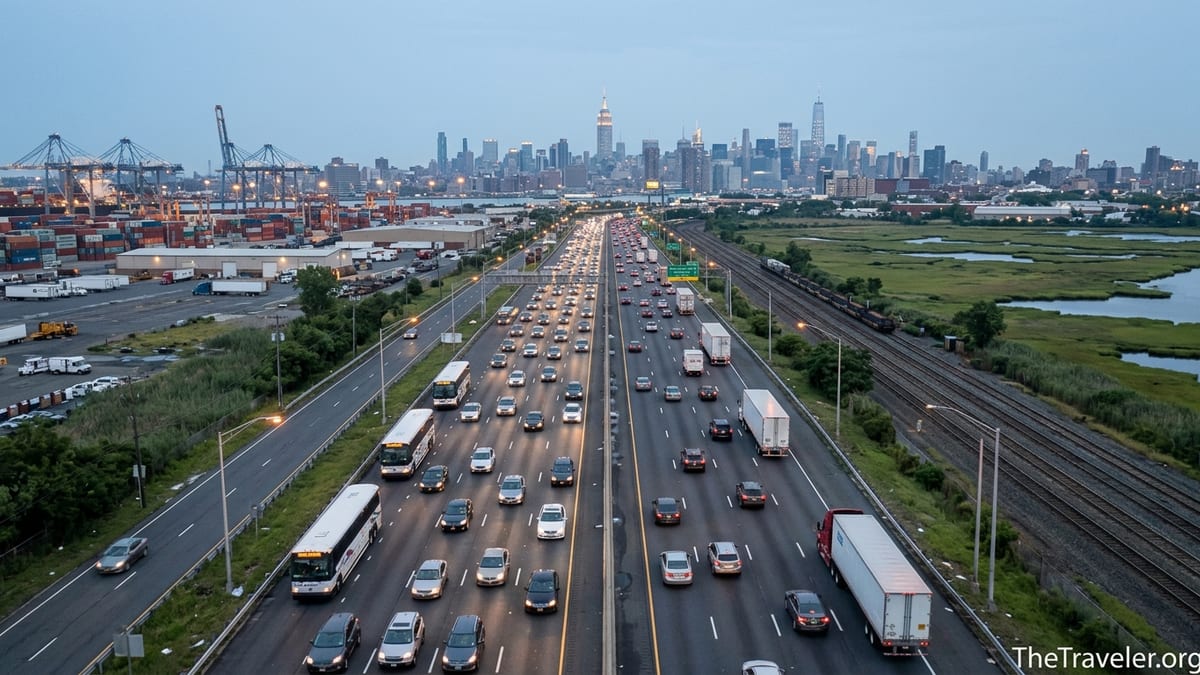
The Backbone of Interstate 95 on the East Coast
The New Jersey Turnpike is not just a state toll road. For most practical purposes it is the New Jersey segment of Interstate 95, the main highway spine of the East Coast running from Miami to the Canadian border in Maine. After years of construction, I‑95 now follows the Turnpike from the Delaware River up through central New Jersey before continuing toward the George Washington Bridge. For long‑distance drivers, that makes the Turnpike an unavoidable link between the Mid‑Atlantic and New England.
Anyone driving from Washington, DC to New York City on a typical Friday afternoon experiences this firsthand. Navigation apps route cars out of DC along I‑95 and the Baltimore–Washington Parkway, over the Delaware River into New Jersey, and then straight onto the Turnpike for a roughly 80‑mile run before traffic spills off toward the Lincoln Tunnel, Holland Tunnel or the George Washington Bridge. Most of that heavy, multi‑state traffic does not touch local New Jersey streets at all. It rides the Turnpike as a controlled‑access corridor designed to keep through‑traffic moving.
This role became even more central after the completion of the long‑planned interchange between the Pennsylvania Turnpike and I‑95 near Bristol, Pennsylvania, which finally closed a historic gap in I‑95’s route. Today, instead of detouring on I‑295 and I‑195 to find the Turnpike farther east, northbound through‑traffic flows directly from the Pennsylvania Turnpike over the Delaware River–Turnpike Toll Bridge and into the Turnpike at Exit 6. The result is more seamless long‑distance travel and more of the I‑95 corridor’s traffic being concentrated on this one New Jersey facility.
For travelers, this can mean a surprisingly efficient run through a state that otherwise has a reputation for congestion. A driver leaving Baltimore early on a Sunday morning can often cruise from the Delaware state line to Newark Airport in under 90 minutes, using the Turnpike’s long, straight sections and higher speed limits to make up time after slower urban driving farther south. The road’s design, and its place within the I‑95 network, make it one of the rare stretches where the East Coast’s great highway artery moves at something close to its intended speed.
A Freight Superhighway Hiding in Plain Sight
While vacationers and daily commuters may focus on traffic jams and toll prices, the Turnpike’s most critical role is moving goods. From Atlanta warehouses to Maine supermarkets, much of the freight that travels the I‑95 corridor depends on this highway. Tractor‑trailers use the Turnpike to cross New Jersey quickly between the port and industrial complexes around Newark Bay and the vast distribution centers that have sprung up along the corridor in central New Jersey.
This freight role is especially obvious near interchanges such as 8A, south of New Brunswick, where distribution hubs for companies like Amazon and major grocery chains cluster close to the roadway. On a weekday afternoon, long lines of double‑stacked container trucks stream between warehouse driveways and the Turnpike ramps, carrying goods that arrived at Port Newark or Elizabeth terminals a few hours earlier. Those containers may be en route to retail stores in New England, big‑box chains in the Mid‑Atlantic or even secondary distribution centers as far south as Virginia.
The Turnpike Authority has recognized this freight pressure by widening some overburdened segments. Between Exit 6 and Exit 9, for example, a multiyear widening program expanded the mainline to a dual‑dual configuration, with separate roadway pairs for cars and for cars mixed with trucks. Engineers focused on this central stretch because it connects the Pennsylvania Turnpike, New Jersey’s port region and the cluster of inland ports and logistics parks that ring towns such as Cranbury, South Brunswick and East Windsor.
For road‑trip travelers, the freight activity is impossible to miss. Many drivers recall cruising in the “cars only” lanes while, just a concrete barrier away, an almost continuous convoy of tractor‑trailers occupies the inner roadway. That design helps keep passenger cars more comfortable while preserving the Turnpike’s primary function: providing a reliable through‑route for the commercial vehicles that keep East Coast stores stocked and e‑commerce deliveries flowing.
Where Buses, Planes and Trains Quietly Intersect
Because the Turnpike runs so close to major airports and rail hubs, it hooks into almost every other mode of travel on the East Coast. Nowhere is this more obvious than near Newark Liberty International Airport, where the Turnpike’s elevated lanes run within sight of the airport monorail and the Northeast Corridor rail line. Travelers arriving on an evening flight from Chicago might see headlights streaming along the Turnpike from their airplane window and then, 30 minutes later, find themselves in a rideshare car using that same highway for the short hop to a Newark hotel or into Manhattan.
The highway is also the backbone of the region’s intercity bus network. Companies such as Greyhound and Megabus schedule multiple daily trips between New York and Washington, DC, using the Turnpike for much of the roughly four‑hour journey. After leaving midtown Manhattan or a curbside stop near Penn Station, these buses dive into the Lincoln Tunnel or cross the Hudson on the George Washington Bridge, then almost immediately merge onto the Turnpike. Southbound, they stay on it until well past New Brunswick before turning toward Philadelphia and Baltimore.
Chinatown buses and other low‑fare operators follow the same general pattern. A budget traveler can pay a modest fare, sometimes as low as the cost of a casual restaurant meal, to ride from lower Manhattan or Brooklyn to Washington or Baltimore. While the tickets may be sold in small storefronts in New York’s Chinatown or online through bare‑bones websites, the actual travel experience depends heavily on the professionally maintained Turnpike roadway and its rest areas. A typical New York to DC bus will pause at a service area such as Molly Pitcher or Clara Barton midway through the trip, giving riders a chance to rest while the driver checks the vehicle and fuel levels.
At the local level, New Jersey Transit buses also use the Turnpike to bridge gaps between communities. Commuter routes from park‑and‑ride lots near interchanges like Vince Lombardi whisk office workers into the Port Authority Bus Terminal in Manhattan each weekday morning. Those commuters may never think about the Turnpike’s larger regional role, but for them it shapes whether a cross‑Hudson bus ride feels like a manageable daily routine or an exhausting ordeal.
Service Areas: The East Coast’s Unofficial Living Rooms
The Turnpike’s network of service areas turns what might otherwise be a monotonous drive into a series of familiar waypoints. Named after historical figures with New Jersey ties, plazas such as Joyce Kilmer, Molly Pitcher, Clara Barton and Vince Lombardi offer fuel, food courts, restrooms and convenience stores spaced at regular intervals along the highway. For drivers covering long distances, these stops become almost ritual: coffee at Molly Pitcher on the way north at dawn, a late‑night hamburger at Vince Lombardi before tackling the last miles into New York City.
In recent years, the Turnpike Authority has invested heavily in renovating and modernizing these facilities. Old cafeterias have given way to brand‑name fast‑food counters and grab‑and‑go markets. At some plazas, travelers can find electric vehicle charging stations alongside traditional gas pumps, allowing EV drivers from places like Virginia or Massachusetts to recharge while they snack. Families with children notice cleaner restrooms, brighter lighting and improved seating areas, which help break up a long drive between, say, North Carolina and New England.
These service areas also serve as informal community spaces for people who share the road but rarely intersect elsewhere. Truck drivers compare notes over an early‑morning coffee; college students heading back to campuses in Boston or Philadelphia kill time scrolling on their phones; grandparents from Florida stretch their legs on their way to visit grandchildren in Connecticut. On peak holiday weekends, the parking lots take on the atmosphere of a temporary town, filled with license plates from Ontario, Georgia, Quebec and nearly every state in between.
For practical trip planning, understanding where these service areas sit along the route can make journeys smoother. A family driving from suburban Washington to Cape Cod might plan a first bathroom break at Clara Barton, a fuel and food stop around Molly Pitcher or Joyce Kilmer, and a final coffee at Vince Lombardi before dealing with New York traffic. That kind of quiet reliability is part of why the Turnpike, for all its utilitarian image, inspires a certain loyalty among frequent East Coast travelers.
Engineering a Dedicated Through‑Route in a Crowded State
New Jersey is one of the most densely populated states in the country, with compact cities, older suburbs and sensitive wetlands all packed between the Delaware River and New York Harbor. Building a highway that can carry millions of long‑distance travelers without constantly colliding with local traffic was never a simple task. The Turnpike’s designers addressed this by emphasizing grade separations, limited access points and, on key stretches, separate carriageways for different kinds of vehicles.
The dual‑dual configuration between Exit 8A and northern interchanges is a prime example. Here, the inner roadway carries a mix of cars and trucks, while the outer roadway is restricted to passenger vehicles. For a family driving from Baltimore to Boston, choosing the outer lanes often means a steadier pace, fewer white‑knuckle moments alongside 18‑wheelers and simpler merges. Meanwhile, freight carriers get a sturdier inner roadway designed with heavy truck volumes in mind.
Even smaller design choices can have outsized benefits for regional travel. Long acceleration lanes at major interchanges help buses and fully loaded trucks enter the traffic stream smoothly, decreasing the risk of sudden braking and bottlenecks. Toll plazas have gradually migrated from traditional booths toward electronic collection using windshield‑mounted transponders, reducing the stop‑and‑go rhythm that once characterized busy weekends. For out‑of‑state visitors, this means shorter delays at toll points and fewer surprises when crossing from other toll roads such as the Delaware Memorial Bridge or the Pennsylvania Turnpike.
The Turnpike also interacts thoughtfully with other major transportation assets. Interchanges near Newark connect directly to airport access roads, while ramps near Secaucus provide links toward the Lincoln Tunnel and midtown Manhattan. Drivers heading for the Jersey Shore can exit near Route 7A or Route 18, using the Turnpike as the fast north–south trunk before branching off to beach destinations like Point Pleasant or Long Branch. This nested design lets the Turnpike function as the backbone while local highways and parkways handle finer‑grained access.
Climate, Congestion and the Next Era of the Turnpike
As East Coast travel patterns evolve, the Turnpike is again at the center of major debates. Traffic volumes have rebounded strongly since the early pandemic years, with freight demand, e‑commerce deliveries and renewed leisure travel all putting pressure on the highway. In response, the New Jersey Turnpike Authority has advanced large‑scale projects such as replacing and widening the aging Newark Bay Bridge, a key link between Newark, Bayonne and the Turnpike Extension toward the Holland Tunnel.
These projects, with multibillion‑dollar price tags and timelines that stretch into the 2030s, have drawn intense scrutiny from environmental groups and local communities. Critics argue that adding highway capacity risks locking the region into car‑dependent patterns and generating more greenhouse gas emissions over time. They point to alternatives such as investing in freight rail improvements, expanding regional rail services or upgrading bus lanes that could move people and goods with less pollution.
Supporters counter that much of the Turnpike’s traffic is regional or long‑distance in nature, with limited practical alternatives. The trucks carrying containers from Port Newark to inland warehouses, or refrigerated trailers hauling food up the corridor from the Mid‑Atlantic, cannot yet shift easily to rail on many routes. For them, a structurally sound bridge and reliable highway connection may be less about comfort and more about basic economic functioning, especially when just‑in‑time supply chains and perishable cargo are involved.
For travelers, the near‑term impact of these debates will be visible mainly through construction zones, adjusted speed limits and occasionally more congested work areas. A family leaving New England for a spring break road trip to the Outer Banks, for example, may encounter narrowed lanes and lane shifts near Newark Bay or other improvement zones. Building a more resilient and modern Turnpike while keeping East Coast traffic flowing is a delicate balancing act that will shape how future generations experience this highway.
How the Turnpike Shapes Travel Choices Without Being Seen
One reason many people underestimate the Turnpike’s importance is that it often fades into the background of their travel stories. A couple might remember their weekend in Philadelphia or their Broadway show in Manhattan but forget that the same concrete corridor carried them between both cities in just a few hours. Similarly, a student booking a low‑fare bus from Boston to Washington may only see the ticket price and Wi‑Fi promise, not the fact that the route depends on being able to cruise at highway speeds across New Jersey.
Consider air travel routing as another example. Airlines schedule dense banks of flights into Newark Liberty International Airport partly because they can rely on quick ground access via the Turnpike. When an early‑morning arrival from Orlando brings hundreds of passengers into Newark, many connect to Manhattan hotels, suburban New Jersey communities or even outlying towns in Pennsylvania. Taxis, rideshare drivers, hotel shuttles and private cars all funnel onto the Turnpike or its connectors, turning the highway into the invisible stage on which those transfer dramas play out.
Even leisure trips that do not seem “about” New Jersey depend on this infrastructure. Snowbird caravans from New England to Florida, for instance, time their winter migrations using familiar legs of the drive: Day one to New Jersey, day two into the Carolinas, day three into northern Florida. For these travelers, New Jersey is not the destination but a predictable checkpoint. The Turnpike’s service areas and straightforward routing let them plan hotel stops in nearby towns like Bordentown, Woodbridge or Newark without worrying about complicated local navigation in the dark.
Because of this, disruptions on the Turnpike can ripple far beyond state lines. A serious accident blocking lanes near Exit 7, or a winter storm that coats bridges in ice, can delay buses full of college athletes, refrigerated trucks hauling seafood, and families headed for long‑planned vacations. When that happens, national media may simply report “I‑95 delays in New Jersey,” but for anyone on the ground, it is a reminder of how heavily the East Coast depends on this specific road.
The Takeaway
The New Jersey Turnpike is easy to dismiss as an unremarkable toll road sandwiched between more glamorous destinations. Yet for East Coast travel, it functions like a vital artery, pumping people, goods and vehicles between major cities every hour of the day. Its design as a controlled‑access, limited‑interchange corridor lets long‑distance traffic bypass local streets in one of the most crowded parts of the United States, while its service areas, interchanges and connections to airports and rail lines quietly knit together multiple modes of transport.
For travelers, understanding the Turnpike’s role can make trips smoother and less stressful. Knowing where major service areas are, when construction might affect schedules and how the highway connects to airports, ports and bus networks allows for more realistic planning. A road‑trip from Quebec to the Carolinas, a budget bus journey between Washington and New York or a family vacation flight into Newark all intersect with this highway in ways that are not always obvious.
As debates continue over future widening, bridge replacements and climate impacts, one fact is unlikely to change soon: if you are moving along the eastern seaboard of the United States, the odds are high that your journey will rely on the New Jersey Turnpike at some point, whether you notice it or not. It may not offer sweeping mountain vistas or iconic roadside attractions, but it is one of the quiet workhorses that keeps the East Coast in motion.
FAQ
Q1. Is the New Jersey Turnpike the same thing as Interstate 95?
The Turnpike carries Interstate 95 for most of its length in New Jersey, especially between the Delaware River and the approach to the George Washington Bridge, but it is operated as a separate toll facility by the New Jersey Turnpike Authority.
Q2. How long does it usually take to drive the full length of the Turnpike?
In light traffic, drivers can often cover the roughly 120 miles between the Delaware Memorial Bridge area and the northern interchanges in about two hours, but congestion around Newark, New York City approaches and major holiday periods can add significant time.
Q3. Why are there separate “cars only” and “cars and trucks” lanes on some sections?
The dual‑dual configuration in central and northern New Jersey separates heavy truck traffic from most passenger vehicles. This design improves safety, helps traffic flow more smoothly and preserves pavement on lanes built for heavier loads.
Q4. Do I need to have an E‑ZPass to use the New Jersey Turnpike?
No, cash and card payment options are still available at many toll points, but E‑ZPass or similar electronic tags usually provide faster passage and can reduce delays, especially at busy interchanges and during peak travel times.
Q5. Which service areas are best for a quick stop on a long‑distance trip?
Many long‑distance travelers favor large, centrally located plazas such as Molly Pitcher, Joyce Kilmer and Clara Barton, which typically offer multiple food options, fuel and restrooms, while Vince Lombardi near the north end is convenient before or after entering the New York City area.
Q6. How does the Turnpike connect to New York City and its airports?
Near Newark, ramps lead directly toward Newark Liberty International Airport, while farther north the roadway splits into spurs serving the Lincoln Tunnel, Holland Tunnel and George Washington Bridge, all of which provide access to different parts of the New York metropolitan area.
Q7. Are there alternatives to the Turnpike for driving between Washington and New York?
Alternatives such as U.S. Route 1, Interstate 295 and various local parkways exist, but they are usually slower and more prone to traffic signals and local congestion, so most through‑drivers and intercity buses still rely on the Turnpike for the New Jersey portion of the trip.
Q8. Is the Turnpike a good route for electric vehicles?
Yes, many Turnpike service areas now offer fast‑charging stations in addition to gasoline and diesel fuel, making it feasible for EV drivers to plan long‑distance trips along the East Coast using stops within New Jersey as predictable charging points.
Q9. How do construction and widening projects affect travelers?
Work zones can bring reduced speed limits, lane shifts and occasional delays, especially near major structures like the Newark Bay Bridge. Checking for current advisories before a trip can help drivers adjust departure times or plan fuel and rest stops around expected slowdowns.
Q10. Why is the New Jersey Turnpike so important for freight movement?
The road links major container ports, airports and warehouse clusters with the rest of the I‑95 corridor. This makes it a primary route for trucks carrying consumer goods, food, industrial supplies and e‑commerce shipments between the Mid‑Atlantic and New England, even when most travelers only notice the passenger side of the story.