


The New Jersey Turnpike is one of the busiest toll highways in the United States, a critical corridor between New York, Philadelphia, and points south. It is also a place where travelers regularly spend more on tolls than they need to, often because they misunderstand how discounts, payment methods, and violations work. With a bit of planning, you can use the Turnpike efficiently while avoiding unnecessary charges, surprise administrative fees, and rental car add-ons.
Get the latest updates straight to your inbox!
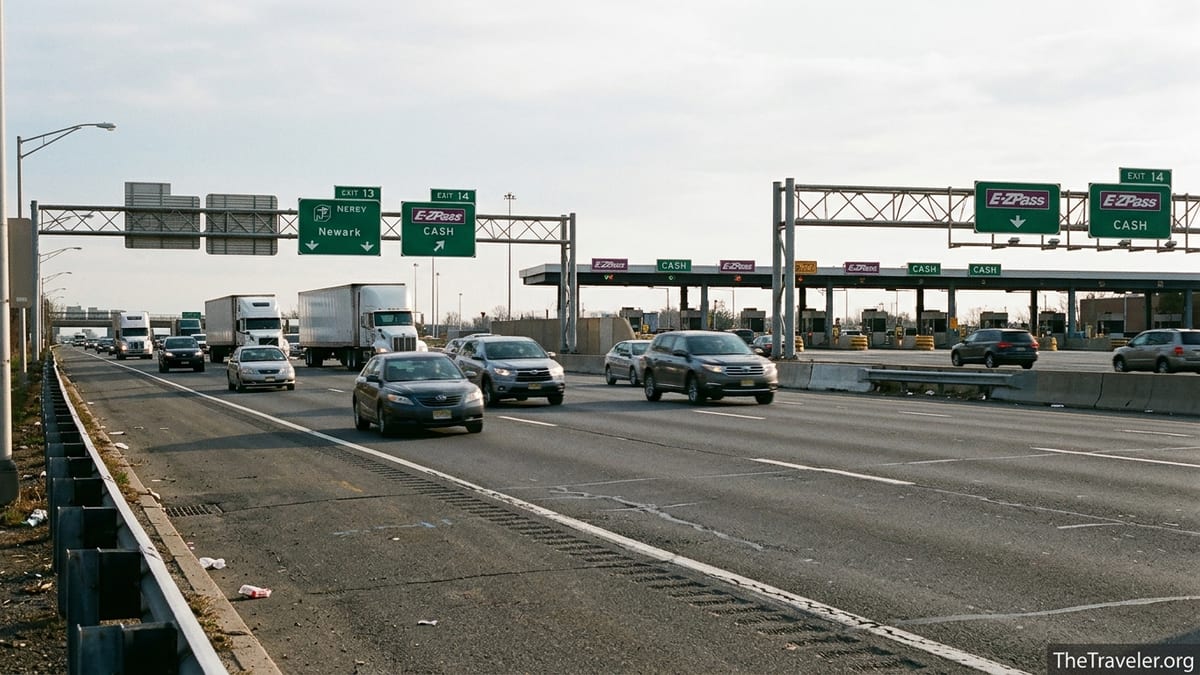
Understanding How New Jersey Turnpike Tolls Are Calculated
The New Jersey Turnpike uses a distance based toll system for most of its length. When you enter the road at a traditional toll plaza, you either take a ticket or your E ZPass tag records your entry. When you exit, your toll is based on the combination of your entry and exit points and your vehicle class. A typical passenger car is Class 1. In simple terms, the farther you drive, the more you pay.
As of early 2026, driving a Class 1 passenger car the full length of the Turnpike, from Exit 1 near the Delaware Memorial Bridge to Exit 18 near the George Washington Bridge approach, costs a little over twenty dollars with E ZPass and slightly more with cash. Shorter trips cost less. For example, a common corridor for visitors is from Exit 14 near Newark Liberty International Airport down to Exit 7A for Six Flags Great Adventure. That middle of the state run is significantly cheaper than running the entire roadway, and you only pay for the specific segment you use.
Newer all electronic tolling zones on the northern segments work differently. There, overhead gantries read your E ZPass transponder or license plate as you pass at highway speed instead of at a traditional toll barrier. The amount charged is still based on your place on the roadway, but there is no need to stop. For E ZPass users, these transactions appear alongside your ticket based trips and are billed at the appropriate discounted or standard rate depending on the time of day and your account type.
To avoid overpaying, it helps to know a rough sense of what your trip should cost before you drive. For instance, if you are taking a family from Philadelphia’s suburbs to Newark Airport, a typical route is to enter near Exit 3 or 4 and exit at 14 or 14C. For a standard car with E ZPass, this is usually in the mid to upper single digits or low teens in dollars, not an enormous jump from the full length toll. If an invoice or rental car toll bill later shows an amount that seems far higher, that is a clue that extra fees or a higher toll by mail rate may have been applied.
Why Having the Right E ZPass Matters
The single most effective way to avoid overpaying on the New Jersey Turnpike is to use E ZPass, and specifically to use a tag issued by a New Jersey based or compatible agency that offers local discounts. E ZPass is accepted on most toll roads and bridges throughout the Northeast, but not all tags are created equal. In New Jersey, passenger vehicles with a New Jersey E ZPass receive a lower rate than cash at all times and an additional discount during off peak hours on the Turnpike.
For example, the New Jersey Turnpike Authority has adopted an approximate twenty five percent discount on off peak tolls for New Jersey E ZPass users in Class 1 vehicles. In practical terms, if a peak period toll for a given entry exit pair is around eight dollars, the off peak E ZPass toll may be closer to six dollars. Over a year of commuting, that difference adds up quickly. A traveler who makes the same trip five days a week could save hundreds of dollars simply by ensuring they have a New Jersey based E ZPass and timing most trips outside peak windows when possible.
There are also special discount plans. New Jersey offers a Green Pass plan for highly fuel efficient vehicles and a senior discount for eligible drivers, both structured as a percentage off the already discounted off peak E ZPass rate. In effect, this creates a stack of savings: lower than cash to start with, an off peak discount for using the road at less busy times, and then a smaller additional percentage off for qualifying vehicles or seniors on top of that. If you drive a hybrid that meets the qualifying standards and mostly travel in non rush hour periods, you might pay noticeably less per trip than a similar driver using cash in the next lane.
Travelers from out of state should pay attention to which agency issued their tag. A New York or Pennsylvania E ZPass will still be accepted and will usually receive the standard E ZPass rate, but not always the New Jersey specific off peak discount. This matters for longer trips. A Virginia family road tripping to New England might reasonably buy an E ZPass in their home state and still save compared with paying cash, but a New Jersey commuter making the daily run from Exit 9 to Exit 14 may want to keep a New Jersey based account specifically to capture the local discount structure.
Peak, Off Peak, and Planning Your Trip Around the Clock
Peak and off peak time windows on the New Jersey Turnpike affect only E ZPass customers, but that is precisely where significant savings can be found. During defined off peak hours, New Jersey E ZPass account holders in passenger vehicles pay a discounted rate that can be roughly a quarter lower than the standard toll. During peak hours, they receive a smaller or no discount relative to the posted E ZPass rate.
The exact schedule can change, but a common pattern is that weekday morning and late afternoon to early evening periods count as peak, while mid day, late evening, and overnight hours count as off peak. Weekends tend to be mostly off peak, though certain high traffic holiday windows may be treated differently. If you are planning a discretionary trip, such as starting a beach weekend or returning from visiting family, consider whether you can enter and exit the Turnpike just outside of peak hours. Shifting a departure from 4:30 p.m. to 7:00 p.m. on a Friday might mean both lighter traffic and a lower toll.
For instance, imagine a driver traveling from Exit 11 to Exit 18W on a weekday. If they make the trip at 8:15 a.m., the toll is charged at a peak E ZPass rate. If they instead start at 10:30 a.m., the same trip is an off peak E ZPass transaction and is billed at the discounted level. Over a summer of repeated trips to North Jersey or New York area events, adjusting timing could quietly save enough to cover a tank of gas.
Because toll schedules and discounts are occasionally updated, travelers should check the latest information from the New Jersey Turnpike Authority or the E ZPass New Jersey customer service site before a long trip. When you see toll charges post to your E ZPass account, compare a couple of sample transactions with what you expected. If off peak trips are being billed at peak rates, that is something to raise with customer service promptly rather than ignoring until the charges blend into a long statement history.
Cash, Toll by Mail, and Rental Car Pitfalls
While E ZPass is the cheapest and simplest method for most frequent users, many occasional travelers still pay with cash or rely on toll by mail. On traditional ticketed segments with staffed exits, cash users pay a posted rate that is typically higher than the discounted E ZPass rate but lower than the toll by mail or violation rate. On some northern gantry based sections, there may no longer be a staffed cash option, and plates are read by camera if you do not have a transponder.
When the Turnpike has to mail an invoice based on a license plate, the rate is often higher than both E ZPass and standard cash, and administrative fees can be added if bills go unpaid. Travelers driving rental cars are especially vulnerable. If you drive through tolls without your own transponder, the rental company’s toll program may bill you the toll by mail rate plus a per day or per transaction service fee. A traveler who drove from Philadelphia to Newark and back in a rental car recently found that, although roadside electronic signs indicated the toll was being paid through E ZPass, the rental company’s toll administrator later charged them at the higher cash or plate rate instead of the discounted E ZPass rate, greatly increasing the final bill.
To avoid this, bring your own compatible E ZPass transponder if you anticipate driving on the Turnpike in a rental car. Before your trip, log into your E ZPass account and temporarily add the rental vehicle’s license plate and state, then remove it when you return the car. Many travelers do this for trips from Newark Airport to Manhattan or from the Philadelphia region up to North Jersey. It allows the tolls to post directly to your own account at the lower rate, bypassing the rental car company’s toll processing fees altogether.
If you do drive without any form of payment, it is important to act quickly. In some cases, especially with traditional booths, the Turnpike Authority allows you to pay a missed toll online or through its app within a short window. Doing so promptly may mean paying the actual toll amount and avoiding hefty administrative penalties. Waiting until a violation notice is generated can result in a maximum toll being charged for that exit pair plus a separate violation fee, sometimes in the tens of dollars, which can easily exceed the amount of the original toll.
Smart Route Choices and Realistic Cost Comparisons
Avoiding overpaying is not only about discounts. Sometimes it is about deciding whether the Turnpike is the right road at all. New Jersey offers parallel free alternatives such as U.S. Route 1, U.S. Route 130, and local highways. In theory, you can avoid tolls entirely by using these alternatives. In practice, congestion, traffic lights, and slower speed limits mean longer travel times and more fuel burned.
Consider a common trip: driving from the Delaware Memorial Bridge area up toward New Brunswick. The most direct toll route is to enter the Turnpike at Exit 1 and travel north to Exits 8 or 9. On a clear day with moderate traffic, that run is fast and predictable. If the full length toll is a bit more than twenty dollars and your time is valuable, the Turnpike may be a rational choice. On the other hand, if you are driving a longer vacation route where time is flexible, using a mix of free highways for part of the way and entering the Turnpike closer to your destination, such as at Exit 4 or 7, can trim the toll by several dollars while adding only a modest amount of time.
Another example is the short northern segment between the Newark Airport area and the approaches to the George Washington Bridge. Some drivers are tempted to avoid Turnpike tolls altogether by taking local streets or parallel interstates. Yet this is a corridor where tolls on other facilities, such as the bridge itself or competing tunnels into Manhattan, can be significantly higher than the few dollars spent on the Turnpike. In that case, the Turnpike segment may actually be the least expensive leg of the trip when viewed against the total cost of the journey.
The key is to compare realistic options rather than focusing narrowly on any single toll. If an alternate route introduces an extra hour of driving through heavy stop and go traffic, the additional fuel burned and fatigue may not be worth saving three or four dollars. On the other hand, if you can shift your Turnpike entry point by one interchange without adding much time, as in joining at Exit 11 instead of 9 on a northbound run, the longer free segment at the start of your trip can reduce the toll in a meaningful way.
Avoiding Violations, Administrative Fees, and Common Mistakes
Many of the biggest toll bills associated with the New Jersey Turnpike are not from the toll itself but from violations and administrative fees. Losing or failing to take a ticket, driving through an E ZPass only lane without a transponder, or ignoring mailed notices can all trigger charges that are far higher than the basic toll for your trip.
One common scenario involves drivers entering at a staffed plaza, misplacing their ticket in the car, and then arriving at an exit with no ticket to surrender. The toll system has to assume a starting point, and if it cannot verify where you entered, it may charge you the maximum toll for that exit, effectively the full length of the roadway for that direction. In 2026, that can mean paying a toll comparable to driving from Exit 1 to Exit 18 even if you only drove a handful of exits. Keeping the ticket on the dashboard or clipped to the sun visor until you exit is a simple habit that can prevent this kind of overcharge.
Another costly mistake is allowing an E ZPass account to go negative or a credit card on file to expire. When the account cannot replenish automatically, some agencies apply fees or temporarily suspend discounts. In the worst cases, a driver may pass through multiple toll points believing they are paying at the discounted rate, only to later receive a batch of violation notices mailed to the address on file, each with a separate administrative fee. Checking your E ZPass balance before a long trip, updating expired cards, and opting into text or email alerts for low balances can prevent this.
Travelers in rental cars or borrowed vehicles should also understand who is responsible for tolls. If you hand a friend your E ZPass tag for a weekend trip, their use will be billed to your account. If they inadvertently trigger a violation, the notice will be sent to the registered owner or account holder. Similarly, ignoring a rental car toll or violation notice in the hope it will vanish can backfire. Some rental agencies add their own administrative fee on top of any penalties from the toll authority, turning a modest oversight into a substantial add on to the cost of the rental.
The Takeaway
Driving the New Jersey Turnpike efficiently does not mean avoiding it altogether. Instead, it means understanding how its toll system works and using that knowledge to your advantage. For most travelers, the single smartest move is to use a compatible E ZPass transponder, ideally one tied to a New Jersey based account if you are a regular user, to access lower rates and off peak discounts.
Beyond that, strategic timing, sensible entry and exit choices, and careful attention to your E ZPass account status go a long way. Whether you are a frequent commuter between Central Jersey and North Jersey, a family driving to the Jersey Shore for a summer week, or an out of state visitor heading from Newark Airport to Philadelphia, small decisions like departing outside peak hours or adding a rental car plate to your own E ZPass can make the difference between paying a fair toll and overpaying once fees and penalties are included.
Viewed properly, the Turnpike is a tool: a fast, reliable corridor that can be cost effective when used thoughtfully. With a clear sense of how tolls are calculated, what discounts are available, and how to avoid the most common missteps, you can focus more on your destination and less on worrying about what might show up on your credit card statement weeks after the trip.
FAQ
Q1. Do I really save money with E ZPass on the New Jersey Turnpike compared with paying cash?
E ZPass almost always costs less than paying cash on the Turnpike, and New Jersey based E ZPass accounts receive additional off peak discounts for passenger vehicles.
Q2. I have an E ZPass from another state. Do I still get the New Jersey Turnpike discounts?
Your out of state E ZPass will work, but you may not receive certain New Jersey specific discounts such as the full off peak reduction reserved for New Jersey issued accounts.
Q3. What happens if I lose my toll ticket before I exit the Turnpike?
If you arrive at an exit without a ticket, the system often charges you the maximum toll for that exit, which can be similar to the full length toll for that direction.
Q4. How can I avoid high toll charges in a rental car on the Turnpike?
Bring your own E ZPass transponder, add the rental plate to your account before driving, and decline the rental company’s toll package when possible to sidestep service fees.
Q5. Are there free alternatives to the New Jersey Turnpike for north south travel?
Yes, routes like U.S. 1 and U.S. 130 run roughly parallel, but they usually involve slower travel with more congestion, traffic lights, and varied speed limits.
Q6. Does the New Jersey Turnpike offer senior or green vehicle discounts?
New Jersey offers a senior discount and a Green Pass plan for qualifying high efficiency vehicles, both applied as a percentage off the already discounted off peak E ZPass rate.
Q7. What is toll by mail and why is it more expensive?
Toll by mail uses license plate images to send invoices. The rate is often higher than E ZPass or cash, and additional administrative fees can apply if bills go unpaid.
Q8. How can I check if I was charged the correct toll on my trip?
Log in to your E ZPass account or review your mailed invoice, compare a few sample trips with the official toll charts, and verify whether they occurred during peak or off peak times.
Q9. Will unpaid New Jersey Turnpike tolls affect my ability to register a vehicle?
Persistent unpaid tolls and violations can eventually lead to collection efforts and may affect your ability to renew vehicle registration, especially for New Jersey registered cars.
Q10. Is it worth timing my trip around off peak hours just to save on tolls?
If you drive the Turnpike frequently or over long distances, planning trips during off peak periods can yield meaningful savings, especially when combined with E ZPass discounts.