


The first time I merged onto the New Jersey Turnpike at its southern end near Carneys Point, I expected a bland, anonymous stretch of interstate. What I found instead was a road that locals talk about with the kind of passion usually reserved for sports teams and neighborhood pizza joints. Driving the Turnpike from end to end taught me that this is more than a toll road. For New Jersey residents, it is a daily battleground, a necessary evil, and a strangely beloved piece of infrastructure that has shaped how people live, work, and even see their own state.
Get the latest updates straight to your inbox!
The Road That Built Modern New Jersey
The New Jersey Turnpike opened in 1951 and runs roughly 122 miles from Carneys Point Township, just across the Delaware River from Pennsylvania, to the shadow of the George Washington Bridge outside New York City. It is officially part of Interstate 95 for most of its length, but New Jersey drivers rarely call it that. To them it is simply “the Turnpike,” a highway that carved a high-speed corridor through industrial towns and marshland and helped cement New Jersey’s role as the connector between two of America’s most important cities.
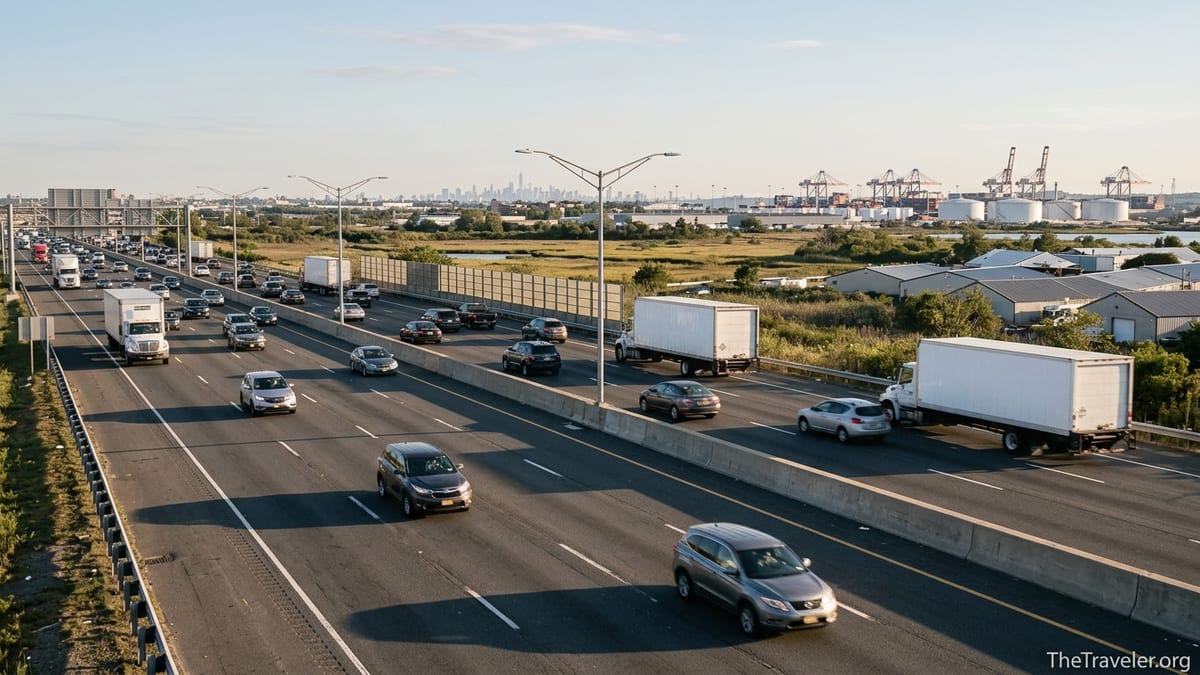
On a typical weekday, the Turnpike carries hundreds of thousands of vehicles, from commuters leaving leafy suburbs around exits 8A and 9 to heavy long-haul trucks grinding north toward the ports near Newark Bay. Much of the central section between interchanges 6 and 9 has been widened over the past decade into a 12-lane dual-dual roadway, with separate carriageways for cars only and for a mix of cars, trucks, and buses. That design reflects the Turnpike’s identity as a workhorse freight corridor as much as a commuter route.
Spend even a few hours on it and you start to understand why New Jerseyans see the Turnpike as a defining state institution. Entire family histories are organized around exit numbers: the grandparents who settled near Exit 4 in South Jersey, the cousin who moved to Exit 13A for a job in the Port Newark–Elizabeth area, the college student shuttling between Exit 9 for Rutgers and Exit 15X for a train into Manhattan. The Turnpike is both literal and emotional infrastructure.
That history shapes local opinions. For some, the Turnpike represents opportunity, a straight shot to jobs in New York or Philadelphia. For others, it is a symbol of environmental sacrifice, skirting oil tanks, container terminals, and smokestacks through a corridor that many travelers assume is all New Jersey has to offer.
Why Locals Love to Hate It
If you ask a New Jersey driver how they feel about the Turnpike, you are likely to get a sigh before you get an answer. Grievances start with congestion. Northern stretches near Newark Airport, the Meadowlands, and the approaches to the George Washington Bridge are notorious choke points, particularly around interchanges 13 through 18W and 16E. Summer Friday afternoons can turn a 20-minute hop from Exit 13 to Exit 15W into an hour-long exercise in patience, especially when beach traffic on the parallel Garden State Parkway pushes more drivers onto the Turnpike.
Tolls are another flash point. Even with E-ZPass, a full run from the Delaware Memorial Bridge area up to the northern terminus can cost a typical passenger vehicle more than many drivers expect for a single state. Periodic toll increases, including percentage-based hikes in recent years, have cemented the Turnpike’s reputation as one of the country’s more expensive long-distance drives. Commuters who travel daily between exits like 7A and 14 or 8A and 16W feel those incremental costs in a way an occasional road-tripper never will.
Then there is the scenery. The stretch between exits 11 and 15W runs past oil refineries, chemical plants, and power stations, with the Pulaski Skyway in the distance and the Port Newark–Elizabeth shipping complex sprawling along the water. Nonresidents often assume this is all New Jersey, and locals bristle at the caricature while still acknowledging this is not the state’s postcard view. It is common to hear residents joke that the Turnpike was deliberately plotted through the ugliest parts of the state so that out-of-towners would stay away from the better bits.
These daily irritations add up. In national surveys of hated highways and toll roads, the New Jersey Turnpike consistently ranks near the top, usually alongside the Pennsylvania Turnpike and congested urban interstates. Longtime residents swap war stories about white-knuckled winter drives north of Exit 13, or crawling through miles of orange cones during a late-night resurfacing project near Exit 8A when all traffic is forced into a single lane.
The Hidden Logic Behind the Madness
Yet beneath the complaints there is a logic to how the Turnpike works, and that logic is part of why locals have such specific opinions. One of the most important quirks is the car/truck separation in the central portion of the highway. Between interchanges 6 and 9, and again in the busy northern section, the Turnpike splits into separate sets of lanes: outer roadways shared by all vehicles and inner lanes restricted to cars. Experienced New Jersey drivers have strong preferences here. Some swear by the inner roadway to avoid slow-moving tractor-trailers and buses; others prefer the outer lanes because they offer more direct access to exits serving towns like East Windsor and Cranbury.
On my own run north through this 12-lane section, I watched the local choreography unfold. At Exit 8A, where warehouses and distribution centers line the horizon, trucks poured onto the outer roadway while sedans and SUVs darted left through short weave zones to dive into the car-only lanes. Miss the split and you may find yourself overshooting your exit by several miles. Longtime residents have memorized which sequence of lanes to choose for a smooth transition, and they judge the driving skills of others accordingly.
Interchange design also fuels opinions. Some exits, like 4 and 7A, are traditional trumpet-style interchanges connected to other major roads, in these cases I-295 and I-195. Others, like 8 and 9, spill into dense commercial corridors along U.S. 130 and local arterials, creating complicated merges and frequent backups. The relatively new Exit 8 complex east of Hightstown reflects a more modern design, with wider ramps and clearer signage, and locals frequently cite it as an example of how the Turnpike can get things right when it invests in upgrades.
Even the overhead signs become part of the conversation. Regulars debate whether the Turnpike’s penchant for listing multiple major destinations on a single panel, such as “Newark Airport / Holland Tunnel / Lincoln Tunnel / George Washington Bridge,” helps unfamiliar drivers or just leads to last-second lane changes. For locals, knowing exactly when to slide from the eastern spur to the western spur near the Meadowlands is a learned skill that separates insiders from visitors.
Service Areas, Snacks, and Subculture
Another reason New Jerseyans feel personally about the Turnpike is that its service areas act like miniature town squares for life on the road. Instead of generic numbers, Turnpike plazas are named after notable figures with Garden State connections, from inventor Thomas Edison to football coach Vince Lombardi and poet Joyce Kilmer. Ask locals which service area is the “best,” and you are guaranteed to start an argument.
On a single southbound drive, a traveler might refuel at the Vince Lombardi Service Area near the northern terminus, grab a coffee at Joyce Kilmer around milepost 78, and stop for a late-night snack at Molly Pitcher in Central Jersey. These plazas increasingly resemble compact shopping courts, hosting familiar chains like Starbucks, Dunkin, and fast-food brands, along with gas stations and small convenience markets. Some now include charging stations for electric vehicles, making the Turnpike one of the few places in the state where an EV road trip still feels straightforward.
Locals form attachments to specific stops for very personal reasons. A night-shift nurse who commutes between Exit 5 and Newark might swear by the 24-hour restrooms and reliable coffee at the John Fenwick and Thomas Edison plazas. A bus commuter from North Jersey may know that the Vince Lombardi Park & Ride, adjacent to the service area near the George Washington Bridge approach, is the best place to meet an early morning coach into Manhattan. Families driving from North Jersey down to the Shore for a long weekend might time their bathroom break for the Forked River rest area off the Turnpike’s sibling, the Garden State Parkway, and then compare it with their usual Turnpike stop on the way home.
These seemingly small preferences carry weight because they are repeated weekly or even daily. A road that you only pass through once may feel anonymous; a road that supplies your morning coffee, your kids’ emergency bathroom breaks, and your late-night slice of pizza after an overtime shift becomes part of your personal geography. That intimacy breeds strong opinions about everything from the cleanliness of the stalls at Walt Whitman to the speed of the drive-through line at Clara Barton.
Turnpike vs. Parkway: A Family Argument
No discussion of Turnpike opinions is complete without mentioning its sibling and rival, the Garden State Parkway. In local conversation, the question “Turnpike or Parkway?” is shorthand for much more than a choice of route. The Parkway runs closer to the state’s coastal towns and was conceived as a more scenic, almost leisurely roadway, especially in its southern stretches where it passes over tidal rivers and pine barrens. The Turnpike, by contrast, was designed as a commercial spine: direct, fast, and unromantic.
Because of that difference, New Jerseyans often develop an identity based on which road they use more. Drivers from the Shore communities around exits 38 to 63 on the Parkway tend to see the Turnpike as a necessary but unpleasant detour, especially when they head toward New York or points south. Meanwhile, those who live inland along the Turnpike corridor, in towns like Woodbridge, Carteret, Bordentown, and Robbinsville, regard it as the default highway and only use the Parkway for occasional weekend escapes to the beaches.
This rivalry plays out in everyday decisions. From Philadelphia to New York City, locals can choose to run almost entirely on the Turnpike, staying in the industrial corridor and using interchanges like 6 and 14, or they can blend routes, hopping from I-295 or U.S. 130 to the Parkway, then back across to the Turnpike near Woodbridge. South Jersey residents often insist the Parkway is more pleasant despite lower speed limits, while North Jersey commuters say they prefer the Turnpike’s straightforward alignments and more predictable truck traffic.
Underneath the teasing is a real geographic truth: both roads reflect different versions of New Jersey. The Parkway highlights pine forests, marshes, and barrier islands. The Turnpike showcases refineries, rail yards, and logistics centers. Locals who are proud of the state’s economic role embrace the Turnpike as a symbol of work and motion, while those who wish outsiders saw more of the state’s natural beauty tend to resent that visitors’ first and last impressions often come from its smokestack-lined exits.
Driving It for the First Time: What Travelers Notice
For an outsider driving the Turnpike for the first time, the experience can feel overwhelming. The toll system, though heavily automated with E-ZPass, still requires cash-paying drivers to collect a ticket at the entrance and pay based on exit. Long-distance travelers heading from Virginia or Maryland into New England may enter near Exit 1 or 6 and not leave until the top of the state. Even a single missed exit can add 10 to 20 minutes to the journey, especially in the central and northern segments where alternative routes are just as congested.
Lane discipline is another immediate shock. New Jersey drivers are famously assertive, and on the Turnpike that translates into a steady flow of traffic well above the posted limit whenever conditions allow. Trucks occupy the right lanes of the outer roadway while fast-moving cars weave from center to left, using the inner lanes like a high-speed express service. Visitors in rental cars often find themselves either being tailgated at 65 miles per hour or pulled along faster than they intended.
Weather compounds the challenge. In winter, lake-effect storms can quickly turn the elevated portions near Newark Bay and the Meadowlands into slippery channels, with wind gusts hammering high-profile vehicles. In summer, sudden thunderstorms drop heavy sheets of rain that pool in low spots, sending plumes of spray up from the tires of passing semis. For locals, these conditions are simply part of the Turnpike skill set. They know which overpasses ice first, which curves near exits 7A and 8A tighten more than you expect, and where the visibility drops to almost nothing in low-lying fog near the Raritan River crossings.
And yet, if you pay attention, there are glimpses of unexpected beauty. Northbound in late afternoon, light glints off the cranes and container stacks at the Port of Elizabeth, turning steel into sculpture for a moment. From the eastern spur, the Manhattan skyline can appear suddenly through a gap in the sound barriers, with the marsh grasses of the Meadowlands in the foreground and freight trains slipping below. Locals may roll their eyes when outsiders call this “scenic,” but many quietly admit there is a certain rough grandeur to the view.
How the Turnpike Shapes Daily Life
Living in the Turnpike corridor means building your schedule around it. In towns like Cranbury, East Brunswick, and Woodbridge, real estate listings routinely emphasize proximity to specific interchanges, and commute times are expressed in exit numbers rather than miles. A job in Jersey City might be described as “about 35 minutes from Exit 8A off-peak, but closer to an hour if you leave after 7 a.m.” Parents planning a weekend youth soccer tournament in North Jersey factor in whether their 9 a.m. kickoff near Secaucus overlaps with the outbound wave from Exit 13 toward Manhattan.
Logistics and warehousing, which have boomed along the central Turnpike, add another layer. Distribution centers clustered around exits 7A, 8A, and 10 attract a constant stream of tractor-trailers, delivery vans, and shift workers. A resident of Robbinsville may time a grocery run to avoid the end of the afternoon shift at a local fulfillment center because they know the on-ramp to the Turnpike will turn into a rolling bottleneck. Meanwhile, businesses depend on the Turnpike’s reliability; a missed delivery window in Edison or Carteret can ripple down the supply chain from New York supermarkets to Philadelphia pharmacies.
Even public events are shaped by the road. A Sunday football game at MetLife Stadium near the northern spurs produces long backups approaching Exit 16W, prompting locals to shift grocery trips or family visits to earlier in the day. Concerts at the Prudential Center in Newark or late-night arrivals at Newark Liberty International Airport send pulses of traffic onto interchanges 13A and 14. Over time, residents develop an intuitive calendar: avoid certain stretches on shore-bound Fridays in July, anticipate truck-heavy mornings around Exit 8A on Mondays, and be extra cautious on snowy evenings anywhere north of Exit 9.
Because the Turnpike is so central to everyday life, it also becomes a touchpoint for broader concerns. When tolls rise, residents see it not just as a cost of driving, but as a tax on going to work, visiting family, and accessing airports. When widening projects or bridge replacements are announced, debates flare about whether to add yet more lanes or to invest instead in rail and bus alternatives that might relieve pressure on the highway. Locals argue about whether continual expansion merely invites more traffic or is necessary to keep the region’s economy functioning.
The Takeaway
Driving the New Jersey Turnpike from end to end is not a classic scenic road trip, but it is one of the most revealing journeys you can take through the modern American landscape. It is a highway built unapologetically for speed, commerce, and connection, carrying commuters to office parks, trucks to ports, and vacationers to beaches. That utilitarian design explains why so many people love to hate it.
Yet spending time on the Turnpike also clarifies why locals care so much. Behind every strong opinion is a lived experience: the nurse who has crawled through pre-dawn fog near Exit 14 more times than she can count, the warehouse worker who knows exactly which service area will have an open table at 2 a.m., the parent who has learned that leaving for the Shore at 6 a.m. instead of 8 a.m. can mean the difference between a two-hour drive and a four-hour ordeal. For them, the Turnpike is not an abstract line on a map but a daily companion, frustrating and indispensable.
If you find yourself behind the wheel on this toll road, pay attention to more than the signs and the toll plazas. Notice how the exits map onto real communities, how the truck traffic hints at the state’s role in the national supply chain, and how the service areas serve as brief, fluorescent-lit rest stops in a region that rarely slows down. In doing so, you may not grow to love the Turnpike, but you will understand why New Jerseyans talk about it the way they do.
FAQ
Q1. Is the New Jersey Turnpike really as bad as locals say?
The Turnpike can be congested, expensive, and visually harsh in places, but experiences vary. Daily commuters feel its worst moments more intensely than occasional travelers.
Q2. When is the best time to drive the New Jersey Turnpike to avoid traffic?
Generally, mid-mornings on weekdays and early afternoons on weekends are calmer. Rush hours around 7 to 9 a.m. and 4 to 7 p.m., plus summer Friday evenings, are the most challenging.
Q3. Are the service areas on the Turnpike safe and well maintained?
Service areas are designed for high-volume use, with regular maintenance, lighting, and security patrols. Like any busy roadside facility, travelers should still keep normal safety habits.
Q4. Do I need E-ZPass to use the New Jersey Turnpike?
No, but E-ZPass makes payment faster and often slightly cheaper. Without it, you take a ticket at entry and pay by cash or card when you exit at a toll plaza.
Q5. Why do some people prefer the Turnpike over the Garden State Parkway?
Many drivers like the Turnpike’s more direct routing, higher typical speeds, and truck separation in some sections. Others find it simpler for long-distance trips between major cities.
Q6. Is the New Jersey Turnpike dangerous to drive?
The Turnpike is a heavily engineered interstate-standard highway, but high speeds, dense traffic, and frequent trucks demand focus. Staying alert and following lane discipline are important.
Q7. Are there scenic parts of the New Jersey Turnpike?
Yes, in a rugged, industrial way. Views of the Meadowlands, Newark Bay, and the distant Manhattan skyline can be striking, especially near the northern spurs at sunrise or sunset.
Q8. How do locals use exit numbers in everyday conversation?
New Jersey residents often describe where they live or work by Turnpike exit. Saying you are “near Exit 8A” or “off 13A” instantly locates you for other locals.
Q9. Why are Turnpike service areas named after people?
The plazas honor notable figures connected to New Jersey, such as Thomas Edison and Vince Lombardi. Over time, these names have become landmarks in their own right.
Q10. Is it worth taking the Turnpike if I am visiting New Jersey for the first time?
Yes. It may not be pretty, but it gives you a clear sense of the state’s role as a transportation hub and lets you reach cities and shore towns efficiently.