


More news on this day
Intercity services between Chattogram and Mymensingh resumed early Thursday after the Bijoy Express continued its journey from Mymensingh’s Gouripur station with most of its coaches, following a derailment that forced three rear compartments off the tracks late Wednesday night.
Get the latest news straight to your inbox!
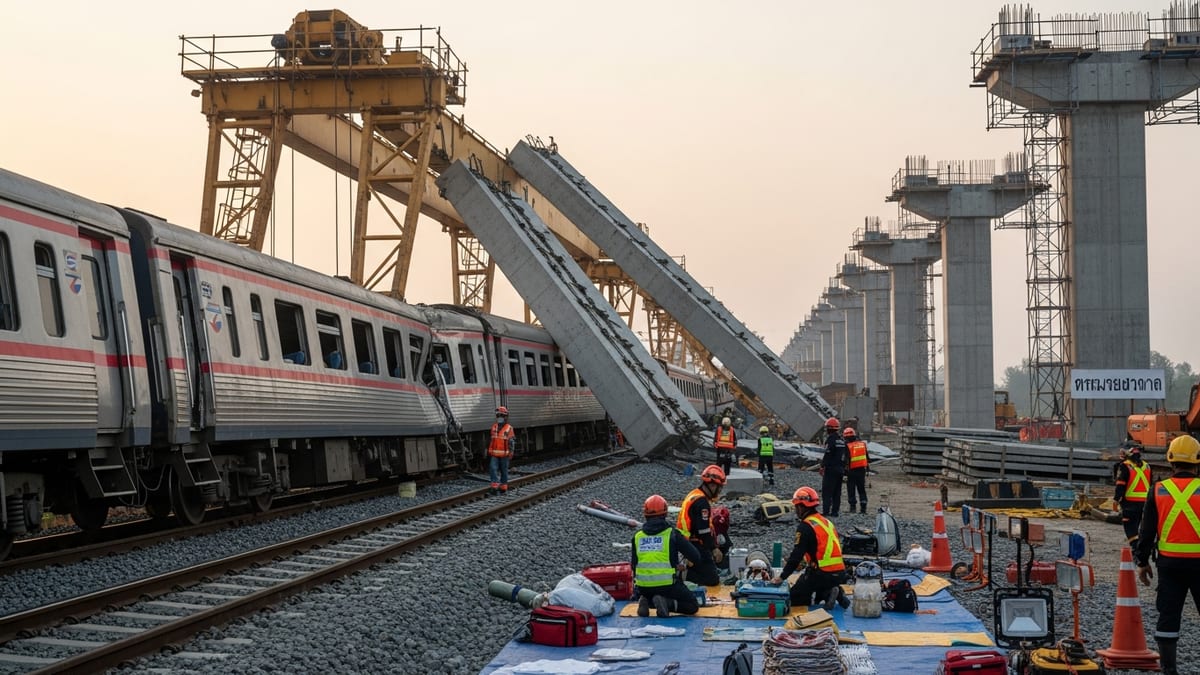
Derailment at Gouripur briefly severs key regional link
According to published coverage, the Jamalpur bound Bijoy Express was passing through Gouripur station in Mymensingh district at around 10:45 p.m. on Wednesday when three carriages at the rear of the train left the tracks. Initial reports describe the incident as a low speed derailment confined to the station area, which helped limit damage and prevent injuries among passengers.
Rail communication on the Chattogram Mymensingh corridor was immediately disrupted, affecting movement on one of the principal routes connecting the port city with the greater Mymensingh and Jamalpur region. Publicly available information indicates that the derailed coaches remained upright beside the track, avoiding a more serious crash scenario that might have involved coach overturning or collisions with adjacent infrastructure.
Bangladesh Railway personnel and security teams were dispatched to the scene to secure the area and assess the condition of the train. Local media reports emphasize that there were no casualties, and that passengers in the unaffected coaches were kept on board while railway staff evaluated whether the remainder of the train could safely continue its journey.
The derailment at Gouripur follows a series of recent rail incidents in and around Mymensingh district, reinforcing concerns among passengers and transport analysts about pressure on the country’s aging track and signaling infrastructure.
Unharmed coaches continue journey to Chattogram
Published reports indicate that after an initial safety inspection, the front eleven coaches of the Bijoy Express were cleared to move on, leaving three derailed rear coaches behind at Gouripur station. At approximately 12:25 a.m. on Thursday, about one hour and forty minutes after the derailment, the operational portion of the train departed toward Chattogram with passengers on board.
This operational decision allowed many travelers to reach their destinations without an overnight delay, even as recovery work on the stranded coaches continued. Observers note that splitting a train after a partial derailment is a well established operational response when track conditions, braking systems, and couplers on the remaining portion are deemed fit, and when the derailed section can be safely isolated.
Journey times for the passengers on the continuing coaches were extended, but the decision avoided a full cancellation of the service. For people traveling between Mymensingh, intermediate stations, and Chattogram, the early morning restart of the train represented an important restoration of mobility on a workday.
Available timetables show that Bijoy Express normally operates as an intercity service between Chattogram and Jamalpur with scheduled calls at Mymensingh and smaller stations such as Gouripur, underscoring its role as a vital link for long distance commuters and regional travelers.
Relief train and recovery operations at Gouripur
Publicly available information shows that a relief train equipped for rerailing and track repair was dispatched to Gouripur to recover the three stranded coaches and repair any damage to the line. Such relief consists typically include cranes, jacks, and specialized crews trained in lifting carriages back onto the rails while minimizing further harm to rolling stock and track components.
Reports describe ongoing recovery work at the station area through the early hours of Thursday, with the derailed cars remaining on site while mainline traffic was gradually restored. The process generally involves first stabilizing the coaches, then disconnecting damaged couplers, inspecting the sleepers and rails, and finally lifting or dragging the rolling stock back into position.
Railway security personnel, including members of the Railway Nirapatta Bahini, were deployed to manage crowds and keep passengers and local residents away from the recovery zone. With no immediate evidence of sabotage reported in local coverage, attention turned to technical and maintenance factors that may have contributed to the incident.
In parallel with physical recovery, standard procedures in similar incidents in Bangladesh include the formation of an inquiry committee to review track condition, train handling, and previous maintenance records for the affected section.
Passengers spared injuries but shaken by disruption
Despite the sudden derailment, news reports consistently state that no passengers sustained injuries on the Bijoy Express. The limited speed at the time of the incident and the location within a station yard appear to have reduced the risk of serious harm, compared with derailments that occur at line speed on open track.
Nonetheless, the disruption left passengers facing uncertainty in the late evening, with some travelers experiencing delays and anxiety as railway staff determined whether a portion of the train could safely proceed. Families awaiting arrivals at downstream stations also encountered confusion until confirmation emerged that the front coaches had resumed their journey.
Observers note that derailments, even when nonfatal, tend to erode public confidence in rail reliability. For regular users of the Chattogram Mymensingh corridor, Wednesday night’s incident adds to a string of service interruptions linked to fires, track defects, and other operational issues on intercity trains in recent months.
In the broader context of Bangladesh’s transport landscape, rail remains a comparatively affordable and essential mode of travel, particularly for long distance journeys. Ensuring that passengers feel secure during routine trips is therefore seen as a key element in maintaining overall trust in the national rail network.
Recent incidents renew focus on rail safety
The Bijoy Express derailment at Gouripur is the latest in a series of rail disruptions in and around Mymensingh and along other major corridors in Bangladesh. In recent weeks, local media have documented separate derailments and engine fires affecting intercity trains, including services that link Dhaka, Mymensingh, Chattogram, and Jamalpur.
According to publicly available reporting and official schedules, Bangladesh Railway has been attempting to balance growing passenger demand with constraints on infrastructure, rolling stock, and maintenance capacity. Single track segments, aging sleepers and rails, and tight turnaround schedules for intercity trains can increase stress on the system and heighten the risk of incidents.
Transport specialists often highlight the importance of sustained investment in track renewal, signaling upgrades, and staff training to reduce derailments and related service disruptions. The recurring nature of such events, including the latest episode at Gouripur station, is likely to intensify calls for comprehensive safety audits on busy routes such as the Chattogram Mymensingh Jamalpur corridor.
For now, the resumption of the Bijoy Express journey offers short term relief to passengers and communities dependent on the service. Longer term, the derailment is expected to feed into ongoing debates over how quickly Bangladesh’s rail infrastructure can be modernized to match rising traffic and safety expectations.