


Braga and Guimarães are two of northern Portugal’s most rewarding day trips, and both can be reached easily from Porto using the Comboios de Portugal (CP) urban rail network. Planning becomes more complex, however, when you try to see both in a single day. This guide explains how the trains work, compares realistic itineraries, and helps you decide whether to dedicate separate days or attempt an ambitious combined excursion.
Get the latest updates straight to your inbox!
Understanding the CP Urban Network from Porto
Porto is the hub of CP’s urban train network in the north, with two central stations that matter for day trips: Porto São Bento in the historic center and Porto Campanhã in the east of the city. Both Braga and Guimarães sit at the end of separate CP urban lines that fan out from Porto and share tracks for part of the way before splitting. In practice this means there are direct urban trains from Porto São Bento to Braga and to Guimarães, but not between Braga and Guimarães themselves. Traveling from one of these cities to the other usually involves backtracking toward the junction near Lousado or returning as far as Porto to change.
On the Braga line, CP’s official timetable that came into force in January 2026 shows frequent urban services throughout the day between Porto São Bento and Braga, stopping at Porto Campanhã and Ermesinde among many intermediate stations. Journey times for the fastest urban services are usually around one hour to one hour five minutes from São Bento to Braga, with slightly shorter times from Campanhã. On the Guimarães line, the most recent CP urban timetable indicates frequent trains from Porto São Bento to Guimarães via Campanhã, Trofa and Vizela, with end to end journey times of roughly one hour fifteen minutes. Early morning departures start before 7:00 and final trains back to Porto typically leave Guimarães shortly before 23:00.
Because these are CP urban services, seats are unreserved and tickets work on a zonal fare system rather than a distance based intercity fare. Tickets are valid only on urban trains, not on Alfa Pendular or Intercidades long distance services. For most visitors based in central Porto, it is simplest to board and return at São Bento, which is within walking distance of many hotels and guesthouses, while Campanhã is better suited to those connecting from other regions of Portugal.
Direct public transport between Braga and Guimarães is provided mainly by regional bus companies rather than CP. There are intercity buses linking the two cities in roughly 35 to 45 minutes, departing from their respective bus terminals. Schedules and operators can change, so for a same day combination of both cities it is important to check a current timetable shortly before travel and to allow some margin for delays when connecting back to the evening trains to Porto.
Tickets, Fares and Andante: How to Pay for the Journey
CP urban trains around Porto use a zonal fare system similar in concept to Porto’s Andante city transport tickets, but they are separate products. A single CP urban ticket covers a defined number of zones and is loaded on a reusable contactless card that you tap on the platform validators before boarding. CP’s current price table for Porto urban trains lists adult single fares starting around 1.60 euro for the shortest journeys and increasing with each additional zone. According to the latest published table, a 10 zone single ticket costs just under 4 euro and the maximum 17 zone ticket is priced at about 6.50 euro.
Braga and Guimarães both lie well outside the core Andante area used for Porto metro, trams and urban buses. While there are integrated Andante products that extend onto some CP suburban routes closer to Porto, the regular Andante Z2 or Z3 tickets that tourists often buy for trams and metro rides do not cover all the zones needed to reach Braga or Guimarães. For most visitors, the practical approach is to purchase CP urban tickets specifically for these trips instead of relying on Andante, unless you hold a local commuter pass that explicitly includes all required zones.
At Porto São Bento and Campanhã, you can buy CP urban tickets from multilingual ticket machines or staffed ticket offices. Machines accept coins, notes up to a modest denomination, and bank cards. You will either purchase a new reusable card loaded with your chosen journey or add additional journeys to a card you already have. Before boarding, you must validate the card at the yellow or green CP validators in the station hall or on the platform. Inspections are common and on the spot fines apply if you have not validated, even if you hold a valid product on the card.
For budgeting purposes, a return trip from Porto to Braga or Porto to Guimarães on CP urban trains typically costs in the region of 7 to 9 euro per adult on standard fares, depending on the exact zone count that applies. If you travel as a couple, expect to set aside around 15 to 18 euro for the rail component of a full day trip. Youth, senior and other discounts can reduce costs but require identification and, in some cases, Portuguese issued cards. It is worth asking at the ticket counter if you fall into one of these categories.
Braga by Train: Arrival, Sights and Bom Jesus do Monte
The Braga urban train brings you into Braga station, which sits slightly south of the historic center. Walking from the station to the main squares of Braga takes around 15 minutes along relatively flat streets, passing everyday shops and cafes. Some travelers choose to pause for a coffee and pastry near the station, but if you are aiming for a full sightseeing day it is better to head directly toward the old town and start exploring around Avenida da Liberdade and the Arco da Porta Nova.
Central Braga is compact. Within a short radius you can visit Braga Cathedral, reputedly the oldest in Portugal and a key stop for those interested in religious history. There is a paid ticket office at the cathedral that offers entrance to the main church and optional add ons to the choir and museum rooms. Nearby, the lively Praça da República and Largo do Paço host cafés with outdoor terraces where you can watch local life unfold over a mid morning espresso. Other notable stops include the gardened square of Jardim de Santa Bárbara and several small churches scattered throughout the center.
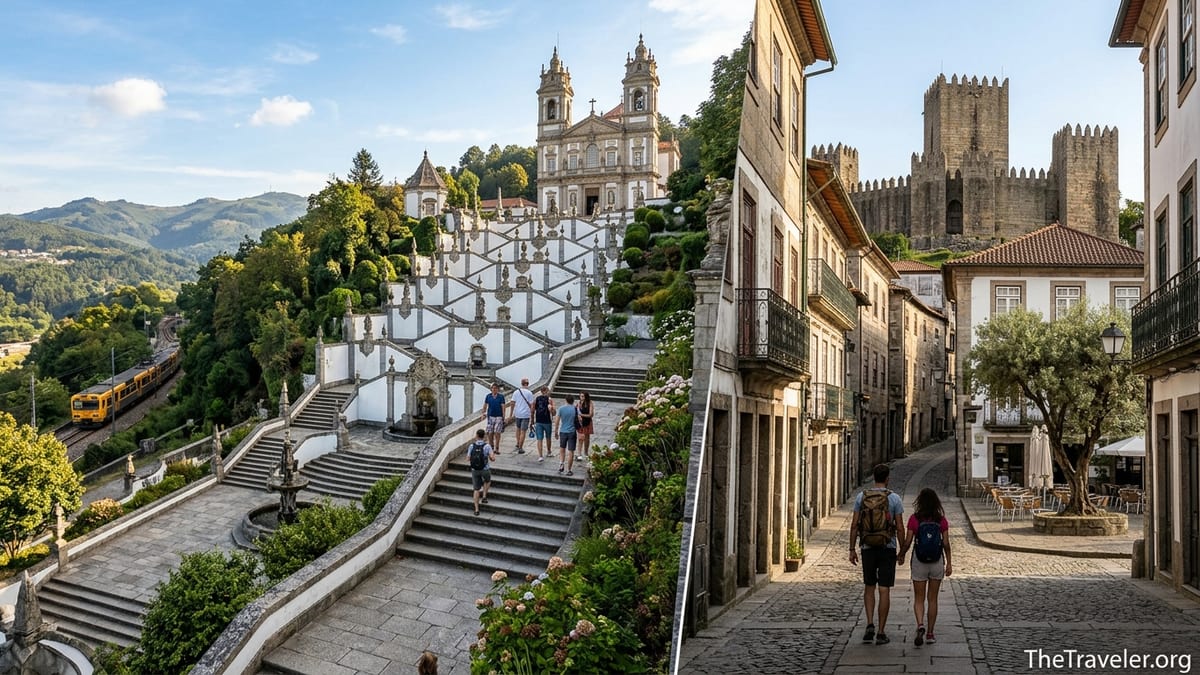
Bom Jesus do Monte, the hilltop sanctuary east of Braga, is the highlight for many visitors. From the city center, local buses run from areas near Avenida da Liberdade and the train station to a stop close to the bottom of the sanctuary’s baroque stairway and the base station of the Bom Jesus funicular. The funicular is a historic water powered system that, when operating, shuttles passengers up and down the steep slope in just a few minutes. As of late 2026, local tourism information indicates that the funicular is temporarily out of service for maintenance, with a replacement shuttle bus running from the lower entrance up to the sanctuary while the works continue. Travellers should confirm the latest status shortly before their visit, since the return to service date has not yet been publicly fixed.
Regardless of whether the funicular is in operation, reaching the sanctuary requires planning for uphill movement. The famous staircase consists of hundreds of steps through multiple terraces, while the road winds around to a paid car park at the top. The sanctuary complex itself is free to enter, with costs applying only to ancillary services such as parking or the funicular when active. Once at the top, you can visit the church, stroll through the gardens, and enjoy panoramic views back toward Braga and the surrounding hills. You should allow at least two to three hours in total for the bus ride up, ascent to the sanctuary, time at the top, and return to central Braga, especially if you want to pause for lunch at one of the hotels or restaurants on the hill.
Guimarães by Train: From Medieval Streets to Castle and Palace
Guimarães station sits somewhat closer to the historic center than Braga’s station does to its own old town, but there is still a short walk involved. From the station, you follow signed pedestrian routes toward the historic core, reaching Largo do Toural and the adjoining streets in roughly 10 to 15 minutes. Along the way you will notice the gradual shift from modern surroundings to medieval urban fabric, with stone houses, narrow lanes and small plazas appearing as you approach the UNESCO listed center.
The heart of Guimarães is Largo da Oliveira and the adjoining Praça de Santiago, two interconnected squares surrounded by arcaded houses and cafés. This area is largely pedestrianized and makes an ideal base to orient yourself, grab a drink, and begin to absorb the atmosphere that leads locals to describe Guimarães as the cradle of the Portuguese nation. From here, many sights are accessible on foot, although the routes can involve moderate inclines and cobbled surfaces that are challenging for some visitors with mobility limitations.
North of the old town, on a hill above the center, stand Guimarães Castle and the Palace of the Dukes of Braganza. The medieval castle is managed as a national monument with a ticketed entrance at around 5 euro for adults under the most recent national pricing guidelines, while combined tickets and concessions are available that also cover the Ducal Palace. The palace complex functions as both a museum and a ceremonial space, with paid admission that grants access to furnished rooms, tapestries and exhibitions. Tickets are sold at the palace ticket office, which also handles entry to the castle and a nearby church, following the fee structure introduced in late 2024.
Access from the old town to the castle and palace is by a walk of about 10 to 20 minutes uphill depending on your starting point, or by local taxi for those who prefer to avoid the climb. Another popular excursion is the Penha Sanctuary on the hill south of Guimarães, served by the Teleférico de Guimarães cable car that runs seasonally from a station near the old town to the wooded summit. Published information for the cable car indicates operation most of the year, with closures for maintenance and a tendency for shorter schedules in the quietest months and in poor weather. If Penha is high on your list, it is essential to check opening dates and hours close to your travel dates and to factor in the extra time required.
Schedules, Closures and Weekend Variations
Both Braga and Guimarães are working cities as well as tourist destinations, and their attractions follow timetables that can impact how much you see in a day. In Braga, churches often close for a few hours at lunchtime and may have limited visiting hours on Sundays or religious feast days when services take priority. Bom Jesus do Monte is generally accessible daily, but individual chapels or indoor spaces may have shorter hours, and the temporary funicular replacement arrangements can change as maintenance progresses.
In Guimarães, the castle and the Palace of the Dukes of Braganza follow schedules aligned with Portugal’s Directorate General for Cultural Heritage. These typically include closing on certain national holidays, with last entry around one hour before the official closing time in late afternoon. Ticket offices follow the same schedule and recent guidance specifies that ticket pricing and discounts conform to a November 2024 decree, which can be updated in future. Museums inside the palace complex and around the city often close on Mondays, so a Monday visit to Guimarães may offer fewer indoor attractions than other days, even though walking the old town remains enjoyable.
CP urban train schedules differ slightly between weekdays, Saturdays and Sundays. On both the Braga and Guimarães lines there are more frequent peak hour trains on weekdays and somewhat fewer departures early in the morning and late in the evening on weekends. However, services generally run from early morning until late at night every day of the week. For example, current data for Guimarães station shows the first weekday urban service to Porto São Bento departing before 6:00 and the last around 22:55, which allows for comfortable day trips that extend into the evening but not for extremely late returns.
When planning a combined Braga and Guimarães day, these variations matter. A late departure from Porto on a Sunday combined with reduced museum hours and potentially shorter cable car schedules on Penha can make it impossible to fit everything in. The most reliable approach is to check the specific date you intend to travel on CP’s website or at a ticket office, screenshot or note the relevant trains in both directions, and then build your sightseeing day around those fixed points rather than assuming a uniform half hourly or hourly pattern all day.
Sample Itineraries: One Day in Braga, One Day in Guimarães, and a Combined Day
A realistic one day itinerary for Braga by train could begin with a departure from Porto São Bento around 8:30, arriving in Braga close to 9:30. From the station you would walk into the historic center and spend the morning visiting Braga Cathedral, strolling through Praça da República and Jardim de Santa Bárbara, and exploring side streets with an eye out for traditional bakeries and tiled façades. After a simple lunch in town, you could board a mid afternoon local bus toward Bom Jesus do Monte, spending two to three hours between the lower entrance, ascent to the sanctuary, church visit and view points, then return to the city in time for an early evening coffee or drink before catching a train back to Porto around 19:00 or 20:00.
A one day Guimarães itinerary by train might follow a similar pattern. You could leave Porto São Bento around 8:30 and arrive in Guimarães a little before 10:00. After walking to Largo da Oliveira, you would explore the medieval streets and perhaps pause for a mid morning snack under the arcades. Late morning and early afternoon could be devoted to the castle and the Palace of the Dukes of Braganza, allowing two to three hours for ticket purchase, visiting the castle walls, and touring the palace interiors. Returning downhill, you might have a leisurely late lunch in the old town. If the cable car to Penha is operating on your travel day and weather is cooperative, you could fit an afternoon or early evening ride up to the sanctuary and wooded walking paths, then descend in time for an evening train back to Porto around 19:00 or 20:00.
Combining both cities in a single day is technically possible but requires sacrifices. One scenario would involve taking the first or one of the early morning trains from Porto to Braga, arriving by about 9:00, and limiting your visit to a quick walk around the historic center and a short cathedral visit, skipping Bom Jesus entirely. Around midday you would take a regional bus from Braga to Guimarães in approximately 40 minutes, arriving early afternoon. You would then focus on Guimarães’ old town and perhaps choose between either the castle and palace or the Penha cable car, but not both, before boarding an evening train back to Porto. In this compressed plan, you miss some of the depth of both destinations and spend a higher proportion of your day in transit.
A more comfortable combined itinerary for those absolutely intent on seeing both would be to prioritize one city and treat the other as a short taster. For example, you might dedicate most of the day to Guimarães, including the castle and palace, and stop in Braga only for an early evening stroll and dinner before a later train back to Porto. Achieving this would likely involve a morning CP train to the first city, a midday or early afternoon bus to the second, and a late CP urban train back to Porto. However, this strategy still means tight connections, and any delay can cascade into missed attractions or a stressful dash to the last train of the night.
Two and Three Day Plans, Costs and Practicalities
If your schedule allows, spreading Braga and Guimarães over at least two days delivers a much richer experience. A practical two day plan is to base yourself in Porto and take one full day trip to Braga and another to Guimarães on separate days. This eliminates the need to watch the clock constantly and lets you adjust for weather. Alternatively, you might stay overnight in one of the two cities. An overnight in Guimarães, for example, allows you to enjoy the medieval streets after day trippers have left and to visit Penha at a more relaxed pace the next morning before returning to Porto or continuing elsewhere.
On a three day version, you could spend the first day in Braga, including Bom Jesus do Monte, the second day in Guimarães with the castle, palace and Penha, and the third exploring smaller experiences such as Braga’s Sanctuary of Sameiro or a slower day in Guimarães focused on local gastronomy and contemporary culture. You could also consider a night in each city, experiencing their different evening atmospheres. Accommodation in Braga and Guimarães is generally a bit cheaper per night than comparable central hotels in Porto, with mid range guesthouses and small hotels often offering good value, particularly outside peak summer weekends and major festivals.
Budgeting for these trips involves adding together CP urban fares, local buses or cable cars, museum and monument tickets, meals and any overnight stays. For a solo traveler doing a single day trip from Porto, you might estimate around 8 euro for return train fares, 4 to 8 euro for local buses or shuttles and short metro rides in Porto, roughly 10 to 15 euro for entry tickets if you visit a cathedral museum and one major monument, and 20 to 35 euro for modest meals and drinks. That brings a basic day trip into the broad range of 40 to 70 euro before any shopping. For a couple, simply double the transport and ticket components and adjust meal costs according to your dining choices, which often means a joint total between about 80 and 130 euro for a full but not extravagant day.
Porto São Bento and Campanhã both offer luggage lockers, and some hotels in Porto will store bags for returning guests, which is useful if you are checking out before a day trip. In Braga and Guimarães, long term luggage storage options are more limited but certain bus stations, commercial locker providers and some central hotels may store bags for a fee. For those with rolling suitcases, the walks from station to center in both cities involve some uneven paving but are manageable if you travel light. Summer heat is another factor: afternoons in July and August can be hot, especially on the exposed stairways of Bom Jesus or the uphill paths in Guimarães. Planning indoor museum visits or café breaks during the hottest hours and aiming to walk major slopes in the morning or late afternoon can make your day far more pleasant.
Should You Prioritize Braga or Guimarães, and Separate Days or One?
Choosing which town to prioritize depends on your interests. Architecture lovers fascinated by baroque churches, religious heritage and hillside sanctuaries often feel more drawn to Braga, with its cathedral, intricate chapels and the dramatic composition of Bom Jesus do Monte. The city’s atmosphere blends traditional religious life with a lively university presence, so the center can feel both historic and youthful, especially in the evenings around the main squares.
History enthusiasts who are captivated by the origins of the Portuguese state may lean toward Guimarães. The combination of a remarkably preserved medieval center, a castle with strong national symbolism and the stately Ducal Palace provides a compact but powerful narrative of early Portugal. The old streets around Largo da Oliveira retain an intimate, almost village-like feel in spite of their popularity with visitors, and evenings on the terraces here can be particularly memorable.
If you have only one free day from Porto, it is advisable to choose either Braga or Guimarães rather than attempt both. Focusing on a single destination lets you enjoy the urban rail journey, explore without rushing, and still return to Porto by a comfortable evening train. If your heart is set on seeing Bom Jesus and you do not mind some uphill walking, pick Braga. If you want fortified walls, a ducal palace and a deeply medieval ambiance, pick Guimarães. In either case, a day is enough for a satisfying overview provided you start early.
With two or more free days, visiting both cities on separate days is clearly superior to squeezing them into one. The CP urban network makes independent travel straightforward and affordable, and late evening return services allow you to linger over dinner before heading back to Porto. While a carefully choreographed combined day is possible by relying on a mix of CP trains and regional buses, it inevitably means sacrificing headline sights such as Bom Jesus or Penha and leaves little buffer for delays. For most travelers, the most rewarding choice is to treat Braga and Guimarães as distinct experiences, each deserving its own day on your northern Portugal itinerary.