


More news on this day
Drivers using the A48 near Chepstow are being advised to build in extra journey time this week after recurring queues and congestion triggered fresh travel warnings across the cross‑border corridor between South Wales and Gloucestershire.
Get the latest news straight to your inbox!
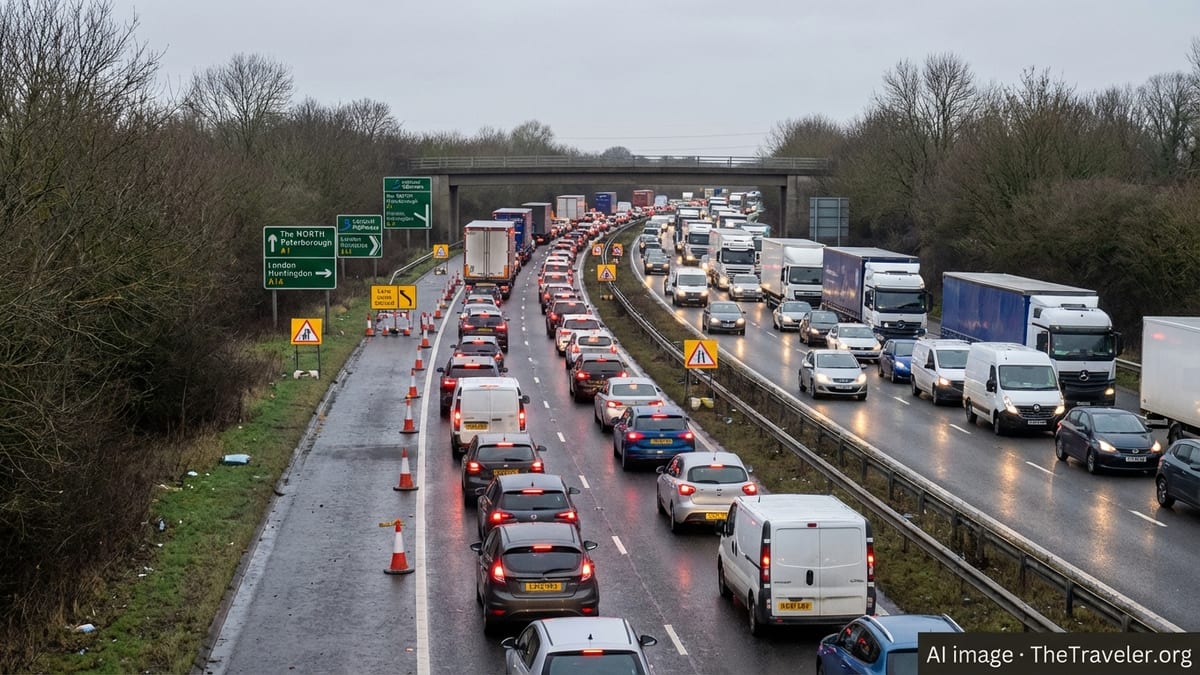
Delays build on key cross-border corridor
Publicly available information from regional traffic monitoring services over recent days indicates repeated congestion alerts on sections of the A48 serving Chepstow, coinciding with the busy morning and afternoon peaks around Tuesday 10 November and Wednesday 11 November 2026. Reports describe slow‑moving traffic and sustained queues forming on approaches to the town and on connecting routes used by commuters and freight traffic.
The A48 is a principal east to west route in South Wales, linking Gloucester with Chepstow before continuing towards Newport, Cardiff and Carmarthen. It also provides one of the two key road crossings of the River Wye at Chepstow, making the corridor particularly sensitive to incidents, volume spikes and changes on nearby sections of the strategic road network.
Recent congestion alerts for the A4232 between the A48 interchange and the M4 at junction 33, published on 13 November 2026, highlight how delays on feeder routes can quickly translate into difficulties for drivers heading towards or away from the Chepstow area. With overnight and long‑term works continuing on the M48 between the Dewstow and Crick overbridges, diversion patterns and altered traffic flows are adding further pressure at peak times.
Travel monitoring services characterise the current disruption around Chepstow as moderate rather than severe, but note that journey times on affected sections of the A48 can increase by around 20 minutes when queues are at their heaviest. Motorists travelling between South Wales, the Forest of Dean and the west of England are being urged to keep conditions under review throughout the day.
Roadworks and incidents amplify long-standing pinch points
Traffic information published by Traffic Wales and national incident trackers shows that a series of planned and active roadworks across South Wales is influencing how vehicles move around the wider network. Lane closures and improvement work on the M48 close to Chepstow, along with overnight schemes elsewhere, are encouraging more drivers to use the A48 for local and regional journeys.
Planning and transport assessments prepared for Monmouthshire County Council in recent years already identify the A48 corridor and its junctions with the A466 as operating close to capacity during weekday peaks. Queue and delay forecasts for a 2026 base year scenario highlight that north and south approaches to key roundabouts are under sustained pressure as background traffic grows.
Additional housing development on both sides of the border, including sites around Chepstow and along the A48 in nearby Tutshill and Sedbury, has been cited in consultation material and public responses as a further factor contributing to heavier flows. Residents and commuters have recorded experiences of queues stretching from Chepstow back towards local schools and residential areas during the busiest periods.
Published commentary from local engagement documents describes traffic as frequently “gridlocked” at times on the English side of the A48 when combined commuter, school and through‑traffic peaks coincide. The latest congestion around Chepstow is therefore being seen in the context of longer‑term capacity challenges rather than as a single isolated incident.
Knock-on effects from wider South Wales congestion
While the longest queues this week have been reported in the immediate Chepstow area, travel data suggests that conditions elsewhere in South Wales are playing a role. Live updates on 13 November list congestion on the A4232 northbound between the A48 interchange and the M4 junction 33, with delays flagged as possible during the morning period.
Similar alerts have appeared in recent weeks on other sections of the A48 and connecting routes around Cardiff, where lane changes and temporary signals have slowed traffic at key junctions. Social media and community discussion forums have referenced queues backing up towards the A48 near several city access points, particularly when local roadworks, events or parade‑related closures are in place.
Although these incidents are some distance from Chepstow, transport assessments for the region note that the A48 functions as part of a single interlinked corridor. When speeds fall on one section, route‑choosing drivers shift onto alternatives, which can in turn overload local town approaches, including those around Chepstow and the Wye crossings.
On cross‑Severn journeys, any restrictions or diversions affecting the M48 or other river crossings can quickly increase reliance on the A48 as a relief route. Recent overnight closures and lane reductions east of Chepstow, listed in official works registers through to March 2027, underline the likelihood of continued periodic pressure as schemes progress.
Advice for motorists planning to use the A48
Travel services advise that anyone planning trips through the Chepstow area in the coming days should check live traffic feeds before departure and allow additional time, particularly for weekday journeys during the 07:30 to 09:30 and 16:00 to 18:30 periods. Drivers heading towards employment centres in Newport, Cardiff, Bristol and Gloucester are most likely to be affected by the current pattern of delays.
For shorter local trips around Chepstow, residents are being encouraged through council transport material to consider alternative modes such as walking or cycling where practical, in order to reduce pressure on the most constrained junctions. Recent placemaking and transport planning documents for the town emphasise efforts to improve active travel links alongside ongoing work to manage vehicle flows.
Motorists who must use the A48 for longer cross‑border journeys are advised by public travel updates to pay particular attention to any changes on the M48 and other trunk routes, since diversions may alter normal traffic patterns with limited advance notice. Where options exist, adjusting departure times outside the main peaks can help reduce the risk of being caught in the worst of the queues.
Given that several major schemes and lane restrictions on key approach routes are scheduled to continue for months, regional observers expect the A48 around Chepstow to remain vulnerable to recurring congestion whenever incidents or poor weather coincide with peak flows. Regularly checking the latest information and remaining flexible over route choice are likely to be the most effective strategies for minimising disruption.