


Brisbane Airport can be confusing if you are not sure whether you should be at the Domestic or International terminal. The terminals are separate buildings a few kilometres apart, served by different airlines and transport options. Turning up at the wrong one can easily cost you your flight. This guide explains the key differences between Brisbane’s Domestic and International terminals and gives practical advice on check in, baggage claim, ground transport and what to do if you go to the wrong place.
Get the latest updates straight to your inbox!
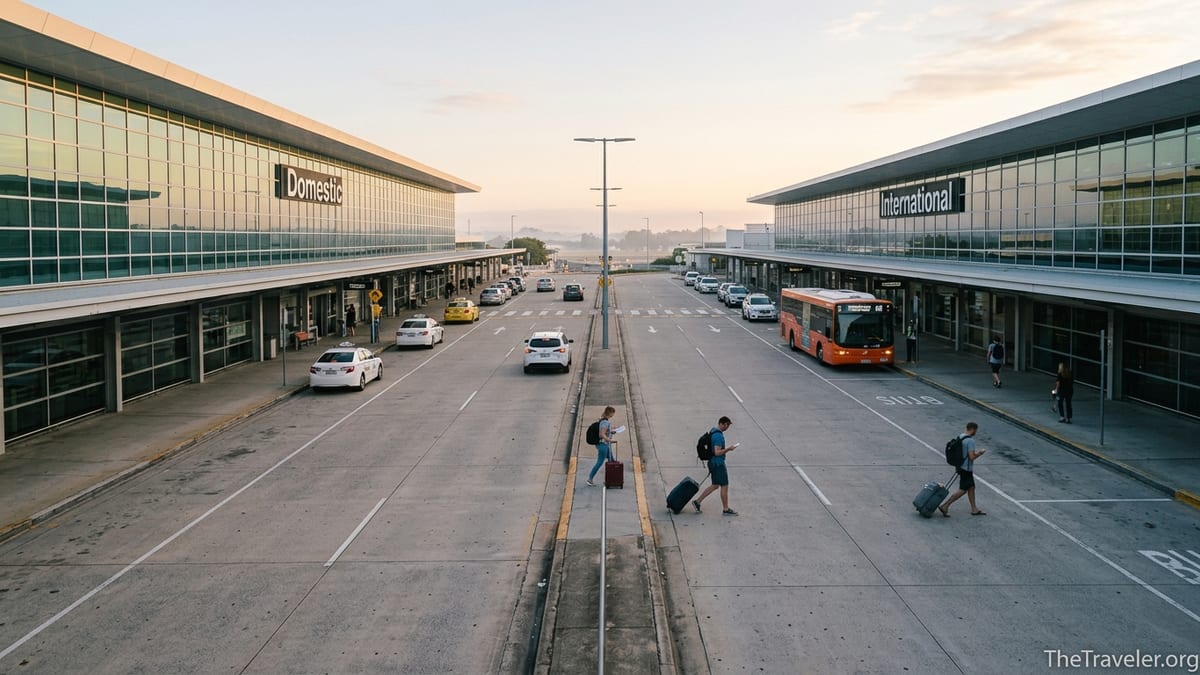
Domestic vs International: Which Terminal Do You Actually Need?
Brisbane has a single airport but two distinct terminals: the Domestic Terminal, often shown as Terminal D or T2, and the International Terminal, shown as Terminal I or T1. They are about four kilometres apart and a short drive by shuttle bus, but you cannot walk between them before a flight and you cannot easily fix a last-minute mistake if you have left it too late.
Use a simple rule. If your flight’s destination is within Australia, you will almost always depart from the Domestic Terminal. That includes major routes such as Brisbane to Sydney, Melbourne, Perth, Cairns or Hobart, as well as shorter hops to places like Rockhampton, Townsville or Mount Isa. Airlines such as Qantas and QantasLink, Virgin Australia, Jetstar and Rex all use the Domestic Terminal for these flights.
If you are leaving Australia, you will depart from the International Terminal. This covers flights from Brisbane to destinations like Auckland, Nadi, Singapore, Doha, Vancouver, Tokyo, Hong Kong and many Pacific islands. Carriers operating international services from Brisbane include Qantas, Virgin Australia, Air New Zealand, Fiji Airways, Singapore Airlines, Qatar Airways, Emirates, Cathay Pacific, Philippine Airlines and several others.
The main grey area is “international” airline brands that also run domestic services. Jetstar Airways, for example, flies both domestic and international routes from Brisbane. A Brisbane to Bali flight with Jetstar will use the International Terminal, while Brisbane to Adelaide with the same airline uses the Domestic Terminal. Always check the departure terminal printed on your booking, and look for “Terminal D/T2” or “Terminal I/T1” on your boarding pass.
Airlines and Typical Routes at Each Terminal
At the Domestic Terminal, the building is roughly divided into three zones. Qantas and QantasLink occupy the northern end, Virgin Australia is at the southern end, and other carriers such as Jetstar and Rex are in the central area. If you are flying a regional QantasLink service to somewhere like Gladstone, your check in will usually be in the Qantas section at the far end. A typical Virgin Australia Brisbane to Melbourne service will check in at the opposite end of the same building.
Domestic low cost carriers concentrate around the middle. Jetstar’s check in counters and gates are located between the Qantas and Virgin ends, with orange branding that is easy to spot once inside. Rex typically shares central facilities and is clearly marked. Alliance Airlines, which often operates flights on behalf of Qantas on regional routes, also uses the Domestic Terminal but you might only see “Qantas” on your ticket.
The International Terminal has a different airline mix and a more global feel. The departures level is lined with check in areas for long haul and regional international carriers. You might see Air New Zealand desks open for a late afternoon flight to Auckland, Fiji Airways counters for a morning departure to Nadi, or Qatar Airways staff preparing passengers for an evening service to Doha. Budget carriers like Jetstar and Batik Air share the same terminal, so a Brisbane to Tokyo Narita Jetstar flight will leave from the same building as a Brisbane to Singapore service on Singapore Airlines.
Knowing which airlines use which terminal helps in real situations. For example, a Queensland family flying Virgin Australia from Brisbane to Queenstown in New Zealand must go to the International Terminal, even though they normally use Virgin’s Domestic end of the other building. On the other hand, a business traveller on Qantas from Brisbane to Canberra will always stay within the Domestic Terminal, even if they are connecting later that day to an international flight from another city.
Check In, Security and Baggage Claim: How the Experience Differs
Check in at the Domestic Terminal is generally faster and more casual. For most domestic flights, airlines typically recommend arriving around 60 to 90 minutes before departure, depending on whether you have bags to check and your frequent flyer status. Self service kiosks and bag drop machines are widely used by Qantas, Virgin Australia and Jetstar, and it is common for regular commuters on routes like Brisbane to Sydney to arrive quite close to departure time during off peak hours.
International departures are a different story. Brisbane Airport itself recommends arriving at least three hours before your international flight, especially for long haul services. You must check in, clear outbound passport control and go through a more intensive security screening. During busy school holiday periods, queues can occasionally stretch across the departures hall, and passengers who turn up only 90 minutes before departure for flights to popular destinations such as Bali, Fiji or Singapore risk missing bag drop closure times.
Baggage claim is also handled differently. Domestically, you simply walk off the aircraft and follow signs to baggage carousels on the arrivals level of the Domestic Terminal. Luggage usually appears quite quickly on main trunk routes. If your bag does not show, you speak to your airline’s domestic baggage services office just off the carousel area. At the International Terminal, you must first pass through passport control and security screening before reaching the baggage hall. Bags for flights from hubs like Singapore or Doha can arrive in waves and inspections by border agencies can further slow your exit.
These process differences matter if you are planning tight connections. A traveller arriving into Brisbane on a domestic QantasLink service at 07:30 with only cabin baggage can often be out at the kerb within 10 to 15 minutes. Someone landing from an overnight long haul flight at the International Terminal at the same time may need 45 to 60 minutes or more to clear formalities and reach the public arrivals hall, particularly if several flights land together.
Getting To and From Each Terminal
Both terminals share similar ground transport options, but the exact pickup points and timings differ. Each has its own railway station on the Airport line, connected to the terminal by covered walkways with lifts and escalators. Trains typically run every 15 minutes during the day and link the airport with Brisbane’s Central business district in roughly 20 to 25 minutes. Services continue down to the Gold Coast, so a passenger arriving on an evening international flight can ride the train directly to stations such as Helensvale or Nerang and change to local light rail or buses.
Road transport is plentiful at both terminals. Metered taxis queue outside the arrivals levels and ride share pickup zones for services like Uber and DiDi are clearly signposted. In practical terms, a taxi from either terminal to Brisbane’s city centre usually takes around 25 to 35 minutes in moderate traffic. To the Gold Coast, the drive can take about 60 to 90 minutes depending on time of day. Shared shuttle services operate from both terminals to popular coastal destinations and major hotels, and visitors can book these at the airport’s visitor information desks on arrival.
Parking and drop off options mirror each other at the two buildings. Each terminal has multi level car parks within a short walk of the check in areas, with a mix of short stay, long stay and premium spaces. Families dropping someone off for an early morning domestic departure, for example, often use the short term area at the Domestic Terminal for 30 to 60 minutes while they help with bags and get a coffee. International travellers heading away for several weeks frequently choose long stay parking, leaving their vehicle close to the International Terminal and collecting it on return.
Local travellers also use Skygate, the nearby retail and dining precinct accessible via the free transfer bus. Some passengers with long layovers between domestic and international flights ride the bus from one terminal to Skygate for a meal or to shop at the outlet centre before returning for their next flight. The key is always to allow extra time to get back through security, particularly on the international side where formalities take longer.
Distance Between Terminals and Transfer Options
Although Brisbane only has one airport, the Domestic and International terminals are physically separate. They are roughly four kilometres apart along the airport roads, which might not sound far but is far too long to walk when you are carrying luggage. The airport operates a free terminal transfer bus that connects both buildings, and for most people this is the easiest option for moving between them.
The free Terminal Transfer Bus typically runs every 10 minutes for most of the day, from early morning into the late evening. The journey time between terminals is usually around 5 to 10 minutes in normal traffic, but you should allow extra time to walk from your gate to the bus stop, wait for the next departure, and then make your way from the bus stop into the check in or arrivals area at the other end. In practice, many travellers report that the full terminal to terminal transfer often takes around 20 to 30 minutes from aircraft door to the other terminal’s check in hall.
At the International Terminal, the free transfer bus picks up passengers on the arrivals level and drops them off on the departures level of the Domestic Terminal. At the Domestic Terminal, look for the orange terminal transfer bus stops outside the building. Staff and signage generally make it clear where to go, and during busy banking periods airline and airport employees are used to directing confused passengers who have landed at one terminal and now need to reach the other for their connecting flight.
Other transfer options exist but are less common. You can take the Airtrain between the two terminals, as each building has its own station, but you will pay a regular train fare and the total time, including walking and waiting, is usually longer than the free bus. Taxis and ride share vehicles can drive you between terminals, though most travellers only choose this if they have mobility issues or are cutting it extremely fine for their connection. In most cases the airport shuttle bus is the most sensible and cost effective choice.
Connecting Flights: Domestic to International and Vice Versa
Many Brisbane passengers connect between domestic and international flights, using the airport as a hub. If you are booked on a single ticket with one airline or alliance, especially with Qantas or Virgin Australia and their partners, your bags are often checked through to your final destination and the airline will give you clear instructions on how to transfer. In that case, you typically collect your onward boarding pass at check in or at a transfer desk and follow signs to the terminal transfer bus.
For example, someone flying from Rockhampton to Brisbane on QantasLink and then onward from Brisbane to Los Angeles with Qantas on a single ticket would check in once at Rockhampton. On arrival into the Brisbane Domestic Terminal, they follow signs to the transfer bus, ride to the International Terminal and then clear outbound passport control. Their checked bag is forwarded automatically and they do not need to collect it in Brisbane. If there is a delay and they miss the connection, Qantas handles rebooking under the rules of that ticket.
Connections are trickier if you book separate tickets. A budget conscious traveller might buy a cheap Jetstar domestic fare from Brisbane to Cairns and a separate international ticket on another airline, for example. In that case, the airlines do not see the journeys as one itinerary. You must collect your bags, transfer yourself between terminals if needed, and check in again from scratch. If your first flight is late and you miss the second, you may have to buy a new ticket and your travel insurance needs to be robust enough to cover that scenario.
Time buffers are essential. While some experienced travellers report successfully making domestic to international connections at Brisbane in as little as 90 minutes, that assumes everything goes smoothly. As a safer rule, many regular flyers aim for at least two to three hours between arrival and departure when changing terminals, particularly if border or security queues have been heavy recently or if they need to re check baggage.
What Happens if You Go to the Wrong Terminal?
Ending up at the wrong terminal is easier than you might think, particularly for visitors who associate a particular airline with a specific building. A common mistake is assuming that “Virgin Australia always flies from the Domestic Terminal” and therefore going there even when your flight is actually an international service. Another frequent error is turning up at the International Terminal for a Jetstar flight that is only going to a domestic destination such as Adelaide or Cairns.
If you discover your mistake early, the situation is usually recoverable. Suppose you are dropped at the Domestic Terminal for a Qantas flight to Auckland that actually leaves from the International Terminal. If you realise this when you try to check in two hours before departure, staff will direct you outside to the orange transfer bus stop. You take the free bus across to the International Terminal, go up to the departures level and check in as usual. You may lose 20 to 30 minutes, but you will still comfortably make the flight.
Problems arise when you only realise late. Imagine you have a 10:00 international departure to Bali on Jetstar, but you arrive at the Domestic Terminal at 08:45 because that is where you last flew with the airline. Check in for many international flights closes about an hour before departure. By the time you learn that you must go to the International Terminal and ride the transfer bus, you may reach the correct check in area only to find the counter closed. In such cases, ground staff can be sympathetic but they are often unable to reopen check in or baggage acceptance, and passengers can lose their ticket.
If you find yourself in this situation, stay calm and speak politely to airline staff at the information desk or ticketing counter. They can explain your options which may include paying a change fee to move to a later flight, buying a new one way ticket, or claiming costs through travel insurance if you are covered for mistakes. The key lesson is to always double check the terminal on your booking confirmation the day before travel, and again on the morning itself, to avoid an expensive error.
The Takeaway
Brisbane Airport is straightforward once you understand that its Domestic and International terminals are separate buildings serving different types of flights. Domestic routes within Australia almost always use the Domestic Terminal, while any journey leaving the country uses the International Terminal, regardless of airline brand. Some carriers, such as Virgin Australia and Jetstar, operate from both sides depending on destination, which makes checking your booking carefully even more important.
From check in procedures and baggage claim to transfer buses and train links, the two terminals share many features but differ in the level of formality and time required. Domestic travel is usually quicker and more relaxed, whereas international departures demand earlier arrival and more patience in queues. If you are connecting between terminals, plan generous buffers and use the free transfer bus, keeping in mind that what looks like a short distance on a map can easily consume 20 to 30 minutes in real life.
Most costly mistakes at Brisbane involve simply being in the wrong building at the right time. Verifying the terminal name and code on your ticket, understanding how your airline uses each terminal and allowing margin for delays will dramatically reduce the risk of missed flights and stressful sprints. With a little preparation, Brisbane’s split terminal layout becomes manageable, and your focus can return to the trip itself rather than the airport in between.
FAQ
Q1. How do I know if my flight uses the Domestic or International Terminal?
Your booking confirmation and boarding pass will state either Domestic/T2 or International/T1. As a rule, flights within Australia use the Domestic Terminal and flights leaving Australia use the International Terminal, regardless of airline.
Q2. How far apart are Brisbane’s Domestic and International terminals?
The terminals are about four kilometres apart along the airport road system. You cannot realistically walk it with luggage, so plan to use the free terminal transfer bus, train or a taxi.
Q3. How long does it take to transfer between terminals?
The free transfer bus journey itself is usually around 5 to 10 minutes, but once you include walking and waiting, many travellers find the total terminal to terminal time is closer to 20 to 30 minutes.
Q4. Is the terminal transfer bus free and how often does it run?
Yes, the airport’s Terminal Transfer Bus between Domestic and International is free. It typically runs every 10 minutes for most of the day from early morning until late at night.
Q5. What time should I arrive before my flight at each terminal?
For domestic flights, arriving 60 to 90 minutes before departure usually works, depending on baggage and peak times. For international flights, Brisbane Airport recommends being at the terminal at least three hours before departure.
Q6. Can I check my bags through from a domestic flight to an international one in Brisbane?
If your flights are on one ticket and with partner airlines, your bags are often tagged through to your final destination. On separate tickets, you usually need to collect your bags, change terminals yourself and check in again.
Q7. What happens if I go to the wrong terminal?
If you realise early, staff will direct you to the free transfer bus and you can usually still make your flight. If you only notice close to check in closing time, you may miss the flight and have to pay change fees or buy a new ticket.
Q8. Are transport options to Brisbane city the same from both terminals?
Yes. Both terminals have their own Airtrain station, taxi ranks, ride share pickup zones, shuttle services and car hire desks. Travel times and fares to the city are very similar from either building.
Q9. Do the same airlines operate from both terminals?
Some do. For example, Qantas, Virgin Australia and Jetstar all have domestic flights from the Domestic Terminal and international flights from the International Terminal. The terminal you need depends on whether your destination is within Australia or overseas.
Q10. Is there anywhere to wait or shop between long connections at Brisbane?
Both terminals have cafes, shops and lounges. You can also use the free transfer bus to visit the nearby Skygate retail and dining precinct during a longer layover, but always allow plenty of time to return and clear security.