


Landing at Brisbane Airport after a long flight, most travelers want one thing: a simple, reasonably priced way to reach their hotel in the city. Brisbane’s airport sits around 15 to 20 kilometers from the Central Business District (CBD), and you have several ways to cover that distance. Each option comes with its own trade-offs on price, luggage space, comfort, and how late it runs at night. This guide walks you through the main choices from Brisbane Airport to the city center so you can match the right transfer to your arrival time and travel style.
Get the latest updates straight to your inbox!
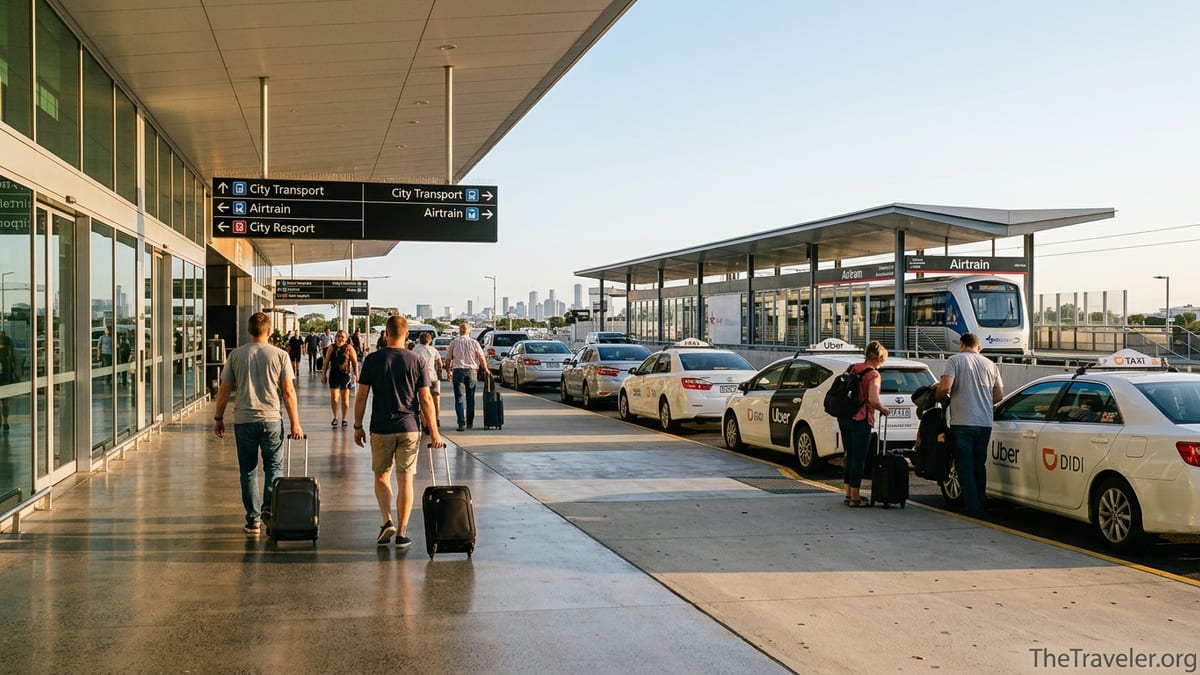
Understanding the Route from Brisbane Airport to the City
Brisbane Airport has two terminals, Domestic and International, separated by roughly 4 kilometers. Both sit to the northeast of the CBD, connected to the city by a mix of motorway, toll tunnels, and the dedicated Airport rail line. In normal traffic, a car or taxi will cover the distance in about 20 to 30 minutes. The Airtrain rail service, which runs on its own track, usually takes around 20 minutes between the terminals and Central Station in the heart of the city.
Most visitors staying “in the city” are booked into hotels around Central, Roma Street, South Bank, Fortitude Valley, or Spring Hill. The good news is that every main transfer option from the airport serves these zones easily. Airtrain stops at Bowen Hills, Fortitude Valley, Central, Roma Street and South Brisbane. Taxis and rideshares can drop you at any CBD or South Bank hotel door, from business towers on Eagle Street to riverfront properties near the Wheel of Brisbane.
Brisbane’s weather can be hot and humid in summer and occasionally very wet, so the comfort of your transfer matters. Stepping into an air-conditioned train carriage or car can make a big difference after landing. At the same time, costs can add up quickly for solo travelers, especially on a private rail service like Airtrain where fares are charged per person rather than per vehicle.
Before choosing, think about how many people are in your group, your luggage load, whether you prefer door-to-door service, and what time your flight lands. A solo backpacker arriving at 11:00 on a Tuesday will likely choose differently from a family of four arriving with surfboards at 23:30 on a Saturday.
Airtrain: Fast Rail Link to Brisbane CBD
Airtrain is the dedicated airport train that links both terminals to Brisbane’s inner-city stations. Official guidance indicates a journey time of around 20 minutes from the airport to the CBD, with services typically running every 15 to 30 minutes during the day. Trains stop at several convenient points including Bowen Hills, Fortitude Valley, Central, Roma Street and South Brisbane, which together cover a large proportion of the city’s main hotel districts.
As of mid-2026, one-way fares from Brisbane Airport to the city for adults are typically in the low- to mid-20 Australian dollar range when bought on the spot, though prices can change and occasional government subsidies or promotions may temporarily lower the cost. Airtrain also promotes online discounts and group deals, sometimes advertising city fares from about 17 Australian dollars per person for two or more people booked together. Children often travel at reduced rates, and at times Airtrain has offered “kids travel free” deals, so it is worth checking for current offers when you plan your trip.
For many travelers, the simplicity is the key benefit. After exiting customs at the International Terminal, you follow clear signs to the Airtrain station via a short covered walk. At the Domestic Terminal, the station sits just outside the terminal building. You can pay using paper tickets, a local go card, or tap-on contactless bank cards and devices, then ride directly to Central Station. From Central, many CBD hotels are within a 5 to 10 minute walk, and South Bank is just two or three more stops away.
However, Airtrain has drawbacks. Fares are relatively high compared with ordinary Brisbane suburban trains, and they are charged per passenger. A solo business traveler staying near Central Station might see this as a fair trade-off for a predictable 20-minute trip. A family of four heading to a South Bank hotel might find that multiplied Airtrain tickets end up close to or even above the cost of a single taxi or Uber, especially once luggage is added into the equation.
Taxi: Classic Door-to-Door Convenience
Metered taxis remain one of the most straightforward ways to reach the city from Brisbane Airport. Official taxi ranks sit outside both the Domestic and International Terminals, with clear signage guiding arriving passengers. You simply join the queue, speak with the marshaller if present, and you are directed to the next available cab. Taxis operate around the clock, which is particularly important for late-night or very early-morning arrivals when train frequencies drop or services stop.
Recent fare estimates from transport information sources suggest that a typical taxi ride from Brisbane Airport to the CBD currently falls in a band of roughly 60 to 70 Australian dollars, including common tolls when the driver uses fast tunnel routes. Some earlier government and airport guidance referenced slightly lower ranges of around 45 to 60 dollars, but tolls, surcharges and incremental price rises over time mean that most travelers now should expect something closer to the 60-dollar mark for a daytime trip, and a bit more at night or in heavy traffic.
Price certainty is not as strong as with a fixed-fare shuttle or pre-booked transfer, because the meter continues running if congestion builds near the city, and tolls are added on top. Still, the convenience can be significant. A taxi from the International Terminal can deliver you straight to a CBD hotel such as those around Queen Street Mall, to business towers along Eagle Street, or to South Bank properties overlooking the river, with no transfers or walking required.
For small groups, taxis become competitive. A party of three sharing a 63-dollar fare to a hotel near Roma Street Station is effectively paying just over 20 dollars per person for a comfortable, air-conditioned ride that includes luggage handling and doorstep drop-off. Compared with buying three separate Airtrain tickets and then walking from Central or South Brisbane station with bags in tow, the difference in total cost may be modest, and the door-to-door comfort can be worth it, especially after a long flight.
Uber and Other Rideshare: Flexible and App-Based
Rideshare services such as Uber operate at Brisbane Airport and are well established. Dedicated pickup zones are signposted at both terminals, and the process is familiar to anyone who uses rideshare apps elsewhere: you request a car once you have your baggage, walk to the designated rideshare area, and meet your driver. The key advantage is price transparency before you get in the car. The app gives you an estimate for the trip from the airport to your hotel, which allows you to compare it with taxi and train costs on the spot.
Uber’s own guidance for airport trips currently highlights an average route price of roughly 50 Australian dollars for a standard service between Brisbane Airport and the inner city, with an average travel time of about 22 minutes in typical conditions. Actual prices move up or down based on demand, time of day, and traffic. During off-peak periods, you might see quotes in the mid-40s. At very busy times, dynamic pricing can push that number higher than a taxi, sometimes substantially, particularly after big events or during peak commuting hours.
Rideshare becomes especially attractive if you have the app set up already and want to avoid standing in a physical taxi queue. If you are staying in more residential neighborhoods near the city, such as New Farm, Kangaroo Point, or West End, a rideshare can be an easy way to reach your exact address without needing to change trains or walk with bags from a station. For example, a couple landing mid-afternoon and heading to an Airbnb near Kangaroo Point cliffs might see an in-app estimate in the high-40-dollar range, which compares well with two separate Airtrain tickets.
Still, there are a few considerations. Some passengers report additional airport-related fees being added to their Uber receipts, and tolls are usually wrapped into the final price. Rideshare services also depend on driver availability at your exact arrival time. Late at night around holidays or during major events, you may face longer wait times, higher prices, or both. If you are arriving with oversized luggage or sports equipment, such as surfboards bound for the Gold Coast, you may need to request a larger vehicle class, which increases costs further.
Shuttles and Private Transfers: Hotel Zones and Groups
Brisbane sees a mix of private shuttle vans and pre-booked transfer services operating from the airport to city hotels. These are typically run by specialist ground transport operators licensed by the airport rather than by public transport agencies. One well-known brand historically associated with Brisbane Airport is Con-X-ion, which has promoted shared shuttle services connecting terminals to a wide network of hotels across the CBD, South Bank and nearby suburbs. Shared shuttles usually charge per person, but the fare per passenger is often lower than a taxi for solo travelers, at the cost of additional stops for other passengers on the way.
As of 2026, commercial shuttle offerings can vary by season and demand, so it is wise to check availability before you travel. When they are running, shared shuttles often cluster their drop-offs by hotel zone: one van might handle central CBD hotels around Queen Street and Ann Street, another might loop through South Bank and West End, and another might handle Kangaroo Point and Spring Hill. A typical one-way adult fare on a shared shuttle might sit in the 20 to 30 dollar range, with discounts for return bookings or children, but exact numbers depend on the operator and current fuel and operating costs.
Private transfers, often described as chauffeur or limousine services, charge per vehicle rather than per seat. These can be pre-booked online with fixed prices agreed in advance for specific routes such as “Brisbane Airport to Brisbane CBD hotel” or “Brisbane Airport to South Bank.” Prices generally come in higher than taxis for solo travelers but can become reasonable for larger families or groups of four to six people. Many operators use late-model sedans, SUVs or people-movers, offer in-terminal meet-and-greet, and monitor your flight for delays so that your pickup time adjusts if your arrival changes.
For example, a family of five arriving from Singapore with several large suitcases and strollers, staying at a South Bank apartment hotel, might pre-book a private van transfer. Even if the cost is in the mid-100-dollar range, the door-to-door service, guaranteed vehicle size, and help with luggage can be worth it. Compared with buying five Airtrain tickets and then taking an additional taxi or walking from South Brisbane station, the price difference may not be dramatic, while the convenience is much greater.
Luggage, Mobility and Hotel Location Considerations
Your transfer decision should factor in not just headline price, but also how easy the journey will be with your particular luggage and mobility needs. Airtrain carriages are designed with airport travelers in mind, offering dedicated spaces for suitcases. However, you still need to wheel your luggage from the terminal to the station, on and off the train, and possibly from a city station to your hotel. A business traveler with a single carry-on bag heading to a hotel opposite Central Station will probably find this straightforward. A couple with two big checked bags arriving in heavy rain at night might not.
Taxis, rideshares and private transfers have the advantage of handling luggage more flexibly. The driver loads bags into the boot, and you do not need to navigate escalators or station platforms. This can be especially important for older travelers, people with limited mobility, or families wrangling small children. If you are staying in hilly neighborhoods such as Spring Hill or in riverside areas without easy rail access, being dropped directly at the hotel entrance can spare you a steep walk with suitcases.
Think also about onward connections. Roma Street Station is Brisbane’s main hub for long-distance Queensland Rail and interstate coach services. If you are connecting to a train bound for the Sunshine Coast or regional Queensland, taking Airtrain straight to Roma Street might be the simplest option. On the other hand, if you are connecting to a cruise ship departing from the International Cruise Terminal or to suburbs well away from rail lines, you may prefer a road-based transfer that takes you precisely where you need to be.
Room type and check-in time matter too. Some CBD hotels, such as those near Queen Street Mall or along Edward Street, can be easily reached on foot from Central Station during the day. But if you arrive at 22:30 with a 23:00 check-in, even a five-minute walk with luggage can feel stressful. In those cases, spending a little more on a taxi or Uber directly from the terminal may buy valuable peace of mind.
Best Transfer by Time of Day and Traveler Type
Different transfer options shine at different times of day. During daytime and early evening, when Airtrain is running frequently and city streets can be congested, the train often offers the most predictable journey time to the CBD. For a solo traveler arriving around 14:00 and staying at a hotel within a few minutes’ walk of Central Station, Airtrain typically represents a good balance between cost and speed. You can be at your hotel reception within 40 minutes of clearing customs, without worrying about traffic jams or surge pricing.
Late at night, however, the equation changes. Airtrain services taper off in the evening and do not run through the small hours. Travelers landing around midnight on New Year’s Eve, for example, will almost certainly need to rely on taxis or rideshares to reach the city, as local discussions and traveler experiences routinely point out. At those times, taxi ranks remain active outside the terminals, and rideshare services continue to operate, though you may see longer waits or higher prices during major holiday periods or big events.
Group size also shifts the balance. A couple arriving mid-morning and heading to a central CBD hotel might find that two discounted Airtrain tickets cost slightly less than a taxi, while avoiding possible traffic delays. A family of four arriving at a similar time might discover that the total cost of four individual train tickets is close to or above a single 60-dollar taxi or 50-dollar Uber, making road transport more attractive, especially with luggage. For groups of five or more, pre-booked private transfers or larger rideshare vehicles can offer a competitive per-person rate alongside maximum convenience.
Budget travelers with light luggage and flexible schedules may look for hybrid solutions. One tactic some locals mention involves using regular Translink bus routes to the Airport DFO shopping complex, then taking the airport’s free precinct shuttle to the terminals or from the terminals back to DFO when leaving. This route can be slower and less straightforward, and it is better suited to those familiar with Brisbane’s public transport system. For most visitors, particularly first-timers, sticking to the main options of Airtrain, taxi, rideshare, shuttle, or private transfer makes for a smoother arrival.
The Takeaway
Choosing the best way from Brisbane Airport to the city center depends on your priorities: speed, price, comfort, or simplicity. Airtrain is fast, frequent during the day, and plugs neatly into Brisbane’s rail network, making it ideal for solo travelers or couples staying near Central, Roma Street or South Bank who prefer a fixed journey time and do not mind a short walk with luggage.
Taxis and rideshares like Uber deliver classic door-to-door convenience, with typical fares now often sitting in the 50 to 70 dollar range for the CBD depending on time of day, traffic and demand. They become especially attractive for small groups or those with heavy luggage, as the per-person cost narrows toward or under the train fare while avoiding transfers and station walks.
Shared shuttles and private transfers occupy the middle and upper ends of the comfort spectrum. When available, shared shuttles can be a cost-effective option for solo travelers headed to major hotel clusters, while pre-booked private cars or vans suit families, business groups and travelers who value a fixed price, meet-and-greet service and guaranteed luggage space.
Ultimately, the smartest strategy is to decide your preferred balance before you fly, check up-to-date schedules and price estimates shortly before landing, and have a backup plan in mind. That way, whether you arrive in Brisbane at 10:00 on a sunny weekday or near midnight in a tropical downpour, you will know exactly how you are getting from the runway to your room.
FAQ
Q1. How long does it take to get from Brisbane Airport to the city?
In normal conditions, it usually takes around 20 minutes on Airtrain and about 20 to 30 minutes by taxi, Uber or private car, depending on traffic and route.
Q2. What is the cheapest way to reach Brisbane CBD from the airport?
For most visitors, the cheapest clear-cut option is usually Airtrain, especially when using online discounts or group fares. Very budget-conscious travelers familiar with local buses may be able to combine suburban services via the Airport DFO precinct, but this is slower and more complicated.
Q3. How much should I expect to pay for a taxi from Brisbane Airport to the city?
Current estimates suggest a typical metered taxi fare of around 60 to 70 Australian dollars to the CBD, including common tolls. The exact amount varies with time of day, traffic and the specific route your driver takes.
Q4. Is Uber cheaper than Airtrain in Brisbane?
It depends on your group size and the time of day. For a solo traveler, Airtrain is often cheaper. For two or more people, an Uber or similar rideshare can be comparable or slightly cheaper per person, especially when you factor in door-to-door convenience.
Q5. Does Airtrain run late at night?
Airtrain operates from early morning until late evening, but it does not run through the night. If you land very late, particularly close to or after midnight, you should plan on taking a taxi or rideshare instead.
Q6. Which transfer option is best if I have a lot of luggage?
If you are traveling with several large suitcases or bulky items, a taxi, Uber, or private transfer is usually more comfortable than the train. You avoid carrying luggage through stations and can be dropped directly at your hotel entrance.
Q7. Can I use contactless payment or a go card on Airtrain?
Yes. Airtrain accepts paper tickets, the local go card, and contactless payment with Visa or Mastercard, including physical cards and compatible phones or watches. This allows you to tap on at the station gates without buying a separate ticket.
Q8. What is the best option for a family with children?
Families often find taxis, rideshares or pre-booked private transfers easiest, as the fare covers the whole vehicle and there is no need to manage multiple tickets or keep children together on a train. For light-luggage families staying close to a station, discounted Airtrain group fares can also work well.
Q9. How do I get to South Bank from Brisbane Airport?
You can take Airtrain directly to South Brisbane station and walk to most South Bank hotels, or use a taxi or rideshare for door-to-door service. A taxi or Uber is particularly convenient late at night or in bad weather.
Q10. Should I book a private transfer in advance?
If you are arriving during busy periods, traveling with a large group, or want guaranteed meet-and-greet service and fixed pricing, booking a private transfer in advance is a good idea. Solo travelers and couples arriving at off-peak times may be comfortable choosing between Airtrain, taxi or rideshare on arrival.