


More news on this day
A preliminary investigation by Canada’s transportation safety agency indicates that a broken section of rail is the likely cause of a December 2025 ore train derailment near Sept-Îles, Quebec, drawing fresh attention to the risks posed by aging track on heavy-haul mineral corridors.
Get the latest news straight to your inbox!
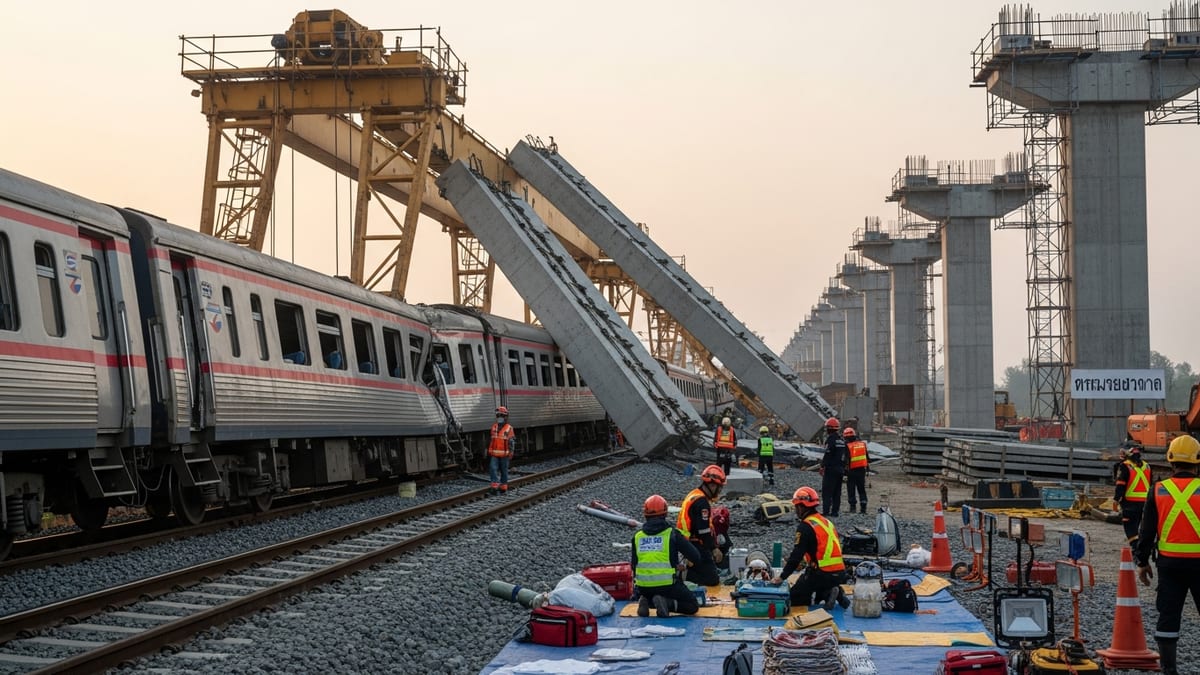
Heavy Ore Train Left Track Twisted Near Sept-Îles
According to published investigation details from the Transportation Safety Board of Canada, the derailment occurred on 28 December 2025 on the Wacouna Subdivision south of Sept-Îles, when an ore train operated on the Quebec North Shore and Labrador Railway left the main track. Early findings indicate that 29 loaded iron ore cars, along with a mid-train remote locomotive, derailed at about Mile 37.7 of the line.
Publicly available information describes extensive damage to track infrastructure and rolling stock, though there were no reports of injuries. The derailed consist, a heavy unit train carrying iron ore from operations serving Quebec’s north shore mining region, came to rest in a remote area, complicating initial site access and cleanup efforts.
The line is a critical freight artery for iron ore exports moving through the deep-water port at Sept-Îles, and the derailment briefly disrupted traffic on a corridor that typically handles high-axle-load trains. Service was gradually restored after track repairs and recovery of the damaged cars and locomotive, based on information released in the weeks that followed.
Investigators documented rail and track components, vehicle damage patterns and onboard data from locomotives, building a timeline of events leading up to the derailment. That work has now converged on a broken length of rail as the most probable initiating factor.
Broken Rail Emerges as Likely Trigger
In its ongoing safety investigation, the Transportation Safety Board has stated that a fractured rail on the main track is viewed as the likely cause of the December 2025 derailment. Examination of the site identified a section of south rail that had separated, with evidence of pre-existing fatigue and final overload failure consistent with a break under the passing train.
Technical summaries indicate that the rail probably failed beneath or shortly ahead of the derailing consist, allowing wheelsets to drop or climb off the running surface and diverge from the track structure. Once the first cars left the rails, the forces involved in a fully loaded ore train amplified the damage, rapidly pulling additional cars and the mid-train remote locomotive off the track.
Investigators are comparing the fracture characteristics at Sept-Îles to previous Canadian derailments where undetected rail breaks played a central role. Past Transportation Safety Board reports have highlighted how small internal defects, sometimes missed by visual inspection and ultrasonic testing, can evolve into full rail failures as repeated heavy loads pass over the same section of track.
While the final report on the December 2025 event has not yet been issued, the working conclusion that a broken rail was the most plausible trigger is already reinforcing long-standing concerns about track integrity on high-tonnage freight lines.
Spotlight on Inspection and Heavy-Haul Operations
The derailment near Sept-Îles has again focused attention on how railways inspect and maintain track under intense heavy-haul conditions. The Quebec North Shore and Labrador corridor routinely handles concentrated flows of iron ore, with axle loads and tonnage that can accelerate the growth of defects in rails, welds and fastenings.
Across Canada, publicly available Transportation Safety Board data show that broken rails remain one of the leading causes of significant freight derailments, despite advances in track testing technology. Industry practice typically combines regular visual patrols with specialized vehicles that use ultrasonic and other non-destructive methods to scan rails for internal flaws.
Investigators examining the December 2025 incident are reviewing recent inspection records, testing intervals and any previous noted defects in the vicinity of Mile 37.7. The aim is to determine whether the fracture developed in between scheduled tests, or whether earlier indications might have been missed or misinterpreted.
For operators of heavy ore trains, the case underscores the challenge of balancing high production volumes with the need for conservative maintenance and renewal strategies, especially in northern climates where temperature swings and moisture can intensify rail stresses.
Regional Rail Safety Context in Quebec
The Sept-Îles ore train derailment fits into a broader pattern of rail safety concerns in Quebec, a province that hosts both dense passenger corridors and remote resource lines. Recent Transportation Safety Board communications have detailed other occurrences in the region involving freight, ore and passenger trains, highlighting a diverse risk profile that includes track defects, equipment failures and grade crossing incidents.
Quebec’s mix of legacy infrastructure and newer upgrades means that conditions can vary sharply from one subdivision to another. On heavy mineral routes, older rail sections and welded joints can be subject to repeated high-impact loading, especially during winter months when steel becomes more brittle and thermal forces intensify.
Publicly available accident records show that, in several Canadian cases, rail breaks have occurred despite operators meeting or exceeding applicable regulatory inspection standards. This has fueled ongoing debate about whether current rules and testing technologies are sufficient for lines carrying large volumes of dangerous goods and heavy bulk commodities.
While the December 2025 ore train did not involve hazardous materials, the scale of the derailment and its proximity to key export infrastructure have made it a reference point in current discussions over asset renewal, redundancy and real-time monitoring on critical freight corridors.
What the Case Means for Travelers and the Industry
For travelers, the Sept-Îles derailment is a reminder that rail networks used by passenger services often share territory, suppliers or maintenance practices with heavy freight and ore operations. Disruptions on freight-heavy corridors can ripple into passenger schedules when detours, slow orders or repair windows affect shared nodes and yards.
Although this particular occurrence took place on a specialized ore line, similar track technologies and inspection regimes are used widely across Canada. As a result, findings from the investigation are likely to feed into broader safety recommendations, potential regulatory adjustments and investment decisions that influence both freight reliability and passenger punctuality.
For the rail sector, the incident reinforces international experience suggesting that broken rails remain a stubborn risk factor, even in networks that deploy modern testing trains and data analytics. Emerging tools, including continuous rail condition monitoring and predictive models for break risk on heavy-haul routes, are being closely watched as operators and regulators look for ways to reduce the odds of sudden, undetected failures.
Travelers following the story can expect further detail when the Transportation Safety Board publishes its full report on the December 2025 Quebec ore train derailment, including any safety action that may be recommended to address the threats posed by broken rail on high-tonnage lines.