


Cairo International Airport can feel overwhelming the moment you step into arrivals: competing taxi offers, hotel reps, and ride-hailing drivers all vying for your attention. Hidden in the middle of that noise is Cairo’s cheapest way into the city: the public bus network that links the airport to downtown, metro stations, and intercity coach terminals. Used well, these buses can save you a lot of money. Used badly, they can turn a long travel day into an exhausting ordeal.
Get the latest updates straight to your inbox!
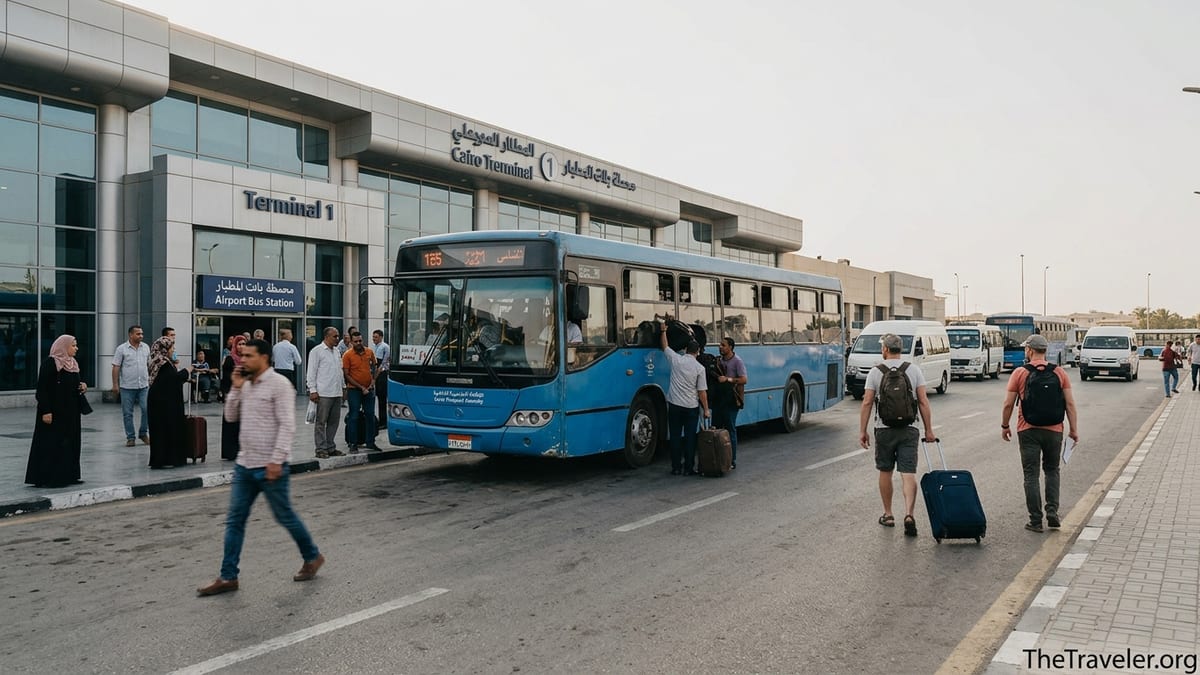
How Cairo’s Airport Bus System Actually Works
Cairo International Airport sits in the Heliopolis district about 15 kilometers from central Cairo. All three passenger terminals are connected by an internal shuttle bus to the Cairo Airport Bus Terminal near Terminal 1, where most public and intercity buses depart. In practice, that means your journey almost always has two steps: a short shuttle from your arrival terminal to the Terminal 1 bus station, then the main bus into the city or onward across Egypt.
Most city buses at the airport are operated by the Cairo Transport Authority or licensed private companies running similar routes. You will see large blue or red city buses and smaller white or cream minibuses. Destinations are shown in Arabic on the front and side, sometimes with handwritten cardboard signs placed in the windshield. Drivers and conductors typically call out “Ramses,” “Tahrir,” “Heliopolis,” or the name of a metro or bus hub to attract passengers.
Crucially, there is no single “airport express” bus like in some capitals. Instead, a handful of regular city routes extend into the airport. They run reasonably late but not 24 hours, and frequencies can drop at night. That can be fine if you land at 3 p.m. and are heading to downtown, but much less ideal if you land at 2 a.m. with a big suitcase and a hotel in Giza.
Think of the airport bus system as one leg of Cairo’s wider transport network rather than a dedicated tourist service. You will often combine it with the metro from stations such as Adly Mansour or Ramses, or with a connecting taxi from a big square like Tahrir to your final hotel. Planning for at least one change is realistic and helps keep expectations in check.
Finding the Terminal 1 Bus Station and Free Shuttle
All routes into Cairo and most intercity buses leave from the Cairo Airport Bus Terminal, located a few minutes from Terminal 1. If you arrive at Terminal 2 or Terminal 3, look for the official airport shuttle, usually signed with “Shuttle Bus” or “Inter-Terminal Bus.” It runs on a loop between terminals and ends at the bus station next to Terminal 1. The shuttle is free, but you do need to watch for it: it does not always wait at the curb, and you may have to stand near the bus signs outdoors.
From Terminal 3, arrivals walk out of the terminal, cross one traffic lane, and follow signs for buses and public transport. Locals often queue in a loose line where the shuttle pulls in. At busy times, such as late evening when many European flights arrive, you may not get on the first shuttle and might wait 10 to 15 minutes. It is still worth persisting; the alternative is paying for a taxi just to reach the bus station, which negates most of the savings.
Once at Terminal 1, the bus station is a fenced-off yard with multiple bays. There is usually no English-language board listing departures. Instead, ask the conductors standing by each bus. A simple “Tahrir?” or “Ramses?” is enough; they will nod and wave you on if that bus goes there. If you are heading for onward travel, ask for “Ramses” for Cairo Ramses railway station, “Tahrir” for the Go Bus terminal and Nile-side hotels, or “Adly Mansour” if you plan to use the metro or long-distance SuperJet buses from the new transport hub.
Give yourself time to navigate this first connection. A common real-world pattern is landing around midday, reaching the bus station by 1 p.m., and then boarding a bus to downtown that takes 45 to 60 minutes in moderate traffic. If you have a 4 p.m. train from Ramses Station, that schedule is tight but plausible. For a 3 p.m. departure, it is unnecessarily stressful and a taxi is safer.
Key City Bus Routes from Cairo Airport and Typical Costs
Airport routes and numbers can change, and many visitors simply ask for destinations rather than line codes. As of mid‑2026, you can expect several standard patterns. One common bus route connects the airport to Ramses Square, the area around Cairo’s main railway station. Another goes toward Tahrir Square and the Nile-side downtown area where many budget and mid-range hotels cluster. Additional minibuses tend to serve Heliopolis and Nasr City, useful if you are staying closer to the airport.
Fares on Cairo’s public buses increased after fuel price rises, and the city introduced new ticketing rules. Regular public buses within Greater Cairo typically charge a flat fare in the range of about 10 to 15 Egyptian pounds per ride for standard non-air-conditioned vehicles, and roughly 20 to 25 pounds for air-conditioned routes, depending on distance and operator. That means a bus from the airport to downtown will usually cost in the same ballpark as any long cross-city ride rather than a special premium. Conductors may collect cash on board, or you might see locals tapping electronic cards, but visitors are almost always allowed to pay cash.
To make the prices concrete, imagine you are two people heading to a hotel near Tahrir Square. A standard taxi from the airport might cost the equivalent of several hundred Egyptian pounds, while two seats on a standard city bus could total in the region of 20 to 30 pounds in cash. Even allowing for a short taxi or ride-hail trip from Tahrir to your actual hotel, you are looking at a deep discount compared with going door to door by car.
Service frequency falls sharply late at night. After about 11 p.m., buses become sporadic and you may find yourself waiting at the bus station longer than the ride itself. In that situation, a budget option is to take whatever bus first heads toward a major node like Heliopolis or Nasr City and then use a ride-hailing app such as Uber to complete the journey. Splitting the distance this way can still cut your final car fare significantly while avoiding the least comfortable part of the network deep in the night.
Using Airport Buses to Connect with Metro, Monorail and Intercity Coaches
For many travelers, the airport bus is not the entire journey but a connector to Cairo’s growing rapid transit network. The Adly Mansour transportation hub on the eastern side of the city has become an important interchange, linking metro Line 3, city buses, a new bus rapid transit corridor, and intercity operator SuperJet. Some airport buses or shuttles now run toward this hub, allowing you to step off the plane, ride a bus, then transfer onto a fast metro or long-distance bus without going all the way into central Cairo.
Metro fares in Cairo are distance-based and generally in the range of roughly 5 to 10 Egyptian pounds for most journeys, which keeps combined bus-plus-metro travel very affordable. A realistic example: you land in the afternoon, take the free airport shuttle to the bus station, ride a public bus to an interchange where you enter the metro, then continue to a station near your downtown guesthouse. Your total outlay for the bus and metro together can easily be under 40 pounds, while a direct airport taxi in the same traffic might be ten times that amount.
If you are heading across Egypt rather than into Cairo, the bus from the airport can also connect you with private intercity companies such as Go Bus and Blue Bus. These operators run from central locations like Ramses and Tahrir to Alexandria, Hurghada, Sharm el Sheikh, Luxor and other cities. A typical Go Bus ticket between Cairo and Alexandria or Cairo and Hurghada might cost in the low hundreds of pounds, depending on seat class and season, which is still markedly cheaper than a domestic flight. Many travelers book online, then use an airport bus into the city and walk or taxi the last few blocks to the coach station.
For very early morning intercity departures, particularly southbound to Luxor or Aswan, consider staying one night in the city rather than trying to step off an overnight flight and go straight to a 6 a.m. coach. The first public buses from the airport are not designed to feed those early services, and a missed connection can mean losing a nonrefundable bus ticket and scrambling for alternatives.
Luggage, Comfort and Safety on Cairo Airport Buses
Egyptians use the bus network heavily, and airport routes are no exception. It is common to see passengers with shopping bags, boxes and even small appliances. That makes traveling with a checked suitcase possible but not effortless. On most large buses, luggage is placed either on an empty seat or in the aisle near the door. There are usually no dedicated luggage racks. On minibuses, bags are squeezed in front of your knees or by the side door. If you are carrying a large hiking backpack and a wheeled suitcase, be prepared to lift them quickly as the bus pulls in and to keep them under your control in crowded conditions.
Comfort levels vary. Older public buses can be hot and crowded, especially in summer afternoons. Air-conditioned buses, where available on airport routes, are noticeably more pleasant and cost only slightly more. Seats may be worn, windows may rattle, and there is no guaranteed space for everyone to sit. For a twenty-something solo traveler heading to a hostel, that may feel like an authentic introduction to Cairo. For a family with small children who have just endured a red-eye flight, it can be overwhelming.
Safety is more about petty hassles than serious crime. Pickpocketing in crowded buses is possible, particularly at busy stops near major squares. Keep your phone and passport in a money belt or zipped inner pocket, and avoid leaving bags by the door where someone could grab and run. Women traveling alone may prefer to sit toward the front of the bus, where drivers and conductors tend to be more protective if any unwanted attention occurs.
Another real-world consideration is language. Most conductors speak limited English but know basic destination words such as “Tahrir,” “Ramses” and “metro.” Showing your destination written in Arabic on your phone can smooth communication. Your hotel or hostel can easily message you the name of the nearest big square or metro station in Arabic script. Hand your phone to the conductor when boarding and say “henna?” meaning “here?” They will usually nod, shake their head, or wave you off the bus if it is not the right one.
When Airport Buses Are Not Practical and Alternatives to Use
Despite their rock-bottom cost, there are several cases when Cairo’s airport buses are simply not a good idea. Very late arrivals are one. If your flight lands after midnight, you clear immigration around 1 a.m. and still have to find the shuttle and bus station, you may discover that services have thinned out or stopped. Standing at a dimly lit bus bay with luggage and no clear information is not worth saving a few dollars. In these situations, pre-arranged hotel pick-ups, ride-hailing apps, or official airport taxis are far safer and more reliable.
Heavy luggage or mobility issues are another red flag. If you are traveling with two large checked bags, a stroller, or mobility aids, the high steps and crowded aisles of standard buses will be tiring and sometimes unsafe. The lack of elevators or escalators at some onward hubs can add another layer of difficulty. Spending extra on a private car or shuttle that can drop you at the door is usually money well spent, especially at the start or end of a long trip.
Time pressure is the third major factor. If you are connecting from an international flight at Cairo to a domestic flight, or to a long-distance train from Ramses station, the bus is almost never the right choice. Cairo’s traffic is unpredictable, and although a bus can reach downtown in 45 minutes on a good day, the same ride can stretch to well over an hour at peak times or in bad weather. With any kind of hard departure within three hours of landing, a taxi or airport shuttle gives you a better margin for delays at immigration, baggage claim, and the roads.
Finally, consider your energy level and comfort with urban chaos. For some travelers, figuring out a developing-city bus system on day one is part of the adventure. For others, it is a fast path to frustration. One approach is to use a taxi or shuttle from the airport when you first arrive, then experiment with buses and metro later in your stay when you are rested, have local SIM data, and know roughly where things are.
How to Pay on Buses and What to Expect in Practice
On most Cairo city buses, including airport-serving lines, payment is still very straightforward: you hand cash to the conductor shortly after boarding. They either give you a small printed ticket or keep mental track of riders. Try to carry small notes, such as 10 or 20 pounds, because conductors may struggle to change large bills fresh from an ATM. If you have nothing but high-denomination notes, it is polite to show them before you sit, allowing the conductor to signal if it is a problem.
Locals increasingly use prepaid or electronic cards offered by the Cairo Transport Authority, which can give discounted segments or flexible distance-based pricing. As a short-term visitor, you do not need one to ride the airport bus. However, if you expect to use buses and metro daily for a week or more, asking at a metro station about stored-value cards can make sense. The cards are usually inexpensive to purchase and can be topped up in small amounts at ticket counters or machines.
Do not expect exact change, receipts, or printed timetables. Buses leave when they are reasonably full or when the driver decides it is time, particularly for minibuses. If you want to be sure you are on the right vehicle, ask twice: once before boarding and again just after paying. Egyptians are generally helpful toward visitors and will often call out when your stop is approaching if they know where you aim to get off.
In practice, a typical first-time journey might look like this: you land at 3 p.m., clear immigration and baggage by 4 p.m., then follow signs to the shuttle and reach the Terminal 1 bus station at 4:20 p.m. You ask a conductor for “Tahrir,” pay a cash fare in the range of 20 pounds, and squeeze your carry‑on into the aisle. The bus rumbles through Heliopolis, then across the city, reaching Tahrir around 5:15 p.m. From there, you either walk five to ten minutes to your hotel or hop in a short taxi ride costing another 50 to 100 pounds, arriving still far under the cost of a direct airport taxi.
The Takeaway
Cairo’s airport buses are not polished or tourist-focused, but they are extremely cheap and, for the right traveler at the right time of day, surprisingly effective. They work best if you are arriving in daylight or early evening, carrying manageable luggage, and heading to a central area like Tahrir or Ramses without tight onward connections. In these scenarios, the savings over taxis are significant, and the minor discomforts are a fair trade.
They become a poor choice when you land very late or very early, are traveling with heavy bags or young children, or face a tight connection to another flight or long-distance train. In those cases, Cairo’s mix of official taxis, ride-hailing apps, and hotel shuttles offer far better reliability and peace of mind, even if they cost several times more than a bus ticket.
The key is to treat airport buses as one tool among many. Use them strategically to reach major nodes, combine them with metro or intercity coaches, and always keep an eye on the clock and your own energy level. With that mindset, you can turn what might have been an intimidating system into a budget-friendly way to see how Cairo really moves.
FAQ
Q1. Is there a direct public bus from Cairo Airport to downtown Tahrir Square?
There is no single branded “airport express,” but regular city buses from the Terminal 1 bus station run to central hubs near Tahrir Square or Ramses, from which you can walk or take a short taxi to most downtown hotels.
Q2. How much should I expect to pay for a public bus from the airport into Cairo?
As a rough guide, standard buses usually cost in the area of 10 to 15 Egyptian pounds per ride and air‑conditioned services somewhat more, so a one‑way trip from the airport into the city often totals the equivalent of a few tens of pounds rather than hundreds.
Q3. Are airport buses safe for solo travelers and women traveling alone?
Many solo travelers and local women use these routes daily. The buses can be crowded and noisy, but serious incidents are rare; standard precautions such as keeping valuables hidden and sitting nearer the front are usually sufficient.
Q4. Can I take the airport bus if I arrive after midnight?
Bus frequencies drop sharply late at night and may stop entirely on some routes, so after midnight a pre‑booked transfer, ride‑hail, or official taxi is generally safer and more reliable than hoping for a late bus.
Q5. Is there space for large suitcases on Cairo airport buses?
There are no dedicated luggage racks, but passengers commonly travel with bulky items. You will likely need to keep your suitcase in the aisle, on an empty seat, or near the door and be ready to move it quickly as people get on and off.
Q6. How do I know which bus to take from the airport bus station?
Destinations are often written in Arabic, so the simplest method is to ask conductors by saying the name of your target area, such as “Tahrir” or “Ramses.” They will usually confirm whether their bus passes there or direct you to the correct one.
Q7. Can I pay for Cairo airport buses with a card or only cash?
Locals increasingly use prepaid or electronic cards, but visitors almost always pay in cash. Keep small notes on hand, as conductors may not have change for large bills from airport ATMs.
Q8. Is it realistic to use the bus if I have a same‑day train or domestic flight to catch?
If your onward departure is within about three hours of landing, the unpredictability of Cairo’s traffic makes the bus a risky choice. In those cases, a taxi or shuttle directly from the terminal is usually wiser.
Q9. Do airport buses connect directly to the Cairo Metro or monorail?
Some buses and shuttles serve hubs that link with the metro, such as Adly Mansour, where you can transfer to rapid transit. You should still expect at least one change and possibly a short walk to complete the connection.
Q10. Should first‑time visitors to Cairo use the airport bus on arrival?
It depends on your tolerance for crowds and uncertainty. Confident budget travelers arriving in daytime often find the bus a worthwhile savings, while many first‑timers prefer the simplicity of a taxi on arrival and experiment with buses later in their trip.