


Cairo International Airport (CAI) can be confusing, especially if you are connecting between its three main terminals on a tight schedule. Airline moves, construction and evolving security procedures mean that advice from a few years ago is often out of date. This guide brings together the latest information for 2026 and real-world traveler experiences to help you navigate transfers between Terminal 1, Terminal 2 and Terminal 3, understand shuttle and train options, and decide how much connection time you realistically need.
Get the latest updates straight to your inbox!
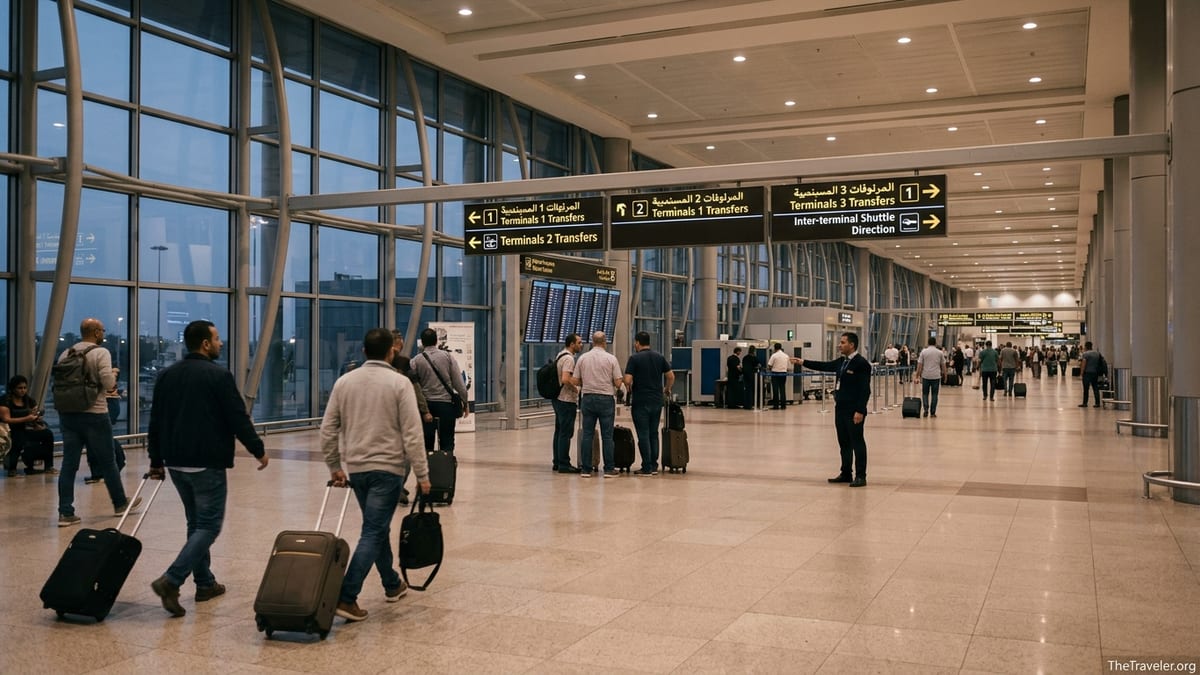
Understanding Cairo International Airport’s Terminal Layout
Cairo International Airport is a spread-out multi-terminal campus. Terminals 2 and 3 form a modern, connected hub handling most EgyptAir and Star Alliance flights, while Terminal 1 and the separate Seasonal Terminal sit off to the side and are reached by shuttle or people mover. In practice, this means that a connection between T2 and T3 is usually much easier than one involving T1, and connections that mix EgyptAir with Gulf or European carriers often require a landside transfer.
Terminal 3 is EgyptAir’s main home and the largest building in the complex, used heavily for EgyptAir long-haul and many regional flights, as well as some Star Alliance partners. Terminal 2, which is physically linked to T3 by an enclosed walkway and airside corridor, typically hosts a mix of international carriers including several Gulf and European airlines, though allocations can shift. Terminal 1, the oldest facility, now focuses mainly on some non-alliance international carriers and certain regional operations, plus the nearby Seasonal Terminal used for peak-period flights such as Hajj and Umrah services.
Because airline-to-terminal assignments can and do change, always check your booking and your airline’s latest terminal information before you fly. Travelers regularly report arriving in Cairo expecting a T3-to-T3 EgyptAir connection, only to discover a partner-operated leg using T2, or a codeshare routing that arrives at T1 and departs from T3. A few minutes spent double-checking can save you from sprinting for a shuttle or queuing at the wrong building after a long-haul flight.
The airport publishes general maps that show T2 and T3 as a joint complex and T1 as a separate spoke, with a free inter-terminal shuttle and people mover linking the buildings. In day-to-day terms, think of T2 and T3 as one “mega-terminal” with a five to ten minute walk between them, and T1 as a distinct terminal that will almost always require some form of vehicle transfer if you are changing planes.
Airside vs Landside Transfers: What Actually Happens
At Cairo, the difference between an airside and landside transfer is crucial. An airside transfer means you remain within the secure area between flights, following “Transfer” signs without passing through Egyptian immigration. A landside transfer means you must clear immigration, collect your luggage, exit to the public arrivals hall, change terminals, then check in and clear security again for your next flight.
For many same-ticket EgyptAir or Star Alliance connections within T2 and T3, the airport aims to route passengers airside. On arrival at T3, for example, you might be directed down a corridor signed “Transit / Transfer” where airline staff check your onward boarding pass and guide you either to a transfer security checkpoint or straight toward the T2–T3 connecting corridor. If your bags are checked through and both flights are on the same booking, you may never see the immigration counters at all.
However, travelers frequently report that airside transfers involving Terminal 1 are inconsistent, and that even some T2–T3 transfers can become landside if ground staff decide a manual handling process is needed. If your flights are on separate tickets, use different airlines that do not interline baggage, or involve a change in airline alliances, you should plan on a landside transfer. In that scenario, you must meet Egypt’s entry rules just as if Cairo were your final destination.
A practical example: a passenger arriving from Frankfurt on EgyptAir into T3 and continuing to Aswan on EgyptAir, both flights on one ticket, will almost always be handled airside with bags checked through. Contrast that with a traveler arriving from Dubai on Emirates in T1 and continuing to London on British Airways or another carrier in T2 or T3 on a separate ticket. They are likely to clear immigration, collect their bags in T1, ride the shuttle to T3, and then check in anew, effectively treating Cairo as two separate trips.
Getting Between T1, T2 and T3: Shuttles, People Movers and Walking
Movement between terminals at Cairo is free, but it is not as simple as walking through a single connected building. A complimentary shuttle bus runs between Terminals 1, 2 and 3 throughout the day and night, usually every 15 to 20 minutes, though intervals can be longer during very late-night lulls or busy periods. The buses typically stop outside each terminal’s arrivals level, where you will see signs for “Inter-Terminal Shuttle” or “Airport Bus.” Actual wait times reported by travelers range from 5 to 25 minutes, so allow a margin.
In addition to the bus, Cairo has a small automated people mover or train that links the terminal area with parking and other airport facilities, and in practice helps connect T1 with the T2–T3 complex on the landside. If you arrive into T3 and need to reach T1, for example, you might walk out of the arrivals hall, follow signs for the shuttle or train, ride for roughly 10 minutes including waiting time, then walk another few minutes into the T1 building. Some recent traveler reports suggest that, at quiet times, airport staff may direct you to whichever comes first, bus or train, depending on availability.
Between T2 and T3, the easiest option is usually to walk. The two terminals are linked by an enclosed bridge and shared concourse area, and the walk typically takes around 5 to 10 minutes at a normal pace. For passengers transferring airside, this walk may be through a secure corridor behind security checkpoints, while landside passengers can also walk between the two departures areas via the public concourse once they have checked in and cleared security in the relevant terminal.
As a real-world timing example, a traveler arriving from Rome into T3, clearing immigration, collecting bags and then heading to T2 for a separate-ticket Gulf carrier flight might take around 45 to 60 minutes end-to-end at a relatively quiet time: 20 to 30 minutes for immigration and baggage, 5 to 10 minutes to find the T2–T3 link, and another 15 to 20 minutes for check-in and security at T2. In peak evening bank periods, especially during holidays, the same journey can easily stretch to 90 minutes or more.
Baggage, Separate Tickets and Recheck Realities
Baggage handling is one of the most important factors in a smooth Cairo connection. If your flights are all on EgyptAir or its Star Alliance partners, on a single booking reference, your bags are usually tagged through to your final destination and transferred automatically between T2 and T3. In that case, an airside connection is far more likely, and your main task is to follow transfer signs and re-clear security where instructed.
Problems arise when you mix airlines or hold separate tickets. Many popular routes to Cairo involve Gulf carriers such as Emirates, Qatar Airways and Saudia, or European airlines that use different terminals and do not always interline bags with EgyptAir on separately issued tickets. For example, a traveler flying Manchester to Cairo on Emirates into T1 and then Cairo to Luxor on EgyptAir from T3 on a separate booking should assume they must collect their luggage at T1, exit, use the shuttle or train to reach T3, and then recheck bags. If the inbound flight is delayed or queues are long, this adds genuine risk to any connection under about three hours.
Even when you are on a single ticket, short connections at Cairo can be stressful. Airline systems may show minimum connection times as low as 60 or 75 minutes between T3 and T2 for protected itineraries, and EgyptAir sometimes sells itineraries with under 90 minutes between international flights. If everything runs on time and your baggage is tagged through, these can work, but traveler reports describe situations where late-arriving flights result in rushed bus transfers to remote stands and manual baggage sorting. When booking your own trip, it is wise to treat airline minimums as theoretical and add at least 30 to 60 minutes of personal buffer.
For do-it-yourself connections with separate tickets, a conservative rule of thumb is to allow at least 3 hours for T2–T3 transfers where you need to collect and recheck bags, and 4 hours or more for any connection involving T1, particularly overnight or during high season for religious travel. This accounts for possible delays in baggage delivery, waits for the shuttle bus, and the need to clear security again in the departure terminal. Travelers who ignored this margin and booked 90-minute separate-ticket transfers at Cairo frequently report narrowly making flights or missing them altogether when even small delays accumulated.
Visa, Immigration and Transit Rules You Need to Know
Whether you need a visa or not during a Cairo connection depends on both your nationality and whether you are transferring airside or landside. If you remain in the international transit area and your bags are checked through, many nationalities do not require a visa for a short layover, even if it is several hours long. You simply follow transit signs, undergo any required security screening, and wait in the departures area for your next flight without formally entering Egypt.
However, if you must change terminals via the public side, collect your luggage, or leave the airport, then you are considered to be entering Egypt. In that case, Egypt’s standard visa policy applies. Citizens of many countries, including most of Western Europe, North America and parts of Asia-Pacific, can usually obtain a visa on arrival at Cairo for a fee in US dollars, or apply in advance for an e-visa. Some nationalities must secure a visa before travel or are not eligible for transit outside the secure area. As visa policies can change and may differ by passport, always check with official Egyptian government or embassy sources for the latest rules for your nationality.
Egypt’s authorities also operate specific rules for transit passengers with longer layovers. Travelers with layovers of between roughly 6 and 48 hours may in some cases be permitted to leave the airport to visit Cairo, subject to holding a valid visa or obtaining one at the airport. EgyptAir has promoted a program that allows some transit passengers on its flights to obtain a complimentary short-stay visa, typically for layovers between 8 and 96 hours, processed via the airline’s transit desk. The exact eligibility criteria can vary and are subject to change, so if you are planning a city visit during a layover, confirm details with EgyptAir or your airline before travel.
A significant number of travelers discover the visa issue only when they realize they must change terminals on separate tickets. For instance, a passenger from Nairobi connecting to a European low-cost airline in T1 might be told on arrival that they have to clear immigration to recheck their bags, only to find that their nationality requires a pre-arranged visa rather than visa on arrival. To avoid this, assume that any self-constructed connection involving different terminals and baggage recheck will require you to meet Egypt’s full entry conditions, and plan accordingly.
How Much Connection Time to Allow at Cairo
There is no single answer that fits every itinerary, but certain patterns emerge from Cairo’s layout and recent traveler experiences. For protected, same-ticket connections handled entirely within T2 and T3, with baggage checked through and no change of airline alliance, 90 minutes is often workable and two hours is comfortable in normal conditions. This assumes no major delays and a relatively smooth transfer process, particularly if both flights are operated by EgyptAir or close partners.
Once your connection involves T1 or separate tickets, the picture changes. For landside transfers where you must clear immigration, collect bags, change terminals and recheck, a minimum of 3 hours is strongly advisable even in off-peak seasons. If your itinerary passes through Cairo during peak evening times, major holidays, or the busy Hajj and Umrah periods, treating 4 hours as a sensible minimum gives you more margin against delays and long queues. Some cautious travelers choose 5 to 6 hours for complex itineraries, building in time for rest, meals and potential disruptions.
Real-world examples illustrate these guidelines. A traveler arriving from Paris into T3 at 17:00 and connecting to Sharm El Sheikh from T3 at 19:10 on a single EgyptAir ticket is likely to be fine with just over two hours, even allowing for immigration if Cairo is their first Schengen-exit point. By contrast, a passenger landing in T1 from Istanbul at 21:15 on one airline and departing T3 for Johannesburg at 23:10 on another, with separate tickets, faces a high risk of misconnection, given the time needed to clear immigration, pick up luggage, wait for the shuttle, recheck bags, and pass security again.
Another factor is Cairo’s security and boarding practices. Many flights use bus gates and remote stands, which can add 15 to 30 minutes between boarding time and actual take-off. Security checks can also occur multiple times: one at the terminal entrance, a standard departure screening, and sometimes additional searches at the gate for flights to certain destinations. When evaluating your connection time, do not just look at scheduled arrival and departure; also consider boarding times and the likelihood of extra checks on your route.
Practical On-the-Ground Tips for Smooth Transfers
A bit of preparation makes a big difference when changing planes at Cairo. Print or save offline copies of your booking confirmations and boarding passes, including terminal information, and have them handy when you disembark. Airport staff often ask to see proof of your onward flight before directing you to the transfer corridor or transit desk. If you are on a same-ticket connection but are unsure whether your bags are checked through, confirm at your origin airport and ask the agent to show that your final destination appears on the baggage tag.
On arrival, follow the overhead “Transit / Transfer” signs closely and ask staff if anything is unclear. In Cairo, procedures can vary even within the same terminal depending on the time of day, airline, and staffing. If you know you need to switch to T1 from T2 or T3, be prepared for a landside process: immigration, baggage, customs, then shuttle or people mover. Keep a small amount of cash handy in case you need to pay for a visa on arrival or a small service like baggage wrapping or a trolley, though many formal fees are priced in US dollars and can sometimes be paid by card.
If you have a long layover, consider how you want to spend it. Within T2 and T3 there are standard airport amenities such as cafés, duty-free shopping and seating areas, though they can feel crowded at peak bank times. Some travelers choose to book lounge access via their airline, a credit card program or a day-pass provider to secure a quieter space with food and showers. If your layover is long enough and you meet visa requirements, you might take advantage of nearby airport hotels or even visit central Cairo; the airport area has several hotels frequently used by airlines for crew and stranded passengers, and taxi or ride-hailing services connect the airport to neighborhoods such as Heliopolis and downtown.
During the connection, stay alert to boarding time updates. Cairo departures can experience last-minute gate changes announced over loudspeakers that may be difficult to understand in a noisy terminal. Check departure screens regularly and, if you are on a tight transfer, inform staff at security or immigration about your boarding time; they may be able to direct you to a faster-moving line. Finally, build realistic expectations into your plans: Cairo is a busy hub for Africa and the Middle East, and while many connections proceed without drama, the combination of multiple terminals, variable staffing and strong seasonal surges means that extra time is rarely wasted.
The Takeaway
Transferring at Cairo International Airport is entirely manageable if you understand the terminal layout, know which transfers will likely be airside or landside, and give yourself enough time. Treat T2 and T3 as a connected pair where same-ticket EgyptAir and Star Alliance connections can be relatively smooth, but view any itinerary involving Terminal 1 or separate tickets with more caution and longer buffers.
Use the free shuttle bus or people mover between terminals, but remember that waiting and walking times add up, especially when combined with immigration, baggage claim and repeated security checks. Where possible, keep your flights on one booking and with cooperating airlines so that your bags are checked through and the airline is responsible if things go wrong. When that is not possible, plan conservatively and assume you will need to meet Egypt’s full visa and entry requirements.
Above all, avoid ultra-tight connections unless your airline is selling them as a protected itinerary, and even then, be prepared for a brisk walk or a short dash between gates. With realistic expectations, a printed copy of your booking, and an eye on the clock, Cairo can function as an efficient gateway between Africa, the Middle East and the wider world rather than a stressful bottleneck in your journey.
FAQ
Q1. Can I transfer between terminals at Cairo Airport without a visa?
If you remain airside in the international transit area and your bags are checked through on a single ticket, many nationalities do not need a visa. However, if you must pass immigration to change terminals or recheck luggage, you are entering Egypt and must meet the country’s visa rules for your nationality.
Q2. How long does it take to get from Terminal 1 to Terminal 3?
In normal conditions, allow around 30 to 60 minutes from walking out of arrivals in T1 to reaching check-in or departures security in T3. This includes time to locate and wait for the free shuttle or people mover, the ride itself, and walking within the terminal. At busy times or late at night, give yourself longer.
Q3. Is there a free shuttle between Terminals 1, 2 and 3?
Yes, Cairo Airport operates a free inter-terminal shuttle bus that runs between T1, T2 and T3, typically every 15 to 20 minutes, though actual intervals can vary. There is also a people mover that helps connect the terminal cluster and parking areas, which staff may direct you to as an alternative.
Q4. Are Terminals 2 and 3 connected by a walkway?
Terminals 2 and 3 are linked by an enclosed passageway that most passengers can walk in about 5 to 10 minutes. Airside transfer corridors allow some connecting passengers to move between the terminals without exiting to the public area, while others can use the landside concourse after check-in and security.
Q5. What is a safe connection time for a T3 to T3 EgyptAir transfer?
For a same-ticket EgyptAir or Star Alliance connection entirely within T3, 90 minutes often works in normal conditions, but two hours is safer. This assumes your inbound flight is reasonably on time and your baggage is checked through to your final destination.
Q6. How much time should I allow if I have separate tickets on different airlines?
For separate-ticket connections that require you to collect bags, change terminals and recheck, aim for at least three hours for T2–T3 and four hours or more if Terminal 1 is involved. During peak travel seasons or if you are unfamiliar with the airport, adding extra time is wise.
Q7. Will my bags be transferred automatically if I use different airlines?
Not always. If your flights are on a single ticket and the airlines interline baggage, your bags are usually checked through. If they are on separate tickets, or the airlines do not have a baggage agreement, you should assume you must collect and recheck your luggage yourself, which makes a landside transfer and full entry to Egypt likely.
Q8. Can I leave the airport during a long layover in Cairo?
Many travelers with layovers of several hours can leave the airport, provided they meet Egypt’s visa requirements and clear immigration and customs. Some passengers on EgyptAir itineraries may be eligible for a short-stay transit visa program. Always confirm current rules and allow generous time to return, re-clear security and reach your gate.
Q9. What happens if my inbound flight is late and I miss my connection?
If you booked your flights on a single ticket and both legs are part of a protected itinerary, the operating airline or alliance is generally responsible for rebooking you on the next available flight. If you created a self-connection on separate tickets, you usually bear the risk and cost of missed onward flights, accommodation and any necessary visas.
Q10. Is Cairo Airport difficult to navigate for first-time visitors?
Cairo can feel hectic, especially at peak times, but the terminals are reasonably signed and staff are used to directing transit passengers. First-time visitors may find the multi-terminal layout and repeated security checks confusing, but with printed itineraries, extra time and a willingness to ask for help, most travelers complete their transfers without major problems.