

More news on this day
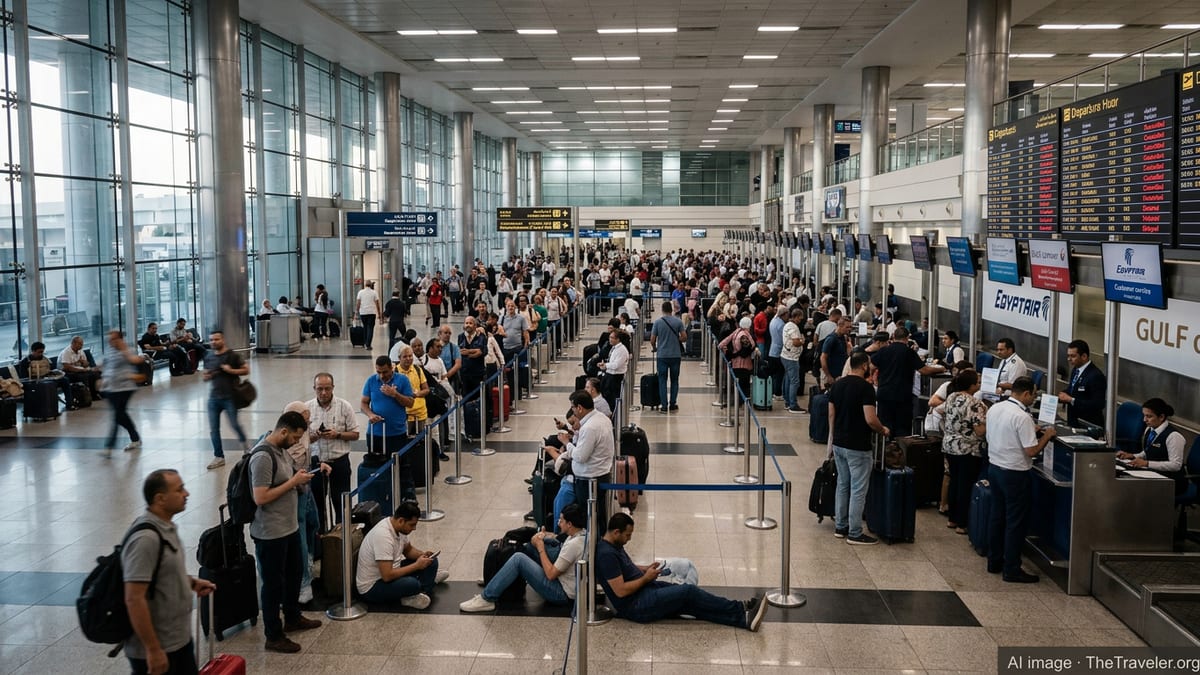
Hundreds of passengers were left stranded at Cairo International Airport on Friday after EgyptAir, Qatar Airways, Gulf Air, Jazeera Airways and Emirates collectively suspended or delayed 51 flights, disrupting major routes to Doha, Dubai, Beirut, Dammam, Abu Dhabi and other Gulf and Levant hubs amid a widening regional airspace crisis.
Regional Conflict Triggers Sudden Wave of Cancellations
The latest disruption in Cairo comes as conflict-linked airspace closures ripple across the Middle East, forcing airlines to ground or reroute services at short notice. Since joint United States and Israeli strikes on Iran on February 28 and subsequent retaliatory attacks, authorities in several Gulf states have restricted or closed their skies, choking off key corridors that normally connect Europe, Africa and Asia through the region.
EgyptAir, the Egyptian flag carrier, confirmed that services from Cairo to multiple regional cities remain suspended or heavily reduced, listing Dubai, Abu Dhabi, Sharjah, Beirut, Doha, Amman, Dammam, Bahrain, Baghdad, Erbil and Kuwait among the affected destinations. While the airline has begun a gradual return of some flights to Dubai and Dammam, it warned that schedules will remain volatile and subject to last minute changes as neighboring countries maintain tight controls over their airspace.
Foreign carriers that usually operate dense schedules into Cairo have also trimmed operations sharply. Qatar Airways has kept regular passenger services to and from Doha largely suspended, operating only limited relief flights as conditions permit. Gulf Air, Jazeera Airways and Emirates have cancelled rotations linking Cairo with Bahrain, Kuwait and Dubai, focusing instead on repatriation-style flights and essential connections as regional hub airports struggle to reopen.
Airport officials in Cairo said the suspension and severe delay of 51 flights over a 24 hour period was directly tied to these airspace restrictions, noting that many outbound services could not secure safe, approved routings across neighboring territories. Incoming flights from the Gulf and Levant, meanwhile, often turned back or diverted en route once new closure notices were issued.
Long Lines, Full Waiting Areas and Confused Passengers
Inside Cairo International Airport’s Terminal 3, the impact was immediately visible. Departure halls filled with travelers queuing at airline counters in search of information, while families stretched out on luggage trolleys and improvised bedding along the concourses. Overhead screens showed waves of red "cancelled" and "delayed" indicators next to flights bound for Doha, Dubai, Beirut and Dammam.
Passengers reported receiving late night messages that their flights were postponed indefinitely, followed by further notifications that services had been scrubbed entirely. For many, Cairo was meant to be a brief transfer point on long-haul journeys between Europe or North America and onward destinations in the Gulf, South Asia or East Africa. Instead, they found themselves unexpectedly stuck, sometimes with expired transit visas or limited local currency.
Airport staff, speaking on condition of anonymity because they were not authorized to brief the media, described a difficult balancing act between managing crowding, providing updates and coordinating with airline operations teams who themselves were waiting on new airspace guidance. One ground agent said that flight plans had been repeatedly rewritten over the course of the morning as neighboring states issued fresh notices restricting overflights at different altitudes and time windows.
Despite the disruption, airport security and basic services continued to function, with additional staff deployed to manage queues and guide foreign travelers to information desks. However, the prolonged uncertainty around departure times and destinations has heightened frustration, particularly among those with onward connections and fixed commitments in the Gulf.
Airlines Offer Waivers but Rerouting Options Are Limited
Airlines affected by the Cairo cancellations have introduced temporary flexibility measures to ease the burden on travelers. EgyptAir has allowed passengers booked on suspended regional routes to rebook without change fees for travel dates through mid March, subject to availability. Emirates and Gulf Air have similarly offered free date changes or refunds on impacted services, prioritizing customers whose journeys were interrupted mid-trip.
Yet finding alternative seats has proved challenging. With Dubai, Doha and Abu Dhabi all operating on significantly reduced schedules, the usual network of onward connections out of the Gulf has been sharply curtailed. Carriers that still have access to relatively open airspace, such as those based in Turkey or Oman, are running near-capacity as travelers attempt to route around the closures via Istanbul or Muscat.
In Cairo, airline staff have been advising some passengers bound for the Gulf to consider flying instead to cities in Europe, East Africa or Turkey, then continuing to their final destinations once regional airspace reopens. This patchwork of options, however, is often expensive and time consuming, and may not be feasible for travelers on tight budgets or short visas.
Travel agents say that the complexity of current routings means even experienced bookers are struggling to keep up. Fares on remaining open corridors have surged, and some carriers have quietly restricted new ticket sales on near term departures to ensure that stranded customers receive priority for any newly available seats.
Safety Concerns Drive Prolonged Airspace Closures
Behind the scenes, aviation regulators and airlines insist that safety considerations are shaping every decision. The swift closure of airspace over parts of Iran, Iraq, Kuwait, Qatar and sections of the United Arab Emirates in late February followed radar detections of missile and drone activity associated with the expanding conflict. Commercial airlines, which typically cruise along high altitude corridors passing through these countries, faced unacceptable levels of risk from debris or misidentification during active military operations.
Authorities have since issued a series of rolling notices to airmen that restrict flights along certain routes and altitudes, forcing carriers either to cancel services entirely or to adopt longer detours that add hours of flying time and increase fuel consumption. For some regional flights out of Cairo, particularly those to Doha, Dubai, Abu Dhabi and Dammam, the available safe corridors have narrowed to the point that operating regular commercial services is no longer viable.
Industry analysts note that Egypt has, to date, kept its own airspace open, allowing Cairo to serve as a fallback hub for some international traffic seeking to avoid the Gulf. But with so many onward destinations from Cairo now off the map or reachable only via complex detours, the airport’s traditional role as a dependable connecting point between continents has been severely tested.
Insurance requirements have also played a part in the prolonged shutdown. Many global underwriters will not cover aircraft flying close to active conflict zones, effectively compelling airlines to stay grounded even when national regulators stop short of formally banning operations.
Travelers Urged to Delay Nonessential Trips and Stay Flexible
With no clear timeline for a full restoration of normal schedules, travel authorities and airlines are urging passengers to postpone nonessential journeys through the region. Those who must transit Cairo or other Middle Eastern hubs are being advised to maintain flexible itineraries, allow for extended layovers and check flight status repeatedly in the hours before departure.
At Cairo International Airport, public announcements throughout the day reminded travelers not to come to the terminal unless they had a confirmed booking and had been instructed by their airline to proceed. Local hotels near the airport reported a surge in last minute bookings from stranded passengers, while some embassies set up help desks in the arrivals area to assist citizens in finding safe onward routes.
For now, the suspension and delay of dozens of flights by EgyptAir, Qatar Airways, Gulf Air, Jazeera Airways and Emirates underscores how quickly regional instability can paralyze air travel networks that millions rely on each year. Until airspace over key Gulf and Levant states is fully reopened and deemed safe, Cairo’s stranded travelers are likely to remain a visible symbol of a crisis stretching far beyond any single airport.