


More news on this day
Passengers in Tamil Nadu are set to gain more rail choices as the Railway Board and Southern Railway roll out new services, convert select routes into daily operations and approve additional stoppages across the state, widening access to both long-distance and regional destinations.
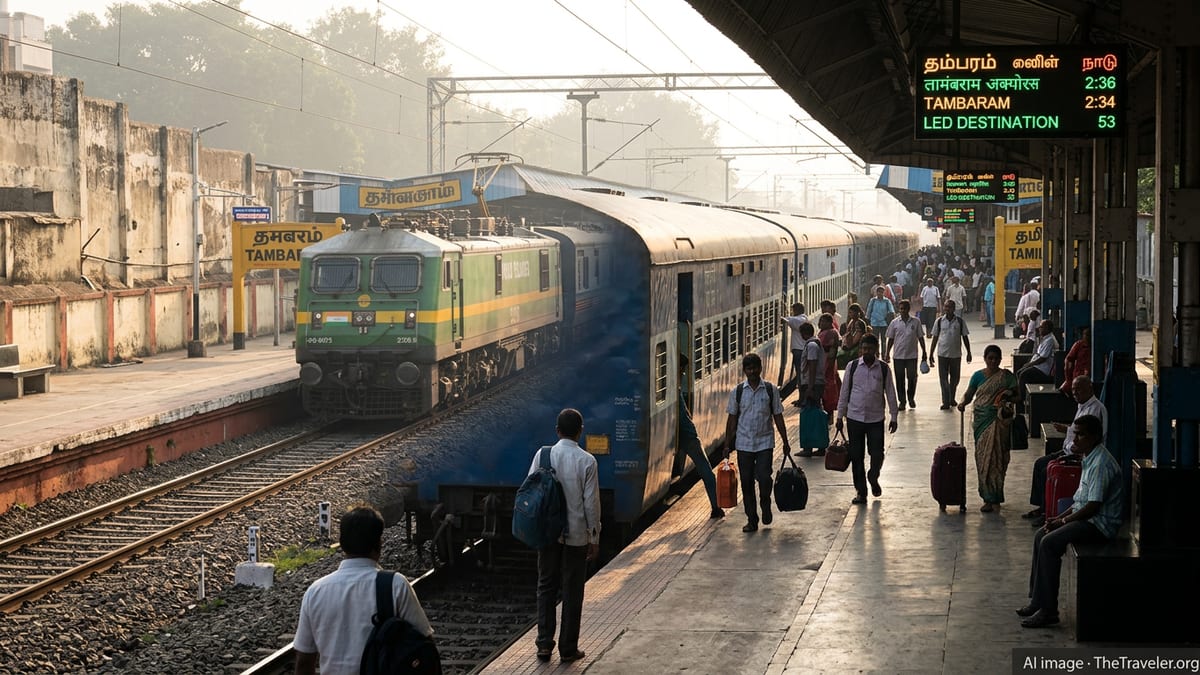
Railway Board Clears Wave of New Stoppages Across the State
The Railway Board has recently approved additional stoppages for 35 trains across Tamil Nadu, a move aimed at improving last-mile connectivity for suburbs and smaller towns that sit along busy main lines. Railway officials said orders have been issued and zonal authorities will notify the implementation dates once operational planning is complete, signaling that passengers can expect phased changes over the coming weeks.
Among the most closely watched changes are new halts for popular intercity services at emerging suburban hubs. In North Chennai, Wimco Nagar, which already enjoys a Metro connection, is due to gain scheduled stops for key express and passenger services, including the Chennai–Vijayawada Pinakini Express and the Vijayawada Jan Shatabdi. The additions are expected to ease crowding at central city terminals by allowing more commuters to board and alight closer to home.
The wider package of stoppage approvals spans routes linking Chennai with important regional centers such as Tiruchirappalli, Madurai and Tirunelveli, as well as trains that cross Tamil Nadu en route to Andhra Pradesh, Odisha and West Bengal. Transport analysts say the strategy reflects a push to maximize the utility of existing trains rather than relying solely on new services to meet rising demand.
For passengers, the practical impact will be shorter road journeys to the nearest station and more choice of departure and arrival points when planning trips. For the network, officials hope better-distributed boarding patterns will smooth peak-time pressure on major junctions and improve overall punctuality.
New Daily and Regularised Services Strengthen Core Corridors
Alongside new halts, Southern Railway has been moving to regularise and increase the frequency of key routes that had previously run as special or limited-day trains. In its latest timetable revision, eight new trains have been introduced across the zone, with several special services converted into regular operations to provide predictable, year-round connectivity for both commuters and long-distance travelers.
Recent years have seen a proliferation of seasonal and festival specials on Tamil Nadu routes, particularly around Pongal and summer holidays. While these trains provide short-term relief, they often come with lower operational priority and less certainty for passengers. The current policy trend, outlined in internal planning documents and public timetable notes, is to identify consistently popular specials and upgrade them into permanent entries in the working timetable.
This regularisation drive is especially visible on corridors radiating from Chennai’s expanding suburban hubs, such as Tambaram. Here, special services that once ran only on peak days have been reworked as daily or near-daily express trains, filling gaps in morning and evening connectivity and giving passengers more evenly spaced options across the day.
Railway planners argue that daily, clock-face services are easier for passengers to remember and plan around, and they allow railways to optimise crew deployment and rake utilisation. For Tamil Nadu’s growing commuter belts on the Chennai–Tiruchirappalli and Chennai–Madurai axes, the shift from sporadic specials to regular daily trains is emerging as a defining feature of the new timetable.
Tambaram Emerges as a Strategic Launchpad for New Routes
Tambaram, Chennai’s third major rail terminal, continues to cement its role as a gateway for southern and eastern Tamil Nadu. In the past year, it has become the origin point for several new express services, easing congestion at Chennai Egmore and Chennai Central while providing direct departures for fast-growing suburbs in the city’s south.
One of the most notable additions is the Tambaram–Rameswaram Express, which was approved by the Railway Ministry with a view to boosting connectivity to the pilgrim island and supporting coastal tourism. Launched in April 2025, the train offers a direct link via important intermediate hubs such as Chidambaram, Thiruvarur and Thiruthuraipoondi, towns that previously had limited through services to Rameswaram.
The route has quickly become popular with both pilgrims and leisure travelers, who now enjoy an additional long-distance option without having to route through the busier Chennai Egmore terminal. Local business groups along the delta belt have also welcomed the service, pointing to easier access for visitors and improved logistics for small enterprises that rely on overnight passenger and parcel traffic.
Tambaram’s growing portfolio now spans conventional express services, new Amrit Bharat Express routes and special trains adjusted to match festival and weekend peaks. With ongoing track and signalling upgrades on the Tambaram–Tiruchirappalli main line and improved yard capacity, officials say the terminal is well placed to handle further route introductions and frequency increases in the coming timetable cycles.
Timetable 2026: Faster Trains and More Consistent Connectivity
The new Southern Railway timetable that came into force on January 1, 2026, has reshaped how core services run across Tamil Nadu, combining additional routes and stops with faster timings. Around 65 Mail, Express and Superfast trains have been accelerated, with journey times trimmed by up to 15 minutes on some of the state’s busiest sectors.
Flagship services such as the Chennai–Tirupati Saptagiri Express, the Chennai Central–Hazrat Nizamuddin Rajdhani Express and the Chennai–Delhi Duronto Express are among those to benefit, reflecting infrastructure upgrades and improved pathing across the network. While individual time savings may appear modest, the cumulative effect is expected to free up paths, improve punctuality and create room for new services on saturated corridors.
The timetable also formalises eight new trains across Southern Railway, some of which touch or originate in Tamil Nadu, including additional long-distance pairs linking the state to the eastern and northern regions. Paired with the Railway Board’s approval of dozens of new halts, the net result is a denser service pattern that offers more boarding points without dramatically extending overall run times.
Passenger groups have cautiously welcomed the changes, noting that consistent timetables and realistic speeds are at least as important as headline journey-time cuts. The coming months will provide the first real-world test of whether the new schedule can balance higher throughput with the reliability that daily commuters and long-distance travelers increasingly expect.
New Long-distance Links Expand Reach Beyond Tamil Nadu
Beyond intrastate connectivity, Tamil Nadu passengers are also seeing gains on long-distance routes as the Railway Board rolls out a new generation of non-AC superfast and Amrit Bharat Express services. These trains are designed to connect distant corners of the country with limited halts, offering faster travel for budget-conscious passengers who might otherwise rely on multiple connections.
From Tamil Nadu, recently introduced Amrit Bharat services now link cities such as Nagercoil and Tiruchirappalli with New Jalpaiguri in North Bengal, traversing Andhra Pradesh, Odisha, Jharkhand and Bihar en route. Another new corridor connects Tambaram with Thiruvananthapuram Central, strengthening ties between southern Tamil Nadu and Kerala while providing additional capacity on an already busy coastal axis.
Railway officials say Tamil Nadu’s share of these new long-distance services reflects both the state’s strong demand profile and recent investments in track doubling, electrification and signalling along key freight and passenger routes. The introduction of limited-stop, superfast trains is also seen as a way to relieve pressure on older express services that have become heavily oversubscribed, particularly during festival seasons and school holidays.
For travelers, the proliferation of new routes, daily services and additional stops is gradually translating into a more flexible rail network. With further timetable tweaks and infrastructure projects already in the pipeline, Tamil Nadu’s rail passengers can expect an even wider menu of options in the coming years, from suburban commutes to cross-country journeys.