


More news on this day
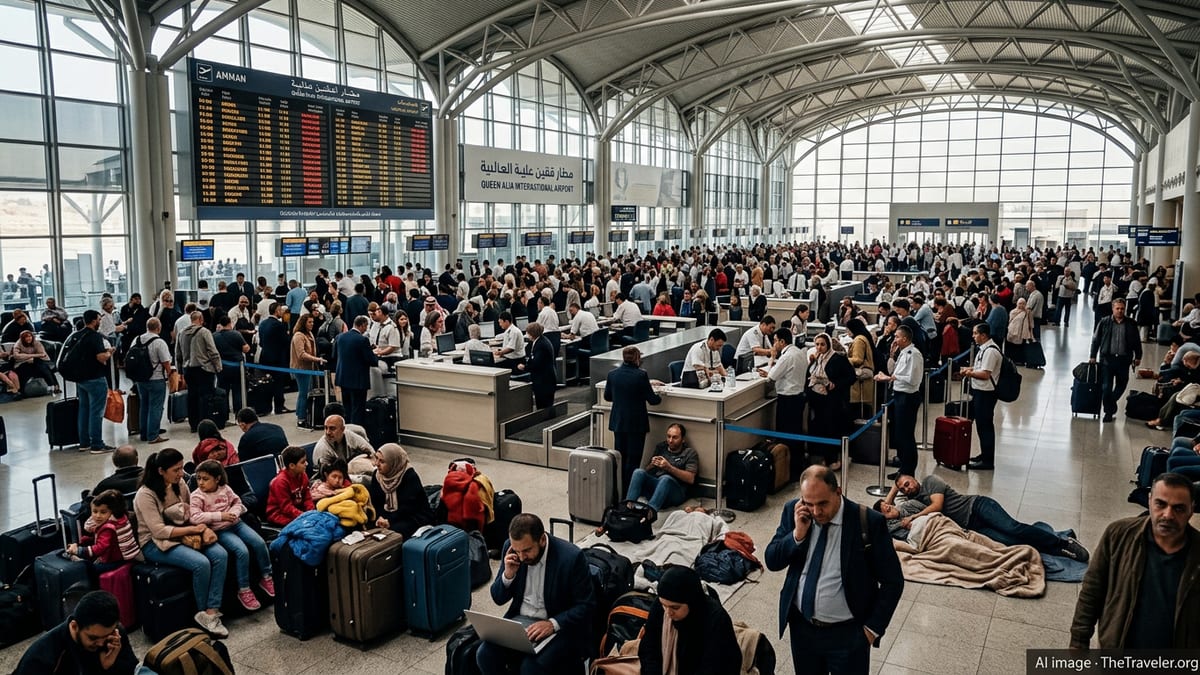
Hundreds of passengers were left stranded at Jordan’s Queen Alia International Airport on Saturday as conflict-driven airspace restrictions triggered 45 flight cancellations and 14 significant delays, snarling operations for Royal Jordanian, Qatar Airways, Oman Air, EgyptAir, Buzz and other carriers amid escalating US-Israel strikes on Iran and heightened Middle East security fears.
Partial Airspace Closures Snarl Jordan’s Main Gateway
The disruption in Amman follows days of rolling airspace closures across the region after coordinated US and Israeli strikes on Iran in late February and subsequent Iranian attacks on Gulf states. Jordan’s Civil Aviation Regulatory Commission initially imposed an overnight closure of national airspace from the evening of March 2, halting inbound, outbound and transit flights for extended night-time windows as a precaution tied to conflict risk assessments.
Although authorities moved this week to reopen Jordanian airspace during daytime and gradually restore normal schedules, operations at Queen Alia remain fragile. Airport staff reported that Saturday’s cancellations and delays were heavily concentrated on routes crossing or bordering conflict-affected airspace, with some aircraft unable to secure safe overflight corridors in time to operate.
Royal Jordanian, based in Amman and reliant on Queen Alia as its primary hub, has been forced to repeatedly adjust schedules as neighboring countries restrict or close airspace. Routes to Gulf hubs and parts of the Levant have been among the most affected, turning what is normally a smoothly choreographed bank of connections into a patchwork of last-minute changes, rolling delays and outright cancellations.
Other regional and European low-cost carriers using Amman as a secondary gateway reported similar pressure. Buzz, a budget operator serving Jordan from Europe, saw rotations disrupted when overnight airspace closures forced aircraft to remain out of position, feeding into Saturday’s wave of cancellations as crews and equipment could not be realigned quickly enough.
Regional Conflict Cascades Across Airline Networks
The turmoil at Queen Alia is one part of a wider aviation shock sweeping the Middle East as the conflict between the US-Israel alliance and Iran spills into civilian airspace. Key Gulf and Levantine hubs have experienced mass cancellations, reroutings and temporary suspensions of scheduled services, sharply reducing the options for travelers trying to reach or transit the region.
Airlines such as Qatar Airways, Oman Air and EgyptAir, all of which typically operate multiple daily services into Amman or rely on it for feed traffic, have been forced to trim or suspend flights on select routes. Safety-driven decisions to avoid large swathes of airspace over Iran, Iraq, parts of the Gulf and the eastern Mediterranean have turned standard point-to-point flights into circuitous journeys, sometimes too long or complex to operate within crew duty and fuel constraints.
Industry analysts say that even when Jordan’s own skies are technically open, the country is exposed to knock-on effects from closures elsewhere. If Doha, Dubai, Riyadh or major European gateways reduce frequencies, the carefully timed connection patterns that make regional itineraries viable begin to break down. Airlines then consolidate passengers onto fewer flights, leaving gaps in the schedule that show up at Queen Alia as cancellations, rolling delays or aircraft arriving without onward connections.
The end result for travelers is uncertainty at every stage. Even passengers whose flights operate as scheduled often find their onward legs disrupted by restrictions far from Amman, extending journey times and complicating rebooking as alternative routes also fill up or face operational limits.
Travelers Face Long Waits, Limited Options and Mounting Costs
Inside Queen Alia’s terminals, the operational statistics translate into long queues at check-in and transfer desks, crowded gate areas and nervous travelers glued to departure boards that refresh with little warning. Families returning from holidays, business travelers on tight schedules and migrant workers heading back to jobs in the Gulf have all found themselves unexpectedly stranded in Amman.
Airport staff and airline ground agents spent much of Saturday trying to juggle hotel allocations, meal vouchers and rebookings as more flights dropped off the board. With many nearby hubs also curtailing operations, options to reroute passengers on the same day were limited, forcing some to accept multi-day waits in Amman or to consider complex itineraries through secondary European or North African airports.
Travelers reported confusion over which flights were likely to operate, as airlines adjusted schedules in line with rapidly changing risk assessments. In several cases, aircraft were positioned and boarding prepared before last-minute updates on airspace availability forced cancellations, adding to passenger frustration as plans repeatedly shifted.
For those without flexible tickets or comprehensive travel insurance, the financial impact is mounting. Extra nights in hotels, additional meals, new ground transport arrangements and, in some cases, the need to purchase entirely new tickets on different airlines have quickly consumed personal budgets. Some travelers have described pooling resources with fellow passengers to share accommodation or taxis into Amman while awaiting news of replacement flights.
Airlines and Authorities Walk Safety Tightrope
Jordanian aviation officials insist that safety remains the overriding priority as they calibrate restrictions in line with the evolving security picture. Regulators are monitoring regional missile and drone activity, military operations and intelligence assessments before authorizing civilian flight paths, a process that can trigger sudden route closures when risk thresholds are exceeded.
Airlines operating through Amman have echoed that stance, stressing that rerouting or cancelling flights is preferable to exposing passengers and crews to potential threats. Carriers including Royal Jordanian, Qatar Airways, Oman Air and EgyptAir have issued repeated advisories urging passengers to check flight status before travelling to the airport and to ensure contact details in bookings are up to date so that alerts can be delivered quickly.
Operational planners are working overnight to rebuild schedules day by day, modelling various contingency routes that would skirt conflict zones while still allowing for commercially viable services. In practice, however, limited available airspace has created bottlenecks in already busy corridors, with air traffic control restrictions and slot constraints further shrinking the number of flights that can safely operate.
Industry observers warn that as long as the military confrontation between the US-Israel alliance and Iran continues, airlines will have to maintain this cautious posture. Even a single incident involving civilian aircraft in contested airspace would have grave implications, a reality that reinforces the bias toward conservative route planning and frequent, disruptive last-minute changes.
What Stranded Passengers in Amman Can Do Now
With cancellations and delays at Queen Alia likely to persist as the regional crisis unfolds, travel experts urge affected passengers to take proactive steps. The most important is to remain in close contact with airlines via official apps, call centers and airport service desks and to avoid heading to the terminal without a confirmed, operating flight.
Passengers holding tickets on disrupted services are typically being offered free date changes or, in some cases, refunds or alternative routings. Those who can be flexible on destinations may find it easier to secure a seat out of the region by accepting a different European or Asian gateway and purchasing separate onward connections from there, rather than waiting for their original itinerary to resume.
Travelers are also advised to keep detailed records of disruption, including boarding passes, delay notifications and receipts for hotels, meals and local transport. These documents can support later claims with airlines or travel insurers once immediate onward travel is secured.
For now, Queen Alia remains open but strained, a critical yet vulnerable node in a regional aviation system unsettled by conflict. Until there is a sustained easing of military tension and a coordinated reopening of airspace across the Middle East, passengers in Amman and beyond should brace for more days of uncertainty in the skies.