


More news on this day
Air passengers across Canada faced a day of mounting disruption as 179 flights were cancelled and at least 403 were delayed at major airports including Calgary, Montreal, Toronto, Quebec City, Vancouver, and Winnipeg, affecting operations at Air Canada, WestJet, Porter, Air Transat, and several smaller carriers.
Get the latest news straight to your inbox!
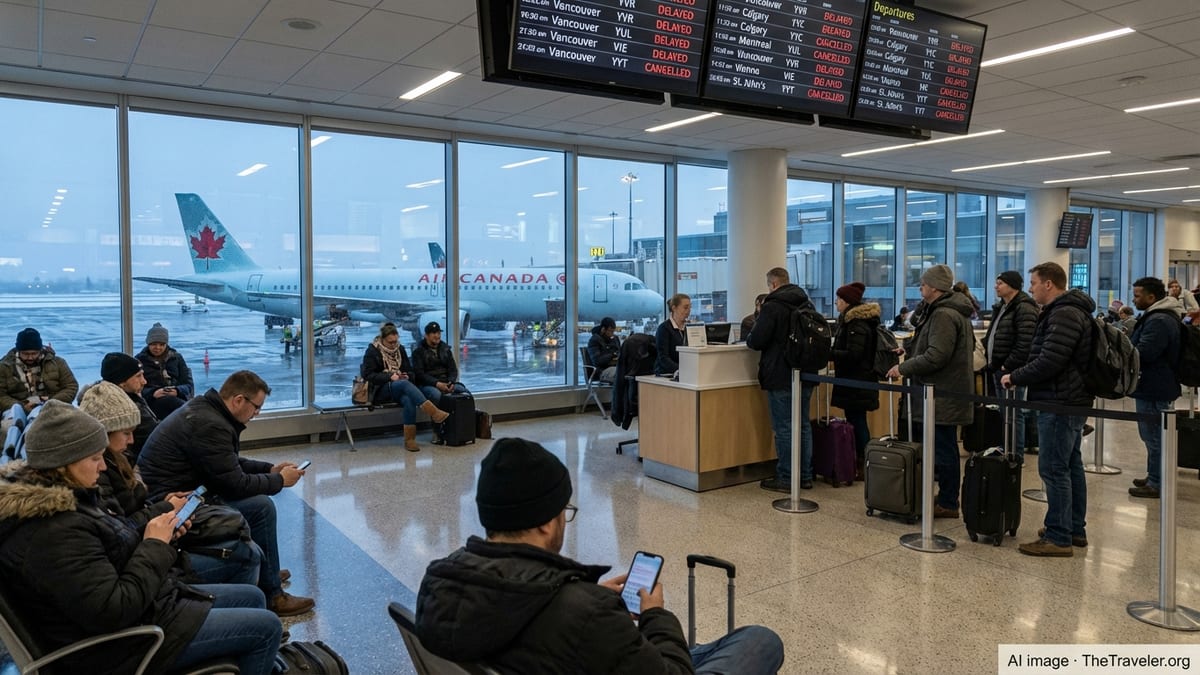
Nationwide Disruptions Hit Canada’s Busiest Airports
Publicly available flight-tracking data and operational summaries show that Canada’s major hubs spent much of the day grappling with cascading delays and cancellations. Toronto Pearson, Montreal Trudeau, Vancouver International, Calgary International, Winnipeg Richardson, and Quebec City Jean Lesage all reported elevated disruption, with dozens of departures and arrivals either scrubbed or running hours behind schedule.
The bulk of the impact fell on Toronto, Montreal, and Vancouver, which serve as primary connection points for both domestic and transborder routes. When early departures from these hubs failed to leave on time, knock-on effects quickly rippled to secondary cities such as Winnipeg and Quebec City, where aircraft and crews scheduled to operate later flights simply did not arrive as planned.
Operations at Calgary and Winnipeg appeared particularly vulnerable to these network effects, as both airports handle a blend of Western Canada links, cross-country flights, and U.S. services. Even where cancellations remained limited, rolling delays altered departure banks and forced airlines to compress turnaround times, driving further schedule instability into the afternoon and evening peaks.
Regional centers and smaller fields feeding into the main hubs also felt the turbulence. As aircraft were held at or rerouted to major airports, feeder flights were trimmed or rescheduled, leaving some travelers facing lengthy waits for rebooked services or overnight stays before a replacement departure could be found.
Air Canada, WestJet, Porter and Air Transat Bear the Brunt
The disruption figures indicate that Canada’s largest carriers absorbed most of the operational shock. Air Canada and its regional partners, which carry the highest share of the country’s domestic and international traffic, saw widespread schedule changes across Toronto, Montreal, Vancouver, and Calgary, with additional knock-on effects in Ottawa, Halifax, Quebec City, and Winnipeg.
WestJet, with a strong presence in Calgary, Vancouver, and smaller Western markets, also contended with a mix of cancellations and late-running flights. Previous weeks have already seen the airline adapting its network, including decisions to trim or consolidate some routes, and today’s irregular operations added fresh pressure on already-tight summer schedules.
Porter Airlines, which has rapidly expanded from its Toronto City Centre base into new jet services from Toronto Pearson and Ottawa, reported clusters of delays and cancellations on short-haul business and leisure routes. Air Transat, which focuses heavily on leisure and transatlantic markets from Montreal and Toronto, encountered schedule revisions that affected both outbound vacationers and inbound returning travelers heading on to domestic connections.
Smaller carriers and regional operators were not spared. Data compiled from recent Canadian disruption events shows that when major airlines re-time or cancel flights at the hubs, regional partners can face aircraft and crew imbalances, forcing their own cancellations even on routes with strong demand and no local weather problems.
Weather, Congestion, and Operational Strain Combine
While precise reasons vary flight by flight, available reports point to a familiar mix of factors feeding into today’s problems. Seasonal weather patterns have periodically disrupted Canada’s air network in recent months, with storms, low visibility, and strong winds triggering ground holds and runway flow restrictions at several key airports.
Even when conditions clear, airports often need hours to unwind backlogs of aircraft waiting for gates, de-icing, or departure slots. That can lead to situations where flights are technically able to operate but no longer fit into the schedule in a way that keeps crews within duty limits or ensures connections for the majority of passengers, prompting airlines to consolidate services or cancel individual rotations.
Operational strain is another recurring theme across recent Canadian travel days. Airlines have been contending with crew shortages on certain fleets, tighter maintenance buffers, and high summer demand that leaves little slack in the system. When combined with longer security and border-processing queues at peak times, even modest early-morning delays can snowball into widespread afternoon disruption.
Industry data from previous disruption days this spring and early summer shows that once cancellations and delays surpass a few hundred flights nationally, recovery often stretches well into the next operating day. That pattern appears to be repeating, with late-evening departures from Toronto, Montreal, and Vancouver shouldering the task of repositioning aircraft and crews for tomorrow’s schedule.
Passengers Face Missed Connections and Overflowing Customer Lines
For travelers, the immediate impact of today’s disruption was felt in crowded departure halls, rebooking lines, and online queues for customer support. With 179 cancellations on the board, many passengers confronted the prospect of overnight stays or multiday detours, particularly those relying on connections through Toronto, Montreal, or Vancouver to reach smaller communities.
Reports from prior disruption days suggest that travelers on complex itineraries, including multi-stop international journeys, are often among the hardest hit. When a single domestic segment is cancelled or pushed several hours late, onward long-haul flights can depart without them, triggering costly reissues and extended layovers in unfamiliar cities.
At the airport level, large volumes of delayed departures can also strain basic services. Seating, food outlets, and hotel shuttles all face surges in demand as passengers remain airside far longer than planned. Families traveling with children and those with mobility or medical needs can find these extended waits particularly challenging, especially when information about new departure times changes repeatedly throughout the day.
Online tools and airline apps have become critical for many travelers trying to navigate this kind of disruption. However, on days when several hundred flights are affected across multiple airlines, booking systems, call centers, and chat services often operate at or beyond their usual capacity, slowing down the process of finding alternative arrangements.
Know Your Rights Under Canada’s Airline Regulations
Today’s events once again highlight the importance of understanding passenger protections under Canada’s Air Passenger Protection Regulations. These rules set out what airlines must provide in cases of delay and cancellation, although compensation depends heavily on whether a disruption is considered within an airline’s control, within its control but required for safety, or entirely outside its control.
If a cancellation or long delay is within the airline’s control and not strictly safety-related, passengers may be entitled to meal vouchers, hotel accommodation, and financial compensation once certain thresholds are reached. For larger airlines, those compensation amounts can increase depending on the length of the delay at arrival and the distance of the journey.
Where disruptions are linked to severe weather, air traffic control restrictions, or other factors categorized as outside an airline’s control, passengers are typically still owed rebooking or a refund for unused portions of their trip, but not financial compensation. In these situations, travelers are encouraged to keep receipts for additional expenses and to review the terms of any travel insurance that might help cover hotels, meals, or missed events.
Consumer advocates regularly advise passengers to document the reason codes listed on their flight and to save any written notifications from airlines, as these details can be important when filing claims later. With cancellation and delay statistics once again spiking across Canada’s major hubs, many travelers will be turning to those regulations and policies in the coming days as they seek redress for disrupted journeys.