


Airport lounge access has become one of the headline perks of premium travel credit cards, and Capital One is now firmly in that game. With upscale Capital One Lounges, new Capital One Landing locations and bundled Priority Pass access, the bank has built a serious network of options. But the rules and fees changed significantly in 2026, especially for guests and authorized users, which means the value math looks very different than it did a few years ago. Understanding exactly what you will pay at the door is the key to knowing whether Capital One lounge access is still worth it for your style of travel.
Get the latest updates straight to your inbox!
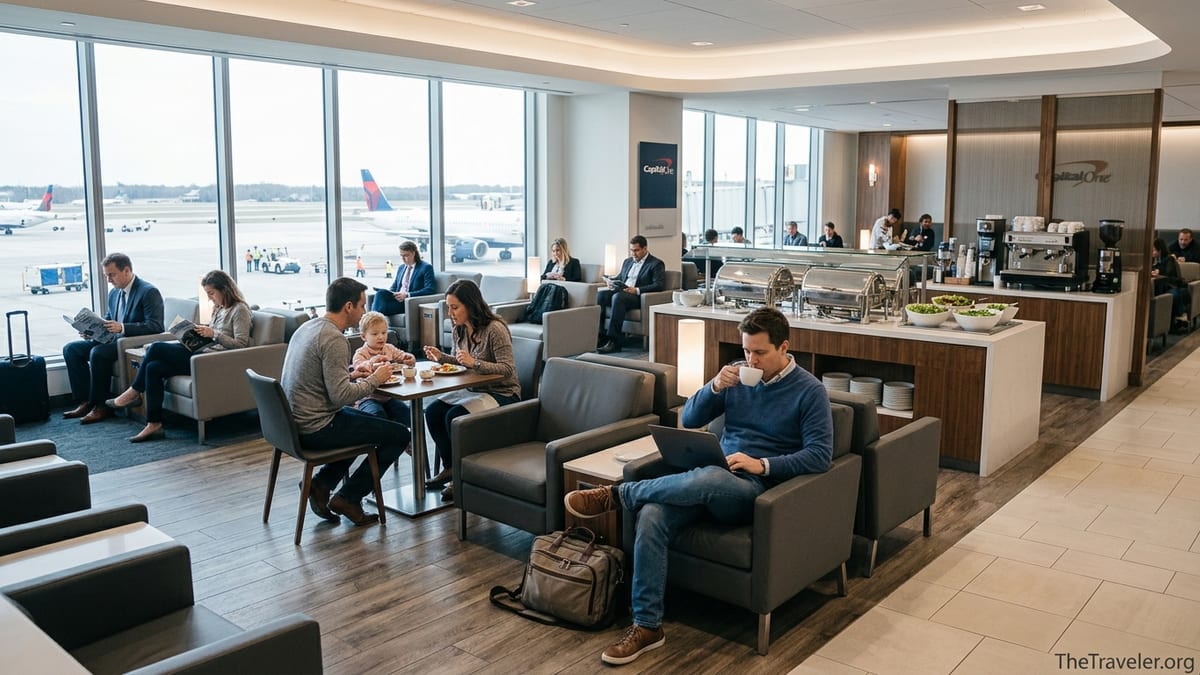
How Capital One Lounge Access Works in 2026
Capital One lounge access today revolves around a few specific cards rather than being available across the entire portfolio. In practical terms, the Capital One Venture X Rewards Credit Card and the Capital One Venture X Business card are the primary products that unlock complimentary entry to Capital One Lounges, Capital One Landing locations and the Priority Pass airport lounge network for the primary cardholder. Other travel cards from the bank, such as the Capital One Venture Rewards and Spark Miles cards, can still get you in the door, but usually at a discounted per-visit rate rather than free access for every trip.
In 2026, Capital One updated its policies so that the primary Venture X cardholder still enjoys unlimited complimentary access to Capital One Lounges and Landings, plus a Priority Pass membership for themselves. However, automatic free access for guests and authorized users effectively disappeared. Instead of simply walking in with your partner and two kids on the same card, you now face clearly stated per-visit fees for each additional person unless you hit very high annual spending thresholds or pay for separate lounge privileges for authorized users.
For travelers who remember the early days of the Venture X card, this is a meaningful shift. When the product launched, one of its biggest selling points was that your whole immediate family could typically come in at no extra cost. Families planning a trip through Dallas Fort Worth or Washington Dulles, for example, frequently used the card to get two adults and several children into a Capital One Lounge for free. Today, that same visit often involves a calculated decision about whether paying guest fees makes sense compared with grabbing a meal in the terminal or skipping the lounge altogether.
Because these rules now vary based on card type and spending, the value of lounge access is much more personal. A solo traveler flying 10 or more times per year may still see enormous value in free entry. A couple traveling together quarterly, on the other hand, may be more sensitive to the new guest fees and need to run the numbers carefully before relying on lounge access as a central part of their travel routine.
Capital One Lounge & Landing Fees: What You Actually Pay
The headline figure that many travelers encounter is the standard pay-in fee to access a Capital One Lounge without qualifying complimentary access. As of mid-2026, walk-up entry for non-qualifying guests is typically around 90 dollars per person, per visit. That rate applies whether or not you hold a Capital One card, and it is broadly in line with what some other premium lounges charge for one-time passes. For example, a couple traveling through Dallas Fort Worth without a qualifying card would expect to pay roughly 180 dollars in total if both want to spend a few hours in the lounge before a long-haul flight.
For Venture X and Venture X Business primary cardholders, the numbers look different. Your own entry into Capital One Lounges and Landings remains complimentary, but guest fees now start at about 45 dollars per adult per visit and 25 dollars per child aged 2 to 17, with children under 2 generally admitted free. That means a family of four traveling together where one parent holds the Venture X card might pay around 45 dollars for the spouse, plus 25 dollars each for two school-age children. The total lounge bill of 95 dollars could easily rival what the family would spend on an airport restaurant meal, so it becomes an explicit value comparison instead of a no-brainer perk.
There is also a high-spend path to complimentary guest access. If a primary Venture X or Venture X Business cardholder spends at least 75,000 dollars in a calendar year on the account, Capital One grants the ability to bring up to two complimentary guests into Capital One Lounges and one complimentary guest into Capital One Landing locations per visit. For a road warrior who charges company travel, client dinners and large expenses to their card, meeting that threshold may be realistic. For a typical household primarily using the card for personal spending, 75,000 dollars per year is a very tall order, which means most cardholders will continue to pay guest fees rather than unlock ongoing free entries.
The result is a tiered system: walk-in visitors pay the highest rate, qualifying Capital One travel cardholders pay mid-level discounted guest rates, and only very high-spend Venture X customers enjoy truly complimentary access for themselves plus guests consistently across the year.
Authorized Users, Priority Pass, and Hidden Costs
Another major 2026 change involves authorized users on Venture X accounts. Previously, adding an authorized user such as a spouse or adult child was a simple way to extend full lounge access to them free of charge. Now, Capital One requires primary cardholders to pay an additional annual lounge access fee of about 125 dollars per authorized user to preserve that privilege. Without this add-on, authorized users cannot simply flash their metal card and enter a Capital One Lounge or Landing at no cost.
To understand how this plays out in real life, imagine a household where one partner frequently travels for work and another travels solo a few times a year to visit family. Under the new structure, the primary cardholder might decide to pay the 125 dollar annual fee to give the authorized user their own lounge access rights. If the authorized user then takes, for example, four round-trip journeys per year and uses the lounge on every departure, they might get eight or more visits annually. That works out to something like 15 to 20 dollars in incremental cost per visit, which can be an attractive trade-off compared with paying 45 or 90 dollars every time.
The Priority Pass side of the equation also deserves attention. Venture X and Venture X Business primary cardholders continue to receive a Priority Pass membership that grants them complimentary access to participating lounges worldwide, usually more than a thousand locations. However, complimentary guest privileges attached to that membership have largely been stripped away. Instead of bringing a friend or spouse into a Priority Pass lounge for free, Venture X holders can expect to pay a guest fee that is often around 35 dollars per person, per visit. For a couple making use of Priority Pass in, say, London Heathrow or Singapore Changi, that can add up quickly across multiple connections.
These authorized user and Priority Pass adjustments are especially important for frequent-traveling couples and families. Where once one premium card smoothed the way for everyone, today having two separate Venture X accounts or combining a Venture X with another lounge-rich product like an American Express Platinum or a high-tier airline card may create better coverage with fewer surprise costs. Every household should map out how often each member actually travels alone and together, then compare the 125 dollar authorized user lounge fee, the 35 dollar Priority Pass guest charges and the 45 dollar Capital One Lounge guest fees against their expected usage.
Real-World Value: When the Annual Fee Makes Sense
Beyond day-of-visit fees, the biggest cost consideration is the annual fee on the Venture X itself, which is currently in the mid-300-dollar range. Whether lounge access is “worth it” depends heavily on how you value the other major perks bundled with that fee. The card includes an annual travel credit of around 300 dollars when you book flights or hotels through Capital One Travel, plus an anniversary bonus of thousands of Capital One miles that many travelers roughly equate to at least 100 dollars in value when used thoughtfully for flights or hotel transfers.
Put in simple terms, a frequent traveler who reliably uses the 300 dollar travel credit and the anniversary miles each year can often recoup most or even all of the annual fee before considering any lounge access at all. For example, if you buy a 600 dollar round-trip ticket through Capital One Travel for a summer trip to Europe and receive a 300 dollar statement credit, the net out-of-pocket for that ticket drops to 300 dollars. Add in an anniversary bonus that you later redeem for, say, a 150 dollar domestic flight, and you have effectively received 450 dollars of value for a fee in the mid-300s. In that scenario, any lounge visits you make during the year can reasonably be treated as extra value.
The calculation is less appealing if you do not regularly use the travel portal or are indifferent to rewards. A traveler who almost always buys tickets directly from airlines, rarely uses miles and only flies two or three times per year may find that the travel credit and anniversary miles sit unused. Without those offsets, the annual fee essentially becomes the price you are paying for lounge access, and you should compare that against the realistic number of times you will visit. If you only expect to use a Capital One Lounge twice per year, even a generous assumed value of 50 dollars per visit would not fully justify a mid-300 dollar annual price tag.
It is also critical to factor guest costs into your value math. A business traveler who frequently flies alone and uses lounges ten or more times per year might save hundreds of dollars compared with buying 90 dollar day passes each time. A parent who only travels with family might find that paying 95 dollars in guest fees for every family departure makes each visit marginal at best, particularly if the airport has decent sit-down dining options or the family has free breakfast included at a nearby airport hotel.
Comparing Capital One Lounges With Other Options
Any judgment about whether Capital One lounge access is worth it exists in a competitive context. Major rivals, notably American Express and Chase, each offer their own premium lounge networks plus Priority Pass memberships on flagship cards. The American Express Platinum Card typically carries a significantly higher annual fee than the Venture X but includes Centurion Lounge access, Priority Pass with restaurant benefits on some versions and a wide array of lifestyle credits. Meanwhile, the Chase Sapphire Reserve, with its own high annual fee, unlocks Chase Sapphire Lounges by The Club and Priority Pass access that still includes free guest privileges in many cases.
Capital One has chosen to keep the Venture X annual fee lower than those marquee products but has narrowed guest benefits and tightened authorized user rules to control costs. For a solo traveler based near an airport with a Capital One Lounge, such as Dallas Fort Worth or Washington Dulles, that bargain can still be attractive. You enjoy a premium physical space that many reviewers compare favorably with top-tier lounges, complete with hot buffet meals, espresso drinks, showers and quiet work zones, without paying an 800 to 900 dollar card fee. However, as soon as you introduce frequent guest usage, the gap begins to close as you stack 45 dollar and 35 dollar guest fees onto every itinerary.
Another important dimension is lounge coverage. Capital One’s physical network remains relatively small compared with the hundreds of locations offered through Priority Pass or the growing footprints of Amex Centurion and Chase Sapphire Lounges. If you primarily fly out of airports that do not yet have Capital One-branded lounges, then most of your value comes from Priority Pass. In that case, you should compare the Venture X against cards like the Chase Sapphire Reserve or certain co-branded airline cards that also bundle Priority Pass access, sometimes with more generous guest rules.
Concrete comparisons can be telling. Suppose you live in New York City and frequently depart from Kennedy airport, which offers several different lounge brands. If you hold only the Venture X, you might use the Capital One Lounge in Terminal 4 when flying an eligible airline, paying 45 dollars to bring your partner. If you instead carried an American Express Platinum or Chase Sapphire Reserve, you might benefit from broader network access or different guest policies at Priority Pass or co-branded lounges, albeit with a higher annual fee. The question becomes whether the lower annual fee of the Venture X compensates for the added cost of your partner’s entry over the course of the year.
Is Capital One Lounge Access Worth It for Different Traveler Types?
For heavy solo travelers, Capital One’s current structure still delivers strong value. Imagine a consultant who flies twice a month for work, always on their own. If they visit a Capital One Lounge or a Priority Pass lounge on 20 trips a year, they might assign a personal value of 30 to 40 dollars to each visit, based on complimentary meals, drinks, Wi-Fi and a calm workspace. That yields an annual perceived benefit of 600 to 800 dollars in lounge value alone. Layer in the travel credit and anniversary miles, and the math often becomes compelling, even after considering the annual fee.
For couples who almost always travel together, the equation is more nuanced. Take two partners who take four leisure trips a year, flying out of airports that have Capital One Lounges or Priority Pass facilities most of the time. If they use a Capital One Lounge on each departure, the primary cardholder enters free while paying 45 dollars each time for the partner. That is 180 dollars in guest fees annually on top of the annual fee. If the couple values each lounge visit at about 40 dollars per person, they might see around 320 dollars of subjective value from those four shared visits, but only 140 dollars of that value accrues to the paying guest. In that scenario, adding a 125 dollar lounge access fee for the partner as an authorized user or even getting them their own Venture X might make more sense if their solo or shared travel increases.
Families with children must especially scrutinize their use case. A common pattern is a family of four taking one or two big trips per year. If they use a Capital One Lounge outbound and possibly inbound, they could easily rack up 200 dollars or more in guest and child fees across those journeys. If kids are picky eaters or restless, the premium food and quiet spaces may not feel especially valuable compared with a quick fast-casual meal in the terminal. On the other hand, families who face frequent delays, multi-hour layovers or overnight connections might find the ability to shower, find quiet corners and access decent food to be worth the outlay, at least occasionally.
Finally, small-business owners charging significant expenses to the Venture X Business card can extract strong value if they or their employees travel often. Hitting the 75,000 dollar annual spend threshold is far more realistic for a small consultancy or e-commerce operation than for a typical household. Once unlocked, complimentary guest privileges at Capital One Lounges can transform meet-ups with clients or colleagues in hubs like Dallas or New York into comfortable, cost-effective working sessions that replace expensive airport restaurants and bars. In that context, the adjusted guest rules look less punitive and more like a volume discount for very high-value customers.
The Takeaway
Capital One’s 2026 lounge policy changes have turned what was once a simple, generous perk into a more complex benefit that demands careful evaluation. The primary Venture X cardholder still enjoys strong value in the form of unlimited access to premium Capital One spaces and a robust Priority Pass membership, all packaged with a mid-tier annual fee that many can offset through travel credits and rewards alone. For solo travelers and high-spend business users, that combination remains compelling.
The pain point now lies squarely with guests and authorized users. Per-visit guest fees around 45 dollars for adults, 25 dollars for minors and roughly 35 dollars for Priority Pass guests, combined with a 125 dollar annual lounge access charge for authorized users, mean that couples and families must run the numbers. The walk-up 90 dollar rate for non-cardholders further underscores that these spaces are premium experiences rather than casual add-ons.
Whether Capital One lounge access is worth it for you ultimately depends on how often you travel, how many people you typically bring and how much you truly value a calm, well-catered space in the middle of a chaotic airport. For some, a single annual card fee that unlocks dozens of comfortable layovers will feel like a bargain. For others, especially occasional travelers with companions, the new fee structure may nudge them back toward airport restaurants, priority boarding or alternative premium cards as their preferred way to upgrade the journey.
FAQ
Q1. How much does it cost to enter a Capital One Lounge without a qualifying card?
Walk-up entry for travelers without complimentary access is typically around 90 dollars per person, per visit, making it one of the more expensive day-pass style options in major U.S. airports.
Q2. What guest fees do Venture X cardholders pay at Capital One Lounges?
Primary Venture X cardholders enter for free, but they usually pay about 45 dollars per adult guest and 25 dollars per guest aged 2 to 17, while children under 2 are generally admitted at no charge.
Q3. How does the 75,000 dollar annual spend threshold affect guest access?
When a Venture X or Venture X Business cardholder spends at least 75,000 dollars in a calendar year, they can bring up to two complimentary guests into Capital One Lounges and one complimentary guest into Capital One Landing locations on each visit.
Q4. Do authorized users automatically receive free lounge access on Venture X accounts?
No. As of 2026, authorized users only receive their own complimentary access to Capital One Lounges, Landings and Priority Pass lounges if the primary cardholder pays an additional annual lounge access fee of about 125 dollars for each authorized user.
Q5. Are Priority Pass guest visits still free with the Venture X card?
In most cases, no. Venture X and Venture X Business cardholders can still enter participating Priority Pass lounges at no cost, but they typically pay a guest fee of around 35 dollars per person for any accompanying travelers.
Q6. Do non-premium Capital One cards provide any lounge discounts?
Travel cards such as Capital One Venture Rewards and certain Spark Miles products may allow cardholders to purchase access to Capital One Lounges and Landings at a discounted rate, often around 45 dollars per visit instead of the standard 90 dollar walk-up price.
Q7. How many times per year do I need to visit lounges to justify the Venture X annual fee?
There is no single break-even number, but many travelers find that if they use the included travel credit and anniversary miles and visit lounges at least several times a year, the total value can exceed the mid-300-dollar annual fee, especially for solo travelers.
Q8. Are Capital One Lounges better than typical Priority Pass lounges?
Many reviewers consider Capital One Lounges to be among the more premium experiences in U.S. airports, often featuring higher-quality food, craft coffee, showers and workspaces compared with the average Priority Pass location, though experiences vary by airport.
Q9. Is it worth paying the 125 dollar lounge access fee for an authorized user?
It can be worthwhile if the authorized user travels alone several times per year and would otherwise pay 45 to 90 dollars per visit. If they only fly once or twice annually, paying per visit or sharing other lounge access cards may be more economical.
Q10. Should I get a separate premium card instead of relying solely on Capital One for lounge access?
Frequent travelers may benefit from combining the Venture X with another lounge-rich card, such as a high-end issuer or airline product, to diversify lounge options and guest policies. More casual travelers, however, may find that a single versatile card or occasional paid day passes are sufficient.