


Airport lounges used to feel like a pure win: quiet space, free food and a comfortable seat while everyone else battles it out by the gate. Capital One has leaned hard into that promise with its Venture X cards and a fast growing network of Capital One Lounges, Landings and Priority Pass partnerships. Look closer though, and the picture is more complicated. Between changing guest rules, new spend requirements, crowded lounges and the simple cost of time, that plush armchair and buffet can carry a bigger price tag than most travelers realize.
Get the latest updates straight to your inbox!
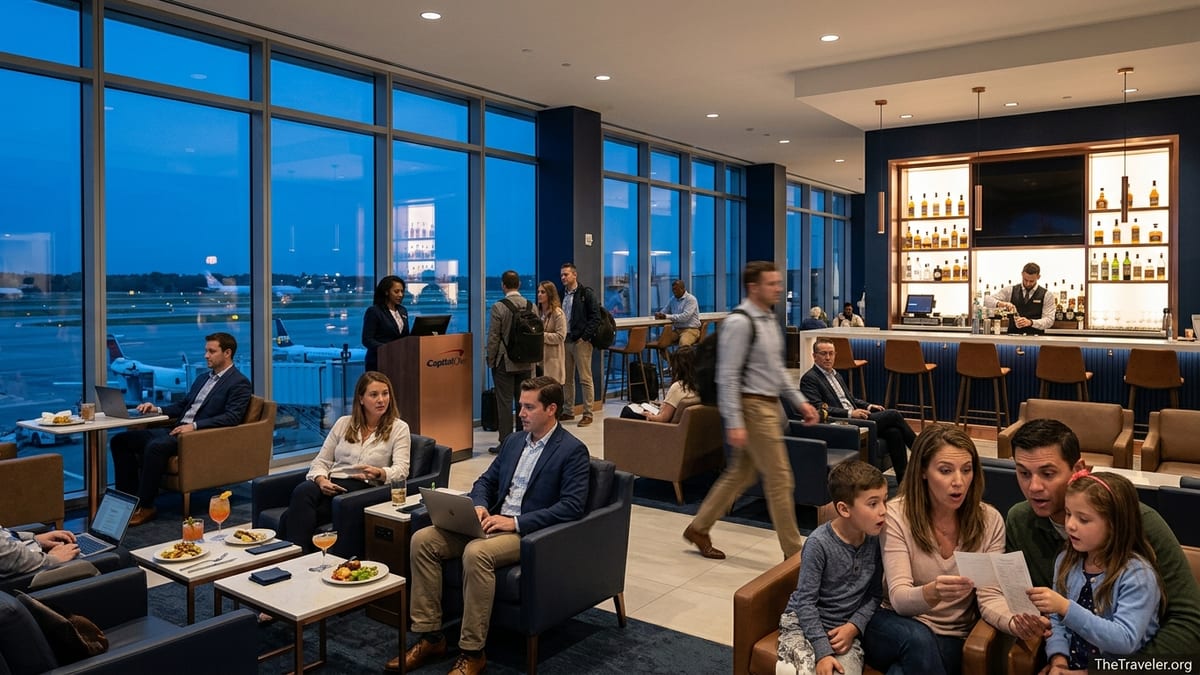
What Capital One Lounge Access Really Includes Today
On paper, Capital One’s premium travel cards look generous. As of mid 2026, primary Capital One Venture X and Venture X Business cardholders can enter Capital One Lounges, Capital One Landings and more than 1,300 Priority Pass locations at no additional fee beyond the card’s annual charge of about 395 dollars. That includes flagship lounges at Dallas Fort Worth, Denver, Las Vegas, New York JFK and Washington Dulles, plus compact Capital One Landing spaces at New York LaGuardia and Washington National.
From a marketing perspective, it sounds like unlimited comfort. In practice, the perk has narrowed over time. Initially, Venture X cardholders could bring two guests into Capital One Lounges and add authorized users who each got their own complimentary lounge access and Priority Pass membership. Over the last couple of years Capital One has steadily rolled that back, citing crowding and a desire to preserve the in lounge experience. Recent policy updates that take full effect on February 1, 2026, now draw a harder line between the primary cardholder’s free access and what everyone else must pay.
The shift mirrors a wider trend in premium travel cards. American Express has tightened guest access for Centurion Lounges and Delta has imposed visit caps on many Sky Club members. Capital One still offers an attractive package for a sub 400 dollar annual fee, but understanding the current fine print is the first step to seeing where the hidden costs start to creep in.
Those costs show up most clearly when you travel with other people, when you rely on authorized users to access lounges, or when you route flights specifically through airports with Capital One facilities. That is where an apparent freebie can begin to drain both your wallet and your travel flexibility.
Guest Fees and the 75,000 Dollar Spend Threshold
The biggest recent change, and the one most likely to surprise travelers, is Capital One’s new spend requirement tied to complimentary guest access. Starting February 1, 2026, primary Venture X and Venture X Business cardholders must spend at least 75,000 dollars on their account in a calendar year to unlock free guest privileges at Capital One locations. If you cross that bar, you can bring up to two guests into a Capital One Lounge and one guest into a Capital One Landing at no extra cost per visit.
If you fall short of that 75,000 dollar threshold, everyone who walks in with you becomes a billable line item. Current guidance indicates guest fees of about 45 dollars per adult and 25 dollars for guests aged 17 and under at Capital One Lounges. Guests at Priority Pass locations accessed via Venture X are expected to be charged around 35 dollars each. Babies and very young children may still enter free, but a typical family of four with two school age children could be looking at roughly 140 dollars in added lounge fees for a single visit at a Capital One Lounge when the primary cardholder has not met the spend requirement.
Imagine a Denver based family flying to Orlando for spring break in March 2026. They hold a single Venture X card that they primarily use for travel and dining, putting about 30,000 dollars a year on it. They arrive at Denver International early and decide to spend an hour in the Capital One Lounge near Concourse A. At check in they discover that the parents are the only ones with complimentary entry. Their two children, ages 9 and 12, will cost 25 dollars each. On the return leg, they repeat the visit. Suddenly their “free” lounge benefit has added about 100 dollars to their vacation. If they stop again at Dallas Fort Worth on a connection, the tab climbs higher.
For solo business travelers, that 75,000 dollar requirement might be achievable with heavy work spend and reimbursable expenses. For many households who took out Venture X because it once offered generous family access, it represents a threshold they will never realistically meet. The hidden cost is not just the occasional 45 dollar guest fee, but the mental math and friction this new policy introduces every time you consider stepping across the lounge doorway with other people in tow.
Authorized Users Are No Longer a Free Shortcut
When Venture X launched in 2021, savvy travelers quickly realized that free authorized users were a powerful multiplier. You could add up to four authorized users at no extra annual fee, each with their own Capital One Lounge access and Priority Pass membership. A couple with two teenagers could give everyone a card, then split up the guest allowance and bring large families or groups into lounges without paying additional fees. Frequent flyer forums are full of old examples where one primary account effectively granted lounge access to six or more people traveling together.
Capital One has now closed that door. Updated policies rolling into effect by early 2026 remove complimentary lounge access for authorized users by default. While you can still add authorized users without an added card fee, their airport lounge perks are no longer automatic. Instead, the primary cardholder must choose to pay a dedicated lounge access fee of approximately 125 dollars per authorized user each year if they want them to have entry privileges to Capital One Lounges, Landings and participating Priority Pass locations.
Consider a common real world scenario. A frequent traveler mom holds the primary Venture X card. Her spouse travels occasionally for work, and their college aged daughter flies between home and school several times a year. Under the old rules she could add both as authorized users for free and know that each of them could stop into lounges independently. Under the new structure, preserving that same benefit level would cost an additional 250 dollars per year in lounge access fees. Combined with the 395 dollar annual fee on the main card, the family would effectively be paying 645 dollars annually just to keep three people lounge eligible, before a single guest fee is charged.
Some families will decide to drop authorized user access and instead rely on the primary cardholder’s presence for lounge admission. That works for trips taken together, but breaks down as soon as a spouse or teenager travels alone. The hidden cost here is not just the optional 125 dollar fee per authorized user, but the loss of flexibility and independence that many cardholders had quietly built into their travel habits.
The Opportunity Cost of Chasing Specific Lounges
There is another layer of cost that rarely shows up in card marketing materials: the routes and schedules travelers choose simply to use their lounge access. Capital One’s lounge network is still relatively small, concentrated in a handful of U.S. airports. As of 2026 you will find full sized lounges at Dallas Fort Worth, Denver, Las Vegas, New York JFK and Washington Dulles, with LaGuardia and Washington National hosting smaller Landings focused on food and drinks rather than full scale amenities.
For many trips, that translates into extra connections or longer layovers. A traveler flying from Kansas City to London might choose to route via Dallas instead of a more direct Chicago or New York connection purely to experience the highly rated Capital One Lounge in Terminal D. That detour could add hours to the total travel time. On a domestic itinerary, you might accept a three hour layover at Denver instead of a quicker connection in Chicago solely to spend ninety minutes in the Capital One space with relaxation pods and showers.
Time is hard to price, but it certainly is not free. If a self employed consultant bills 150 dollars per hour, adding two or three hours of travel time purely for lounge access effectively wipes out much of the value of that “free” food and quiet space. Parents flying with small children might trade an extra night in a hotel near the connecting airport in order to take a morning flight that lines up with lounge hours, adding both lodging and meal costs to a trip that could have been a simple evening direct flight without lounge time.
Airlines occasionally change gates and terminals at the last minute, which can erase the benefit entirely. There are real world stories of travelers who booked longer layovers at Dallas specifically to use the Capital One Lounge in Terminal D, only to have their connection moved to a far flung satellite terminal with tight timing. They ended up power walking past the lounge entrance, unable to spare the extra trek, and watched the carefully planned lounge visit evaporate. In these cases the hidden cost is the opportunity cost of missed time, flexibility and sometimes even higher airfares caused by choosing less efficient routings for the sake of a glass of wine and a buffet.
Crowding, Time Limits and Capacity Controls
Capital One Lounges earned a strong reputation early on for being quieter and more polished than many competitors, with craft cocktails, barista made coffee and locally inspired food. As more cardholders have flocked to them, the comfortable hush has started to fray at the edges. To keep the experience manageable, Capital One, like other lounge operators, has begun relying more on capacity controls and time limits that can catch casual visitors off guard.
In practice this can mean being turned away at busy times, placed on a waitlist, or given only a limited window to stay inside. Travelers have reported peak evening hours at Dallas Fort Worth where a line forms just to get into the lounge, undercutting one of the main selling points of lounge access in the first place. At Denver, the popular relaxation area with dimmed ceiling lights and nap style pods can fill quickly, so late arriving guests might find only standard seating available despite the lounge’s premium branding.
These crowding issues intersect with guest fees in subtle ways. A couple might decide to pay 45 dollars each to bring two friends into the lounge at Las Vegas before a late evening flight, only to find that seating is scarce and the hot food stations are picked over. In effect, they paid nearly 200 dollars for access to a room that feels only marginally better than the busy concourse bar next door. Because there is no guarantee of a particular seat, shower slot or quiet zone, a paid guest fee becomes a gamble based on how crowded the lounge happens to be in that specific hour.
Capacity policies can also limit early airport arrivals. Some lounges restrict entry to a few hours before departure to prevent all day camping. If you show up six hours early hoping to work, you may be asked to return closer to your flight time. That can push you back into the main terminal to buy coffee and workspace elsewhere, effectively negating the replacement value that lounge access was supposed to provide for meals and productivity.
Food, Drinks and the Illusion of Savings
One of the most compelling selling points for lounge access is the idea that you will save money on airport food and drinks. In a typical U.S. airport, a basic entree and beverage at a sit down restaurant can easily reach 30 to 40 dollars per person. In that context, a lounge buffet and complimentary bar sound like a clear win. The reality is more nuanced, especially once guest fees and card annual fees are factored in.
Consider a couple on vacation who do not meet the 75,000 dollar spend threshold and face a 45 dollar guest fee at a Capital One Lounge. If they arrive two hours early and eat a modest meal, the non cardholder’s effective cost for that food and drink becomes comparable to ordering from a midrange airport restaurant. At some lounges, the hot food spread is excellent, with chef driven dishes and specialty desserts. At others, especially at off peak hours, the selection can be closer to upgraded cafeteria fare. If the guest is not particularly hungry or only has time for a quick snack, the value proposition shrinks rapidly.
The annual card fee itself can be thought of as a prepayment for future lounge visits. A primary cardholder paying 395 dollars a year who uses Capital One or Priority Pass lounges ten times annually is effectively spending around 39 dollars per visit before any guest charges. A road warrior passing through lounges 40 times a year drives that average under 10 dollars per visit, which can make a lot of sense. A casual traveler who uses the benefit twice a year may discover that the math no longer works, especially if each visit also involves paid guests.
There is also a tendency to over indulge simply because access feels free. Travelers who normally might grab a simple sandwich in the terminal find themselves sampling multiple cocktails, desserts and heavy dishes in order to “get their money’s worth” from the lounge. The hidden cost here is not just financial but physical. Overeating and combining alcohol with jet lag can leave you feeling worse on the flight than if you had stuck with a light meal and water by the gate.
In some airports, dining credits through other card programs or Priority Pass restaurant partnerships can offer more predictable value than a paid lounge visit. While Venture X’s Priority Pass benefit no longer includes most non lounge restaurant credits, travelers who carry multiple cards may find that a 28 dollar per person dining credit at a terminal restaurant beats paying 35 dollars to enter a packed lounge where they struggle to find a seat.
Comparing Capital One’s Hidden Costs to Rival Cards
Capital One is not operating in a vacuum. American Express, Chase and several airlines have been tightening lounge access rules as their premium card products have grown. Understanding how Capital One’s hidden costs stack up against rivals can help travelers decide which trade offs they are willing to accept.
The Platinum Card from American Express commands a much higher annual fee, in the neighborhood of 695 dollars, but includes extensive lounge options such as Centurion Lounges, Delta Sky Clubs when flying Delta, and Priority Pass lounges. American Express has its own hidden costs, including strict guest fees and, in some cases, requirements for high annual spend to unlock complimentary guests at Centurion Lounges. A family that flies infrequently may find that both Amex and Capital One look expensive if lounge access is the main goal.
Chase’s Sapphire Reserve card occupies a middle ground, with an annual fee around 550 dollars and access to Priority Pass lounges plus a growing network of Chase Sapphire Lounges operated by The Club. Chase currently allows two complimentary guests at its own lounges, which can be a better deal for couples or small families than Capital One’s post 2026 structure, especially for those who will never come close to 75,000 dollars in annual card spend.
Where Capital One still shines is the relatively modest headline annual fee compared with the range of lounge access it unlocks. For a solo traveler or a couple that consistently routes through airports with Capital One Lounges or high quality Priority Pass options, the Venture X can offer strong value. The hidden cost emerges when you include authorized users, frequent guests, or when you cling to the card mainly for a perk that you only occasionally use.
In short, choosing a premium travel card primarily for lounge access is less about which issuer is the most generous on paper and more about matching the fine print to your actual travel pattern. A card that looks more expensive upfront can end up cheaper if its guest rules better fit your typical trips and if it keeps you from paying repeated per visit fees at the airport door.
The Takeaway
Capital One’s lounge ecosystem has evolved from a surprise overachiever to a more tightly controlled perk that rewards big spenders and frequent solo travelers. The comfortable seats, quality food and thoughtful amenities at locations like Dallas Fort Worth and Denver are still very real. So are the growing web of conditions attached to who gets to enjoy them for free, who must pay per visit, and who can no longer simply coast in on someone else’s authorized user card.
The hidden costs of using Capital One lounge access show up in several forms. There are the obvious guest fees of 35 to 45 dollars per person when you have not met the 75,000 dollar spend requirement. There are the optional but tempting 125 dollar lounge access fees for authorized users. There is the annual card fee itself, amortized across however many lounge visits you truly make each year. Layered on top of that is the opportunity cost of longer routes, extended layovers and the occasional crowded lounge that fails to deliver the promised calm and comfort.
For some travelers, particularly those who fly often alone or with one partner and pass through key hub airports, Venture X lounge access still represents excellent value. For others, especially casual vacationers and families, it may make more sense to downgrade to a lower fee card, pay for quality airport meals as needed, or selectively buy lounge day passes when the circumstances justify it. The key is to treat lounge access not as a glamorous add on that automatically makes a card worthwhile, but as one variable in a larger calculation about how you actually travel.
Before your next renewal, take an honest look at how many times you entered a Capital One or Priority Pass lounge in the past year, how often you paid guest fees, and whether you adjusted your flight choices purely to use the benefit. When you put real numbers to those questions, the true cost of that quiet hour before boarding becomes much clearer.
FAQ
Q1. Are Capital One Lounge visits really free with the Venture X card?
For the primary Venture X or Venture X Business cardholder, entry into Capital One Lounges and Landings is included in the annual fee, but guests may incur additional charges.
Q2. How much do Capital One Lounge guests typically cost if I have not met the spend requirement?
Guest fees are generally around 45 dollars per adult and 25 dollars for guests aged 17 and under at Capital One Lounges, with Priority Pass guests often charged about 35 dollars each.
Q3. What is the 75,000 dollar spend rule I keep hearing about?
Starting February 1, 2026, primary Venture X cardholders must spend at least 75,000 dollars on the card in a calendar year to unlock complimentary guest access at Capital One Lounges and Landings.
Q4. Do authorized users on my Venture X card still get free lounge access?
By default they do not. To give authorized users lounge privileges, you will generally need to pay an additional lounge access fee of around 125 dollars per authorized user per year.
Q5. Is it worth routing my flights through airports with Capital One Lounges?
It can be worthwhile for frequent flyers who value the amenities, but adding extra connections or longer layovers purely for lounge access can quietly increase trip time and overall travel costs.
Q6. How crowded are Capital One Lounges compared with other airport lounges?
They are often praised for quality but can be quite busy at peak times, especially at large hubs like Dallas Fort Worth and Denver, which may lead to waitlists or limited seating.
Q7. Can paying lounge guest fees still save me money on airport food and drinks?
Sometimes, but not always. If a guest eats a full meal and spends a couple of hours inside, the value can be good. For quick visits or light snacks, a standard airport restaurant may be cheaper.
Q8. How should I think about the Venture X annual fee in relation to lounge access?
Divide the card’s roughly 395 dollar annual fee by the number of lounge visits you expect each year. If the effective cost per visit seems high, the card may not be worthwhile for lounge access alone.
Q9. Are there other cards that offer better lounge value for families?
Some competitors, such as Chase Sapphire Reserve or certain airline cards, offer guest policies that may work better for couples or small families, though they often carry higher annual fees.
Q10. What is the best way to avoid surprise costs with Capital One lounge access?
Review the current lounge terms before each trip, track your annual card spend, and decide in advance when you are willing to pay guest or authorized user fees versus skipping the lounge altogether.